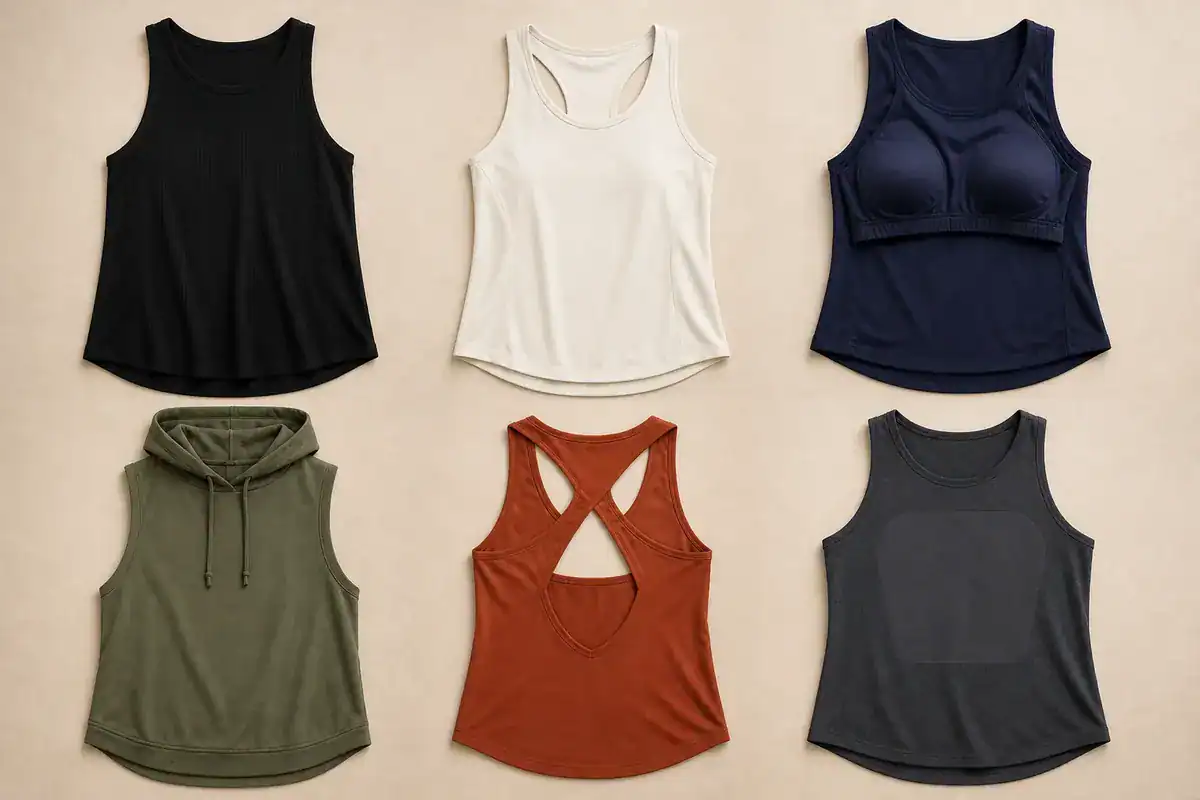
Tank tops can be classified by neckline, strap and back shape, armhole depth, fit, length, fabric, construction, and intended activity. A single garment can belong to several groups at once. For example, one style may be a cropped, ribbed, racerback performance tank. For product development, the useful name is the one that tells the pattern maker what must change.
The 36 names below are organized for activewear founders, product developers, sourcing teams, merch programs, and private-label buyers. Each entry pairs the market name with a detail that should be confirmed before sampling. The list describes terminology. It does not promise that every fabric, construction, or style is available for every project.
What counts as a tank top?
A tank top is a sleeveless upper-body garment with open armholes and shoulder straps or shoulder panels. It is usually collarless and buttonless. The term overlaps with sleeveless shirt, vest, singlet, cami, stringer, and athletic top, and the preferred name changes by market. The general history and regional terms are summarized in the sleeveless shirt reference.
That overlap is not a problem until a name is treated like a complete specification. "Racerback" only describes the back. It does not confirm body length, neckline, compression, fabric, lining, binding, or logo method. "Muscle tank" suggests an open armhole and gym-led shape, but two muscle tanks can have very different coverage and fit.
For a product brief, build the name from several decisions:
- use: running, gym, studio, teamwear, lifestyle, uniform, layering, or merch;
- front: scoop, crew, V, square, boat, high, or asymmetric neckline;
- back and straps: standard, racerback, Y-back, T-back, cross-back, halter, or spaghetti strap;
- fit and length: compression, fitted, regular, relaxed, oversized, cropped, or longline;
- material and construction: jersey, rib, interlock, mesh, seamless, lined, or built-in support;
- finish: print, embroidery, heat transfer, wash, perforation, reflective detail, label, and packaging.
DTS already has a broad guide to more than 100 sportswear types. Here the scope narrows to one product family, with the measurements and construction decisions that turn a category name into a clearer sample request.
Neckline and shoulder shapes
1. Basic scoop-neck tank
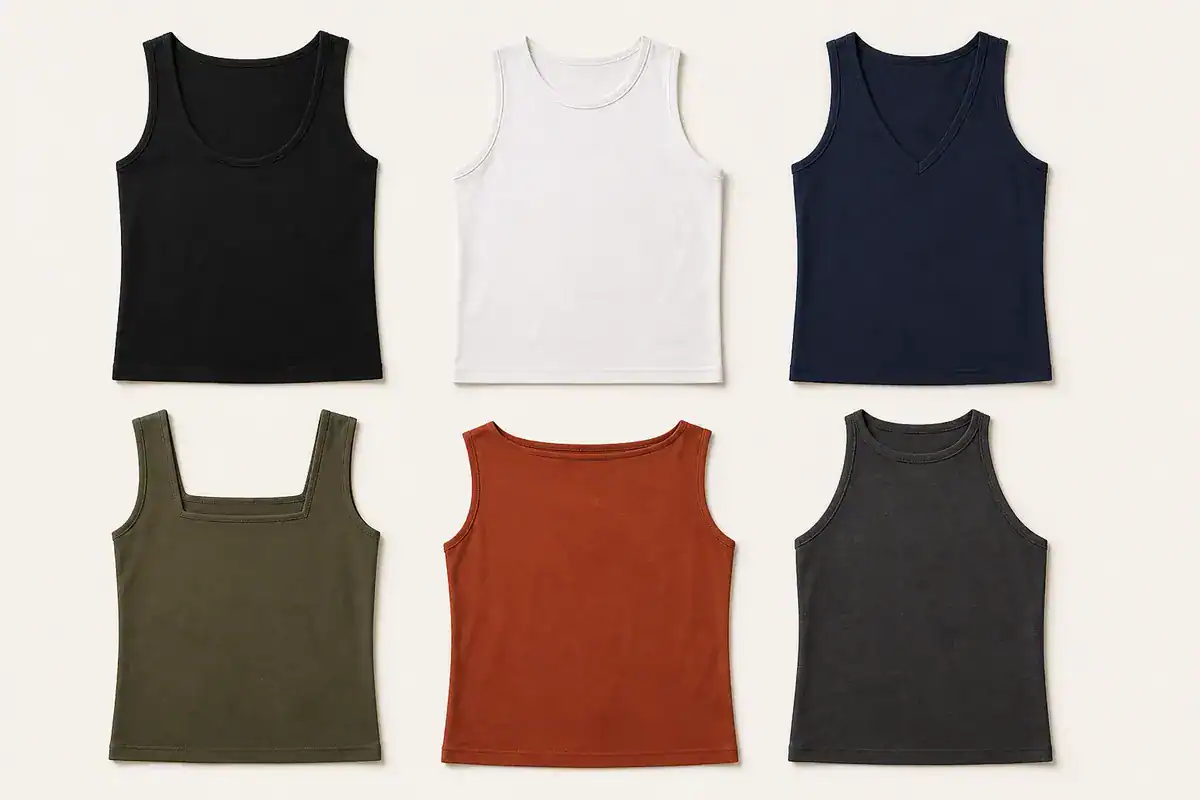
The basic tank uses a rounded neckline, standard shoulder width, and moderate armholes. It is the neutral starting point for casual, promotional, gym, and layering programs. A buyer should still define neckline depth, shoulder width, armhole drop, body width, and hem shape. Calling it "basic" does not create a shared fit standard.
2. Crew-neck tank
A crew-neck tank has a higher, closer round neckline than a scoop tank. The front provides more coverage and a larger uninterrupted print area, which can suit gym merchandise, uniforms, and streetwear. Check whether the neck uses self-fabric binding, rib binding, or a turned finish. The opening must stretch over the head without losing shape.
3. V-neck tank
The V-neck uses two neckline edges that meet at a center-front point. A shallow V reads like a small styling change; a deep V changes coverage, binding tension, and the space available for artwork. Specify the V depth, point shape, binding width, and whether the center is joined, overlapped, or cut as a continuous edge.
4. Square-neck tank
A square-neck tank has a horizontal front edge with straighter corners near the straps. The shape works in studio, lifestyle, and fitted fashion programs, but the corners can stretch or distort if the pattern, elastic, or binding tension is weak. Confirm corner construction, coverage, strap position, and whether the neckline must stay flat during movement.
5. Boat-neck tank
A boat-neck tank uses a wide neckline that travels toward the shoulder points. It can create a clean lifestyle or studio silhouette while keeping a sleeveless body. The wide opening changes shoulder stability and may expose underlayers if the front and back depths are not controlled. Specify neckline width, shoulder coverage, and intended undergarment compatibility.
6. High-neck tank
A high-neck tank raises the front neckline toward the collarbone. It is common in training, tennis, studio, and fashion-led activewear because it provides front coverage and a strong area for small logos. Armhole shape becomes more important as the neckline rises. The sample should be checked for pulling at the shoulder and gaping at the side.
Back and strap constructions
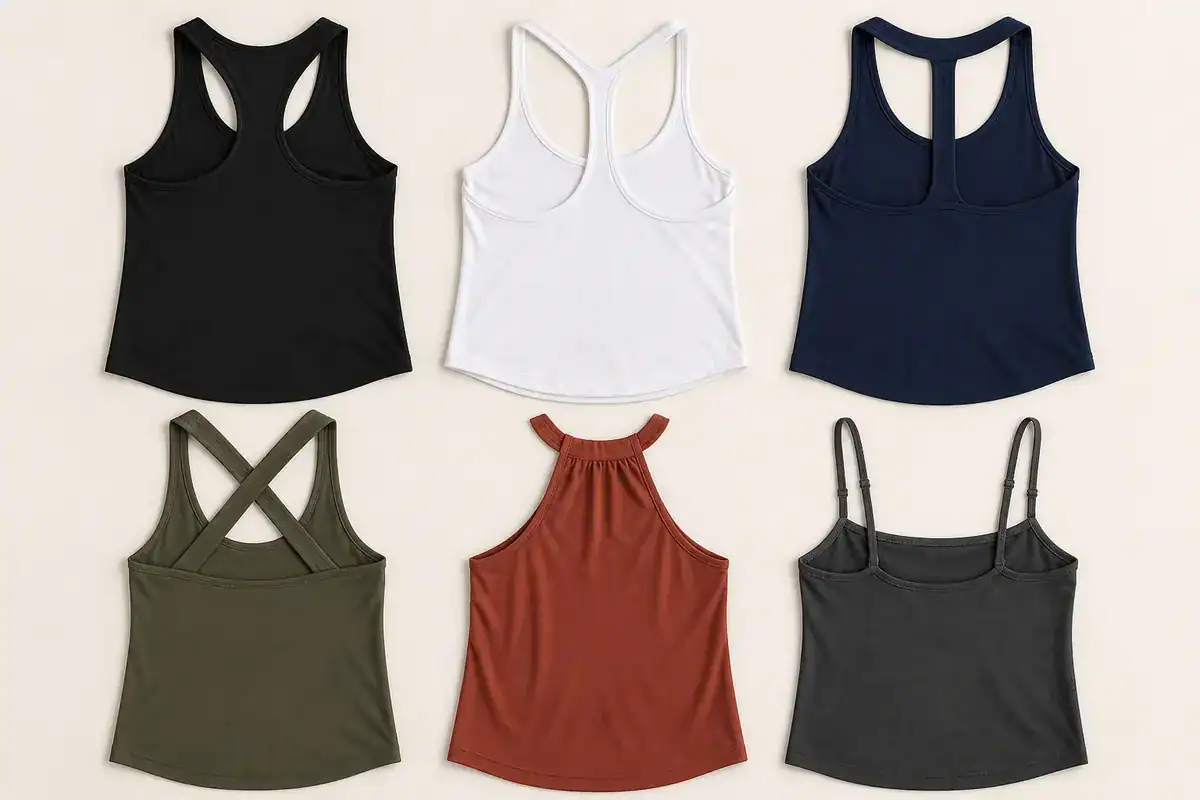
7. Racerback tank
A racerback narrows between the shoulder blades, usually in a T-like or curved shape. It can free the shoulder area and pair with activewear styling, but the term covers many back widths. Confirm the narrowest back measurement, strap angle, armhole coverage, neckline, bra-line relationship, and whether binding or elastic stabilizes the edge.
8. Y-back tank
The Y-back brings the straps together into a distinct Y at the upper or middle back. It is used in gym and performance styles for a sharper athletic look. The junction can be cut as one panel or assembled from separate straps. That choice affects seam bulk, stretch, strength, and logo placement. Put the junction height and strap width in the tech pack.
9. T-back tank
A T-back has a narrow vertical back section meeting a horizontal or shoulder-level top section. It exposes more of the shoulder blades than many racerbacks and often appears in fitted training tops. Because coverage is low, the sample must be reviewed on the target size range. Check edge stability, neck balance, and how the back behaves when the wearer bends or reaches.
10. Cross-back tank
Cross-back or strappy-back tanks use straps that cross, overlap, twist, or form a geometric pattern. They create a strong visual feature but add grading and assembly risk. The brief should show strap routing from front to back, finished strap width, attachment points, elastic recovery, adjusters if used, and the exact view that must remain symmetrical.
11. Halter tank
A halter tank directs the straps toward the neck, leaving more of the shoulders and upper back open. It may tie, clip, or join permanently. Halters can be lifestyle, studio, swim-inspired, or event garments, and they should not be assumed to provide support. Confirm neck pressure, closure, bust coverage, back opening, lining, and intended activity before sampling.
12. Camisole or spaghetti-strap tank
A camisole uses very narrow shoulder straps and a lighter upper-body shape. It can be a base layer, studio top, lifestyle piece, or intimate-style garment depending on its fabric and coverage. Strap length, adjusters, front and back neckline depth, lining, edge finish, and opacity matter more than the generic "cami" name.
Gym and performance cuts
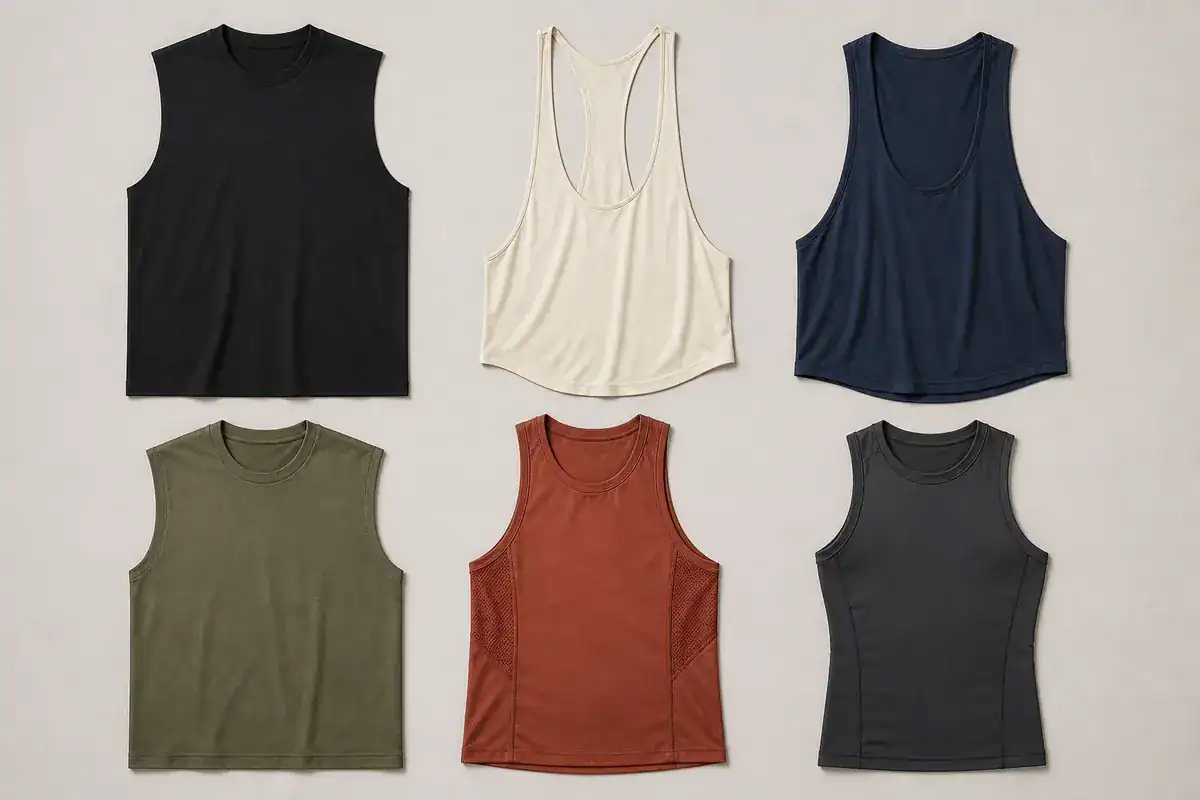
13. Muscle tank
A muscle tank resembles a sleeveless T-shirt with broader shoulders and larger armholes. It may be regular, relaxed, or oversized. The armhole can expose the side torso, so "deep armhole" needs a measurement rather than a moodboard reference. Define chest width, shoulder width, armhole depth, side-seam start, body length, and the intended level of coverage.
14. Stringer tank
A stringer uses narrow shoulder straps, a low neckline, and open armholes, usually for bodybuilding or gym collections. Y-back and racerback versions are common. The style is sensitive to strap stretch, side coverage, and grading. Buyers developing this cut can compare the dedicated custom stringer manufacturing page before sending a product brief.
15. Drop-arm tank
A drop-arm tank has armholes that extend farther down the side than a standard muscle tank. It is common in gym and streetwear programs where ventilation and a loose silhouette matter. The lowest armhole point should be measured from a stable reference such as high point shoulder. Specify whether a side panel, gusset, or raw-style edge changes the opening.
16. Sleeveless T-shirt
A sleeveless T-shirt keeps the body and neckline of a tee while removing the sleeves. It usually has more shoulder coverage and smaller armholes than a stringer or drop-arm tank. The edge may be bound, turned, or intentionally cut. If it is derived from an existing T-shirt block, check that removing the sleeve has not made the armhole stand away from the body.
17. Athletic performance tank
An athletic performance tank is designed around movement, sweat, ventilation, and repeat laundering rather than one fixed silhouette. It may use mesh zones, quick-drying knits, reflective details, or flat seams. "Moisture-wicking" should be treated as a testable fabric claim. AATCC TM195 evaluates liquid moisture management in textile fabrics.
18. Compression tank
A compression tank uses a close fit and stretch fabric intended to remain near the body. The word "compression" does not state a verified pressure level. The buyer needs fabric stretch, recovery, growth, modulus or support target, seam placement, body measurements, and end-use testing. ASTM D2594 explains why stretch and fabric growth are separate measurements.
Running and team styles
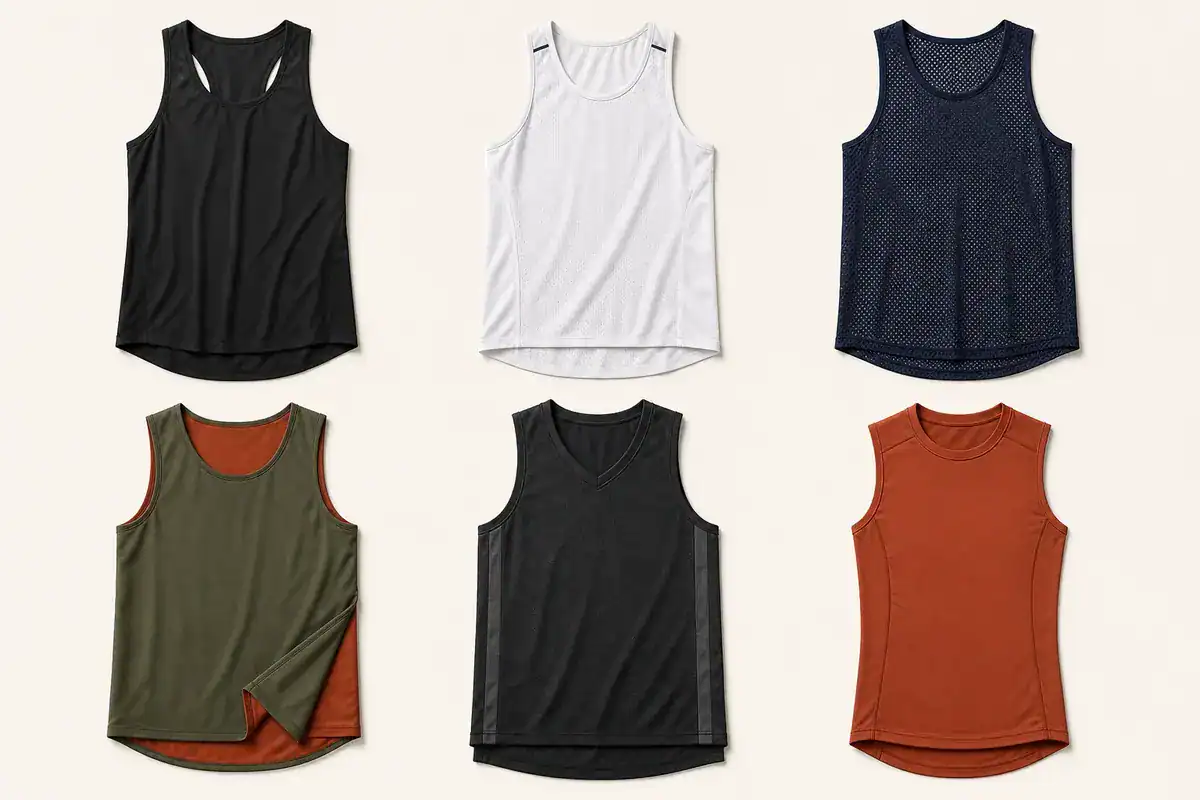
19. Running tank
A running tank normally uses a lightweight body, controlled armhole coverage, and a fit that avoids excessive movement or chafing. It can be fitted or relaxed. Confirm fabric weight, drying target, seam placement, side vent, reflective detail, body length, and whether the garment will be worn alone or over a sports bra or base layer.
20. Race singlet
A race singlet is a competition-led running top, often lighter and more minimal than a general training tank. It may carry a team name, sponsor marks, bib, or event graphics. Decoration must not turn a breathable panel into a stiff sheet. Specify artwork size, print method, placement tolerance, fabric behavior, and how the front sits when a race bib is attached.
21. Mesh tank
A mesh tank uses an open or perforated knit for airflow, visual texture, or layering. Mesh can be the whole garment or a panel. Hole size, yarn, stretch direction, transparency, snag resistance, and decoration compatibility vary widely. State whether the product needs full coverage, a liner, reinforced seams, or a specific opacity under normal and stretched conditions.
22. Reversible team tank
A reversible tank provides two wearable faces, usually through two layers or a reversible fabric construction. It suits training and team programs that need two colors or identities. The extra layer affects weight, heat, drying time, seam bulk, and decoration. Confirm which labels are allowed, how neck and armhole edges are finished, and whether both sides need equivalent appearance.
23. Basketball jersey tank
A basketball jersey tank has broad shoulder panels, sport-specific armhole shaping, and a body designed for team graphics and movement. It may be mesh, double-knit, or another performance construction. Number size, team name, sponsor placement, neckline and armhole trim, side panels, length, and size grading should be approved together rather than as separate artwork tasks.
24. Sleeveless cycling base layer
A sleeveless cycling base layer sits close to the body under a jersey. It is usually lightweight and selected for moisture and temperature management rather than visual coverage. Seams, hem bulk, body length, stretch, and drying behavior matter because the garment sits under another layer. Confirm whether it needs mesh zones, a dropped back, or bonded edges.
Fit and length options
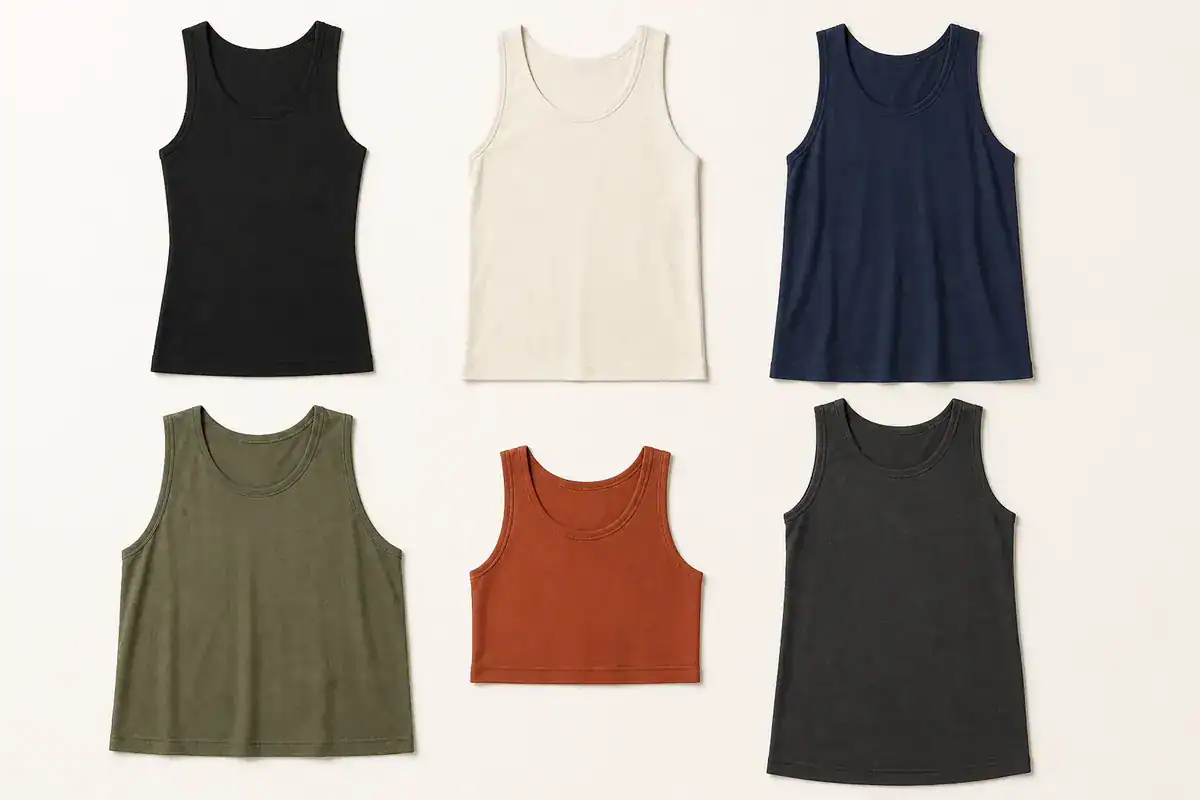
25. Fitted tank
A fitted tank follows the body without requiring a verified compression function. It may be used for gym, studio, layering, or lifestyle collections. The pattern needs a defined amount of negative or positive ease at chest, waist, and hem. Fabric recovery and size grading decide whether the fit remains consistent across the range.
26. Regular-fit tank
A regular-fit tank sits between close and relaxed fits. It is often chosen for blank programs, uniforms, casual activewear, and printed merchandise. "Regular" is not a measurement system. Give the supplier a reference size, chest width, body length, shoulder width, armhole depth, and target grade rules.
27. Relaxed or flowy tank
A relaxed tank adds ease through the chest, waist, or hem. A flowy version may use drape, a curved hem, or an A-line body. Lightweight fabrics can expose fit problems at the armhole and neckline because the edges have less structure. Confirm drape, sweep, side seam angle, length, and whether the hem must cover leggings or shorts.
28. Oversized tank
An oversized tank is intentionally larger in width, shoulder, armhole, or length. Simply grading up a regular tank can produce the wrong neckline and armhole. The pattern should define where the extra volume belongs. For streetwear and gym programs, review shoulder extension, side exposure, body width, length, and how the graphic scale relates to the larger body.
29. Cropped tank
A cropped tank ends above a standard body length and can be fitted, relaxed, racerback, high-neck, or built with support. "Crop" can mean below the natural waist, at the waist, or above it. Specify finished length from high point shoulder, intended bottom pairing, hem construction, and how the length changes across sizes.
30. Longline tank
A longline tank extends below the standard hip area or is deliberately longer than the reference block. It can support layering, modest coverage, gym styling, or a tall fit. Check that extra length does not create excessive twisting or hem flare. Define side-seam length, front and back drop, vent, sweep, and whether the garment is meant to tuck.
Fabric and construction-led types
31. Ribbed A-shirt
The ribbed A-shirt is a close sleeveless basic, often made from a rib knit with a scoop neckline and wide straps. Rib structures can stretch substantially in width and may need elastane or controlled knitting tension for recovery. CottonWorks describes how rib, jersey, and double-knit structures differ in stretch and stability.
32. Seamless tank
A seamless tank is knitted with reduced cut-and-sew seams, often on circular equipment. It can use engineered zones for ventilation, support, or texture. "Seamless" rarely means there are no finishing operations. The brief should identify body map, knit structure, openings, strap construction, color, size range, logo method, and any seams still permitted.
33. Built-in-bra or shelf-bra tank
This tank adds an internal support layer, elastic, cups, or a bra-like construction. Support level cannot be assumed from the name. Confirm whether the inner layer is a shelf, separate bra, removable cup pocket, molded cup, or compression panel. Fit approval should cover underbust elastic, cup position, strap load, neckline coverage, and movement in the intended activity.
34. Hooded tank
A hooded tank combines a sleeveless body with a hood, often for gym or streetwear collections. The hood adds weight at the back neckline and can pull a light body out of balance. Specify hood depth, overlap, drawcord, lining, neck seam, fabric weight, and whether the hood must sit flat when it is not worn.
35. Cut-out tank
A cut-out tank uses planned openings in the front, side, or back. The openings may be bound, faced, bonded, laser-cut, or left with a stable raw edge when the fabric allows it. Each cut-out needs a measured shape and position. Wear testing should check stretch, coverage, edge curl, and whether the cut-out grows after laundering.
36. Graphic or merch tank
A graphic tank is defined by its artwork or program rather than one silhouette. It may use a basic, muscle, cropped, or athletic body. The design must be matched to fabric and stretch. Large ink areas can change hand feel and ventilation, while embroidery can add weight or distortion. Confirm print method, color count, artwork size, placement tolerance, and wash expectation.
How to choose a tank top type for a product line
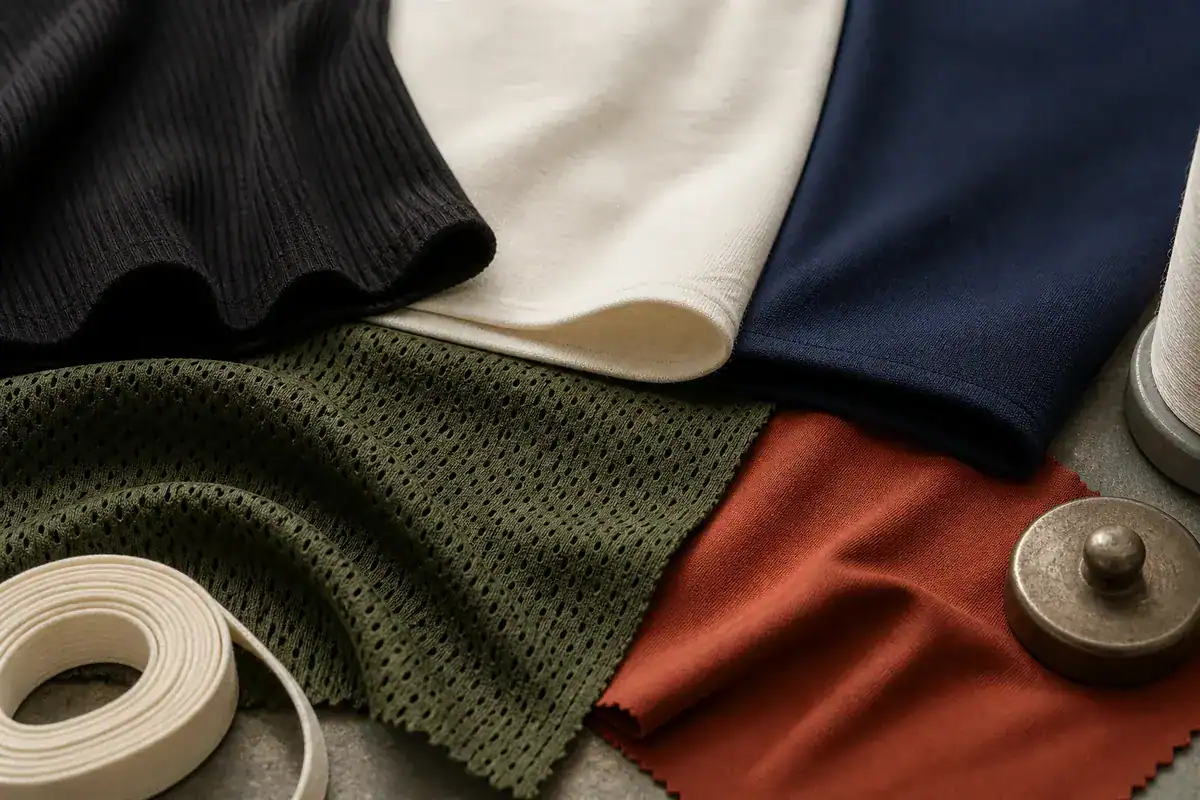
Start with the wearer and activity, then name the silhouette. The decision becomes easier when the buyer answers these questions in order:
1. What will the wearer do: lift, run, cycle, practice yoga, work, travel, layer, or attend an event? 2. Where is coverage needed at the front, side, back, and underarm? 3. Should the garment compress, follow, skim, or hang away from the body? 4. Which fit point is most sensitive: neckline, strap, armhole, chest, waist, hem, or body length? 5. What must the fabric do under sweat, stretch, friction, repeated washing, and decoration? 6. Which visual detail makes the style recognizable to the buyer’s customer?
A gym brand may start with a muscle tank or stringer, but a beginner-facing training program may need more side coverage. A running brand may prefer a lightweight singlet, while a team order needs room for numbers and consistent trim. A studio brand may choose a high-neck racerback or built-in-bra tank, but support and opacity need testing. The popular name narrows the field. It does not approve the product.
Fabric, binding, seams and decoration
Fabric composition alone is not enough. Two polyester-elastane jerseys can differ in weight, knit density, stretch, recovery, surface, opacity, and drying behavior. Two cotton ribs can have different growth after wear. Ask for a fabric reference that includes composition, construction, weight, usable width, stretch direction, color method, and the tests required for the final market and use.
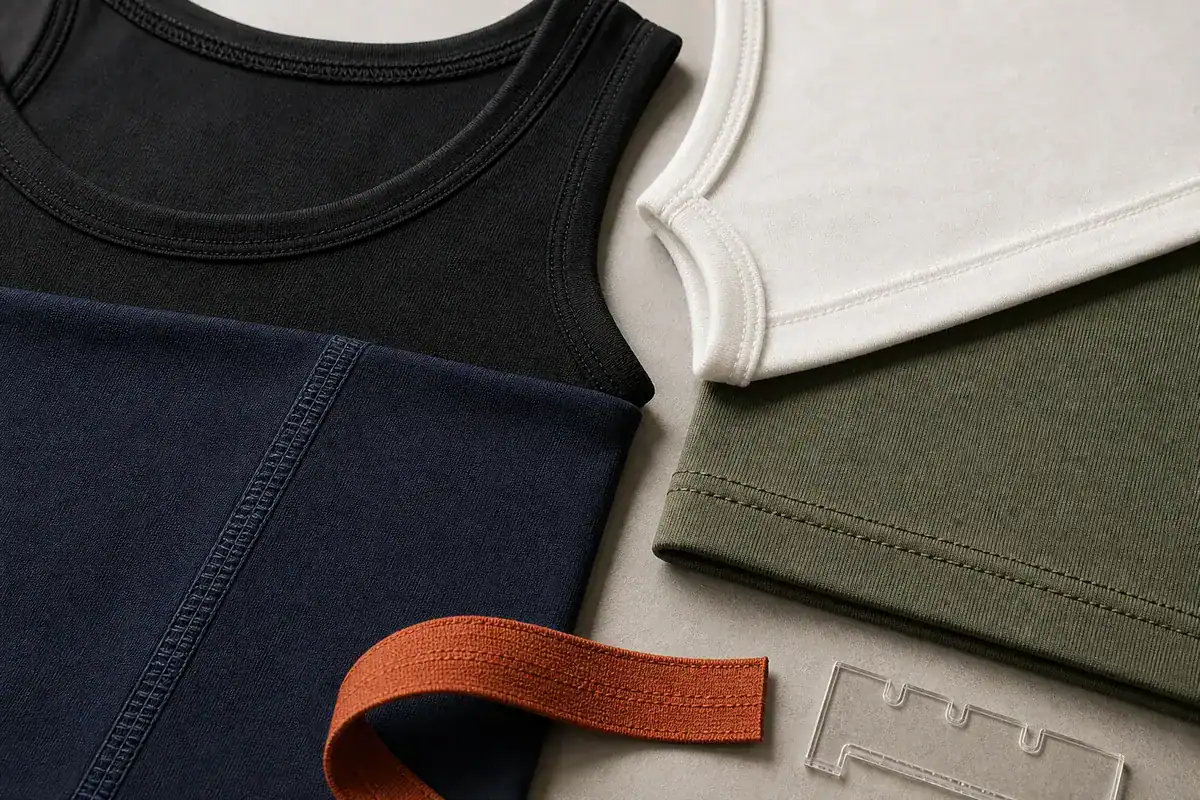
Binding controls many tank-top failures. It must stretch enough to sew around curves, then recover so the neckline and armhole lie flat. Too much tension can pull the opening inward. Too little can produce gaping or a wavy edge. A self-fabric binding, rib binding, fold-over elastic, clean finish, or bonded edge will not behave the same way.
Seams should be selected around stretch, skin contact, appearance, and equipment. Overlock with coverstitch is common, but flat seams, bonded seams, or reduced-seam construction may suit certain performance products. The correct option depends on the fabric and wear area. Avoid promising "chafe-free" performance from a stitch name alone. It needs a finished-garment review.
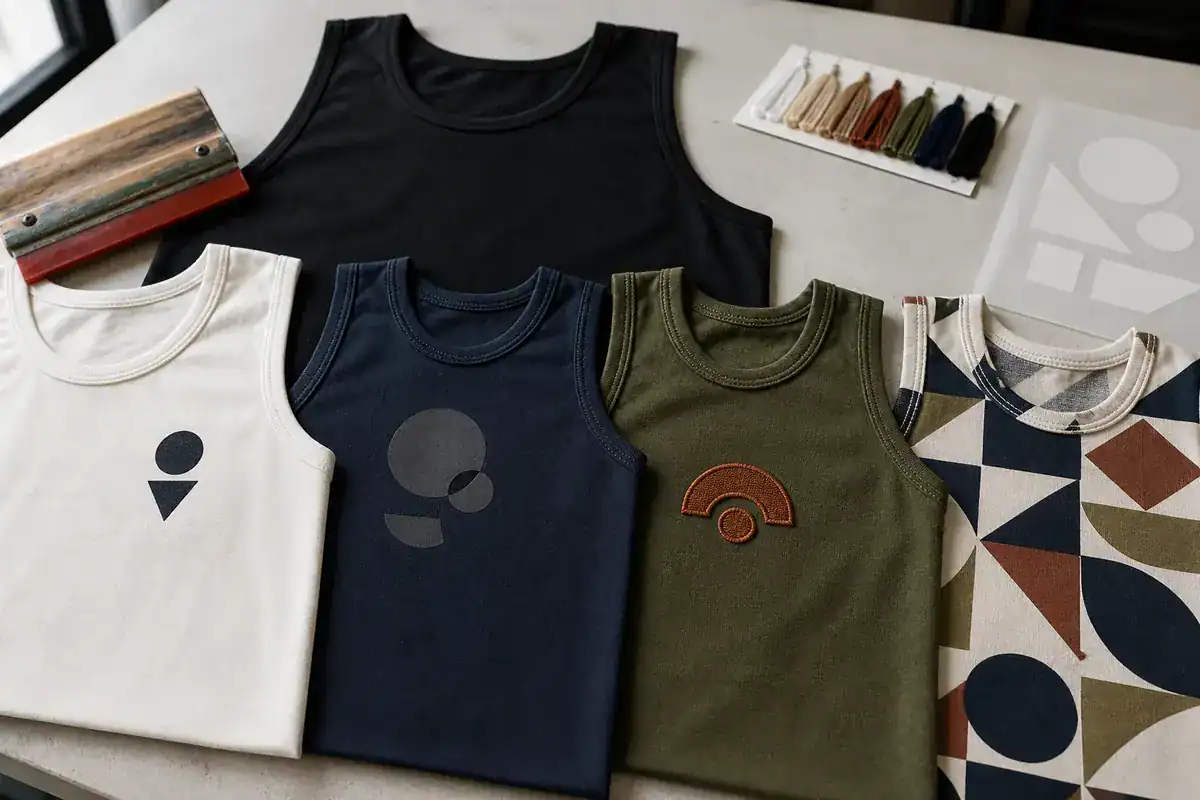
Decoration has to move with the body. A print that works on a regular cotton tank may crack, distort, or feel heavy on a high-stretch compression top. Embroidery can pucker a light jersey. Heat transfers can bridge open mesh. Give the supplier the final artwork, size, color, position, fabric, stretch direction, and wash expectation before the decoration sample is approved.
What goes wrong when the specification is vague
- The sample has the right front view but the wrong side coverage because the armhole depth was never measured.
- Straps stretch longer in wear because the fabric and elastic recovery were not checked.
- A high neck pulls backward because the front, back, and shoulder balance are wrong.
- A large print restricts stretch or airflow because artwork was approved separately from the fabric.
- A cropped style becomes much shorter in larger sizes because the grade rule was not agreed.
- Binding waves after washing because edge tension and shrinkage were not evaluated together.
- A reversible or built-in-bra tank becomes too warm because the extra layers were not considered in the use case.
Most avoidable cost appears later, when missing measurements, unclear materials, or untested construction assumptions force another sample cycle.
What to send before requesting a sample or quote
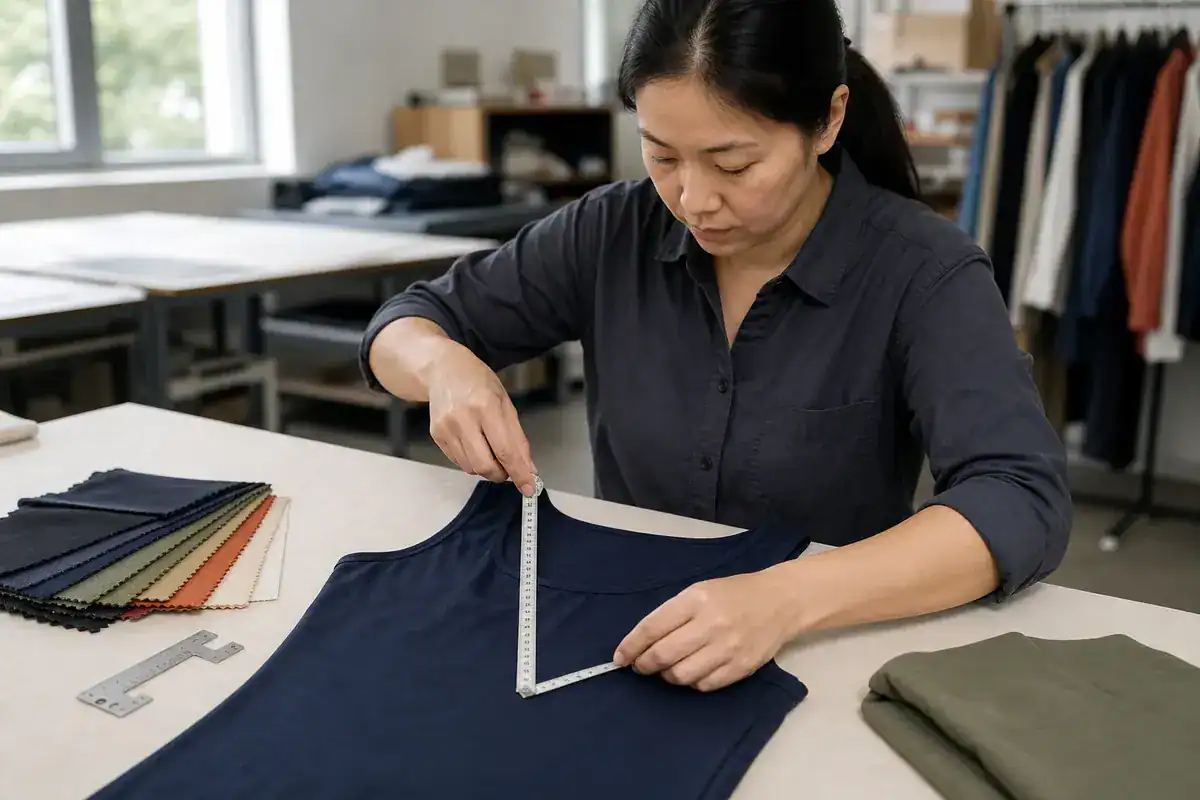
Prepare one package with the information below:
- reference images with notes showing what to copy and what to change;
- front and back flat sketches, or a clear moodboard if flats are not ready;
- target wearer, activity, market, price position, and sales channel;
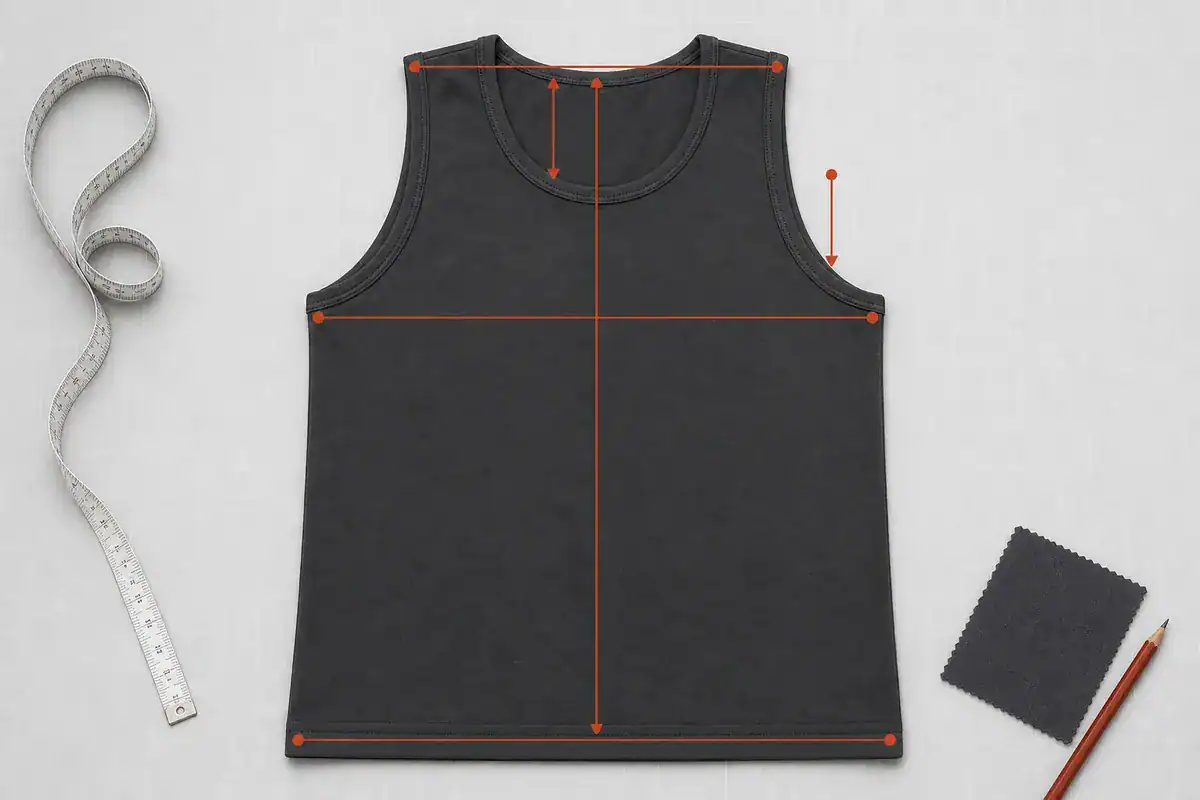
- reference size and measurements for neckline, shoulder or strap, armhole, chest, waist, sweep, and body length;
- fabric direction including composition, construction, weight, stretch, recovery, hand feel, opacity, and color;
- binding, seam, lining, elastic, cup, label, trim, and packaging requirements;
- logo files, decoration method, size, color, and placement;
- size range, colorways, estimated quantity, destination, and target timing;
- required tests, documents, and acceptance criteria for the exact product and market.
If the information is incomplete, the tech pack customization route can help organize the missing fields before a physical sample. A sample should then be checked against the approved measurements, fabric, construction, decoration, labels, and packing requirements through the sampling and prototyping process and the relevant quality-control checks.
Frequently asked questions
The main families are neckline-led tanks, racerback and strap-led tanks, gym cuts, running and team styles, fit and length variations, and construction-led tanks such as ribbed, seamless, mesh, or built-in-bra designs. One garment can belong to several families.
A sleeveless T-shirt usually keeps more of a T-shirt’s shoulder and body shape. A tank top often has narrower shoulder panels or straps and more open armholes. The names overlap in retail, so a product brief should use drawings and measurements.
No. Racerback describes a narrowed back shape. A stringer is a gym-led tank with narrow straps, a low neckline, and open armholes. A stringer may use a racerback or Y-back, but many racerback tanks are not stringers.
It depends on the customer and activity. A muscle tank or stringer offers more openness, while an athletic tank can provide more side coverage. Compression and built-in-support styles need closer fit and fabric testing. Start with movement, coverage, fit, and fabric behavior.
There is no universal best fabric. Cotton jersey and rib suit many casual or merch programs. Polyester or nylon blends may suit performance uses. Mesh improves airflow but changes opacity and decoration. The final choice should be checked for stretch, recovery, weight, hand feel, drying, shrinkage, color, and use.
The name does not prove a support level. Support depends on pattern, fabric, elastic, cups, lining, straps, size range, and intended movement. The sample should be fitted and wear-tested for the target activity.
Common points include high point shoulder length, neckline width and drop, shoulder or strap width, armhole depth, chest, waist, sweep, body length, and front or back drop. Add product-specific points for cups, elastic, panels, vents, hoods, or cut-outs.
Yes. "Cropped ribbed racerback tank" combines length, fabric structure, and back shape. This is more useful than choosing one label, provided the brief also includes drawings, measurements, fabric, construction, and artwork.
Turn the style name into a sample-ready brief
A useful style name reduces ambiguity. Choose the use first, then lock the front, back, armhole, fit, length, fabric, edge finish, decoration, size range, and approval checks. The design and production teams then have enough information to quote and sample the garment.
For a custom program, review the custom tank top manufacturing options and send your reference images, tech pack, target quantity, colorways, size range, fabric direction, destination, and required timing. Exact product feasibility, MOQ, lead time, testing, and compliance scope must be confirmed for the project.