Sportswear includes sport-specific uniforms, training garments, performance layers, activewear, outdoor protection, swimwear, and athleisure. The right type depends on the activity, movement, climate, support, fit, fabric behavior, construction, branding, and order requirements.
This guide names more than 100 common sportswear types and explains where each one fits. It is written for activewear brands, private-label sellers, teamwear buyers, and product developers who need to turn a category idea into a workable product brief.
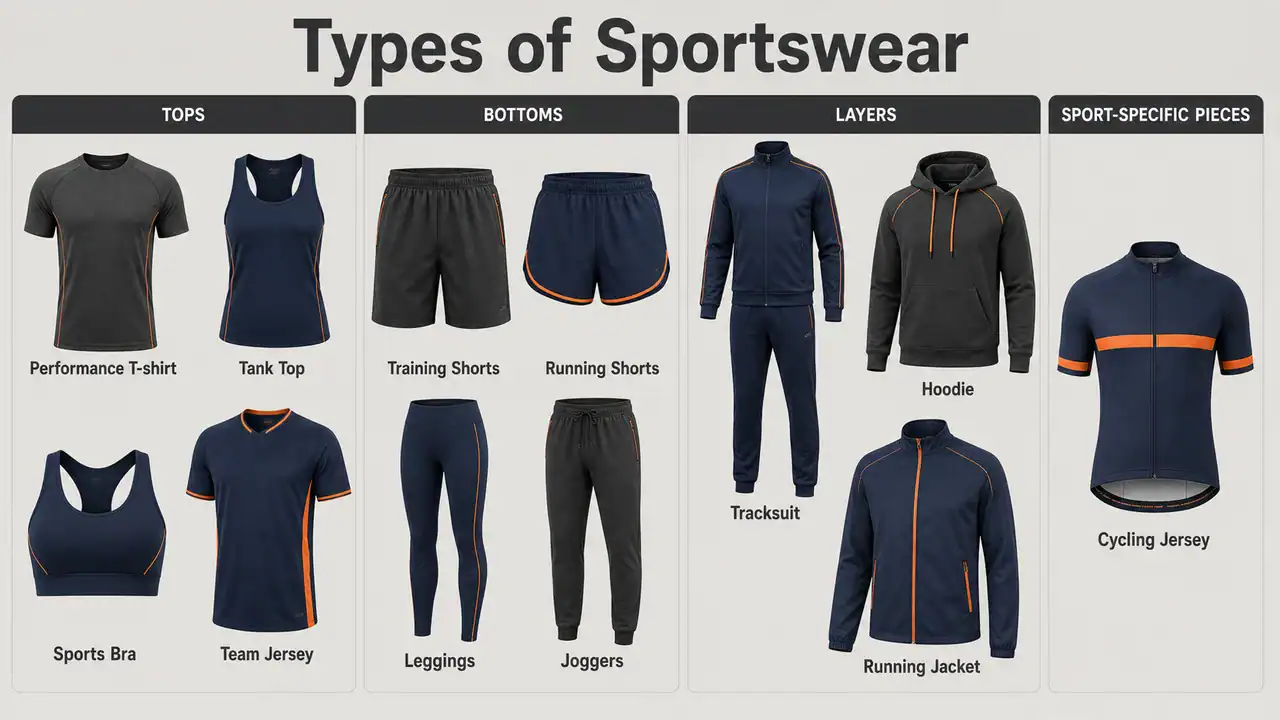
Short answer: the main sportswear groups are tops, bottoms, layers, coordinated sets, sport-specific uniforms, performance-function garments, and accessories. A name such as “running short” or “compression top” is only a starting point. Fabric composition, stretch and recovery, fit, seams, decoration, size range, testing, quantity, and packaging still need to be defined.
Prepared by: DTS Activewear product development team. This page uses common market terminology. Product feasibility, MOQ, testing, and lead time must be confirmed against the final design brief.
What counts as sportswear?
Sportswear is clothing designed for sport, exercise, training, movement, or a related active lifestyle. The term covers both sport-specific garments and general-purpose clothing used for physical activity. The practical reason for choosing sportswear is usually a combination of movement, comfort, climate, safety, team identification, and appearance. Wikipedia’s sportswear overview gives a useful high-level definition and examples, but a commercial product still needs its own measurable specification.
These terms overlap, but they are not interchangeable in every product brief:
| Term | Typical meaning | What a buyer should clarify |
|---|---|---|
| Sportswear | The broad category for clothing used in sport, exercise, training, and active lifestyles. | Activity, climate, movement, protection, identity, and target wearer. |
| Activewear | Exercise and movement clothing that often crosses between training and everyday wear. | Whether the product is performance-led, lifestyle-led, or a hybrid. |
| Gym wear | Garments intended for strength training, cardio, studio work, or general gym sessions. | Sweat management, mobility, durability, support, and decoration placement. |
| Performance wear | Clothing specified around particular functional requirements such as stretch, moisture management, warmth, or visibility. | Which function is required and how the brand will verify it. |
| Teamwear | Coordinated uniforms and warm-up garments that identify a club, school, league, or organization. | Size run, numbering, names, repeat orders, color consistency, and replacement pieces. |
| Athleisure | Sports-influenced lifestyle clothing intended for casual use as well as light activity. | Silhouette, hand feel, fabric weight, branding, and everyday care requirements. |
A product can sit in more than one group. For example, a brushed jogger may be gym wear, travel wear, or athleisure. A long-sleeve base layer may be used for running, skiing, hiking, or team warm-ups. The activity and the expected behavior should therefore be recorded before the factory evaluates fabric and construction.
100+ types of sportswear by garment
The following list contains common market names, not a claim that every brand uses the terms in exactly the same way. Similar products may have different names in different countries. For a quotation, send a sketch, measurement chart, reference garment, or tech pack so the name can be matched to the intended silhouette.
Tops and upper-body sportswear
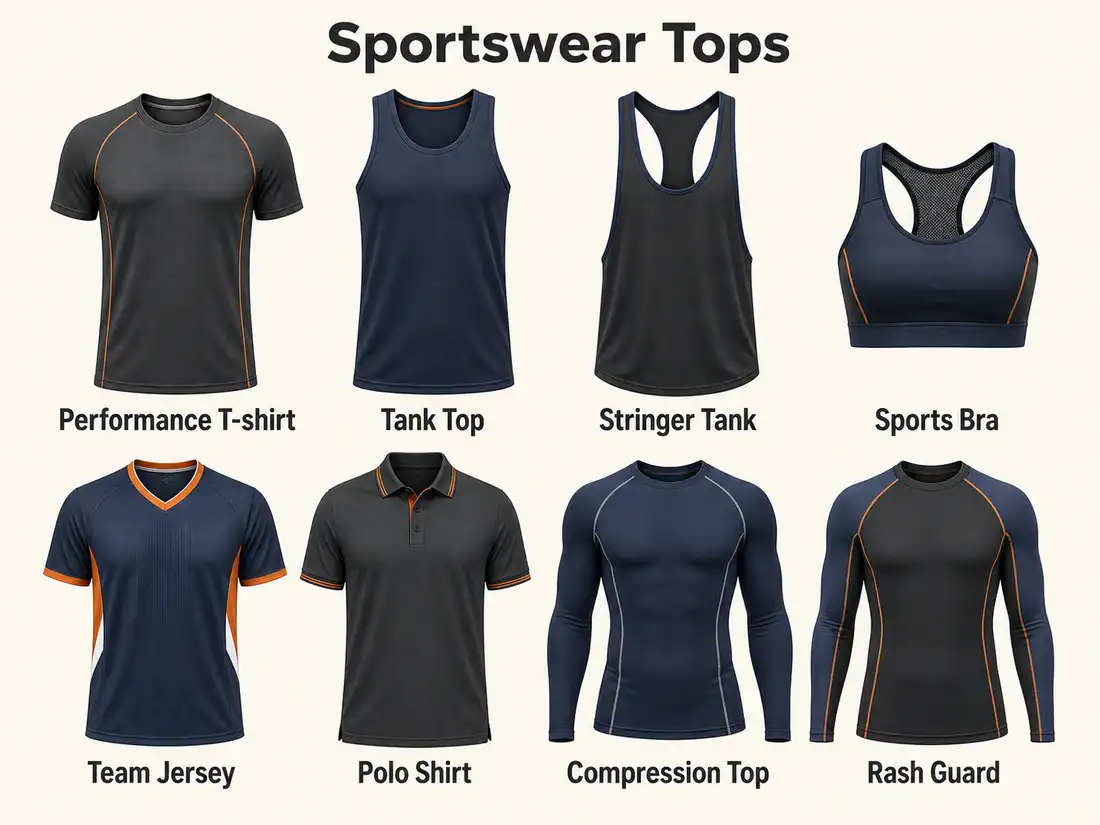
- Sports T-shirt. A general activity top with a cut, fabric, and finish chosen for movement and care.
- Performance T-shirt. A T-shirt developed around a stated function such as moisture management, lightness, or breathability.
- Training T-shirt. A versatile top for repeated gym, team, or conditioning sessions.
- Running T-shirt. Usually cut for arm movement and low-bulk comfort during road or trail running.
- Gym T-shirt. A training-focused tee where mobility, sweat handling, durability, and branding are common concerns.
- Oversized gym T-shirt. A relaxed silhouette used in strength training and streetwear-active collections.
- Quick-dry T-shirt. A market term for a top intended to release moisture faster than a conventional casual tee.
- Mesh training T-shirt. Uses mesh panels or a mesh body to increase ventilation in selected zones.
- Long-sleeve training top. Adds arm coverage for warm-ups, cooler gyms, or transitional weather.
- Base-layer top. A close-to-body first layer designed to sit under a jersey, jacket, or mid-layer.
- Compression shirt. A close-fitting top whose pressure, stretch, and recovery must be defined carefully in the brief.
- Quarter-zip training top. A pullover with a short front zipper for ventilation and temperature adjustment.
- Half-zip running top. A running layer with a longer opening and a fit intended for active movement.
- Tank top. A sleeveless top used for gym, running, studio, casual activewear, and warm-weather programs.
- Racerback tank. A tank with a back shape that leaves the shoulder blades more open for movement.
- Muscle tank. A relaxed sleeveless top often used for strength, bodybuilding, and lifestyle collections.
- Stringer tank. A low-coverage training tank associated with bodybuilding and gym wear.
- Crop top. A shorter top that can be lifestyle-led or designed as part of a coordinated activewear set.
- Sports bra. A support garment whose level, cup construction, straps, lining, and band need to match the activity.
- Low-impact sports bra. Suited to gentle studio movement, lifestyle wear, or lower-impact activities.
- Medium-support sports bra. A middle support option for many gym, cycling, studio, and training programs.
- High-support sports bra. Requires close attention to support structure, straps, elastic, fit, and size grading.
- Crop bra top. Combines a shorter crop silhouette with the support and lining decisions of a bra-style top.
- Team jersey. A numbered or decorated top that identifies a team, club, school, or event.
- Football or soccer jersey. A lightweight team top where decoration, ventilation, fit, and repeat-order consistency matter.
- Basketball jersey. A sleeveless team top designed for shoulder and arm mobility.
- Cycling jersey. A close-fitting top that may include a back pocket system, cycling-specific fit, and a front zipper.
- Polo sports shirt. A collared sports or club top used in golf, tennis, school, corporate, and lifestyle programs.
- Golf polo. A polo adjusted for shoulder movement, collar behavior, comfort, and club branding.
- Rash guard. A close-fitting water or outdoor top intended to reduce rubbing and provide coverage.
- UV-protective sun shirt. A coverage garment whose protection level should be supported by the fabric and test documentation.
For a custom T-shirt or tank program, confirm the body length, shoulder and armhole shape, neckline, fabric weight, stretch direction, decoration method, and size range. DTS’s custom T-shirt program and tank top program are useful starting points for this discussion.
Bottoms and lower-body sportswear
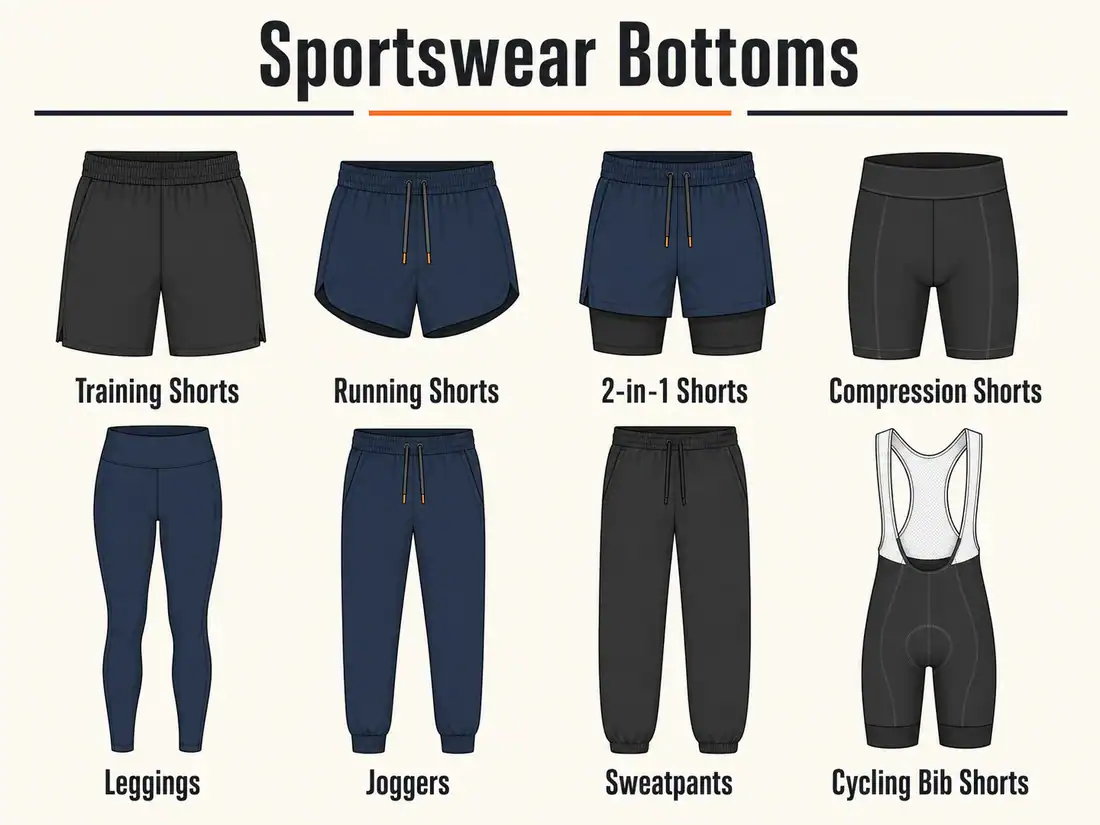
- Training shorts. A general training bottom for gym, conditioning, team warm-ups, and active lifestyle use.
- Running shorts. Designed around stride, lightness, ventilation, and secure storage.
- Split running shorts. Use a split side construction to increase leg movement and reduce bulk.
- 2-in-1 running shorts. Combine an outer short with an inner liner for coverage, support, or reduced friction.
- Gym shorts. A broad training category with fit and fabric choices based on squat, lunge, and lifting movement.
- Basketball shorts. Usually have a freer leg opening and a length selected for court movement.
- Football or soccer shorts. Lightweight team bottoms coordinated with the jersey and decoration program.
- Tennis shorts. Court shorts that may need ball storage, directional movement, and a clean club look.
- Volleyball shorts. Often close-fitting or short-cut to support jumping and rapid lateral movement.
- Compression shorts. Close-fitting shorts that depend on stretch, recovery, opacity, and leg-opening stability.
- Boxer-style performance shorts. Inner-layer shorts used for coverage, training, or layering under an outer short.
- Biker shorts. Close-fitting shorts used in cycling, studio movement, gym, and lifestyle activewear.
- Cycling shorts. Close-fitting cycling bottoms that may require a specific pad, panel layout, and chamois construction.
- Cycling bib shorts. Cycling shorts with shoulder straps that reduce waistband movement during riding.
- Leggings. Close-fitting full-length bottoms used across gym, studio, running, and lifestyle categories.
- Crop leggings. Leggings ending above the ankle for warmer conditions, studio use, or a shorter silhouette.
- High-waisted leggings. A higher rise that changes coverage, waistband construction, and fit grading.
- Yoga pants. Stretch bottoms developed for studio movement, comfort, coverage, and body-position changes.
- Flared yoga pants. Yoga or lifestyle pants with a wider lower leg and a more fashion-led silhouette.
- Compression tights. Full-length close-fitting bottoms where the intended support and pressure must be specified.
- Track pants. Loose or tapered warm-up pants used for team, running, training, and lifestyle programs.
- Joggers. Tapered pull-on pants used for training, travel, warm-ups, and active streetwear.
- Training joggers. Joggers adjusted for movement with a fabric, gusset, waistband, or cuff suited to exercise.
- Sweatpants. Usually softer and more relaxed than technical training bottoms, although the terms overlap by market.
- Cargo joggers. Joggers with utility pockets or panel details that combine active and streetwear cues.
- Warm-up pants. Team or training pants worn before activity or during sideline periods.
- Hiking pants. Outdoor pants where mobility, abrasion, pocket security, and weather exposure need to be considered.
- Ski pants. Snow-sport bottoms that may require insulation, weather protection, articulation, and reinforcement.
- Golf trousers. Club or performance trousers designed around walking, bending, sitting, and a polished appearance.
- Tennis skirt. A court skirt that may include an inner short, ball pocket, and stretch waistband.
- Sports skort. A skirt-and-short combination used in tennis, golf, pickleball, and lifestyle collections.
- Swim briefs. Close-fitting swim bottoms whose lining, chlorine exposure, and coverage need to be specified.
- Board shorts. Longer water-sport shorts used for surfing, beach activity, and casual outdoor wear.
The pattern block should reflect the activity. A running short, basketball short, and training short may all be called “shorts,” but their rise, leg opening, liner, pocket position, and movement allowance can be very different. See DTS’s training shorts collection when defining a gym or conditioning program, and confirm whether the intended product is a basic style or a technical prototype.
Layers, sets, and outerwear
- Tracksuit. A coordinated jacket and trouser set used for warm-ups, team identity, travel, and lifestyle wear.
- Track jacket. A lightweight zip layer for warm-ups, travel, and casual sportswear.
- Team warm-up jacket. A decorated outer layer worn before competition or on the sideline.
- Training jacket. A general-purpose layer whose weight and ventilation depend on the training environment.
- Windbreaker. A light outer layer intended to reduce wind exposure; fabric performance must be confirmed.
- Running jacket. A movement-friendly layer with decisions around hood, pockets, cuffs, visibility, and packability.
- Lightweight shell jacket. A shell layer designed to be worn over a base or mid-layer.
- Softshell jacket. A stretch outer layer balancing mobility, comfort, and selected weather resistance.
- Rain jacket. A rain-oriented layer that requires a clear water-resistance or waterproofing specification.
- Waterproof shell. A technical shell whose membrane, seam construction, closures, and test requirements must be defined.
- Running vest. A sleeveless outer layer used for warmth, visibility, storage, or wind protection.
- Cycling gilet. A lightweight sleeveless cycling layer that usually prioritizes wind protection and packability.
- Puffer vest. A sleeveless insulated layer for outdoor, travel, lifestyle, or team programs.
- Fleece jacket. A brushed or fleece layer used for warmth, comfort, and casual outdoor programs.
- Training hoodie. A hooded training layer whose fabric weight, hood construction, and sweat behavior should be specified.
- Zip hoodie. A full-opening hoodie used for warm-ups, travel, teamwear, and active lifestyle collections.
- Oversized hoodie. A relaxed hoodie silhouette often used in streetwear-active programs.
- Performance sweatshirt. A sweatshirt adjusted with a fabric, finish, or construction detail for activity use.
- Crewneck sweatshirt. A non-hooded pullover used for warm-ups, lifestyle, and team programs.
- Quarter-zip sweatshirt. A pullover with a short zipper for ventilation and easy layering.
- Thermal mid-layer. A warm layer worn between a base layer and an outer shell.
- Insulated sports jacket. A padded or filled jacket where warmth, bulk, care, and climate need to be agreed.
- Base-layer set. A coordinated close-to-body top and bottom system for layering or cold-weather activity.
- Gym set. A coordinated training top and bottom, often a tank or tee with shorts, leggings, or joggers.
- Running set. A coordinated running capsule that may combine a top, short, jacket, and visibility details.
- Yoga set. A coordinated studio outfit, commonly a bra or crop top with leggings or yoga pants.
- Tennis dress. A one-piece court garment that combines a dress silhouette with movement and coverage requirements.
- Sports jumpsuit. A one-piece active garment whose entry, stretch, rise, and bathroom practicality need attention.
- Dance unitard. A close-fitting one-piece for dance, studio, performance, or gymnastics-related use.
- Skating dress. A performance garment that combines movement, coverage, decoration, and presentation requirements.
Layering products should be designed as a system rather than as isolated garments. Confirm whether a jacket is worn over a T-shirt, jersey, hoodie, or insulated layer. That decision affects ease allowance, armhole depth, sleeve construction, zipper length, pocket access, and the final size chart.
Sportswear accessories and supporting garments
- Ankle performance socks. Low socks for training, running, court sports, and lifestyle use.
- Crew performance socks. Higher socks that add coverage and can carry team or brand identity.
- Compression socks. Close-fitting socks whose pressure, graduated construction, and sizing require a specific brief.
- Arm sleeves. Separate sleeves used for coverage, warmth, compression, or team color matching.
- Calf sleeves. Sleeveless lower-leg garments used for coverage, support, or visual team coordination.
- Knee sleeves. Close-fitting support or warmth accessories; the intended support claim must be defined carefully.
- Wristbands. Absorbent or identity-focused accessories used in training and court sports.
- Sweatbands. Head or wrist accessories designed to manage perspiration during activity.
- Sports headband. A narrow head accessory for hair control, sweat management, or brand identity.
- Running cap. A lightweight cap for sun, weather, and visibility considerations.
- Sports visor. An open-top headwear option used in running, tennis, golf, and outdoor programs.
- Neck gaiter. A tubular accessory that can provide coverage, warmth, or dust and wind protection.
- Sports hijab. A movement-aware head covering whose coverage, secure fit, and fabric behavior need to be agreed.
- Base-layer shorts. Close-fitting inner shorts worn under an outer short or skirt.
- Modest sports skirt. A longer coverage-oriented skirt that may include an inner short or layered panel.
- Dance tights. Close-fitting legwear used for dance, studio, gymnastics, and performance programs.
- Gymnastics tights. Stretch legwear designed around movement, coverage, and performance presentation.
- Boxing trunks. Loose performance shorts for boxing and combat-sport training.
- Grappling shorts. Close-fitting or reinforced shorts for wrestling, MMA, BJJ, and grappling movement.
- Climbing shorts. Durable movement shorts with decisions around abrasion, harness compatibility, and storage.
- Rowing singlet. A close-fitting or team-identified upper-body garment for rowing programs.
- Team warm-up bib. A lightweight identifier worn over a uniform during drills or warm-ups.
- Referee shirt. A sport-official top whose color, pockets, collar, and identification details are defined by the program.
- Coach jacket. A team or club outer layer intended for staff, coaches, travel, or sideline use.
Accessories often have different sizing, packaging, decoration, and reorder rules from apparel. Include them in the product brief only when the brand can define the intended use, measurement system, material, and care instructions.
Types of sportswear by sport and activity
Organizing products by garment is useful for a catalog, but buyers also need to think by activity. The same T-shirt can be a gym tee, a team training tee, or a lifestyle product depending on the movement and environment it must support.
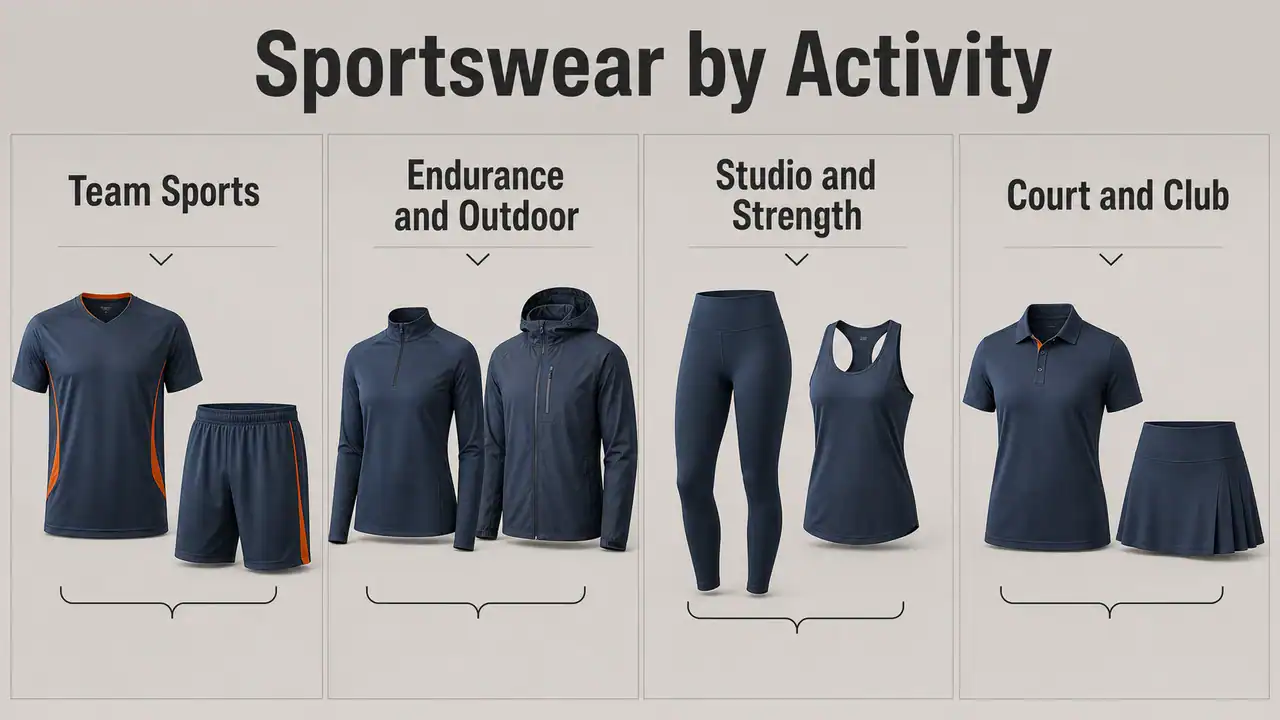
Team and field sports
Football, soccer, basketball, baseball, softball, volleyball, rugby, hockey, lacrosse, cricket, and American football programs commonly use coordinated tops, bottoms, warm-up layers, socks, and outerwear. The buyer brief should define the complete uniform, not only the jersey. Include the size range, player names and numbers, logo positions, decoration method, replacement policy, color standard, and expected reorder quantities.
Teamwear also has an operational requirement that lifestyle activewear may not have: the same style may need to be reproduced in several colors and sizes over multiple seasons. Confirm artwork control, color approval, packaging by player or size, and whether small replacement runs are required.
Running, cycling, and endurance sports
Running and cycling products are shaped by repetitive movement, climate exposure, storage, visibility, and low-bulk comfort. A running brief may include a split short, liner, secure pocket, reflective placement, and a lightweight top. A cycling brief may add a cycling-specific posture, a longer back hem, a front zipper, rear pockets, a gilet, or padded shorts.
For trail running, hiking, and triathlon, also record the weather range, layer compatibility, pocket access, abrasion areas, and whether a shell or base layer must be tested for a particular performance claim. Do not use “waterproof,” “UV protective,” or “thermal” as decorative wording. Treat each as a requirement that needs material and verification details.
Gym, strength, HIIT, and functional training
Gym and strength programs often start with T-shirts, tanks, stringers, training shorts, leggings, joggers, sweatpants, and hoodies. The important decisions are range of motion, coverage during squats and bends, waistband stability, abrasion from equipment, sweat handling, and the placement of prints or embroidery.
A gym brand should decide whether it wants a close performance fit, a relaxed bodybuilding fit, an oversized streetwear fit, or a small capsule that combines all three. The answer affects grading, fabric weight, seam reinforcement, and the way the collection is merchandised. DTS’s sports, fitness, and yoga brand program is the most relevant commercial starting point for this type of development.
Yoga, Pilates, dance, and studio movement
Studio garments usually need a controlled stretch direction, comfortable seams, stable waistbands, suitable coverage, and a fit that stays in place during changes of position. Leggings, crop tops, sports bras, yoga pants, wrap layers, unitards, and coordinated sets are common starting points.
Ask whether the fabric must remain opaque during deep bends, whether the garment will be layered, whether the wearer needs low or medium support, and whether the product is intended for studio training or everyday lifestyle use. These choices are more useful than selecting a fabric from a color card alone.
Court and club sports
Tennis, golf, pickleball, badminton, table tennis, and squash combine repeated directional movement with a polished club or team appearance. Common garments include polos, skirts, skorts, dresses, shorts, lightweight jackets, and vests.
Specify whether the garment needs ball storage, a collar, a clean tuck-in proportion, a longer back hem, club embroidery, contrast panels, or a repeat-order color system. Club garments often need a balance between performance and a consistent identity across men’s, women’s, and junior size ranges.
Outdoor, winter, water, and protection-oriented sports
Hiking, climbing, skiing, snowboarding, swimming, surfing, paddling, and water training have different exposure and protection needs. Hiking and climbing may prioritize abrasion, pockets, articulation, and layering. Winter sports may require insulation, weather protection, and glove-friendly closures. Swim and surf products may require lining, chlorine or salt-water considerations, coverage, and secure fit.
Separate a lightweight activewear product from a technical protective product. A name such as “rain jacket” or “UV top” is not enough to establish a performance level. Record the intended market, test requirement, care instructions, seam construction, and documentation needed before making a product claim.
Types of sportswear by performance function
Performance words are useful only when they are connected to a garment, fabric, construction, and verification plan. The table below is a starting framework for a product brief.
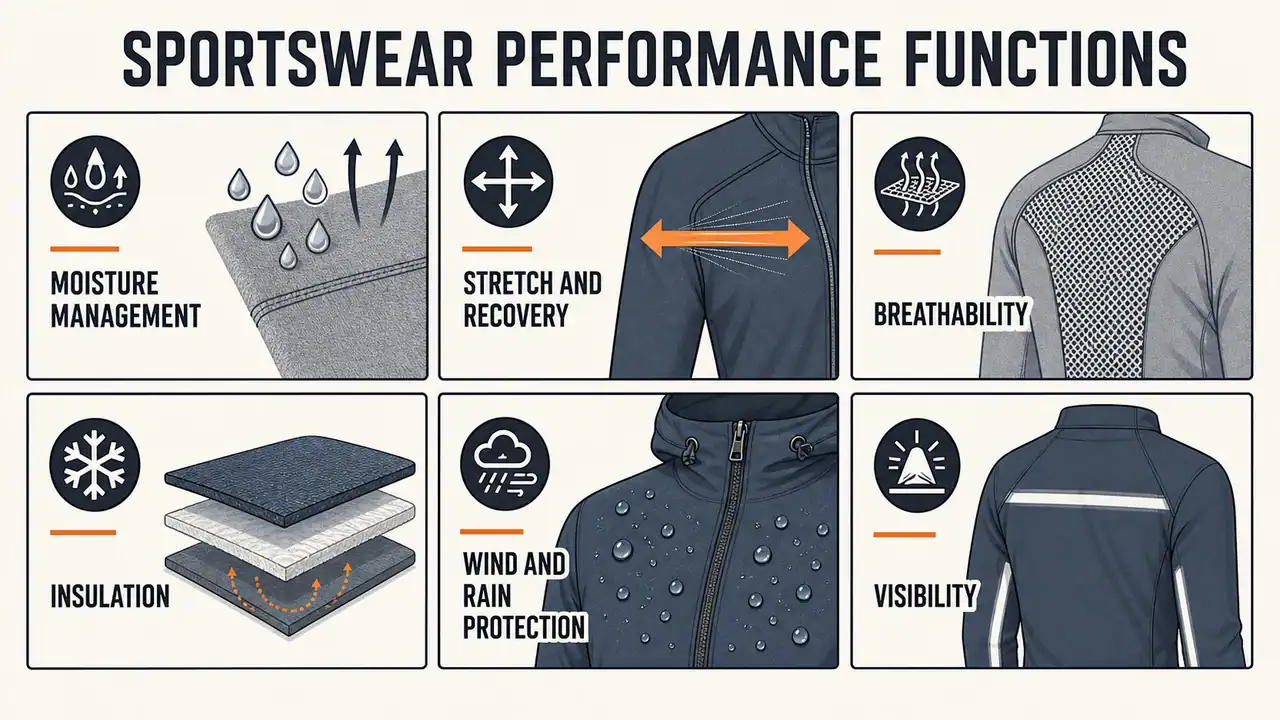
| Performance function | Common garment examples | Questions for the brief |
|---|---|---|
| Moisture management and quick drying | Training T-shirts, tanks, running tops, base layers | What activity, fabric composition, finish, care process, and test method support the claim? |
| Breathability and mesh ventilation | Gym tees, jerseys, running tops, side panels | Where is ventilation needed, and will mesh affect opacity, durability, or decoration? |
| Stretch and recovery | Leggings, compression tops, yoga sets, fitted shorts | What is the stretch direction, desired fit, recovery expectation, and grading rule? |
| Compression and support | Compression shirts, tights, bras, socks, sleeves | What level of support is intended, and how will pressure, size, and comfort be controlled? |
| Thermal or base-layer insulation | Base layers, fleece, thermal mid-layers | What temperature range, layering order, fabric weight, and care instructions apply? |
| Wind and rain protection | Windbreakers, shells, running jackets, ski pants | Is the requirement wind resistance, water resistance, or waterproofing? What seam and closure details are needed? |
| UV or rash protection | Sun shirts, rash guards, surf tops, swim layers | What coverage, fabric construction, test documentation, and care statement are required? |
| Reflective visibility | Running jackets, vests, shorts, cycling tops | Where should reflective trims sit, and how will they survive washing and decoration? |
| Anti-chafe construction | Running shorts, liners, cycling shorts, base layers | Which seams, gussets, hems, and fabric surfaces contact the skin during movement? |
| Padding and impact protection | Cycling shorts, goalkeeper wear, contact-sport garments | What pad, insert, placement, coverage, and test or compliance requirement applies? |
| Seamless or low-bulk construction | Bras, leggings, base layers, studio sets | Which seams can be removed, bonded, or softened without reducing durability? |
| Odor-control or antimicrobial treatment | Base layers, socks, training tops | What treatment is used, what claim is allowed, and what documentation supports it? |
| Coverage-focused sportswear | Long sleeves, modest skirts, sports hijabs, layered sets | What coverage, ease, opacity, ventilation, and movement requirements matter to the wearer? |
| Adaptive sportswear | Easy-entry tops, seated-fit trousers, accessible closures | Which user movement, closure, seam, opening, and dressing requirement should drive the pattern? |
| Inclusive and plus-size grading | Bras, leggings, joggers, tees, team uniforms | How will support, rise, waistband, armhole, and grading remain consistent across sizes? |
| Preferred-fiber programs | Recycled polyester tees, recycled nylon leggings, cotton-rich lifestyle wear | Which fiber source, certification, traceability, color, finish, and price target are required? |
For moisture-management discussions, AATCC TM195 describes a test method for liquid moisture-management properties of textile fabrics. For stretch, growth, and recovery terminology, ASTM D3107-26 is a useful technical reference. These references explain how a buyer can discuss performance; they do not prove that a particular garment meets a result, and they do not mean DTS performs either test unless the project scope confirms it.
Sportswear fabrics and material choices
There is no single best sportswear fabric. A suitable material depends on the garment, activity, hand feel, fit, climate, decoration, target cost, care process, and performance evidence required. Start with the intended behavior, then compare fabric options and samples.
| Material family | Common reasons to consider it | Questions before approval |
|---|---|---|
| Polyester and recycled polyester | Often considered for durability, color development, quick-dry programs, and decorated teamwear. | Fiber source, hand feel, moisture behavior, pilling, colorfastness, and decoration compatibility. |
| Nylon and polyamide | Often selected for a smoother hand feel, abrasion considerations, and stretch-blend programs. | Recovery, opacity, abrasion, color, heat sensitivity, and care requirements. |
| Elastane blends | Add stretch to leggings, bras, fitted tops, shorts, and studio garments. | Stretch direction, recovery after wear and wash, blend percentage, heat exposure, and grading. |
| Cotton-rich fabrics | Useful for comfort-led gym, streetwear-active, travel, and lifestyle collections. | Drying behavior, shrinkage, color, surface finish, weight, and the difference between lifestyle and technical use. |
| Mesh and spacer fabrics | Create ventilation, structure, or visual contrast in selected garment zones. | Opacity, snagging, seam stability, edge finishing, wash durability, and decoration placement. |
| Fleece and brushed fabrics | Provide a softer hand feel and warmth for hoodies, sweatshirts, joggers, and layers. | Weight, bulk, pilling, shedding, shrinkage, brushed direction, and care instructions. |
| Shell and coated fabrics | Used when wind, rain, or outdoor exposure is part of the product requirement. | Coating or membrane, seam construction, breathability, closures, testing, and repair or care guidance. |
For a deeper buyer comparison, use DTS’s best fabric for activewear guide. A sample should be evaluated for hand feel, opacity, stretch and recovery, seam appearance, shrinkage, color, decoration, and fit after the intended care process. A fabric that feels good on a swatch may behave differently in a finished garment.
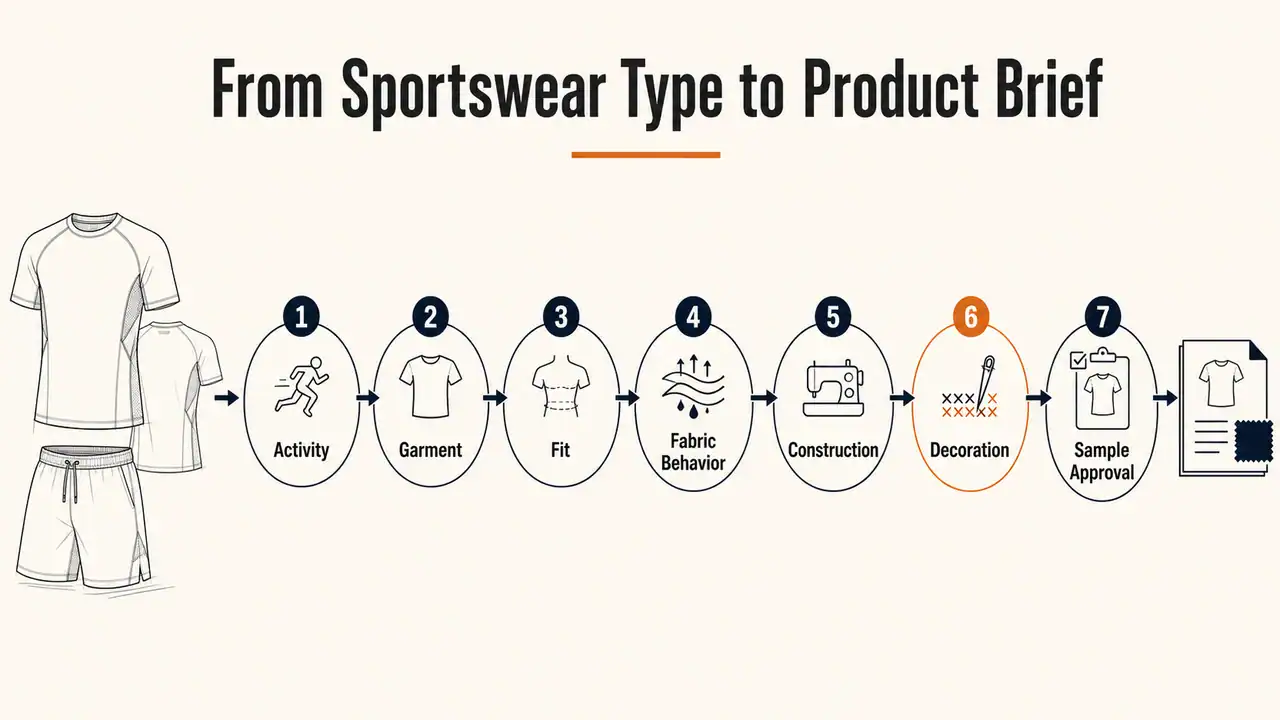
How to turn a sportswear type into a buyer brief
A category name is not a production specification. Before asking for pricing, translate the name into the decisions a pattern maker, fabric team, sample room, and quality team need to understand.
- Define the activity. State whether the garment is for strength training, running, yoga, team competition, travel, outdoor use, or everyday wear.
- Define the user and fit. Record target wearer, body coverage, support level, intended fit, size range, and grading expectations.
- Define the fabric behavior. Include composition, GSM or weight range, stretch direction, recovery, opacity, surface, and care requirements.
- Define the construction. Show seams, gussets, panels, hems, waistbands, pockets, zippers, drawcords, lining, reinforcement, and closures.
- Define decoration and identity. Add logo size, artwork, print or embroidery method, reflective trims, labels, hangtags, and packaging.
- Define quality questions. Identify color, measurement, seam, appearance, wash, pilling, stretch, or performance checks relevant to the program.
- Define the order plan. State quantity by style, color, and size, target market, sample quantity, packaging, delivery location, and expected reorder pattern.
Sportswear tech-pack checklist
- Target activity and user profile.
- Front, back, side, and detail sketches.
- Measurement chart, grading, and tolerances.
- Fabric composition, weight, stretch direction, and recovery expectation.
- Fit, support, coverage, opacity, and lining requirements.
- Seams, hems, waistbands, pockets, closures, and reinforcement.
- Logo, print, embroidery, reflective, label, and trim placement.
- Color references and lab-dip or strike-off approval process.
- Quantity by color and size, packaging, and destination market.
- Sample comments, approval status, revision history, and final sign-off.
DTS can review a moodboard, sketch, reference garment, or technical package before sample development. See tech-pack customization for the type of information that makes a review more precise, then use sampling and prototyping to manage fit, fabric, construction, and revision decisions.
Which sportswear type should a brand develop first?
New brands often try to launch too many garment types at once. A smaller product system is easier to sample, photograph, price, explain, and reorder. The best first product is the one that matches the brand’s audience and can demonstrate its design point with manageable development risk.
| Brand starting point | Practical first family | Main questions | Useful DTS next step |
|---|---|---|---|
| Gym or strength brand | T-shirt, tank, training shorts, joggers | Movement, sweat, durability, fit, and decoration. | Product review and technical brief. |
| Yoga or studio brand | Leggings, bra, crop top, coordinated set | Stretch, opacity, recovery, waistband stability, and support. | Fabric comparison and prototype. |
| Teamwear brand | Jersey, shorts, warm-up layer | Size run, numbers, names, repeat orders, and color consistency. | Sports brand program and artwork review. |
| Streetwear-active crossover | Oversized tee, hoodie, cargo jogger | Silhouette, fabric weight, labels, trims, and collection balance. | Designer consultation and sample plan. |
| Running or outdoor brand | Performance top, shorts, vest, or shell | Visibility, climate, pockets, protection, and evidence for performance claims. | Tech-pack review and prototype testing plan. |
| New private-label seller | One coordinated set or focused capsule | MOQ, sample risk, packaging, target price, and reorder potential. | Review the MOQ and manufacturer guide. |
For selected DTS programs, public site information indicates that MOQ can start from 50 pieces, but the final quantity depends on fabric, color, size, trim, decoration, and style complexity. Treat any starting figure as a discussion point, not a universal promise. For a new collection, it is usually better to confirm the sample route and technical feasibility before committing to a full category range.
Frequently asked questions about sportswear types
What are the main types of sportswear?
The main groups are sportswear tops, bottoms, layers, coordinated sets, sport-specific uniforms, performance-function garments, and accessories. They can also be organized by activity, such as team sports, running, cycling, gym, studio, court, outdoor, winter, and water sports.
What is the difference between sportswear and activewear?
Sportswear is the broader term. Activewear usually refers to clothing designed for exercise, movement, and active lifestyles, while sportswear may also include uniforms and garments developed for a specific sport or competition.
What is the difference between sportswear and gym wear?
Gym wear is a use-case subset of sportswear for strength training, cardio, conditioning, and studio workouts. Sportswear also includes team jerseys, cycling kits, ski layers, swimwear, court garments, and other activity-specific products.
Which sportswear is best for gym training?
Common starting options are a training T-shirt, tank, stringer, sports bra, training shorts, leggings, joggers, and a light hoodie. The best choice depends on movement, coverage, fit, sweat behavior, equipment contact, and whether the brand wants a performance or streetwear silhouette.
What is the difference between joggers and sweatpants?
Joggers usually have a tapered leg and a cuff, while sweatpants often describe a softer, more relaxed pull-on trouser. The terms overlap in the market, so define the leg shape, fabric weight, waistband, cuff, pockets, and intended use in the tech pack.
Which fabric is commonly used for sportswear?
Polyester, recycled polyester, nylon, polyamide, elastane blends, cotton-rich fabrics, mesh, fleece, and coated or shell fabrics are common options. The right choice depends on the garment, activity, hand feel, stretch, care, decoration, target price, and performance evidence required.
How should a brand choose its first sportswear product?
Start with the audience and activity, then select one product family that demonstrates the brand’s design point. Confirm fit, fabric behavior, construction, decoration, size range, sample process, MOQ, packaging, and reorder potential before expanding the collection.
Can a manufacturer develop sportswear from a moodboard or reference garment?
Yes, a moodboard or reference garment can start a discussion, but a sample becomes more accurate when the buyer also provides measurements, fabric preferences, fit comments, artwork, quantity, and intended use. DTS offers design consultation and tech-pack support for this type of development path.
What should a sportswear tech pack include?
Include sketches, measurements, tolerances, grading, fabric composition and weight, stretch direction, fit, support, coverage, construction, decoration, labels, packaging, quantity, and quality requirements. It should also record sample comments and approval revisions.
What affects sportswear MOQ, sample cost, and lead time?
Fabric availability, color, size range, style complexity, trims, decoration, packaging, sample revisions, and order quantity all affect the commercial plan. Confirm the details for each style instead of relying on a single universal MOQ or lead-time statement.
The right sportswear type starts with the product brief
A useful sportswear name list should make the next decision easier. Choose the activity, garment, fit, fabric behavior, construction, decoration, size range, quantity, and approval criteria first. Then ask a manufacturer to evaluate feasibility, sampling, pricing, quality checks, and production timing.
If you already have a reference image, moodboard, sketch, or tech pack, send it with the target product type and expected quantity. DTS Activewear can review the development path and identify the information still needed for a meaningful quotation.
Ready to develop a sportswear product?
Request a Custom Quote or Send Your Moodboard or Tech Pack for Review.