Shorts are classified by what they are used for, their cut, their length and rise, their construction, and their fabric. Common named types include running, basketball, cycling, compression, Bermuda, chino, cargo, denim, and sweat shorts. This guide indexes 122 useful names and design options so apparel teams can compare the garment name with the actual specification.
The 122 entries below do not represent 122 unrelated base garments. The list separates 62 market style names from fit, length, construction, and material options. A single product may combine several labels—for example, a relaxed 7-inch training short with a woven shell, mesh liner, elastic waist, and secure pocket.
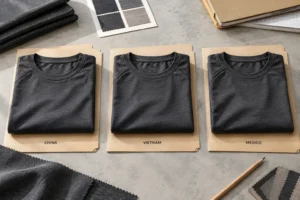
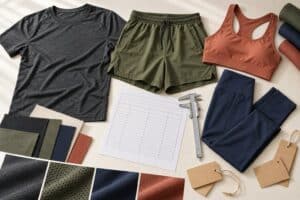
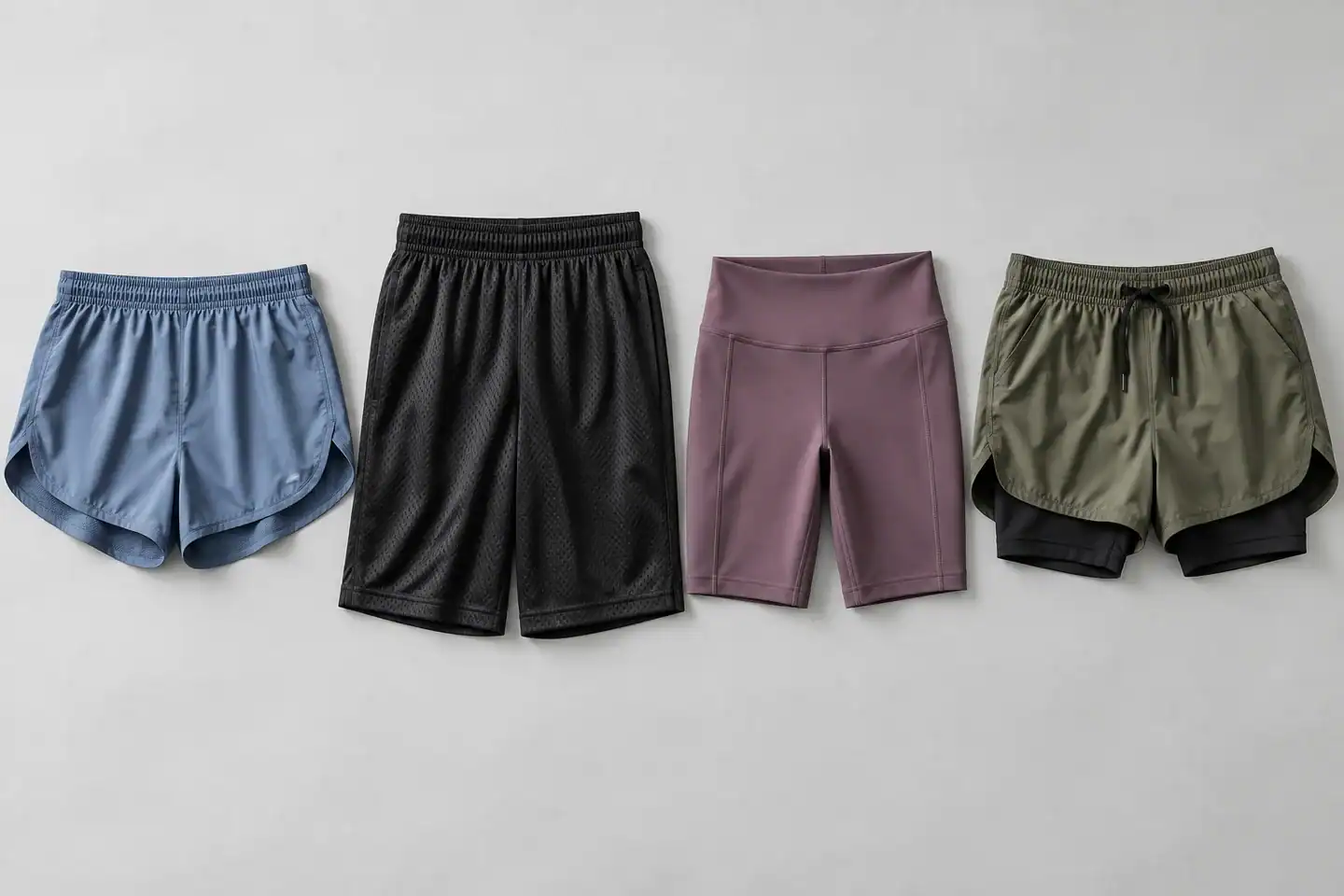
All visuals in this article are AI-generated illustrations. They are not DTS inventory, supplier-approved samples, factory evidence, or test results.
How to read the 122 shorts types and design options
The word “type” is used loosely in clothing searches. Some names identify an end use, such as running shorts; others describe a silhouette, waistband, inseam, liner, or fabric. These labels can overlap, so a buyer should treat them as design inputs rather than mutually exclusive product codes.

Use the list in five passes: name the garment family; select the fit and leg shape; record rise and inseam; specify the waistband, liner, and pockets; then identify the fabric platform and finish. That sequence keeps a supplier quote tied to the same sample brief.
62 named shorts styles by activity and use
A style name narrows the category; it does not specify the finished product. Two items both called “running shorts” may differ in shell fabric, liner, inseam, pocket layout, side split, and rise.
Athletic, training, and sport-specific shorts
- 1. Running shorts — Built around a runner’s chosen coverage, movement, and storage needs; record shell, liner, inseam, and pocket details.
- 2. Split running shorts — Use a split or curved outer-leg opening to change stride clearance and visual shape.
- 3. Track shorts — A light athletic short used for track sessions, warm-ups, or team programs; specify side stripes and decoration separately.
- 4. Training shorts — A general workout category; define whether the intended use is strength work, conditioning, or mixed training.
- 5. Gym shorts — A broad fitness label, not a fabric standard; state fit, liner, stretch, pocket, and care requirements.
- 6. Basketball shorts — Commonly cut for court movement and team identity; confirm body length, mesh or knit construction, and number or logo placement.
- 7. Soccer or football shorts — A team short whose fabric, color blocking, and crest or number positions need to match the uniform brief.
- 8. Rugby shorts — A sport-specific short where seam placement, reinforcement, and movement requirements should be reviewed against the team’s use.
- 9. Tennis shorts — Specify pocket depth and ball storage, length, waistband, and whether the short is designed for a skirt, liner, or standalone garment.
- 10. Volleyball shorts — Often selected for close coverage and court movement; confirm rise, inseam, stretch, and opacity on the sample.
- 11. Badminton shorts — A court-sport option whose fit and leg opening should allow repeated lunges and lateral movement.
- 12. Cycling shorts — Close-fitting shorts for riding; state whether a seat pad or liner is required instead of assuming it is included.
- 13. Mountain-bike shorts — Often use a looser outer shell or reinforced panels; define layering, pocket, closure, and abrasion zones.
- 14. Triathlon shorts — A multi-discipline design; specify the intended swim, bike, and run use and any pad or pocket constraints.
- 15. Compression shorts — Close-fitting stretch shorts; the desired compression level must be validated on the actual fabric and size set.
- 16. Two-in-one training shorts — Combine a looser shell with an inner short; record both layers, attachment method, and liner length.
- 17. Yoga shorts — A fitted movement short; define stretch, recovery, waistband behavior, coverage, and surface opacity.
- 18. Pilates shorts — A studio-wear category where comfort, movement, and visual coverage matter; state the intended rise and leg opening.
- 19. Dance shorts — A broad category covering varied movement styles; specify the choreography, coverage, and required freedom of movement.
- 20. Cheer shorts — Often developed as part of a coordinated uniform; list team colors, trim, waistband, and decoration placement.
- 21. Wrestling shorts — A close-fitting competition or training garment; confirm the relevant organization’s current uniform rules before sampling.
- 22. Martial-arts shorts — Define the discipline, range of motion, waistband, side openings, and any event-specific uniform requirements.
- 23. Hiking shorts — A practical outdoor category; specify pocket use, stretch, abrasion zones, and whether a belt or liner is needed.
- 24. Trail-running shorts — A running variant where pocket bounce, liner choice, shell weight, and layer compatibility should be trialed.
- 25. Climbing shorts — Specify harness compatibility, gusset needs, pocket access, and the range of movement expected.
- 26. Golf shorts — Usually developed around a more structured appearance; record belt loops, fly, pocket layout, and dress-code requirements for the buyer’s market.
- 27. Swim trunks — A short swimwear form; identify lining, drawcord, water-use requirements, and care instructions.
- 28. Board shorts — A longer swim or surf style; specify fly or pull-on closure, tie, pocket drainage, and intended water activity.
- 29. Surf shorts — Define length, closure, stretch, seam placement, and whether the garment is designed for board contact.
- 30. Water shorts — A general water-activity label; specify the intended use and fabric behavior rather than relying on the name alone.

Casual, workwear, and lifestyle shorts
- 31. Denim or jean shorts — Specify denim weight, wash, rise, hem treatment, and shade approval.
- 32. Cut-off shorts — A denim or woven short with a cut edge; state whether the hem is raw, stitched, frayed, or finished.
- 33. Jorts — A market term for longer or looser denim shorts; define the actual length and leg width in the tech pack.
- 34. Bermuda shorts — A longer short that generally finishes around the knee area; set the finished inseam and hem position on the approved size chart.
- 35. Chino shorts — Usually made in a chino-style woven fabric; record composition, twill appearance, closure, and pocket details.
- 36. Cargo shorts — Add cargo pockets as a defining feature; specify pocket size, placement, flap, closure, and reinforcement.
- 37. Carpenter shorts — A workwear style with utility details; confirm tool-loop placement, pocket function, and fabric weight.
- 38. Utility shorts — A broad practical category; the brief should identify which functional details make the design “utility.”
- 39. Tailored shorts — Cut with trouser-like details; record front pleats or darts, fly, waistband, pocket, and hem finish.
- 40. Pleated shorts — Use one or more front pleats; note direction, depth, and how they affect the waist-to-hip fit.
- 41. Flat-front shorts — A cleaner front without visible pleats; specify the rise, closure, and intended ease.
- 42. Linen shorts — Define fiber content, weave, weight, lining, and expected texture; do not infer composition from appearance.
- 43. Seersucker shorts — A puckered-surface woven category; state the target texture, stripe direction, and color approval.
- 44. Corduroy shorts — Record wale direction, wale width, weight, pile direction, seam bulk, and wash or care route.
- 45. Leather shorts — Specify genuine or synthetic material, lining, seam construction, and care labeling; do not use the word as a substitute for composition.
- 46. Faux-leather shorts — Identify the exact base material and surface coating, then review cracking, color transfer, and care requirements on the selected quality.
- 47. Sweat shorts — A casual short using sweatshirt-like construction; specify loopback or brushed reverse, weight, and waistband finish.
- 48. French-terry shorts — State fiber blend, loopback face, finished weight, and whether the surface will be brushed.
- 49. Fleece shorts — Define knit structure and brushed surface, if any; request the actual sample because “fleece” can describe different constructions.
- 50. Lounge shorts — A comfort-oriented category; define waistband, pocket, fabric hand, and fit through a wearer or size-set review.
- 51. Sleep or pajama shorts — Specify closure, seam comfort, labeling, and the intended sleepwear market.
- 52. Boxer shorts — An underwear category rather than an outer short; confirm whether the product is woven sleepwear or close-fitting underwear.
- 53. Culotte shorts — A wide-leg short with a skirt-like drape; record the finished leg opening and rise.
- 54. Skort — A shorts-and-skirt combination; define the under-short, overlay, overlap, and attachment details.
- 55. Paperbag-waist shorts — A gathered waist feature; record waistband height, elastic or tie construction, and the intended fit.
- 56. Wrap-front shorts — Use an overlapping front panel; clarify whether it is decorative or functional and how it is secured.
- 57. Tie-front shorts — Include a visible tie or draw detail; specify whether it adjusts the waist or is decorative only.
- 58. Maternity shorts — Define the panel or waistband approach, stretch recovery, and how fit changes across the intended size range.
- 59. Walking shorts — A general casual category; set length, fabric, pocket use, and fit rather than treating the name as a standard.
- 60. Uniform shorts — Developed for a team, school, or work program; confirm color, logo, labeling, size range, and replacement-order consistency.
- 61. Dolphin shorts — A very short athletic style with curved side openings; record the curve, binding, and hem details.
- 62. Short shorts — A broad length description; replace it in production documents with a measurable inseam and garment length.
20 fit and leg-shape options
Fit labels are useful for the design brief, but they are not a substitute for measurements. Two suppliers may use “relaxed” differently. Show the reference garment or list finished measurements and tolerances.

- 63. Slim fit — Reduced ease through the hip and thigh; check sitting, squatting, and stride movement.
- 64. Standard fit — A baseline fit description that still needs garment measurements.
- 65. Relaxed fit — More ease through the seat or thigh; state where the added room belongs.
- 66. Roomy fit — A visibly generous shape; distinguish it from a standard fit with a reference sample.
- 67. Baggy fit — A loose silhouette; define leg width, rise, and finished length to avoid unintended oversizing.
- 68. Straight-leg fit — A similar opening from thigh toward hem; confirm the opening circumference.
- 69. Wide-leg fit — A larger leg opening; specify the opening and drape rather than just the trend label.
- 70. Tapered-leg fit — Narrows toward the hem; review the leg opening against movement and liner requirements.
- 71. Flared-leg fit — Opens toward the hem; mark the flare point and target width.
- 72. A-line fit — Gradually widens from waist toward hem; confirm the waist-to-hem proportion.
- 73. Boxy fit — A straighter, broader shape; include front and back measurements for the intended size range.
- 74. Body-contouring fit — Follows the body closely; fit-test stretch, recovery, seams, and coverage.
- 75. Drop-crotch fit — A lower crotch point changes rise and movement; review stride and sitting positions.
- 76. Curved-side-seam fit — Uses a shaped side seam; specify panel shape and seam placement.
- 77. Split-side-leg fit — A side opening changes leg movement; state the split length and reinforcement.
- 78. Scalloped-hem fit — A curved edge changes the hem outline; confirm binding or turnback finish.
- 79. Cuffed-hem fit — Adds a folded or attached cuff; define cuff depth and whether it can roll.
- 80. Paneled-leg fit — Uses multiple pieces or color-block panels; mark panel lines and seam allowances on the spec.
- 81. Modest-coverage fit — A buyer preference rather than a standard; state the required coverage through sample comments.
- 82. High-mobility fit — A design goal, not a test result; verify range of motion in the actual garment.
14 length and rise descriptors
The most useful length reference is a finished garment measurement, especially inseam and outseam. Descriptions such as “short,” “mid-length,” or “long” vary by wearer, size, brand, and cut.

- 83. Low-rise — The waistband sits lower on the body; define its position against the pattern or fit sample.
- 84. Mid-rise — A middle rise description; provide the front and back rise measurements.
- 85. High-rise — A higher waistband position; check seated comfort and waistband rollover.
- 86. Ultra-high-rise — A more elevated waistband; show the target top edge on a fit reference.
- 87. Very-short inseam — A high-thigh length; provide the inseam in the size spec.
- 88. Short inseam — A shorter leg length; do not rely on the label alone for grading.
- 89. Mid-thigh length — A visual placement description; confirm it across the size set.
- 90. Long inseam — A longer leg length; record the actual measurement for each size or grading rule.
- 91. Above-knee length — A hem position description; show the intended position on a fit sample.
- 92. Knee-length — A hem near the knee; note wearer height and size when approving fit photography.
- 93. Below-knee length — A longer short or short-pant proportion; clarify whether it remains in the shorts product family.
- 94. 3-inch inseam option — A possible design selection, not a universal short-short standard.
- 95. 5-inch inseam option — A possible selection to test against wearer, rise, and size range.
- 96. 7-inch inseam option — A possible option often compared in training briefs; approve on the actual garment.
14 waistband, liner, and pocket constructions
Construction details often change cost, comfort, grading, and sample revisions. Treat each as a separate line on the tech pack instead of leaving the pattern room to infer it from a style name.

- 97. Full elastic waistband — State elastic width, stretch, recovery, and casing finish.
- 98. Encased elastic waistband — Define casing depth and whether topstitching is visible.
- 99. Exposed elastic waistband — Confirm branding, finish, skin-contact feel, and wash durability.
- 100. Internal drawcord — Specify cord material, exit points, and whether ends are secured.
- 101. External drawcord — Confirm cord length, tip finish, and any labeling or logo requirement.
- 102. Pull-on waistband — Define the opening and recovery so the garment can pass over the hip comfortably.
- 103. Belt-loop waistband — Specify loop count, position, width, and fly construction.
- 104. Mesh brief liner — Identify liner fiber, coverage, seam finish, and attachment method.
- 105. Compression inner liner — Set liner length, stretch, recovery, and whether it is attached at the hem.
- 106. Unlined construction — State if a separate base layer is expected and test opacity where relevant.
- 107. Side-entry pocket — Record pocket opening angle, bag depth, and whether items must stay in place during movement.
- 108. Secure zip pocket — Confirm zipper length, garage, direction, and intended object size.
- 109. Cargo patch pocket — Specify pocket dimensions, flap, closure, bartacks, and placement.
- 110. Waistband pocket — Define opening, depth, and whether the pocket must hold a phone or only a key.

12 fabric and surface platforms
A garment name does not determine fiber content. Each fabric platform below can vary by yarn, construction, weight, finishing, and supplier. Record the exact composition and request the actual quality before approving a bulk order.

- 111. Cotton jersey — A knit option; record fiber content, weight, width, stretch, and shrinkage expectations.
- 112. Cotton French terry — A loopback knit option; specify whether it is brushed and approve the reverse face.
- 113. Cotton fleece — A brushed knit description; confirm fiber blend, finished weight, pilling expectations, and care.
- 114. Polyester woven — Specify yarn and construction, weight, lining, and the intended performance tests.
- 115. Polyester knit — Identify knit construction, fiber percentage, stretch direction, and recovery.
- 116. Recycled-polyester blend — Request documentation for the exact recycled-content claim and product scope.
- 117. Nylon woven — State composition, weight, finish, and abrasion or water-related requirements if they apply.
- 118. Nylon-elastane knit — Record blend ratio, stretch, recovery, and opacity on the selected construction.
- 119. Cotton-polyester blend — Provide the exact percentages by weight rather than using “cotton blend” alone.
- 120. Polyester-elastane blend — Set the blend and test expectations for the finished garment.
- 121. Open mesh — Describe the body or panel placement, hole structure, opacity, and seam finish.
- 122. Ripstop woven — Specify grid appearance, yarn, weight, and whether the fabric is coated or untreated.

Match shorts types to the activity and buyer brief
Start with use, then move to fit and construction. For mixed-use gym shorts, a brand might compare a plain woven shell, a knit option, and a two-in-one sample. For running, the decision may turn on liner choice, pocket bounce, side split, and inseam. For teamwear, color blocking, decoration, and replacement-order consistency may matter more than a fashion cut.
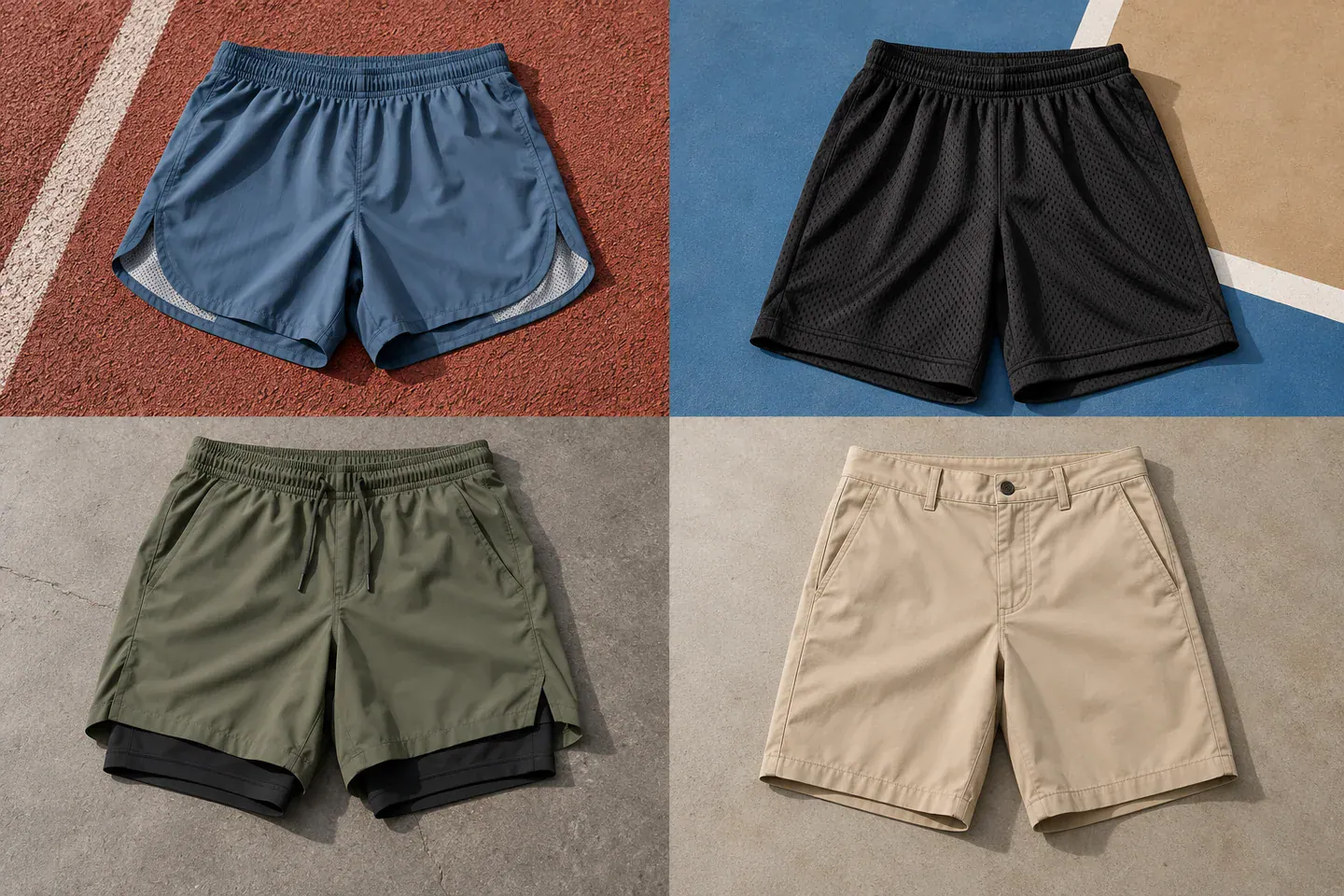
Use this decision order:
- Name the use case. Identify the activity, wearer, climate, and whether the garment is outerwear, underwear, swimwear, or teamwear.
- Set coverage and fit. Define rise, inseam, leg opening, body ease, and any liner.
- Choose construction. Add waistband, closures, pockets, gusset, panels, and reinforcement.
- Specify material. Record fiber content, knit or woven construction, finished weight, width, finish, and care requirements.
- Confirm branding and market. List print or embroidery locations, labels, packaging, target quantity, and destination market.
- Approve on a sample. Review fit, movement, seams, decoration, and measurements before bulk.
Buyer checklist for a custom shorts tech pack
The list below helps a supplier quote the same product the brand is picturing. If one item is undecided, mark it as an open choice and request a sample comparison instead of leaving it unstated.

Include:
- Reference image, garment sample, sketch, or current tech pack.
- Shorts type and use case, plus intended wearer and size range.
- Front, back, and detail views with construction notes.
- Finished garment measurements by size, grading rule, and tolerances.
- Rise, inseam, outseam, leg opening, waistband, and drawcord details.
- Shell and liner fiber percentages, knit or woven construction, weight, and color.
- Pockets, zipper, hardware, gusset, panel, seam, and reinforcement details.
- Print, embroidery, labels, care information, packaging, and carton requirements.
- Order quantity, color count, size breakdown, destination market, and requested sample stage.
- Required tests, method, conditioning, and acceptance limit where a performance claim is made.
U.S. labeling check: covered textile products have prescribed fiber-content, responsible-business, and origin disclosures. Confirm which provisions apply to the exact item and destination in the FTC’s current Textile Fiber Rule and labeling guide.
Sample and bulk checks before approving a shorts program
A quote-ready description is only the beginning. Compare the physical sample against the approved specification, then retain the approved sample or reference record for bulk checks.
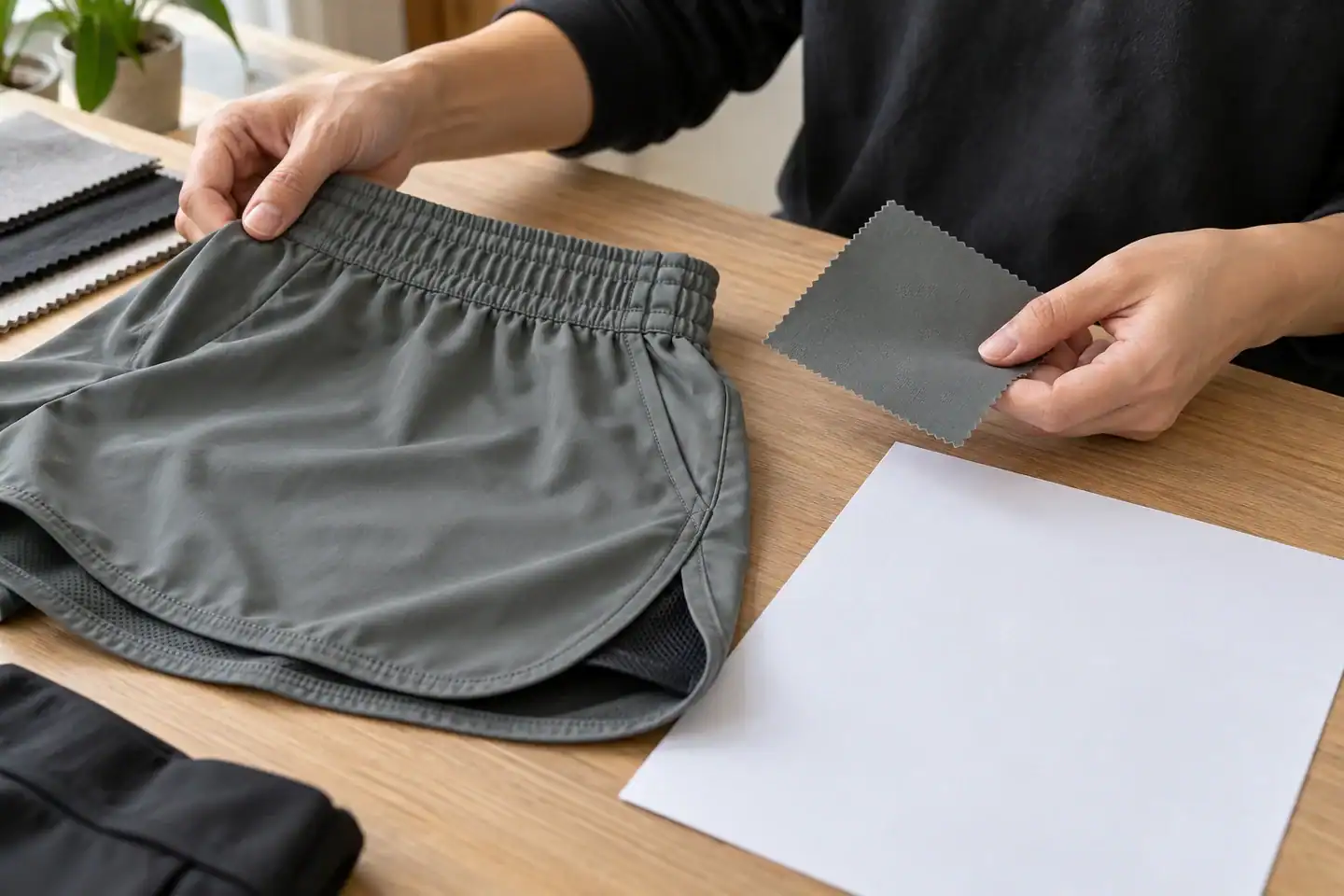
Review the selected size set for waistband position, rise, inseam, leg opening, pocket placement, liner attachment, and ease during the intended movement. Check sewing, seam puckering, skipped stitches, print position, color, surface, and wash instructions against the agreed acceptance criteria. Where the product is sold with a claim such as moisture management, stretch recovery, or water resistance, record the test method and acceptance limit; do not infer test performance from a fabric name or an illustrative image.
A useful supplier comparison holds the design constant. If two quotations differ, list the changed inputs—fabric, liner, pocket, decoration, quantity, labeling, packaging, or sample scope—before comparing price or timing. Exact MOQ, sample cost, and lead time require a project-specific quote.
Shorts questions buyers ask
What are the main types of shorts?
Common named styles include running, training, basketball, cycling, compression, swim, board, Bermuda, chino, denim, cargo, sweat, and tailored shorts. Buyers should then specify fit, rise, inseam, waistband, liner, pockets, and fabric because those details distinguish two products with the same style name.
What is the difference between running shorts and gym shorts?
“Running shorts” usually describes a running use case, while “gym shorts” is broader. Neither name sets a universal fabric or construction. Compare the intended movement, inseam, side opening, liner, pocket security, waistband, and fabric on the actual sample.
How should a brand choose an inseam?
Choose based on wearer coverage, activity, rise, and the intended fit. Record a finished inseam measurement for each size or a clear grade rule, then review it on a fit sample. Terms such as short, mid-length, and long are not substitutes for the garment measurement.
Are cycling shorts the same as compression shorts?
They can share a close fit, but the names describe different design purposes. Cycling shorts are developed around riding requirements; compression shorts describe a close-fitting construction. Confirm whether the cycling design needs a liner or seat pad rather than assuming every pair includes one.
What should a buyer send when requesting a custom shorts quote?
Send a reference or tech pack, intended use, target fit, size range, measurements, fabric and liner requirements, color, branding, quantity, size breakdown, destination market, and sample needs. Ask the supplier to identify any missing inputs that could change the quotation.
Turn the chosen shorts type into a quote-ready brief
DTS Activewear’s custom training shorts page is the product route for brands developing custom training and gym shorts. Availability, fabric, quantity, sample scope, and timing depend on the project brief. Send the design or tech pack to request a custom shorts quote; if the style is still open, ask for a sample plan that compares the specific fit, fabric, and liner options.