Different leggings types are usually named by a mix of rise, length, activity, construction, surface treatment, and fit coverage. That is why a product can be called a high-rise, pocketed, 7/8 training legging and a ribbed studio legging at the same time. The names describe different decisions.
For an apparel brand, the name is the starting point, not the specification. The sample still needs measurements, fabric construction, stretch and recovery targets, seam details, waistband dimensions, decoration instructions, care requirements, and approval criteria. The 36 styles below are organized as a buyer reference so a product developer can move from a market term to a clearer brief.
How to read the 36 leggings types
The groups below are six overlapping naming axes. They are not six fixed product categories. A brand might combine a high-rise waistband with a 7/8 cut, a gusset, a side pocket, a brushed fabric, and an extended-size fit. A good product name can be long when the decisions matter.
Use the list to decide what belongs in the collection. Then use the measurement chart and construction notes to make the decision repeatable. Terms such as "sculpting," "buttery," "squat proof," and "high support" should not be left as slogans. If the claim matters, define the fabric, test route, wearer, and acceptance standard behind it.
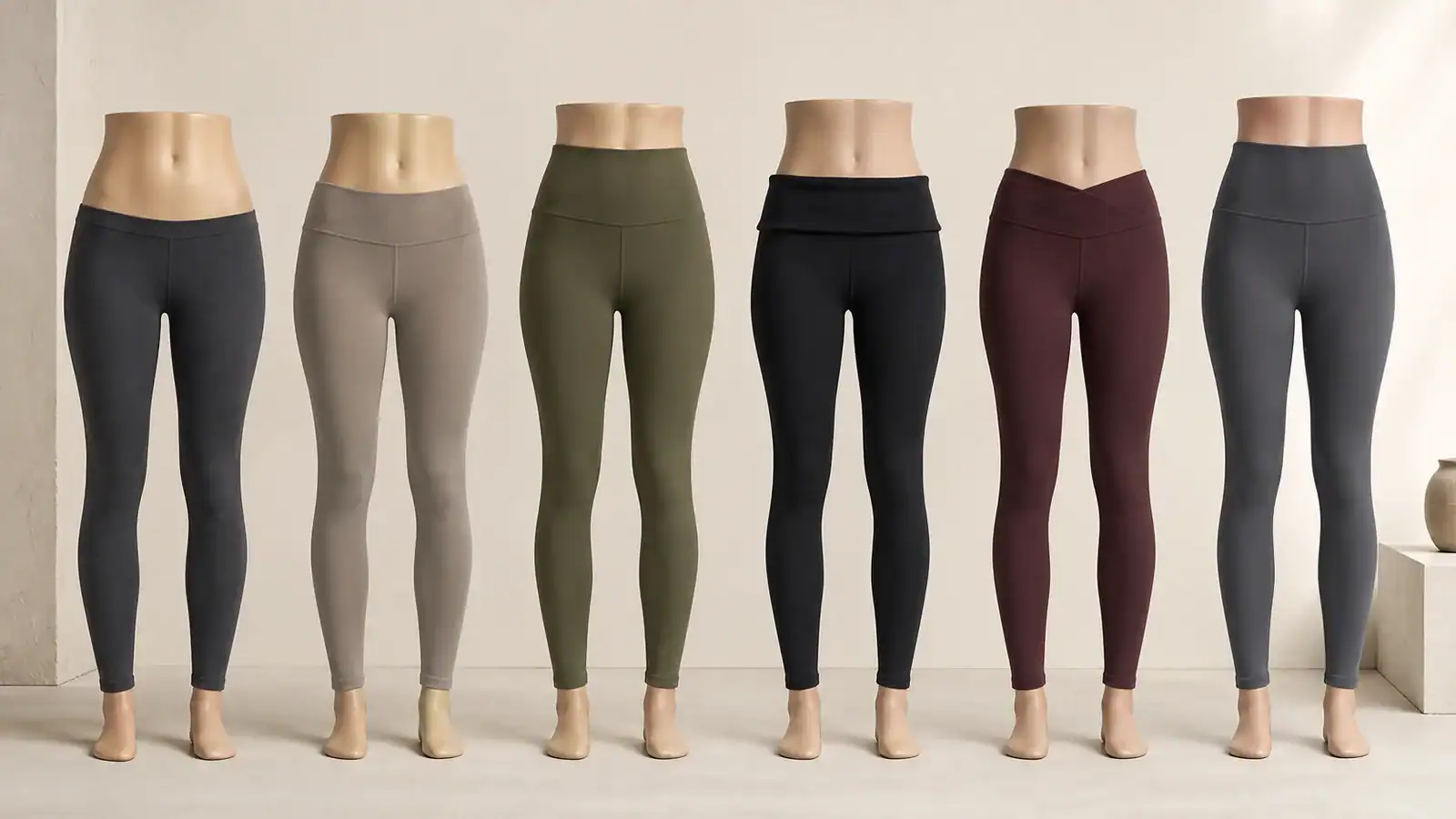
Rise and waistband types
1. Low-rise leggings
Low-rise leggings sit below the natural waist and may be used in fashion, dance, lifestyle, or specific styling programs. The finished rise needs a clear reference point because a low-rise block can look very different across body shapes. Confirm front rise, back rise, waistband height, hip ease, top edge pressure, and whether the product should stay in place during the intended movement.
2. Mid-rise leggings
Mid-rise leggings sit between the low waist and the natural waist. They are often easier to position across casual, studio, and training collections, but "mid-rise" is not a universal measurement. State the reference size, front and back rise, waistband height, top edge finish, and target waist location. Review the rise on the body after sitting, bending, and lifting the knee.
3. High-rise leggings
High-rise leggings extend higher on the torso and usually need a stable waistband that does not roll. Confirm finished rise including or excluding the waistband, elastic or self-fabric construction, waistband height, top edge recovery, and the relationship between waistband and bust or bra line for the target wearer. A high rise can still be relaxed, compressive, sculpting, or maternity.
4. Foldover-waist leggings
Foldover-waist leggings use a wider waistband that can be worn unfolded or folded down. The product needs enough height, stretch, and recovery to work in both positions. Specify the waistband height, fold line, top edge finish, body attachment, seam allowance, and target pressure. Test the folded position after repeated movement because a smooth fold can become a rolling edge on a soft knit.
5. Crossover-waist leggings
Crossover-waist leggings use a V-shaped or overlapping front waistband. The crossover can be a visual feature or a way to shape the front waist. The pattern needs a defined overlap depth, center-front point, top edge angle, seam direction, and support level. Check that the point does not gape during a bend and that the waistband does not twist toward one side after wear.
6. Wide-waistband leggings
Wide-waistband leggings use a broad self-fabric or multi-layer waistband to spread pressure and create a clean top line. Width alone does not prove support. Confirm finished height, number of layers, internal elastic or power mesh if used, seam placement, edge finish, and recovery. A wide waistband can change the front rise and pocket opening, so review it with the complete pattern.
Length and cut types
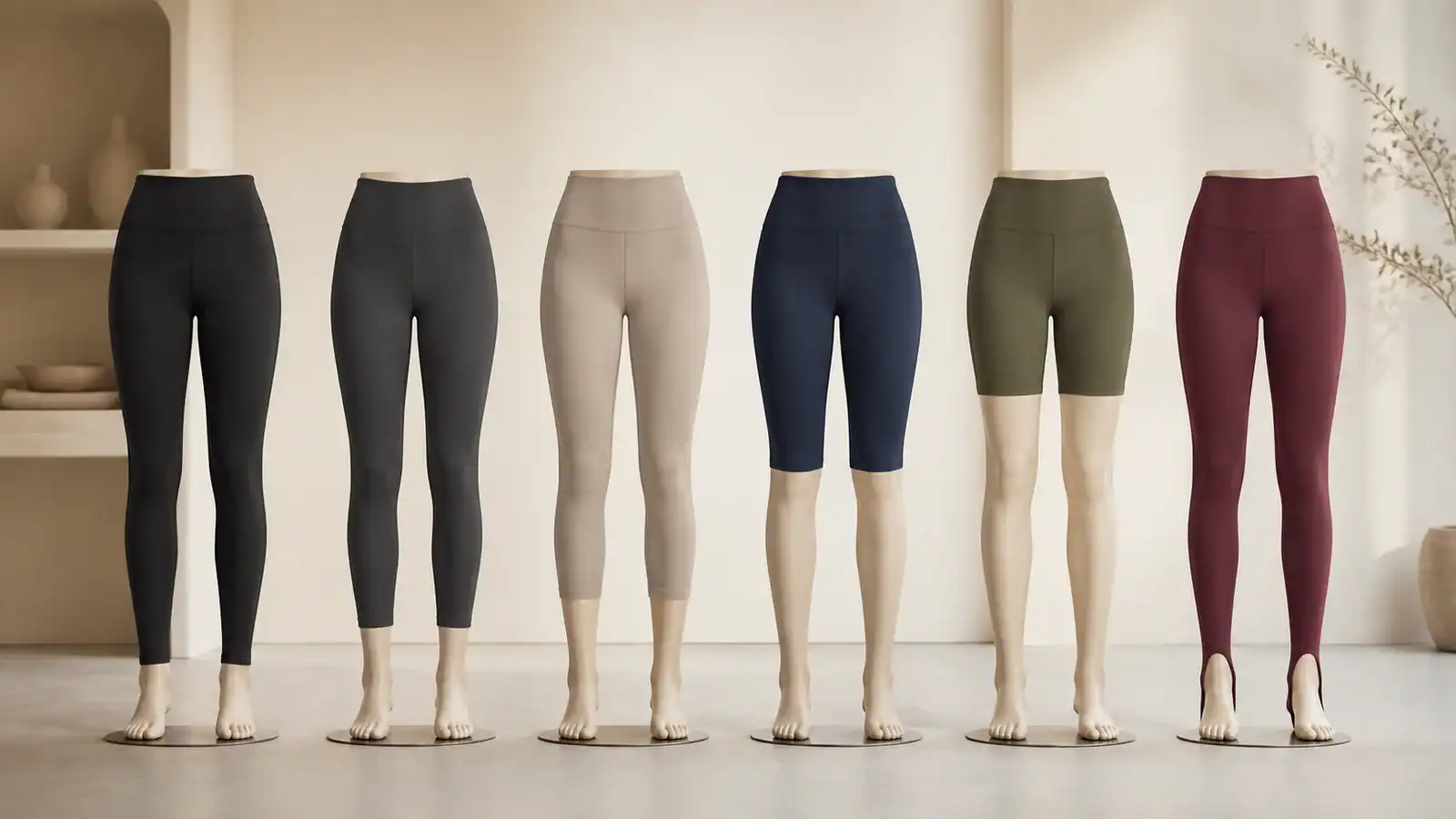
7. Full-length leggings
Full-length leggings reach the ankle or slightly above it, depending on the block and wearer. The production note should define inseam, outseam if needed, ankle opening, and the intended break over the foot. State whether the finished measurement includes a hem band. Length can change noticeably after washing, so the post-care measurement target matters.
8. 7/8 leggings
7/8 leggings end above the ankle and are often used for studio, training, and warm-weather collections. The fraction is a market shorthand, not a complete measurement. Confirm the actual inseam for the reference size, grading method, ankle opening, and desired position on different heights. A sample that looks 7/8 on one fit model may read as full length on a shorter wearer.
9. Capri or cropped leggings
Capri and cropped leggings finish between the knee and ankle. Retailers use the terms inconsistently, so the product brief should show the target hem location and exact inseam. Confirm hem construction, leg opening, coverage during a squat, and how the length is graded. A cropped style can require a different knee and calf shape rather than a simple reduction to a full-length pattern.
10. Knee-length leggings
Knee-length leggings finish around the knee and can be used for warm-weather training, studio wear, or layered styling. Define the hem position from a stable waist point, not only from the knee cap, because knee location changes across sizes and body shapes. Check hem grip, coverage during movement, front and back rise, and whether the fabric grows at the knee.
11. Bike-short leggings
Bike-short leggings are short, close-fitting bottoms that usually finish at the upper or mid-thigh. They may be sold as cycling shorts, training shorts, or a separate activewear category, but the legging naming axis is useful for collection planning. Confirm inseam, leg opening, hem pressure, inner-thigh coverage, gusset shape, and opacity. Test riding, squatting, and walking rather than judging the garment while standing still.
12. Stirrup leggings
Stirrup leggings extend a narrow strap or shaped panel under the foot to keep the leg in position. The foot opening, strap width, attachment points, and stretch need careful review. Confirm whether the strap is intended for shoes, socks, or bare feet and whether it should remain visible. Check pressure under the foot, seam comfort, and laundering behavior before using the style in volume.
Activity and function types
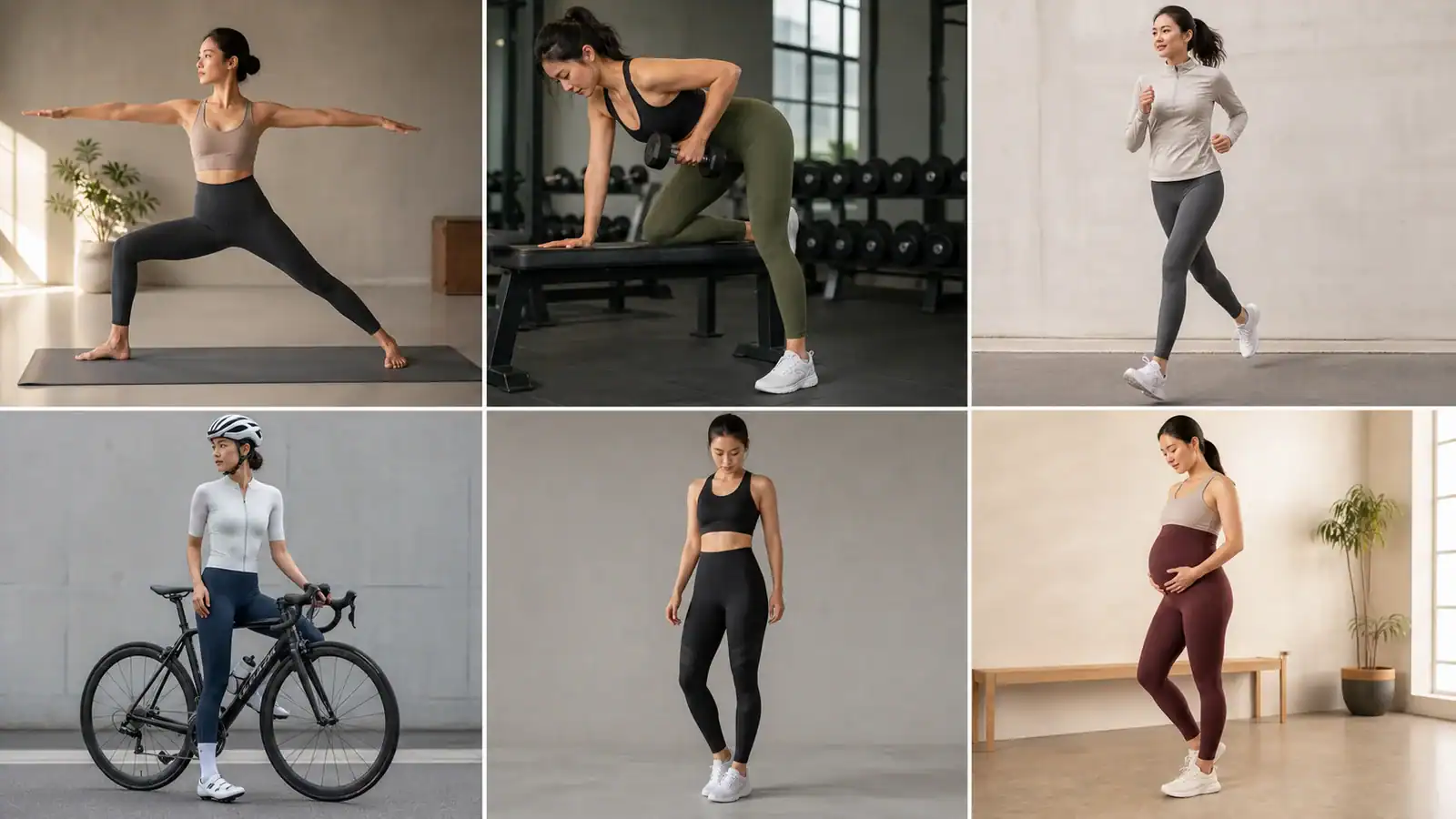
13. Yoga leggings
Yoga leggings are usually designed around bending, stretching, floor contact, and a low-distraction waistband. The product brief should cover opacity in deep flexion, waistband stability, seam placement, gusset shape, hand feel, and recovery. A soft fabric may feel comfortable but still lack the support or coverage required by the target pose and market.
14. Training leggings
Training leggings are planned for repeated gym movement such as squats, lunges, lifting, and machine work. Confirm the movement range, support level, pocket needs, waistband behavior, fabric recovery, and resistance to the intended care route. Terms such as performance or sweat-wicking need a defined material and test requirement if they appear in product copy.
15. Running leggings
Running leggings may need a stable fit, low-bulk seams, secure storage, reflective details, and a fabric suited to the climate. A warm-weather running legging and a cold-weather running legging are different products. Specify inseam, ankle entry, pocket contents, visibility details, wind or warmth requirement, and decoration placement. Review bounce and seam rubbing with the intended items in the pockets.
16. Cycling leggings
Cycling leggings can refer to a long tight for road, indoor, or lifestyle cycling, while padded cycling bottoms are a separate construction decision. Confirm whether padding is required, where it sits, how the waistband works in a bent riding position, and how the leg stays in place. The brief should also address saddle contact, panel direction, seam placement, and the difference between indoor and outdoor use.
17. Compression leggings
Compression leggings use a closer fit and a defined pressure or support intention. "Compression" should not be used as a substitute for a tested medical or therapeutic claim. State the intended activity, fit level, target body areas, fabric stretch, recovery, seam tolerance, and size logic. If the product makes a regulated claim, confirm the applicable market requirements before finalizing labels or copy.
18. Maternity leggings
Maternity leggings change the front rise, waistband shape, panel construction, or support area to accommodate a growing abdomen. They may use an over-bump panel, under-bump waistband, crossover front, or adjustable construction. Confirm the stage of pregnancy, panel stretch, pressure, coverage, recovery, seam comfort, and size approach. A generic high-rise block is not automatically a maternity pattern.
Construction and utility types
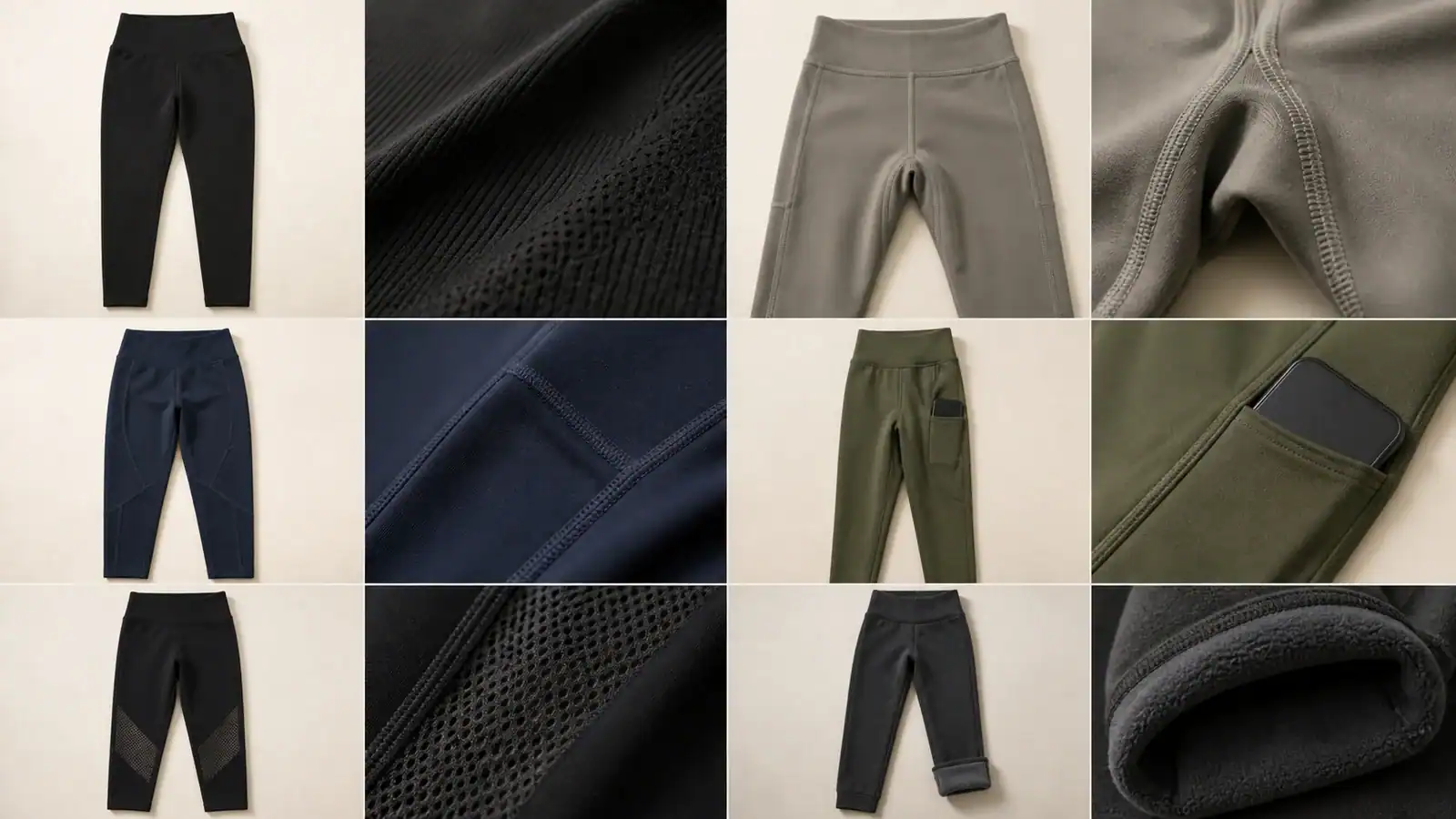
19. Seamless leggings
Seamless leggings reduce or relocate sewn seams through circular knitting, engineered knitting, or a largely seamless construction. The name does not mean that the garment has no seams at all. Confirm knitting method, body mapping, waistband attachment, leg opening, stretch direction, yarn composition, and tolerance for knit lines. Sample review should check transparency, recovery, snagging, and how the pattern performs in movement.
20. Gusseted leggings
Gusseted leggings add a shaped panel at the crotch to improve mobility, reinforce a high-stress area, or reduce a central seam. Define gusset shape, length, width, grain or stretch direction, seam construction, and fabric matching. The gusset should be reviewed in a deep squat and a wide stride. A correct panel can help movement; an oversized or poorly shaped panel can create extra bulk.
21. Paneled leggings
Paneled leggings divide the leg into two or more fabric pieces. Panels may create color mapping, shaping, ventilation, decoration zones, or a distinctive silhouette. Specify each panel, seam location, grain, stretch direction, stitch type, topstitch, and match point. Mixed materials need a shrinkage and recovery review because a stable panel beside a high-stretch panel can twist the leg.
22. Pocketed leggings
Pocketed leggings add storage at the side seam, waistband, back yoke, or thigh. Confirm the item to be carried, pocket opening, bag dimensions, access while moving, closure, reinforcement, and the effect on stretch. A phone pocket that looks flat on a hanger may pull the leg sideways when filled. Test the pocket with the actual object and in the intended activity.
23. Mesh-panel leggings
Mesh-panel leggings use open or engineered mesh for ventilation, contrast, or visual detail. Mesh can stretch, snag, grow, or show different opacity from the body fabric. Specify mesh construction, open area, panel location, edge treatment, skin-contact comfort, colorfastness, and wash route. Review the junction between mesh and body fabric because the seam is often the first failure point.
24. Fleece-lined or thermal leggings
Fleece-lined or thermal leggings add a brushed inner surface, a double layer, or a warmer knit for cold conditions. The product needs a clear climate and activity brief because a warm material that works for commuting may overheat during high-output training. Confirm thickness, stretch, recovery, opacity, warmth target, ankle entry, seam bulk, and care behavior.
Surface and fashion direction types
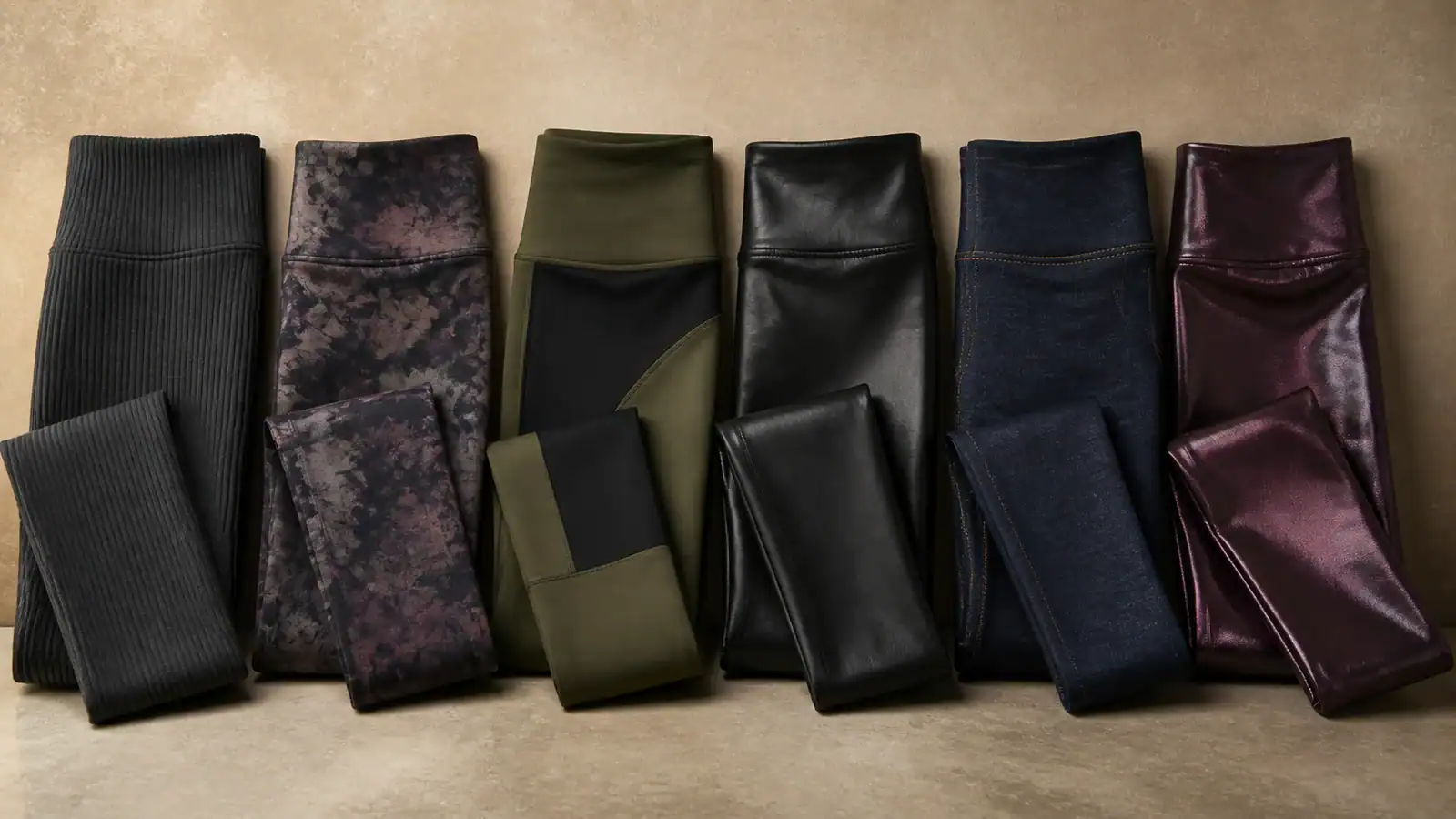
25. Ribbed leggings
Ribbed leggings use a rib knit or rib effect to add texture and directional stretch. Rib spacing, depth, and recovery change the way the garment fits and photographs. Confirm the rib construction, composition, weight, opacity, vertical growth, and whether the waistband uses the same or a different rib. A rib that looks compact in a swatch may open during movement.
26. Printed leggings
Printed leggings carry a placement print, all-over print, sublimation, or another surface design. The decoration method depends on fiber, color, stretch, artwork, and care route. Provide the artwork file, scale, repeat, color standard, placement tolerance, and the expected appearance when the garment stretches. Check white areas, dark base coverage, seam matching, and color transfer.
27. Color-block leggings
Color-block leggings use two or more colors or materials across panels, waistbands, gussets, or hems. The product may be simple or highly engineered. Define the color map, seam position, matching points, grain, stretch direction, and shade tolerance. Different colors from the same base fabric can still behave differently after dyeing or finishing, so approve the complete garment.
28. Faux-leather leggings
Faux-leather leggings use a coated or laminated surface to create a leather-like appearance. The base fabric, coating, thickness, stretch, recovery, heat sensitivity, and seam behavior all matter. Confirm surface gloss, hand feel, opacity, crack resistance, needle marks, and care instructions. This style may need a different fit allowance from a soft jersey legging.
29. Denim-look or jegging leggings
Denim-look leggings use print, coating, knit construction, or stretch denim to imitate jeans while retaining a closer legging fit. Clarify whether the buyer wants a knit legging, a true stretch denim garment, or a visual effect. Confirm waistband, fly or faux fly, pocket treatment, rise, seam details, stretch, recovery, and colorfastness.
30. Glossy or metallic leggings
Glossy or metallic leggings use a reflective finish, coated face, foil, yarn, or surface treatment. The appearance can change with stretch, light, and seam direction. Specify reflectivity, gloss level, color, opacity, abrasion expectations, and care route. Review the garment under retail lighting and after movement because a surface that looks even when flat may crease or lighten at high-stretch areas.
Fit and coverage types
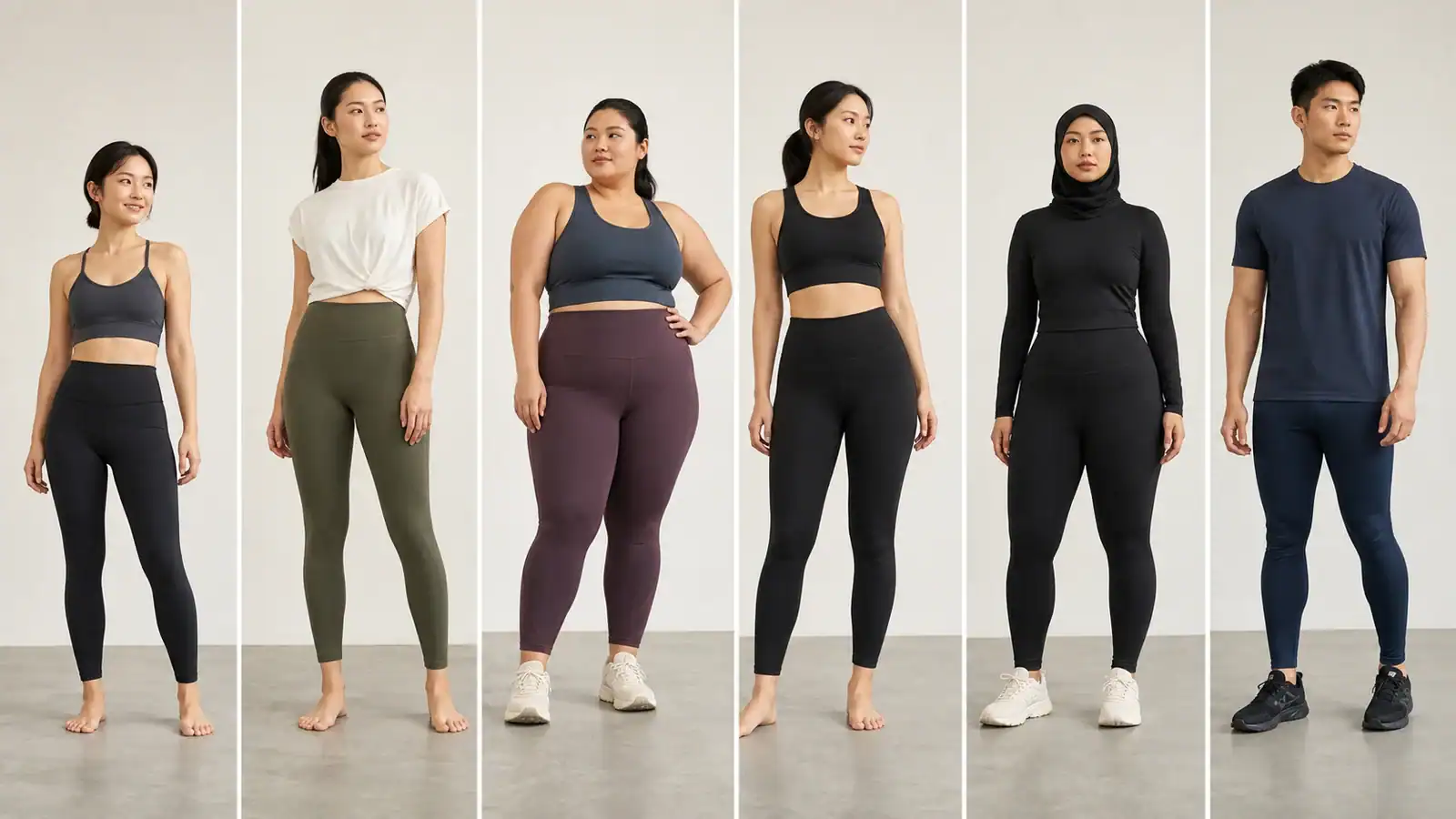
31. Petite leggings
Petite leggings use a length and proportion strategy for shorter wearers. Simply shortening the inseam can leave the rise, knee, waistband, and pocket position out of balance. Confirm the target body measurements, rise, inseam, knee position, ankle opening, and grade rules. Fit review should include the full size range rather than one shortened sample only.
32. Tall leggings
Tall leggings add length and may adjust rise, knee position, waistband height, or ankle coverage. State the target wearer and body measurements, then confirm the actual inseam and outseam. A long leg with a standard rise can pull the waistband down during movement. Review the full pattern, not just the lower-leg length.
33. Extended-size leggings
Extended-size leggings need a size strategy that accounts for proportions, support, recovery, pocket position, and grading. A larger version of a straight-size block may not preserve the intended fit. Confirm hip-to-waist relationship, front and back rise, thigh, knee, leg opening, waistband pressure, and stretch recovery. Fit approval should include body movement and sitting, not only a standing front view.
34. Sculpting or shaping leggings
Sculpting leggings use seam placement, fabric behavior, panels, waistband construction, or targeted compression to create a closer contour. Avoid treating "shaping" as proof of a guaranteed body outcome. Define the intended fit, support zones, panel tension, seam tolerance, opacity, and size logic. The garment should be checked for rolling, pressure marks, seam discomfort, and fabric shine at high stretch.
35. Modest or full-coverage leggings
Modest or full-coverage leggings may prioritize opacity, a longer top, a less revealing fit, a denser fabric, or a layered styling role. Define what coverage means for the target wearer and activity. Confirm fabric opacity in stretch, waistband coverage, front rise, inseam, gusset, and the relationship with tunics or longer tops. Do not use a vague coverage claim without a defined evaluation condition.
36. Men's performance leggings
Men’s performance leggings use a block and support strategy for a male target wearer. Some products are worn alone, while others are base layers under shorts. Confirm front rise, pouch or front construction if required, waistband, inseam, thigh and calf proportions, support, opacity, and intended layering. A unisex label does not remove the need to review the actual fit.
Turn a style name into a production specification
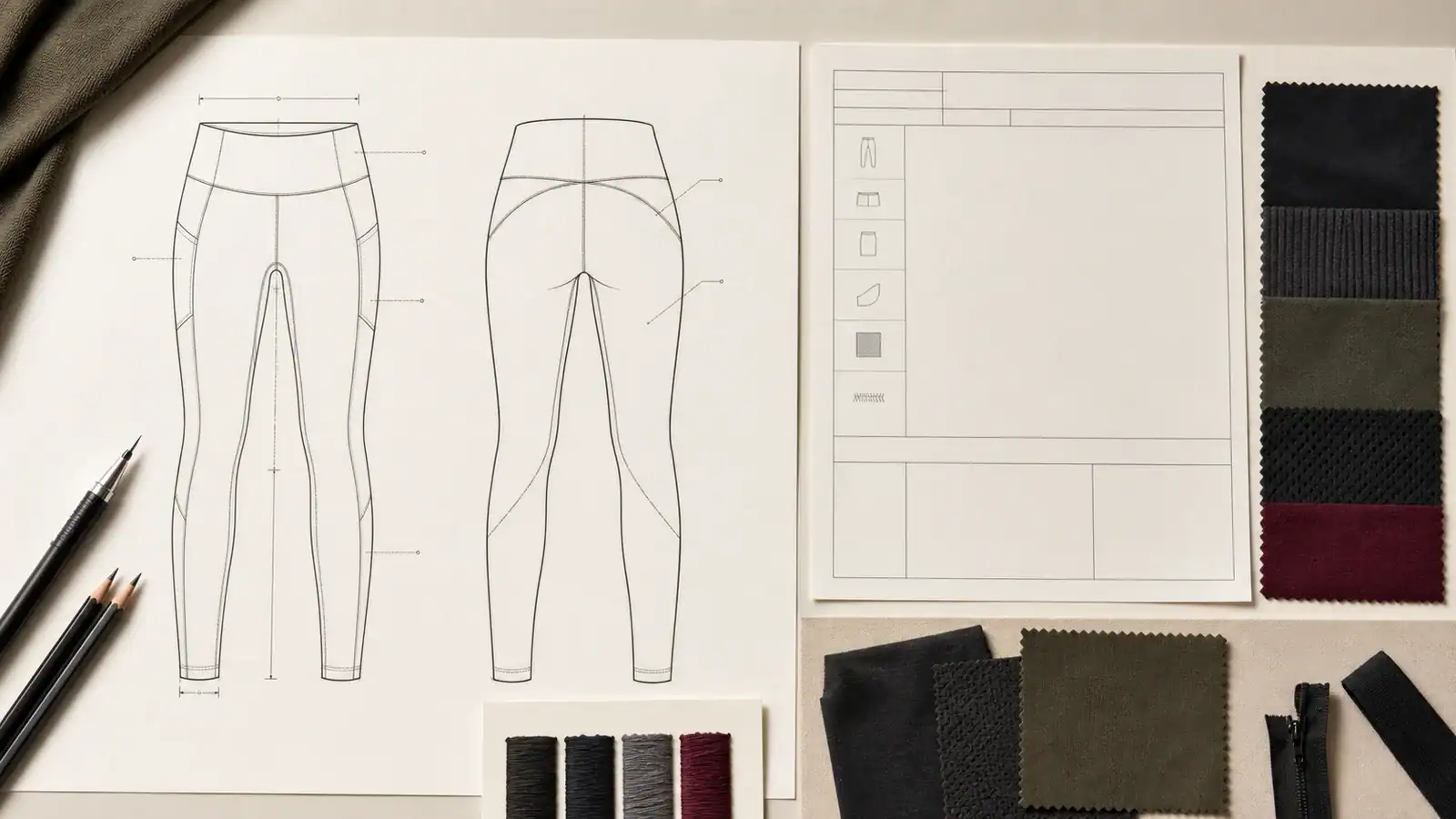
Start the brief with the wearer and use. "High-rise training leggings" is more useful than "premium leggings," but it still leaves several decisions open. Add the target activity, reference size, fit intention, rise, length, leg opening, waistband, gusset, pockets, decoration, fabric, and care route.
The measurement chart should state how each point is taken. Common points include waist relaxed and stretched, waistband height, hip, front rise, back rise, total rise if used, thigh, knee, calf, inseam, outseam, ankle or leg opening, gusset dimensions, pocket position, and pocket-bag dimensions. Mark whether measurements are taken flat, around the garment, with the waistband relaxed, or after a specified stretch.
The material section should cover fiber composition, knit or woven construction, finished weight, stretch direction, stretch amount, recovery, opacity, hand feel, surface, color, shrinkage, and care. A fabric name is not a test result. If the product uses words such as compression, quick dry, abrasion resistant, or squat proof, the brief needs a clear test route and acceptance target for the market.
The construction section should show seam type, thread, seam allowance, coverstitch or flatlock requirements, gusset, waistband layers, elastic, pocket reinforcement, hem, labels, and decoration. A reference photo can help, but it should be marked with what to copy and what to change. A tech pack or annotated sketch gives the sample team a usable record. DTS provides a tech pack customization route for buyers who have a concept, reference, or incomplete specification.
Match the type to the collection role
Choose combinations that answer a real product need. The following examples are starting points, not universal formulas:
- Studio capsule: high-rise, 7/8, gusseted, ribbed, and yoga-oriented. Check floor movement, waistband stability, and opacity.
- Gym training line: high-rise or mid-rise, full length, pocketed, paneled, and training-oriented. Check squat movement, phone storage, recovery, and seam strength.
- Running layer: mid-rise or high-rise, full length, mesh-panel, pocketed, and running-oriented. Check bounce, low-bulk seams, visibility details, and climate.
- Indoor cycling program: high-rise, full length or knee length, paneled, compression-led, and cycling-oriented. Confirm whether a pad or special seat construction is required.
- Cold-weather drop: high-rise, full length, thermal, gusseted, and brushed or fleece-lined. Check warmth, stretch, ankle entry, and bulk under layers.
- Maternity range: high-rise or crossover, full length, over-bump or under-bump, and maternity-specific. Check support and pressure through the intended stage of pregnancy.
- Fashion-led drop: low-rise or crossover, 7/8 or stirrup, glossy, printed, or faux leather. Check surface behavior, opacity, seam marks, and care.
- Extended-size offer: high-rise, full length, wide waistband, gusseted, and full coverage. Check grading, waist-to-hip balance, recovery, and pocket position.
One product can cover more than one role, but the collection should not force every style to use the same block. A training legging with a storage pocket and a fashion legging with a coated finish may need different approval priorities even when both are sold under the word leggings.
Fabric, labeling, and test decisions
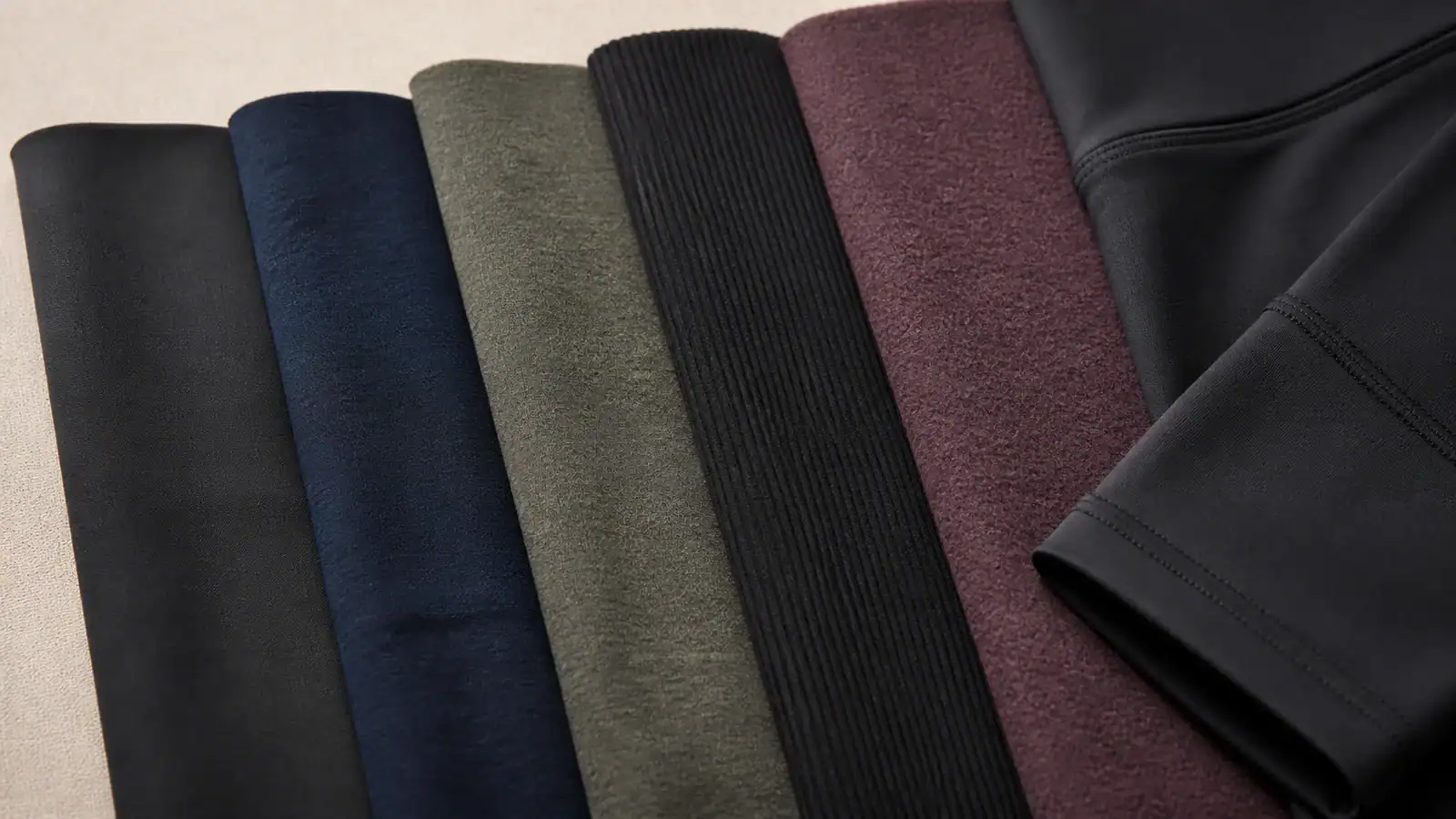
Fabric selection should follow the garment and the use. Nylon-elastane can suit a smooth, close-fitting product, while polyester-elastane may suit different printing or performance requirements. Cotton blends, rib knits, brushed knits, and coated fabrics each change stretch, recovery, opacity, hand feel, drying, care, and decoration. Compare physical swatches and the finished sample instead of selecting from a fiber name alone.
For U.S. apparel, the FTC apparel-labeling guidance covers fiber content, country of origin, the identity of the responsible business, and care information. The FTC Care Labeling Rule also expects regular care instructions with a reasonable basis. Exact labeling needs depend on the sales market and product construction, so the final label should be reviewed for the intended destination.
Testing should be tied to a claim or risk. ASTM D4966 is one named method for abrasion resistance, but the method itself does not create a universal pass or fail limit for every legging. A buyer may also need dimensional change, colorfastness, pilling, stretch and recovery, seam performance, opacity, or decoration checks. Put the method, specimen or garment condition, target, and acceptance rule in the project brief.
For a broader overview of activewear material decisions, see DTS’s best fabric for activewear guide. This leggings article narrows the question to how fabric choices affect the selected style and the approval process.
Sampling and QC checkpoints
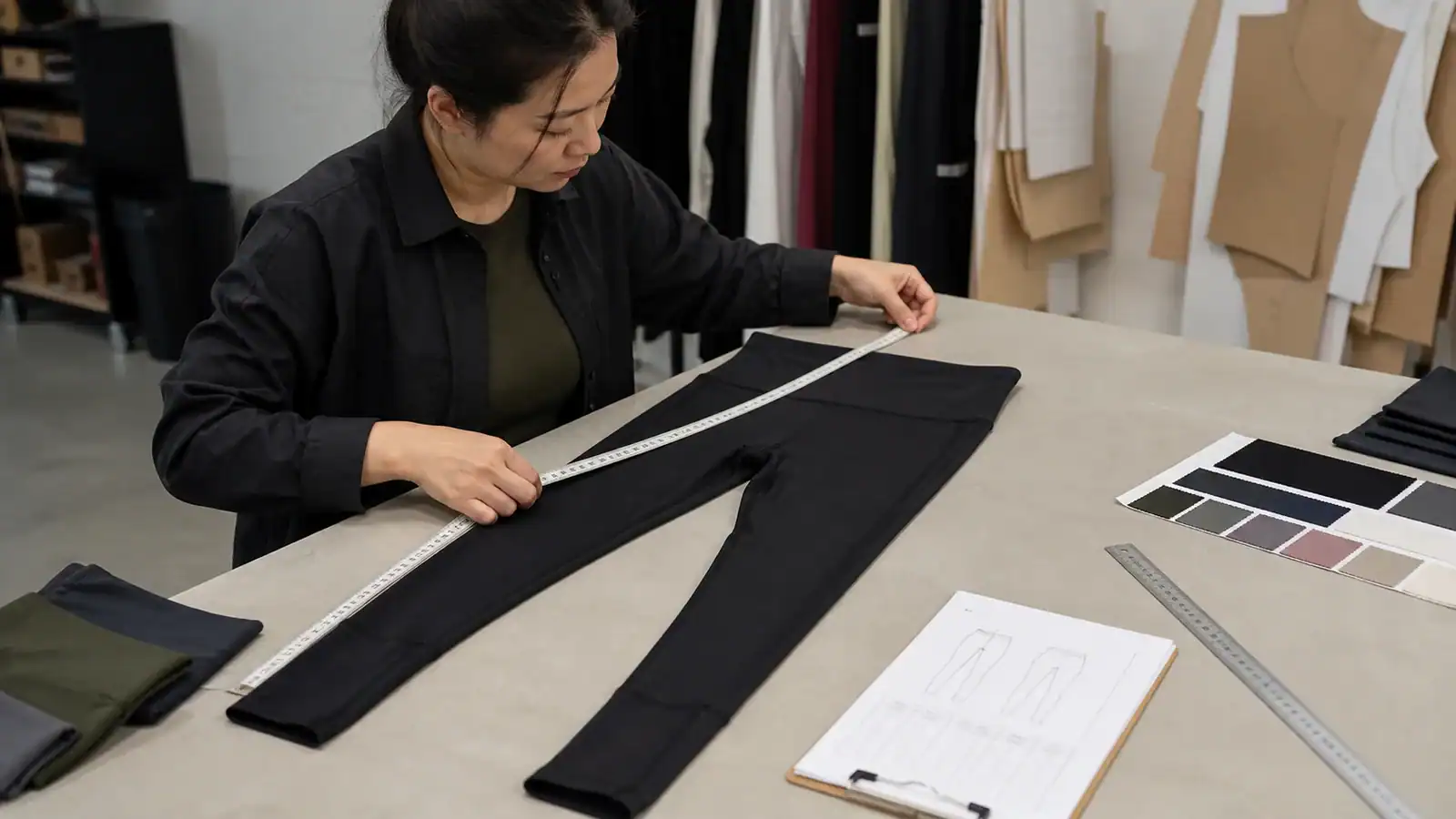
At the first sample, compare the garment with the brief at the reference size. Check the rise on the body, waistband pressure, top edge recovery, gusset position, inseam, leg opening, opacity, seam comfort, pocket access, and decoration. A flat measurement check is necessary, but it cannot replace movement review.
At the next sample, confirm the changes instead of relying on memory. Record the measurement chart version, fabric lot or approved swatch, trim, artwork, color, and comments. This is where vague terms such as "more supportive," "less shiny," or "a little longer" need to become a measurement, material, or visual reference.
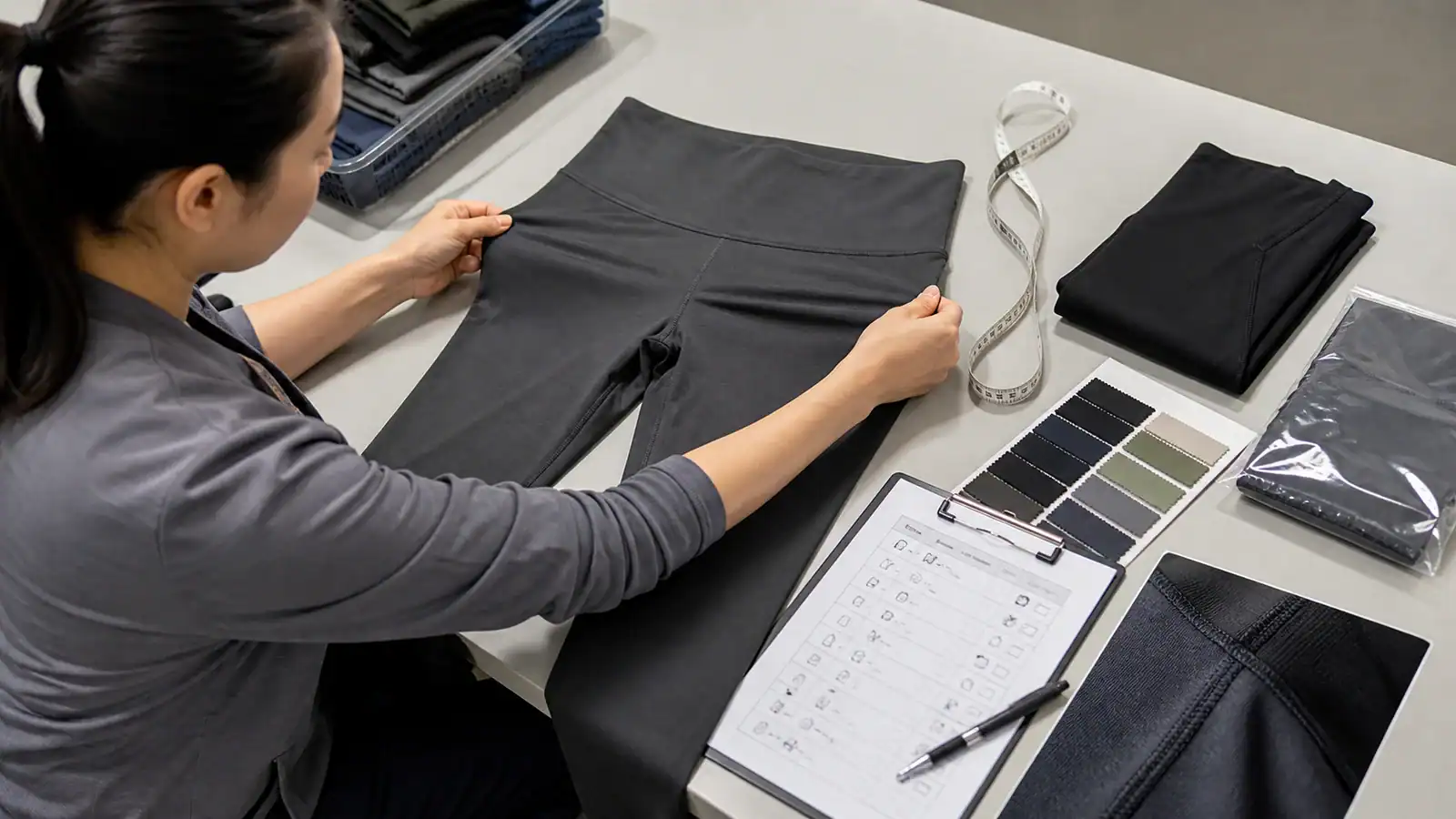
Before bulk approval, review:
- garment measurements and grading against the approved chart;
- waistband height, elastic, top edge, recovery, rolling, and pressure;
- stretch, recovery, opacity, shine, pilling, and dimensional change;
- gusset, crotch, seam extension, coverstitch or flatlock, and high-stress points;
- pocket dimensions, placement, reinforcement, closure, and movement with contents;
- hem or ankle opening, stirrup attachment, leg grip, and length after care;
- color, shade matching, print or coating, artwork placement, and wash behavior;
- fiber, origin, care, size, brand, and other labels required for the destination market;
- packaging, folding, polybag or carton instructions, size marks, and carton details.
DTS has a sampling and prototyping process and a separate quality-control page for the next stage of this workflow. Exact inspection scope, tolerances, tests, and documents should be confirmed for the product and destination.
What to send when requesting a leggings quote or sample
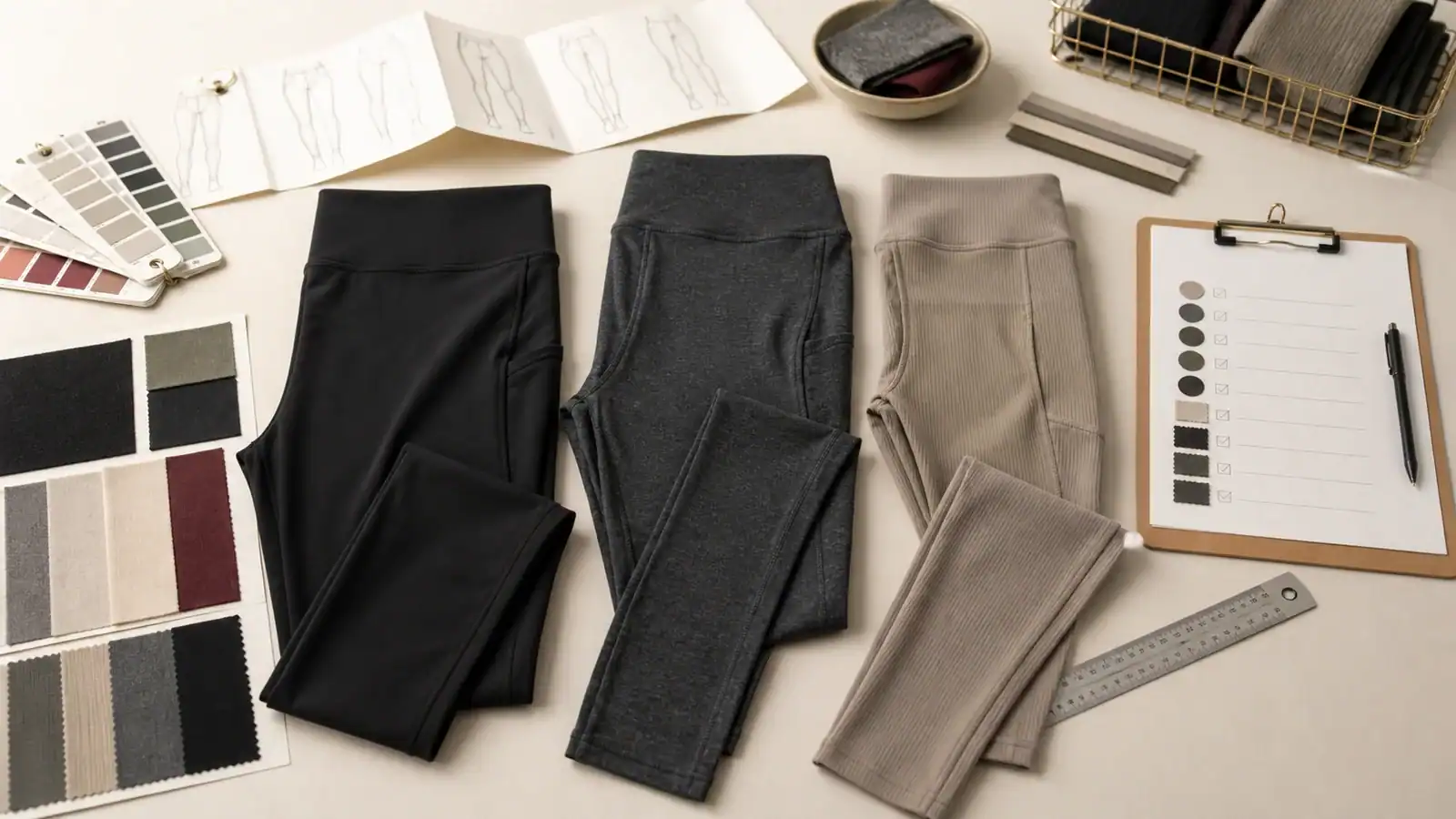
Send one project brief rather than a loose folder of screenshots. Include the target wearer, activity, market, reference size, style combinations from the list, front and back references, measurement chart, fabric direction, colorways, artwork, labels, packaging, estimated quantity, size range, destination, and target timing.
If you have only a moodboard or an incomplete tech pack, say what is fixed and what needs development. If a reference product is available, mark the parts to follow and the parts to change. This reduces the chance that a sample team treats a visual reference as a complete specification.
For a custom project, DTS can review the brief through its NDA inquiry route. Feasibility, fabric options, MOQ, sampling cost, lead time, testing, compliance, and packaging remain project-specific and should be confirmed in the quote and approval record.
Frequently asked questions
The main naming groups are rise and waistband, length and cut, activity and function, construction and utility, surface and fashion direction, and fit and coverage. Common examples include high-rise, 7/8, yoga, training, seamless, pocketed, ribbed, sculpting, and extended-size leggings. These names can overlap in one product.
Full-length leggings usually reach the ankle, while 7/8 leggings finish above the ankle. The exact position depends on the reference size, inseam, wearer height, rise, and grading method. Put the actual inseam and desired hem location in the brief instead of using the fraction alone.
No. Compression leggings describe a closer support intention that may require a defined pressure approach or regulated claim review. Sculpting leggings usually refer to fit, panel, seam, waistband, or fabric effects that create a closer contour. The two can overlap, but neither word should replace a measurable fit and material specification.
Seamless leggings use circular knitting, engineered knitting, or a construction that reduces sewn seams. The garment may still have a waistband attachment, gusset, logo, or other seam. Confirm the actual knitting and construction method, then sample opacity, recovery, snagging, knit lines, and movement.
They can be, if the pocket is designed around the object it must carry. Confirm phone size, pocket opening, bag dimensions, placement, closure, reinforcement, and bounce during movement. A side pocket that looks clean when empty can distort the leg or pull on the waistband when full.
There is no single best fabric. The right choice depends on activity, fit, stretch and recovery, opacity, hand feel, surface, decoration, care, climate, and price position. Compare a physical swatch and a finished sample. If the product uses a performance claim, confirm the test method and target for the sales market.
Common points include waist relaxed and stretched, waistband height, hip, front and back rise, thigh, knee, calf, inseam, outseam, leg opening, gusset, pocket, and decoration placement. Define how each point is measured and add product-specific points for crossover waists, stirrups, panels, or maternity construction.
The number depends on the complexity of the style, the number of colorways and sizes, the fabric and decoration, and the amount of development needed. Start with a clearly defined reference sample and approve the fit, materials, construction, artwork, and care route before discussing bulk. A project-specific sampling plan is more useful than a fixed number for every style.
Build the collection around a clear legging brief
A style name helps a buyer search, compare, and plan a collection. It does not confirm fit, fabric, performance, or compliance. Select the leggings types that match the customer and activity, then write down the rise, length, measurements, construction, material, decoration, size range, care, tests, and approval checks.
If you are ready to discuss a custom legging program, send the style references, tech pack or moodboard, target quantity, colorways, size range, destination, and timing through the DTS Activewear inquiry route. The team can confirm which details need development before a sample or quote is prepared.