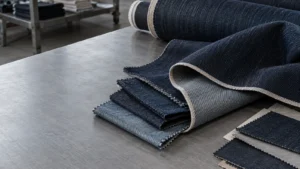
If you are deciding between cotton or polyester, start with the product job rather than the fiber label. Cotton usually offers a familiar soft hand, absorbency and a breathable feel, while polyester can deliver low moisture uptake, quick drying, crease resistance and strong color or shape retention when the fabric is engineered for the use. Neither fiber is automatically better. Knit or woven construction, yarn, GSM, finish, fit and care route can change the result as much as fiber content.
For a buyer, the useful question is not "Which fiber wins?" It is "Which combination of fiber, construction and finish gives this garment the required comfort, movement, dry time, durability and care result?" This guide turns the cotton versus polyester debate into a brief that a supplier can quote, sample and test.
Cotton or polyester: what is the practical difference?
Cotton is a natural plant fiber that is spun into yarn and developed into knitted or woven fabric. Polyester is a manufactured fiber made from a synthetic polymer. That origin affects how each fiber interacts with liquid, heat and repeated care, but it does not determine the whole garment performance by itself. CottonWorks describes cotton as a natural fiber for textiles, while Textile Exchange describes polyester as a strong, durable, crease-resistant and quick-drying fiber used widely in apparel and other products.
The comparison below is a starting point for product development, not a pass or fail result. A lightweight open polyester mesh and a dense polyester fleece will not feel or perform the same way. A loose cotton jersey, a compact cotton pique and a cotton-rich brushed fleece also create different wearer experiences.
| Buyer question | Cotton tendency | Polyester tendency | What still needs confirmation |
|---|---|---|---|
| Where does the fiber come from? | Natural cellulose fiber from a plant source | Manufactured synthetic fiber | Exact fiber content, blend percentage and label wording |
| What happens when liquid reaches it? | Often absorbs and holds more liquid in the fiber and yarn structure | Naturally absorbs little liquid, but can be engineered to move liquid across the surface | Construction, yarn, finish, absorbency, wicking and drying test result |
| How does it feel next to skin? | Often soft and familiar, with a dry or natural hand depending on finish | Can feel smooth, crisp, slick, brushed or highly technical | Yarn type, knit or weave, finish, seams and wearer trial |
| How does it behave in care? | Can wrinkle, shrink or change hand if the route is not controlled | Often resists wrinkles and dries faster, but heat can damage unsuitable constructions or finishes | Dimensional change, heat exposure, colorfastness and final care route |
| What does it mean for activewear? | Comfortable for lower-sweat or comfort-led products, and can be engineered for moisture management | Common for quick-dry and performance-led products when the construction supports it | Activity, climate, air permeability, wicking, drying and recovery |
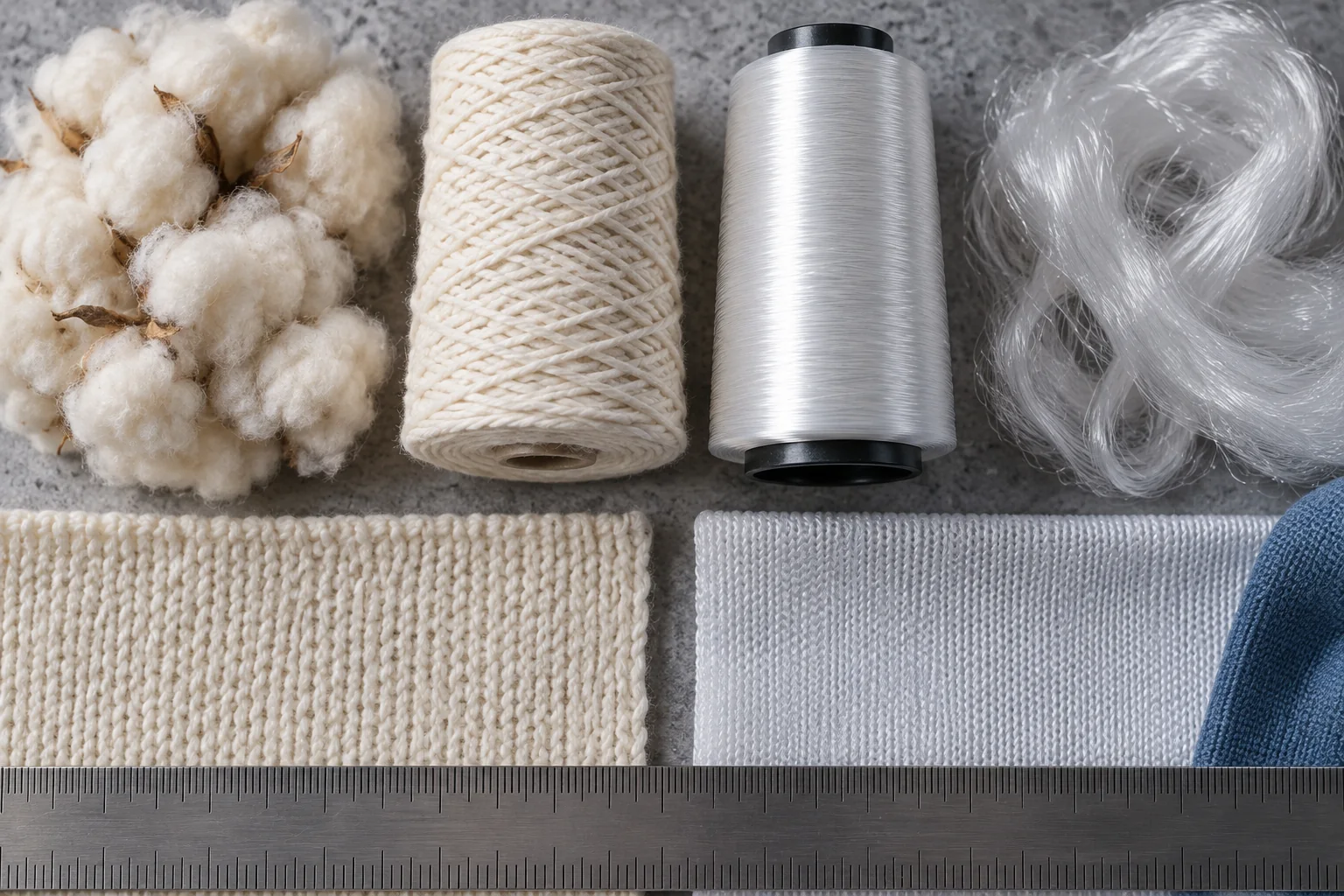
CottonWorks also defines moisture management as more than one property. Absorbency, liquid movement, drying speed, air permeability and the internal geometry of a fabric can all affect comfort. Treat the word breathable or moisture-wicking as a performance claim that needs a material and test basis, not as an automatic benefit of a fiber name.
Why the fiber label is not enough
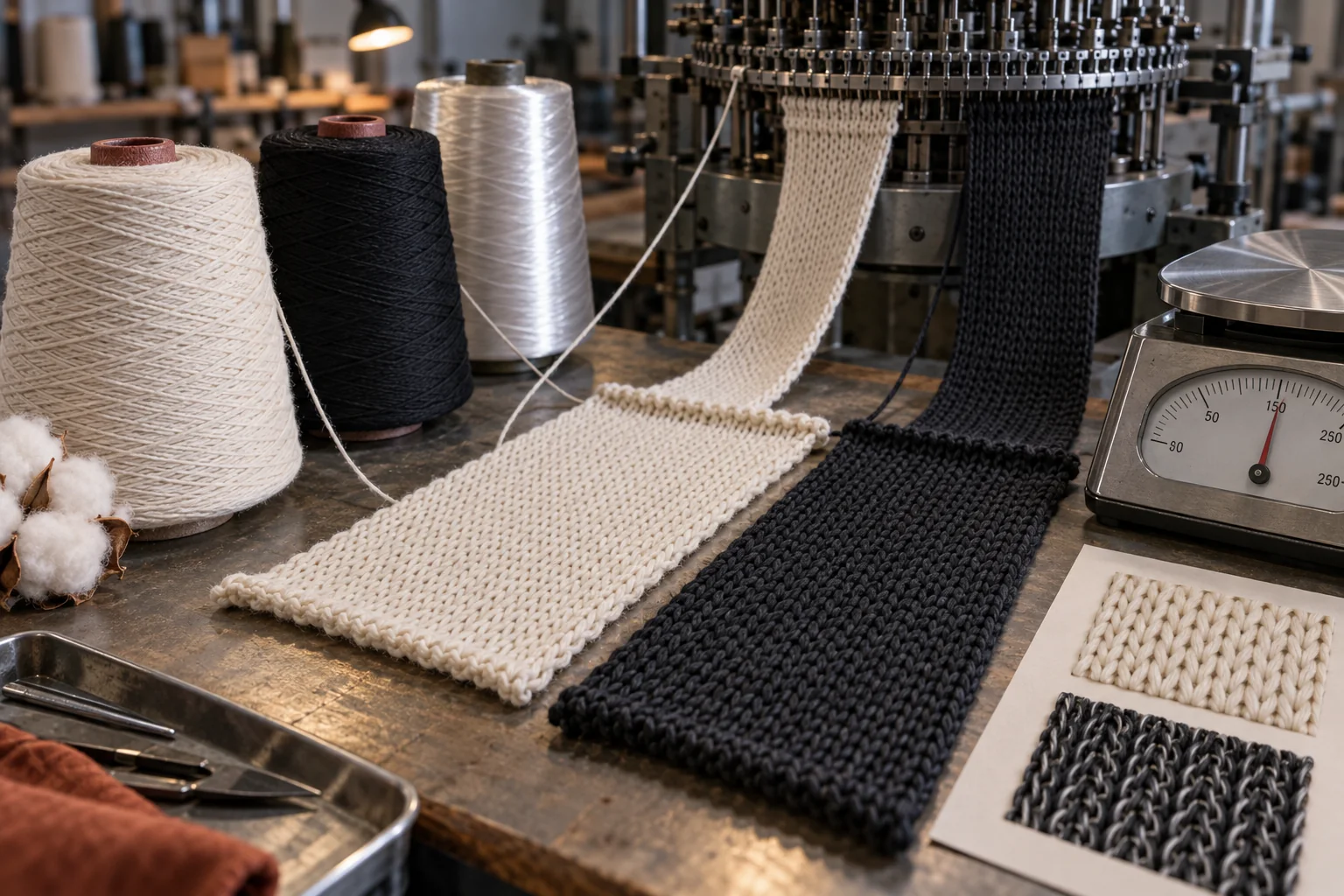
The same fiber can be turned into very different materials. Construction controls the spaces between yarns, surface area, stretch, thickness and airflow. Yarn size and spinning route influence surface, strength and hand. GSM changes coverage and weight. Finishing can alter softness, luster, moisture movement, pilling, wrinkle behavior and care response.
This is why a buyer should compare cotton and polyester at a similar product stage. Comparing a 160 GSM single jersey with a 280 GSM brushed fleece and then assigning the difference to fiber would produce a misleading conclusion. Start with the garment, then compare samples that are close enough in construction and weight to answer the actual design question.
| Specification layer | What it controls | Why the fiber name cannot replace it |
|---|---|---|
| Fiber content | Material family, labeling and some moisture or heat behavior | A fiber percentage does not identify fabric density, finish or garment fit |
| Yarn | Surface, strength, hairiness, sheen and hand | Different yarns can make the same fiber feel very different |
| Knit or woven construction | Stretch, stability, airflow, coverage and seam behavior | Open mesh and dense fleece can share the same fiber but serve different products |
| Finished GSM | Weight, opacity, coverage, drape and yield | GSM is a control field, not a universal quality score |
| Finish or treatment | Softness, wicking, water repellency, brushing, anti-pilling or appearance | A treatment can change performance and must be verified after care |
| Garment engineering | Fit, panels, seams, lining, decoration and ventilation | A good fabric can fail when the pattern or construction creates the wrong risk |
If you want a broader material framework, the best fabric for activewear guide compares fiber, construction, GSM, stretch and testing at the garment level.
What cotton does well, and where it can create risk
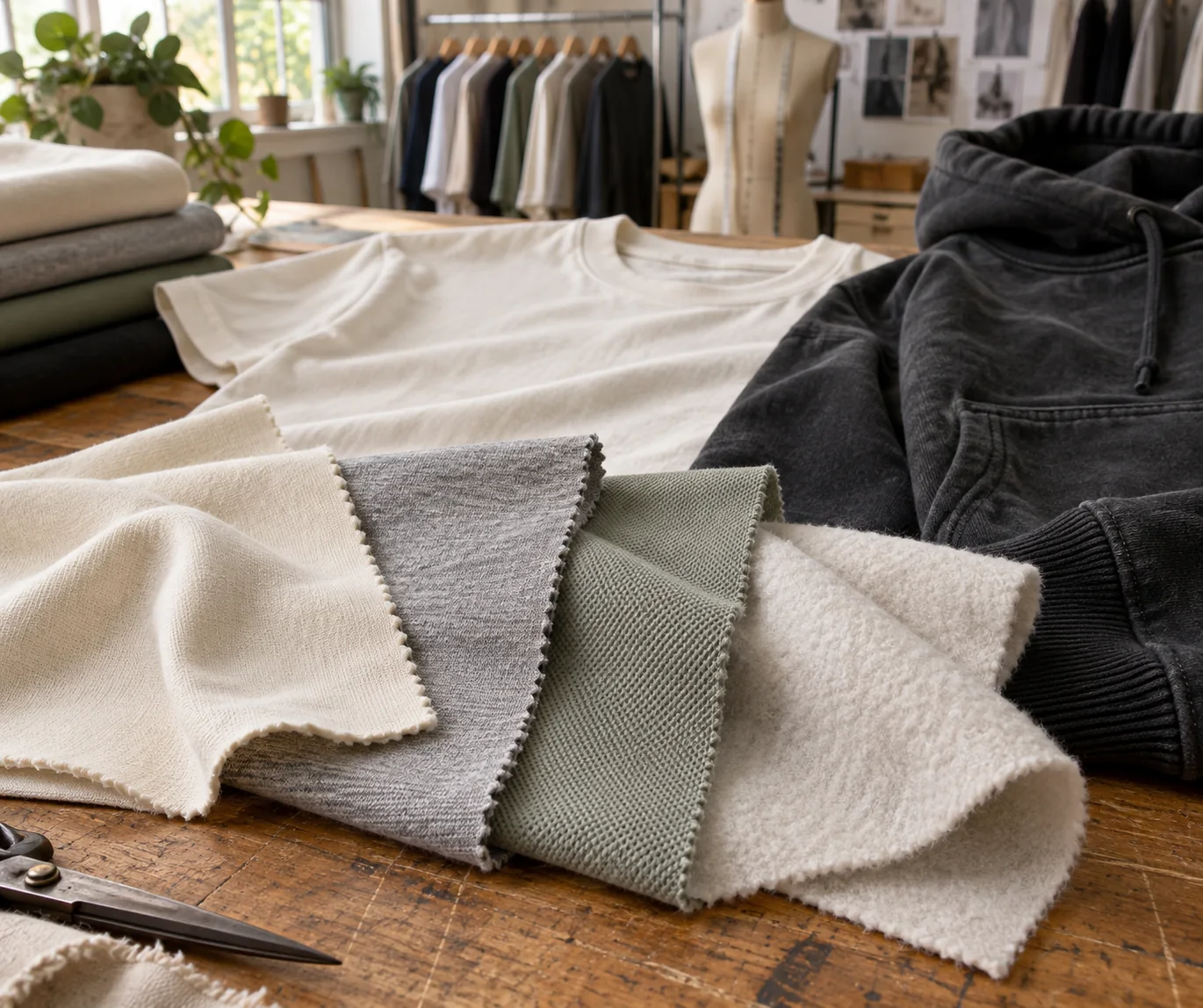
Cotton is often selected when the product needs a familiar hand, natural fiber positioning, absorbency or comfort in a lower-intensity use. It is common in T-shirts, casual tops, hoodies, sweatshirts, underwear, lifestyle joggers and cotton-rich blends. CottonWorks notes that cotton’s fiber structure supports air and moisture transfer, and its quality resources connect comfort to construction, airflow and moisture handling rather than to fiber content alone.
The main cotton tradeoff is that absorbing sweat is not the same as moving it away from the body and drying quickly. Untreated cotton can become heavier and slower to dry after it takes up liquid. It can also wrinkle, shrink or skew if the fabric and garment care route are not controlled. Those are not reasons to reject cotton. They are reasons to specify the product use and approve a finished sample.
| Cotton use case | Why a buyer may choose it | Risk to check before bulk |
|---|---|---|
| Casual T-shirt | Familiar hand, broad styling range and comfort-led positioning | Shrinkage, twist, pilling, color change and weight after laundering |
| Cotton-rich hoodie or sweatshirt | Body, warmth and a natural hand can support a heavier product | Brushing quality, pilling, lint, seam stability and drying route |
| Lifestyle jogger | Soft touch and a cotton-led appearance can fit daily wear | Knee growth, recovery, shrinkage, colorfastness and pocket loading |
| Underwear or base layer | Softness and absorbency may suit the intended comfort brief | Wet cling, drying time, stretch recovery, seam comfort and care |
| Cotton-polyester blend | Can balance hand, easy care and selected performance needs | The ratio alone does not prove the required moisture or durability result |
Engineered cotton finishes can change the usual moisture behavior. CottonWorks describes performance technologies that combine cotton comfort with moisture movement, and its liquid moisture management material emphasizes objective testing of knitted, woven and nonwoven fabrics. If a supplier proposes a treated cotton route, record the treatment, construction and post-wash claim rather than describing it simply as cotton.
What polyester does well, and where it can create risk
Polyester is often chosen when the product needs quick drying, crease resistance, color stability, abrasion resistance or repeatable synthetic performance. It is common in training tops, sports shorts, leggings, jackets, fleece, mesh, uniforms and private-label activewear programs.
Polyester is not one finished behavior. A filament jersey, textured interlock, brushed fleece, mesh and coated woven fabric can all be polyester while creating different air permeability, hand, heat retention and moisture movement. A low-absorbency fiber can still feel clammy if a dense construction holds sweat against the skin or if the finish does not spread liquid effectively.
Textile Exchange presents polyester as a durable, easy-care option that can dry quickly, while also noting sourcing and environmental questions around virgin and recycled polyester. Those points are useful for direction, not a substitute for product-specific testing or a certification claim.
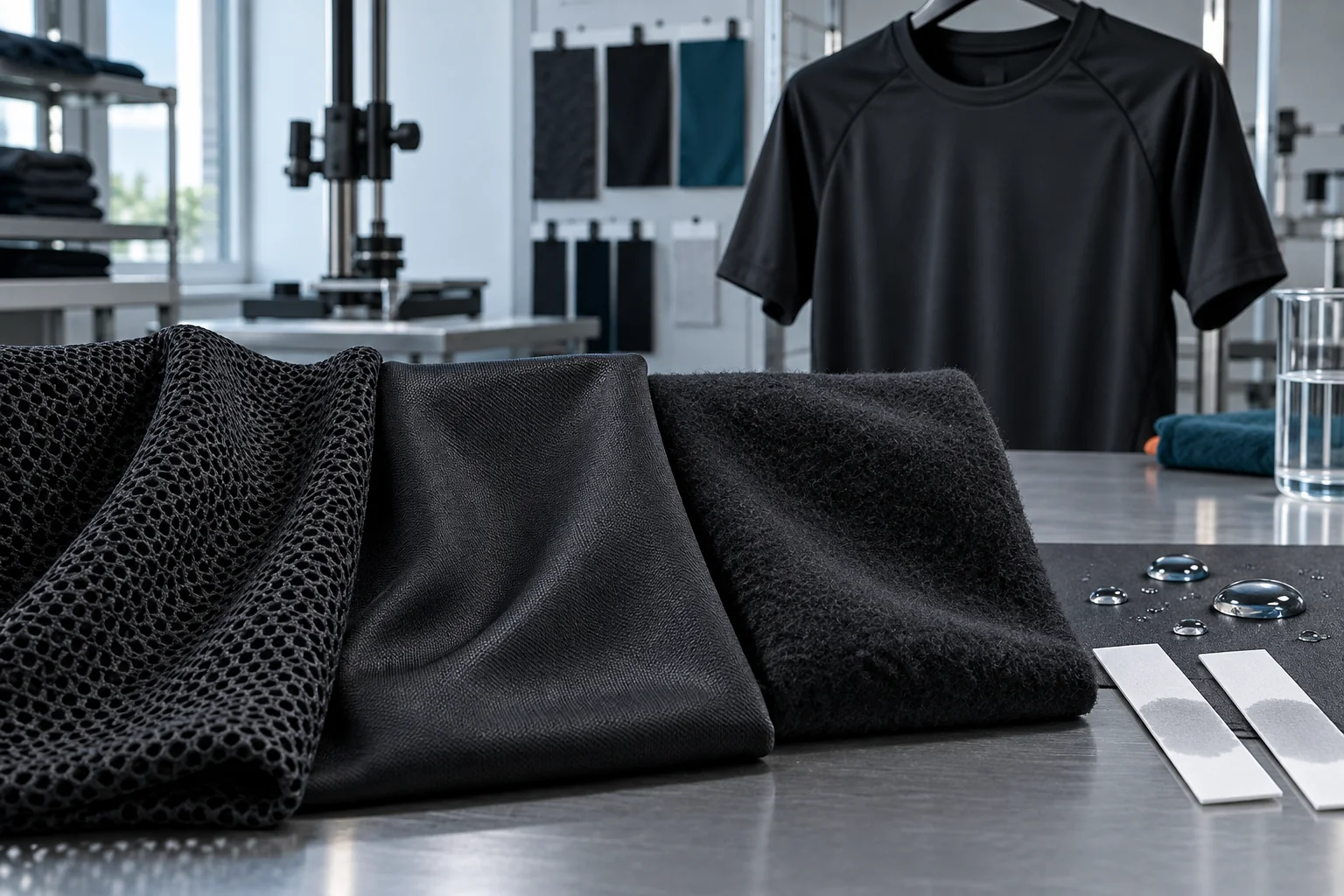
| Polyester use case | Why a buyer may choose it | Risk to check before bulk |
|---|---|---|
| Training T-shirt | Quick-dry potential, color range and easy-care route | Wicking, drying, odor retention, pilling and heat comfort |
| Running or gym short | Low moisture uptake, light weight and durable construction options | Liner comfort, opacity, abrasion, seam strength and chlorine or sweat exposure |
| Performance mesh | Airflow and low bulk can support ventilation | Snagging, transparency, print adhesion, edge stability and wash appearance |
| Brushed fleece | Warmth, color repeatability and a soft technical surface | Pilling, shedding, heat retention, weight and dimensional change |
| Recycled polyester product | Can support a documented recycled input pathway | Chain-of-custody evidence, exact claim wording, fiber content and test result |
Do not use polyester as shorthand for moisture-wicking. Wicking is a system result involving fiber, yarn, geometry, finish and test method. The liquid moisture management reference from CottonWorks explains that test results reflect fabric structure and the wicking characteristics of the fibers and yarns.
Cotton vs polyester for activewear
For activewear, polyester often has an advantage when the brief prioritizes fast drying, low moisture uptake, repeated washing and a technical hand. Cotton can be the better fit for light training, lifestyle fitness, warm-up layers, recovery products and brands whose main promise is a soft, breathable, natural-feeling garment. A cotton-polyester blend can sit between those positions, but the final ratio and construction still need testing.
The activity matters as much as the fiber. A loose cotton lifestyle tee may feel comfortable during walking but become heavy during interval training. A dense polyester tee may dry quickly but feel hot if its construction limits airflow. A lightweight polyester mesh may ventilate well but fail an opacity or snag requirement. A cotton-rich fleece may be ideal for a studio warm-up but unsuitable for a high-sweat base layer.

| Product job | Starting direction | Questions that decide the final choice |
|---|---|---|
| Low-intensity studio or lifestyle top | Cotton, cotton-rich blend or soft polyester | Does the wearer value dry hand, softness, airflow, easy care or low cling most? |
| High-sweat training top | Engineered polyester or tested performance blend | Does it move liquid, dry at the required speed and remain comfortable during repeated movement? |
| Training short | Polyester, cotton-polyester blend or selected cotton route | What are the liner, abrasion, opacity, pocket and wash requirements? |
| Warm-up jacket or streetwear layer | Cotton, polyester woven, fleece or blend | Does the product need body, wind resistance, drape, color stability or a soft hand? |
| Compression or fitted product | Tested polyester-elastane or another stretch system | What are extension, recovery, heat, seam and repeated-cycle requirements? |
| Teamwear or merch program | Cotton, polyester or blend selected by wear context | Do decoration, color repeatability, care, quantity and reorder needs change the choice? |
Use the existing fabric and trim library to frame the material conversation, but send the actual product brief before treating any material name as approved.
When cotton-polyester blends make sense
Blends can balance the hand and moisture interaction of cotton with the easy-care, strength or drying advantages associated with polyester. Common blend names such as 50/50 or 65/35 describe a ratio, but they do not identify the knit, yarn, finish, GSM or final garment behavior. A 65/35 jersey, fleece and pique can have very different results.
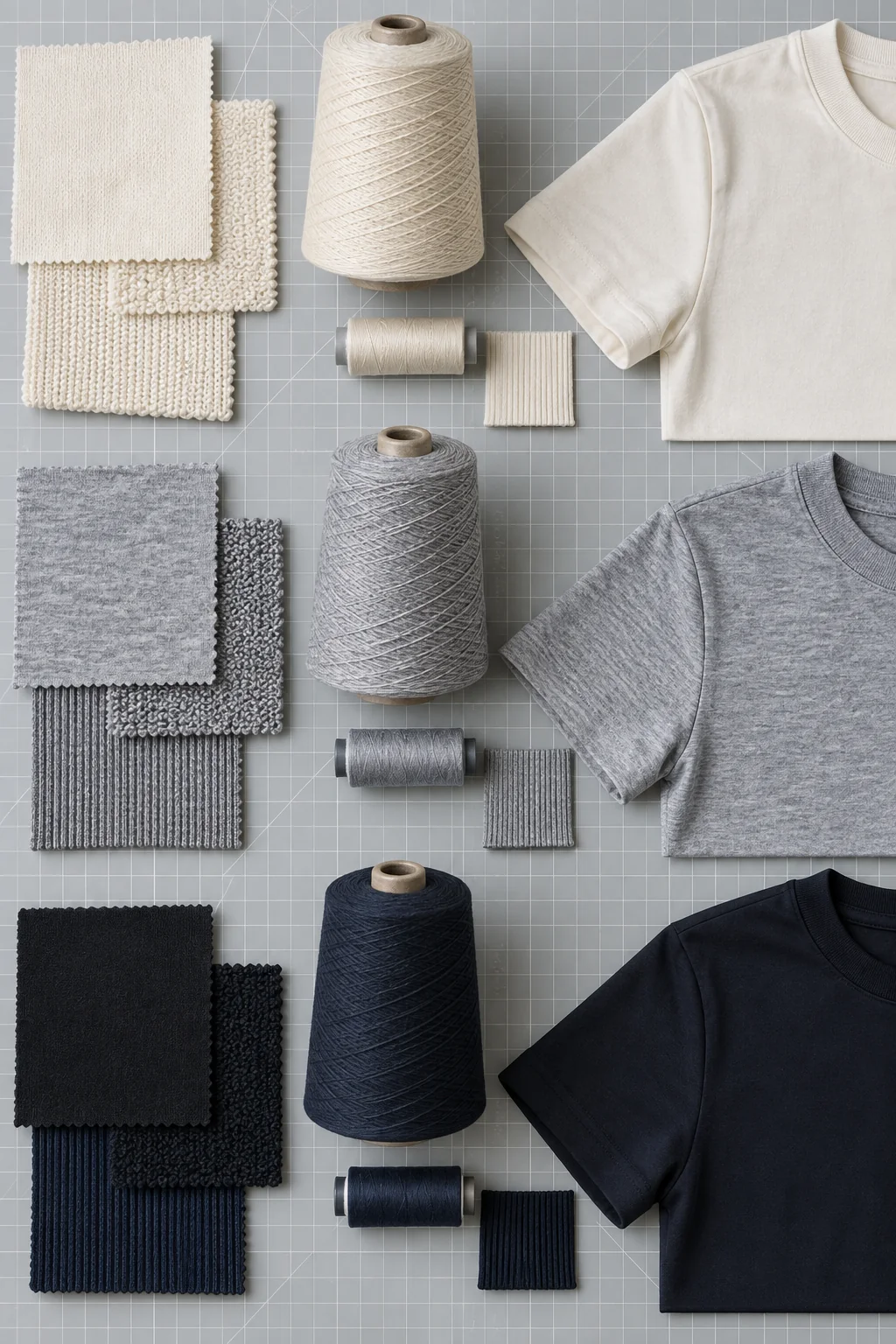
| Blend direction | Potential reason to test it | Do not assume |
|---|---|---|
| Cotton-rich | Softer hand, cotton-led appearance and absorbency potential | That it will dry like pure polyester or resist shrinkage automatically |
| Balanced blend | A middle position between hand, care and durability goals | That the ratio alone creates a balanced wearer experience |
| Polyester-rich | More technical hand, faster drying potential and stronger easy-care direction | That it will be breathable, odor resistant or comfortable without construction review |
| Blend with elastane | Added extension and recovery for a fitted or movement-led product | That recovery remains stable after heat, washing and repeated cycles |
For a private-label program, a blend may be useful when the brand needs one material family across several product categories. Keep the approved ratio, yarn route, GSM, finish, shade standard and care result in the same material record so a reorder does not silently change the product.
Cotton or polyester for shirts, shorts, joggers and hoodies
Application changes the decision. The best fabric for a T-shirt is not automatically the best fabric for a short or hoodie because the garment introduces different loads, contact areas and care risks.
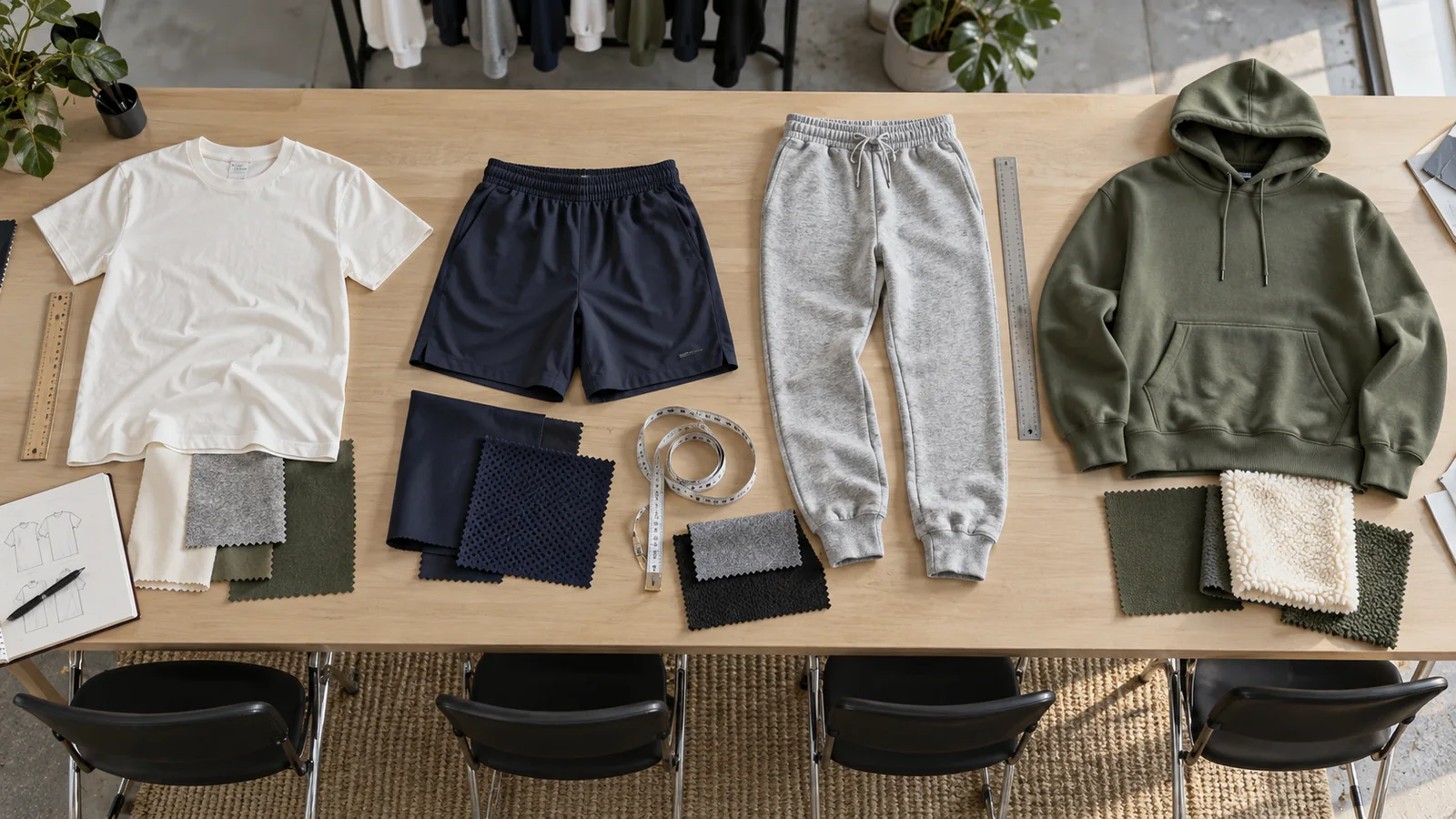
| Garment | Cotton may fit when | Polyester may fit when | Approval focus |
|---|---|---|---|
| T-shirt | Soft hand, casual comfort and a cotton-led story matter | Quick dry, color repeatability and active use matter | GSM, air permeability, shrinkage, twisting, pilling and print |
| Training short | A cotton or cotton-rich lifestyle short is intended | Sweat, abrasion and rapid care are central | Liner, opacity, pocket, seam, abrasion and drying |
| Jogger | Softness, body and a natural casual hand lead | Easy care, color stability or lighter technical construction lead | Knee growth, recovery, pilling, pocket loading and wash |
| Hoodie | Warmth, body and brushed cotton feel are central | Lightweight warmth, color repeatability or quick care matter | Brushing, pilling, lint, weight, shrinkage and hardware |
| Tank top | Soft casual or gym-lifestyle positioning is intended | Quick-dry training or low-bulk performance is intended | Armhole comfort, stretch, opacity, wicking and decoration |
This is a starting map, not a product promise. A supplier should confirm the exact material and sample against the design, target wearer and destination market.
Which fabric is cooler, quicker drying or easier to care for?
The short answer is conditional. Cotton can feel cooler and more breathable in an open, lightweight construction, but it can hold more liquid after heavy sweating. Polyester can dry faster and retain shape well, but a dense or poorly engineered fabric can feel warm or clammy. Neither outcome can be guaranteed from the fiber label alone.
| Performance question | Cotton direction | Polyester direction | Better buyer question |
|---|---|---|---|
| Cooler in dry heat | Often comfortable in a light, open, breathable construction | Can work when lightweight, porous and engineered for airflow | What are the air permeability, fit and fabric weight? |
| Handles heavy sweat | Can absorb quickly but may become wet and heavy | Often supports faster spreading and drying when engineered correctly | What are absorbency, wicking and dry-time results? |
| Resists wrinkles | Usually needs construction or finish support | Often has stronger crease resistance | What appearance rating is required after care? |
| Easy to wash and dry | Care depends on shrinkage, color and finish | Often dries quickly, but heat can be a risk | What wash, dry and pressing route is approved? |
| Feels comfortable | Often soft and familiar | Can be smooth, crisp, brushed or technical | What hand, seam, fit and wearer trial are approved? |
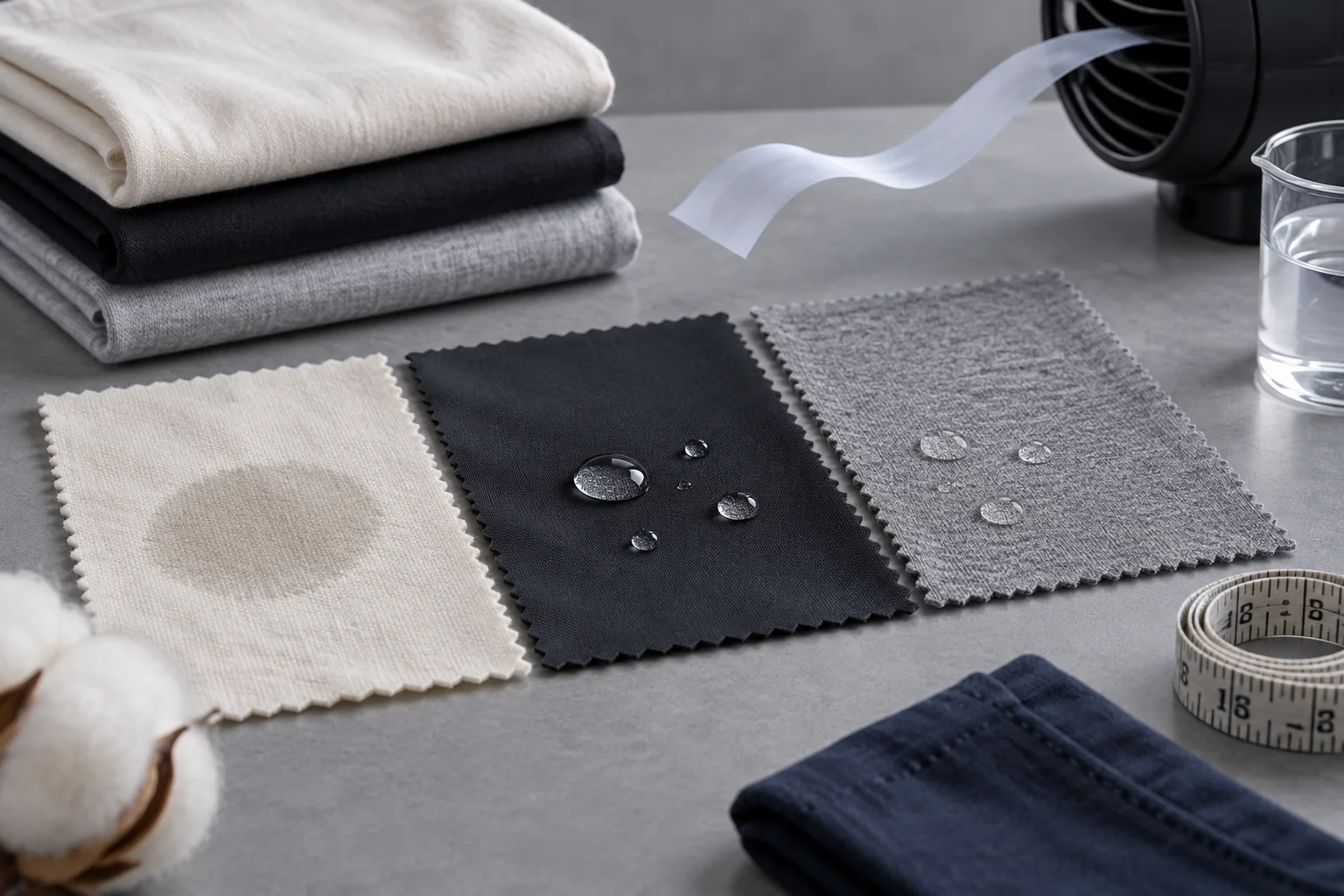
CottonWorks quality guidance groups air permeability, moisture handling and drying speed as separate quality questions. Use the fabric types and buyer specifications guide when the project needs a broader comparison across fibers, constructions and finishes.
How should a buyer specify cotton or polyester fabric?
The inquiry should state the garment, wearer, use conditions and acceptance evidence before asking for a price. A clear material brief reduces the chance that two suppliers quote different constructions under the same word.
| Tech pack field | What to write | Why it matters |
|---|---|---|
| Fiber and ratio | Cotton, polyester, blend percentage and any recycled input requirement | Controls labeling, material direction and claim review |
| Construction | Single jersey, interlock, pique, fleece, mesh, woven or another named route | Controls stretch, airflow, coverage, hand and stability |
| Finished GSM | Target weight and acceptable tolerance | Supports yield, opacity, drape, warmth and cost comparison |
| Yarn and surface | Spun or filament direction, count if known, brushing, texture or sheen | Helps reproduce hand, surface and print behavior |
| Width and stretch | Usable width, stretch direction, extension and recovery | Connects fabric to marker planning, fit and movement |
| Finish | Wicking, softener, anti-pilling, brushing, coating, water repellency or none | A finish can change care, comfort and performance |
| Color and decoration | Shade standard, dye route, print, embroidery, heat transfer or wash | Color and decoration can change hand, crocking and durability |
| Care and market | Wash, dry, pressing route, labeling market and compliance needs | Approval must match the finished garment and destination |
| Sample evidence | Swatch ID, sewn sample, test method, tolerance and approval owner | Prevents a material substitution during bulk or reorder |

For United States apparel labeling, the FTC Textile Fiber Rule requires applicable textile products to disclose generic fiber names and percentages by weight, along with other required information. Check the destination market and final product construction before approving label copy.
How should cotton and polyester be tested before bulk?
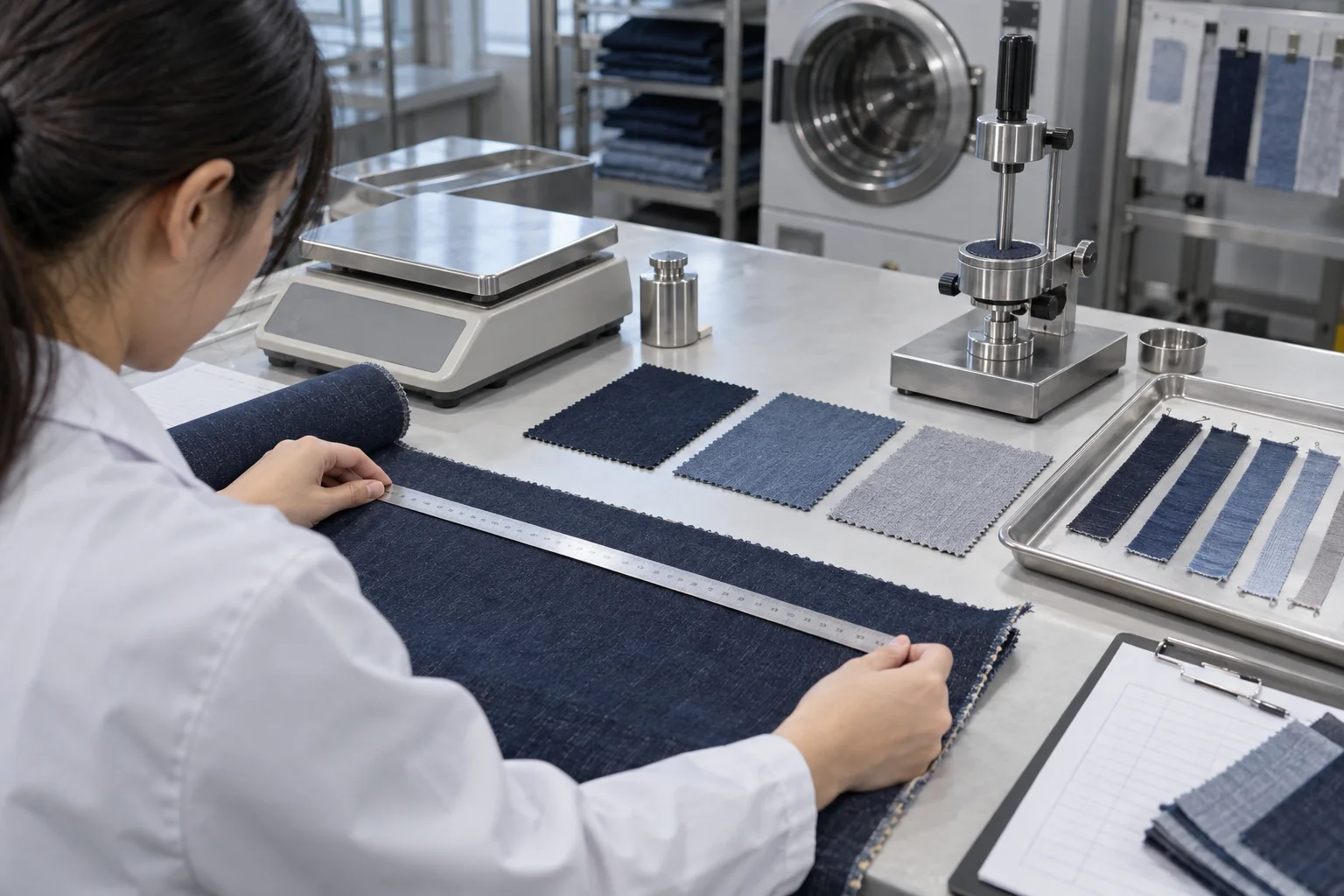
Test the failure modes the customer will notice. A basic material screen can include mass per unit area, usable width, dimensional change, colorfastness, pilling, abrasion, seam behavior, air permeability and moisture management. The final set depends on the product job.
| Test area | Buyer question | Evidence to keep |
|---|---|---|
| Mass per unit area | Is the fabric within the approved weight range? | Method, conditioning, locations, readings and tolerance |
| Width and construction | Can the pattern and marker use the material consistently? | Usable width, edge condition, face direction and construction record |
| Dimensional change | How do length and width change after the planned care route? | Before and after measurements, wash route and garment impact |
| Moisture management | Does the material absorb, move and release liquid as required? | Method, specimen conditioning, results and acceptance limit |
| Air permeability | Does the fabric allow enough airflow for the product job? | Test method, construction, finish and target range |
| Pilling and abrasion | Will the surface remain acceptable under use? | Cycles, specimen photos, rating scale and failure rule |
| Color and crocking | Will shade transfer or change during wear and care? | Shade standard, rubbing or wash result and lot record |
| Finished garment trial | Does the material work with seams, fit, decoration and movement? | Sewn sample, wearer or movement trial, comments and approval status |
ASTM D3776 provides test methods for mass per unit area, while AATCC TM135 addresses dimensional changes after home laundering. CottonWorks also points to AATCC moisture management methods for objective testing of fabric liquid behavior. The standard name is not a pass result. Record the method, specimen, conditioning, cycle, rating and acceptance limit with the sample.
How should recycled polyester and sustainability claims be handled?
Cotton and polyester should not be compared with a single broad sustainability slogan. Fiber origin, farming or feedstock, energy, water, chemistry, finishing, transport, use phase, durability and end of life all change the result. Textile Exchange warns that life-cycle data across different fiber categories are not always directly comparable because scopes and assumptions can differ.
For recycled polyester, ask for the exact fiber percentage, source claim, chain-of-custody evidence and applicable certification scope. For cotton, record the exact cotton claim and supporting documentation rather than using words such as sustainable or eco-friendly without proof. If the project needs a certification or market claim, make it a documented requirement in the tech pack and verify the certificate against the actual supplier and product scope.

How should cotton or polyester be approved in sampling and bulk?
Use the same approval path for both fibers. The material decision is not complete when a swatch looks attractive. It is complete when the buyer can connect the approved fiber, construction, weight, finish, sample, care route and bulk inspection rule.
- Define the garment job, wearer, activity, climate, fit and decoration.
- Request cotton, polyester and blend options that meet the same target construction and weight range.
- Record fiber content, yarn, knit or woven route, GSM, usable width, stretch, finish and shade.
- Compare swatches under the agreed light and review hand, opacity, airflow, surface and reverse.
- Test the material and sewn sample against the product risks, including wash and movement.
- Lock the approved sample ID, tolerances, care instructions, label wording and bulk inspection points.

When the project is ready, use the tech pack customization service to connect the material decision to measurements, decoration, labels, packaging and sampling. For confidential artwork or an early concept, the inquiry and NDA path is the appropriate starting point.
Choose the fiber after the garment job is clear
Choose cotton when the brief prioritizes a natural hand, absorbency, familiar comfort or a cotton-led product story and the care or dry-time limits are acceptable. Choose polyester when quick drying, crease resistance, repeatable color, durability or a technical performance direction matters and the construction supports comfort. Choose a blend when a controlled middle position is useful, then test the actual ratio and construction rather than assuming the blend will solve every tradeoff.
Send a fabric brief with the product type, target wearer, activity, fiber direction, blend percentage, construction, GSM, usable width, stretch, finish, color, decoration, care route, quantity and required evidence.
Frequently asked questions
Neither is universally better. Cotton often suits comfort-led, casual and lower-intensity products, while polyester often suits quick-dry, easy-care and repeated-use products. The correct choice depends on construction, weight, finish, fit and the acceptance tests for the garment.
For high-sweat gym clothing, an engineered polyester or tested performance blend is often the stronger starting direction because drying and moisture movement matter. Cotton can suit lighter training, lifestyle fitness and comfort-led products. Approve the finished fabric and garment rather than selecting only from the fiber name.
Polyester can support strong wicking and drying when the yarn, geometry and finish are designed for moisture movement. Untreated cotton commonly absorbs more liquid and may dry more slowly. A fabric test is needed because fiber content alone does not prove a wicking result.
Cotton can feel breathable in a lightweight, open construction. Polyester can also be engineered for airflow through mesh, yarn and knit design. Compare air permeability, GSM, fit and finish rather than treating fiber as the only control.
Polyester often resists wrinkles and dries quickly, but high heat can damage some synthetic fabrics or finishes. Cotton may need closer control of shrinkage, wrinkles, color and shape. The care label should follow the tested finished garment.
They can be useful when a buyer wants to balance hand, care, durability or cost direction. The ratio does not guarantee a specific result. Record the exact ratio, construction, GSM, finish and test performance before approval.
No. A 100% polyester fabric can be dense, brushed, smooth, open, coated or poorly suited to the intended activity. Performance depends on construction, yarn, finish, garment design and evidence such as moisture, airflow, durability and care results.
Send the garment type, target wearer, activity, climate, reference image or tech pack, fiber direction, target GSM, construction, width, stretch, color, finish, decoration, care route, quantity and required tests. A clear brief allows the supplier to propose a sample that can be judged against the real product job.