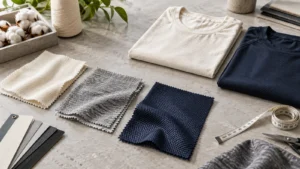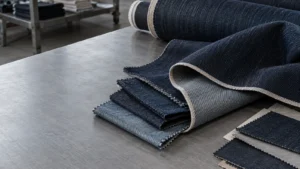
If you are asking what is denim fabric, the practical answer is that denim is a woven fabric family usually recognized by a warp-faced twill construction, a colored warp and a contrasting filling yarn. Traditional indigo denim is commonly made with blue warp yarns and a lighter or white filling yarn, but the word denim alone does not tell a buyer the fiber ratio, finished weight, stretch, wash, width or performance result.
That missing detail is where most sourcing mistakes begin. A lightweight denim shirt, rigid workwear jean, stretch cargo short and washed streetwear jacket may all be called denim while requiring different yarns, construction, finishing, seam plans and acceptance tests.
This guide explains how denim is built, how weight and wash change the garment, when denim works for activewear or streetwear, and what to write into a fabric brief before sampling. The goal is not to choose the heaviest cloth. It is to match the denim route to the product job and then approve the result with evidence.
What is denim fabric?
Denim is a woven textile with a characteristic twill surface. In the traditional route, the warp yarns are dyed before weaving and the filling yarn is kept lighter, which creates the familiar blue face and paler reverse. CottonWorks describes denim as a popular cotton fabric normally made with a 2 x 1 or 3 x 1 twill construction. That is a useful starting definition, not a complete purchase specification.
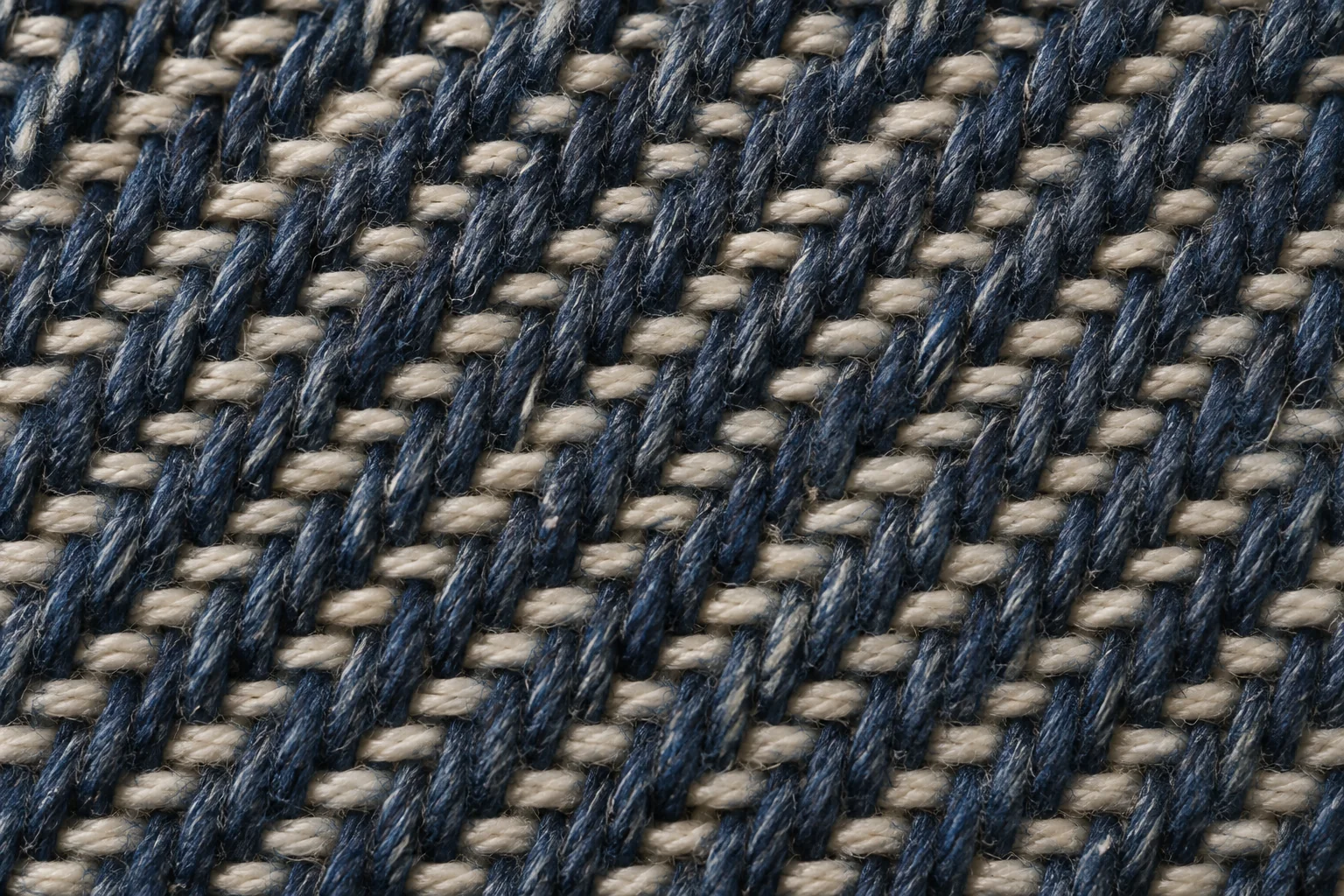
The word denim describes a combination of appearance and construction. It does not prove that the fabric is 100 percent cotton, rigid, heavy, breathable, stretchable, pre-shrunk or suitable for a particular sport. A supplier quotation should add the material, target weight, width, stretch route, shade, finish and end use.
| Term on a buyer document | What it identifies | What it does not prove |
|---|---|---|
| Denim fabric | A denim construction and appearance route, usually a warp-faced twill | Exact fiber content, weight, width, stretch or wash result |
| Indigo denim | A denim route using indigo-colored yarns, normally in the warp | Shade fastness, number of dye dips, wash recipe or color transfer result |
| Raw or dry denim | Denim supplied with limited wash-down or garment-aging treatment | That the fabric has zero shrinkage or one fixed stiffness |
| Stretch denim | Denim with a stretch fiber or stretch yarn system | Stretch direction, force, recovery or long-term size retention |
| Washed denim | Denim or denim garments treated to change hand, shade or surface appearance | The exact wash chemicals, abrasion level, shade tolerance or care result |
| Denim look fabric | A fabric designed to resemble a denim appearance | That it uses a denim construction, indigo yarn route or denim performance profile |
For a custom order, write the construction beside the fiber and end use. Cotton-rich 3 x 1 stretch denim, target GSM, usable width, medium indigo, garment-washed, for relaxed cargo shorts is far more useful than blue denim fabric.
How is denim constructed?
Woven fabric uses two yarn directions. Warp yarns run along the length of the roll, while filling or weft yarns cross the width. A denim twill gives the warp a stronger presence on the face, so the dyed warp dominates the visible color. The diagonal line comes from the repeating interlacing order rather than from a print.
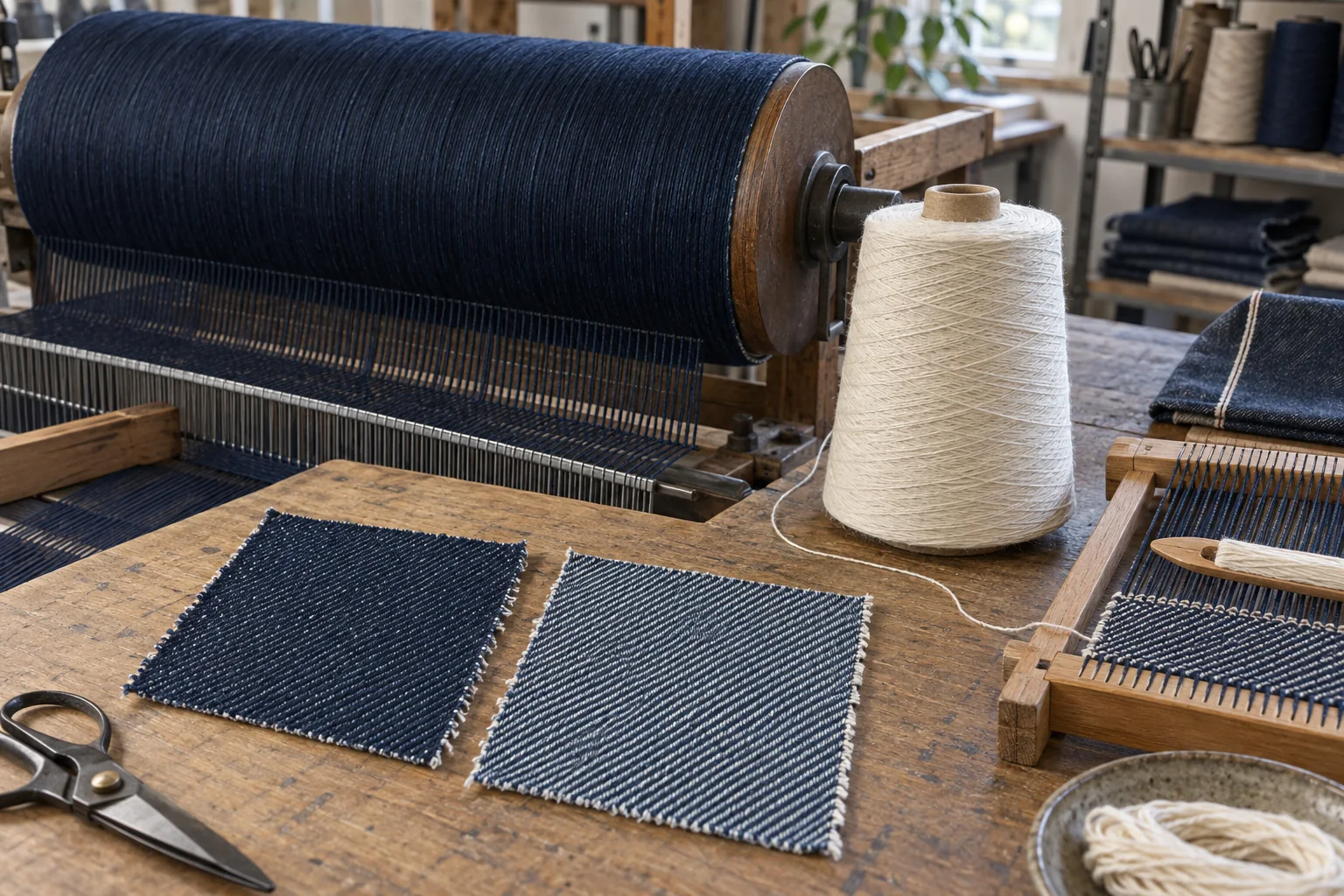
CottonWorks groups common denim designs into 3 x 1, 2 x 1, 2 x 2 and broken-twill routes. In a 3 x 1 construction, the warp is visible across three interlacings before it goes under one filling position in the repeat. A 2 x 1 route can produce a lighter or more flexible fabric, but the actual result still depends on yarn size, density, finishing and fabric weight.
The construction changes several buyer-facing outcomes at once:
- A tighter or heavier construction can add body, coverage and resistance to wear, but may increase sewing force and garment weight.
- A lighter construction can improve drape and comfort for shirts or overshirts, but may need more attention to opacity, seam support and abrasion.
- A broken twill changes the visual direction of the diagonal line and can alter the look of fading after washing.
- A warp and filling color contrast influences the face, reverse, worn-in effect and the appearance of cut edges.
- Ring-spun, open-end and blended yarn routes can create different surface character and hand even when the weave notation is the same.
| Construction field | What it controls | Buyer check before approval |
|---|---|---|
| Twill repeat | The relationship between warp and filling interlacings | Confirm the stated construction on the supplier swatch or technical sheet |
| Warp color | Dominant face shade and the way fading may become visible | Approve shade under the intended light and record the color reference |
| Filling color | Reverse appearance, contrast and inside-garment visual effect | Photograph both sides and confirm whether the reverse is acceptable |
| Yarn route | Surface character, strength potential, softness and price basis | Record yarn type, count system and any blend or recycled content claim |
| Fabric density | Coverage, body, hand, weight and marker behavior | Check full-width construction, not only a small attractive swatch |
| Direction of twill | Face direction, cutting appearance and panel matching | Mark the face direction if the garment needs consistent placement |
Denim quality cannot be judged from the diagonal line alone. A sample should be opened, measured, sewn and washed through the route planned for the finished garment.
How do denim weights change the product?
Denim is commonly described in ounces per square yard, while many apparel teams work in GSM. CottonWorks notes a broad finished denim range from about 3.5 to 16.5 ounces per square yard, with lighter cloth used for tops and heavier cloth often used for trousers, jeans and jackets. Those bands are useful for planning, but a buyer should still specify a target and tolerance instead of treating a weight label as a guarantee.
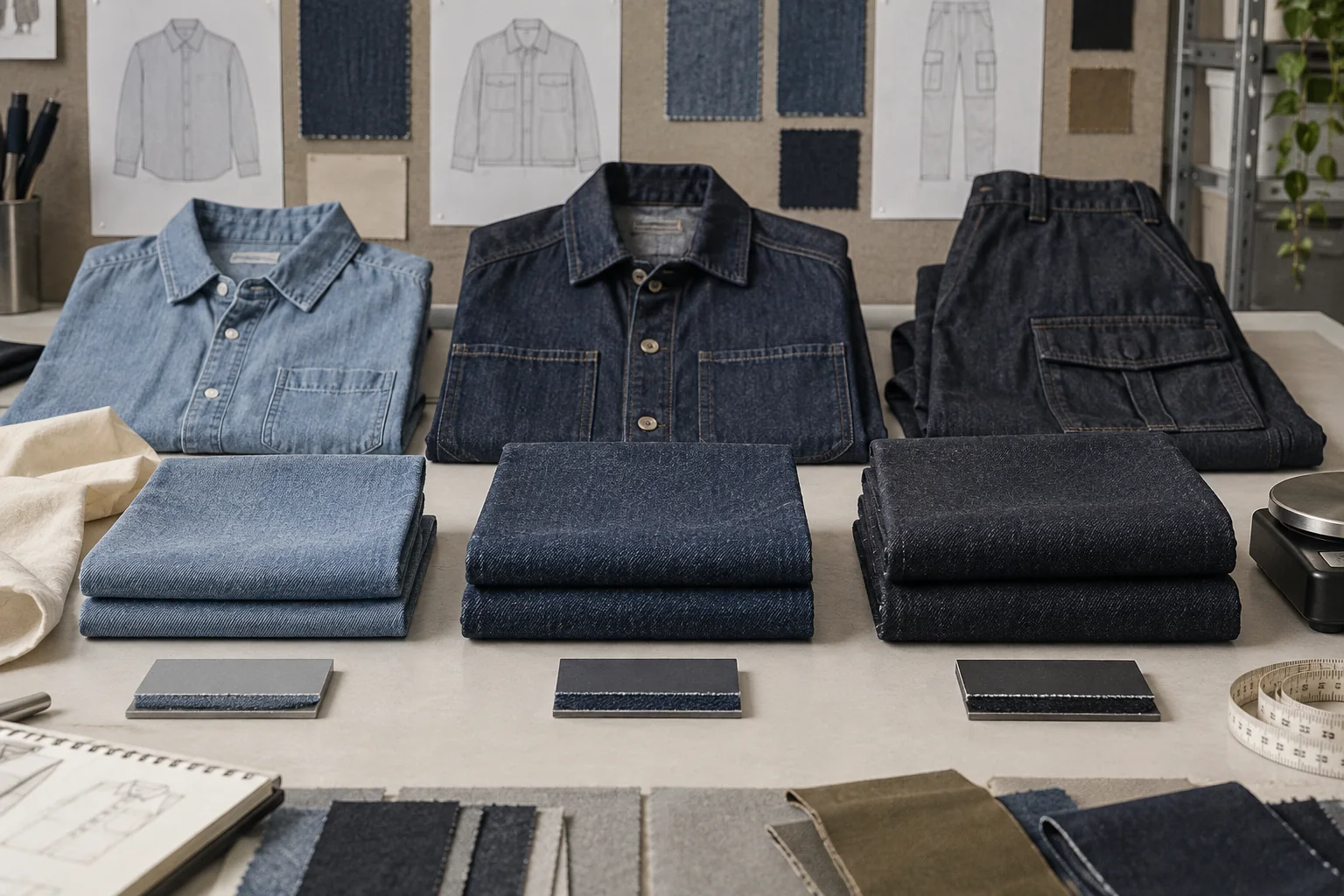
Weight changes the whole product experience. It affects how a pocket hangs, how a waistband behaves, how much heat the wearer feels, how much thread and needle force a factory needs, and how much space the finished garment takes in packing. It also interacts with wash. A soft washed heavy denim and an unwashed heavy denim may have very different hands even when their measured weights are close.
| Approximate route | Common product direction | Main buyer question |
|---|---|---|
| Light denim | Shirts, tops, overshirts, lightweight skirts and relaxed layers | Does it provide enough coverage after washing and under the intended light? |
| Midweight denim | Everyday trousers, cargo shorts, jackets and structured streetwear | Is the hand firm enough for shape without making the garment uncomfortable? |
| Heavy denim | Workwear trousers, rigid jeans, jackets and utility products | Can the sewing line handle the thickness at seams, pockets and belt loops? |
| Stretch denim at any weight | Fitted jeans, movement-led shorts and selected fashion bottoms | What are the extension, force and recovery results after repeated wear? |
| Washed denim at any weight | Products where softness, fading or a worn surface is part of the design | Will the wash result, shade and dimensional change stay within the approved range? |
Use both weight systems when the supply chain crosses markets. A conversion is only a reference because conditioning, selvage inclusion and the test method can change the reported result. If the number will affect costing or fit, agree the method and specimen basis before comparing suppliers.
Which fibers and yarns can be used in denim?
Cotton remains the reference fiber for traditional denim, but modern denim programs may use cotton blends, stretch fibers, regenerated fibers or other yarn choices. CottonWorks explains that denim warp yarns may be ring-spun or open-end, and that the warp and filling can use different spinning combinations. The buyer should ask what the fiber and yarn route is intended to do rather than assuming a named blend has one universal performance profile.
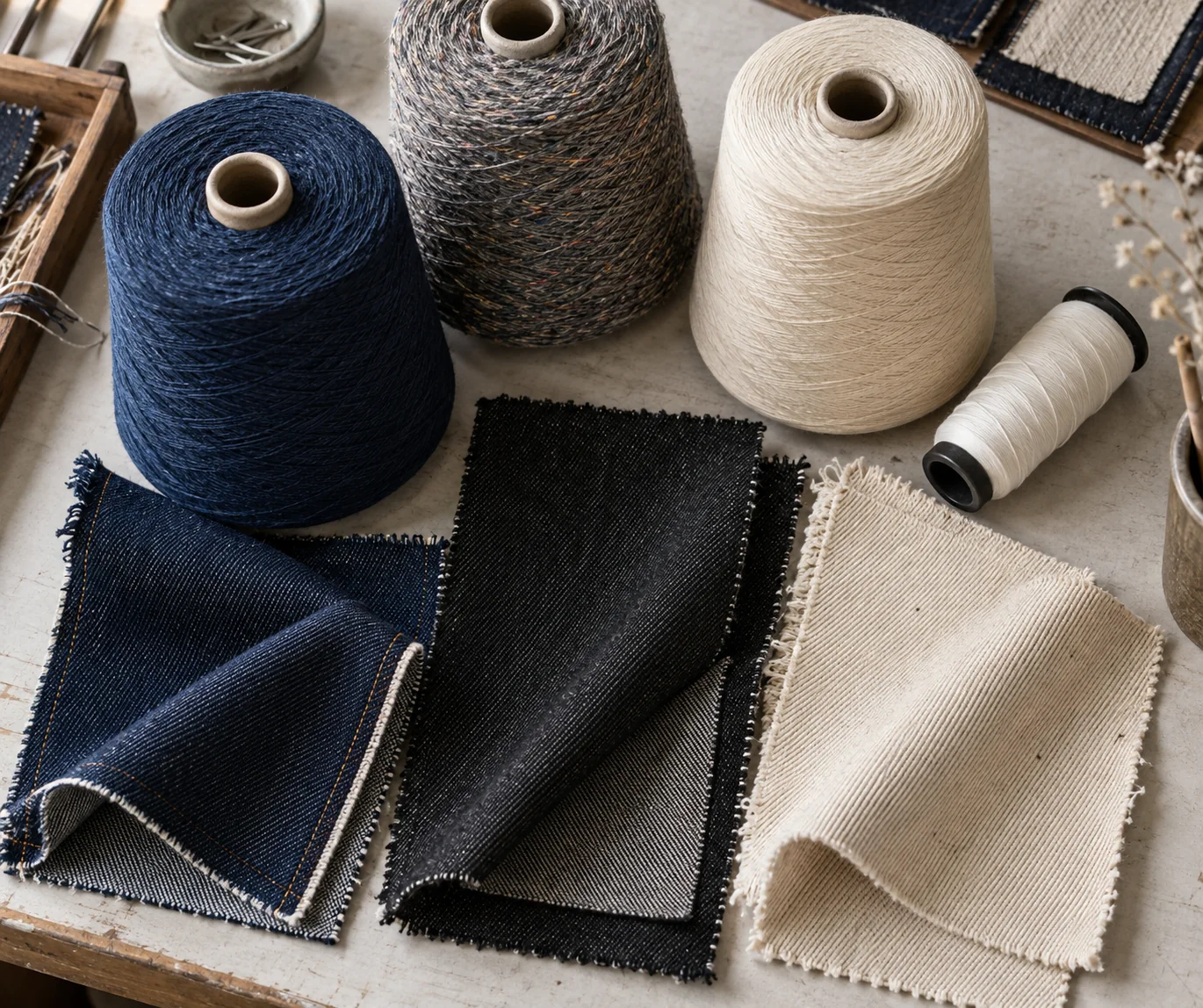
| Fiber or yarn direction | Why it may be considered | What must be verified |
|---|---|---|
| 100 percent cotton | Familiar denim hand, natural fiber content and a wide range of weights and washes | Shrinkage, comfort, shade change, care route and the final label declaration |
| Cotton and polyester blend | Can change durability, drying behavior, cost and dimensional response | Exact ratio, pilling, heat response, recycling claim and shade behavior |
| Cotton with elastane | Adds extension for fitted bottoms or movement-led products | Stretch direction, force, recovery after repeated cycles and heat exposure |
| Cotton with regenerated fiber | Can alter softness, drape and hand for lighter or fashion-led denim | Fiber declaration, wet behavior, dimensional change and wash stability |
| Ring-spun yarn route | May create a distinctive surface character and hand | Yarn count, strength data, lot consistency and cost basis |
| Open-end or rotor yarn route | Can support a different price and surface strategy for selected denim | Surface uniformity, strength, hairiness and the approved swatch reference |
If the marketing brief uses words such as soft, durable, comfortable or sustainable, translate each word into a measurable or inspectable requirement. Fiber content and yarn route are inputs. They are not a substitute for finished-garment tests.
Denim vs twill, canvas, chambray and other woven fabrics
Denim is a type of twill, but not every twill is denim. Canvas or cotton duck may be a sturdy plain-weave fabric with a different surface and flex behavior. Chambray can resemble denim in color contrast but commonly uses a plain weave, so it should not be specified as denim unless the construction and appearance are intentionally confirmed.
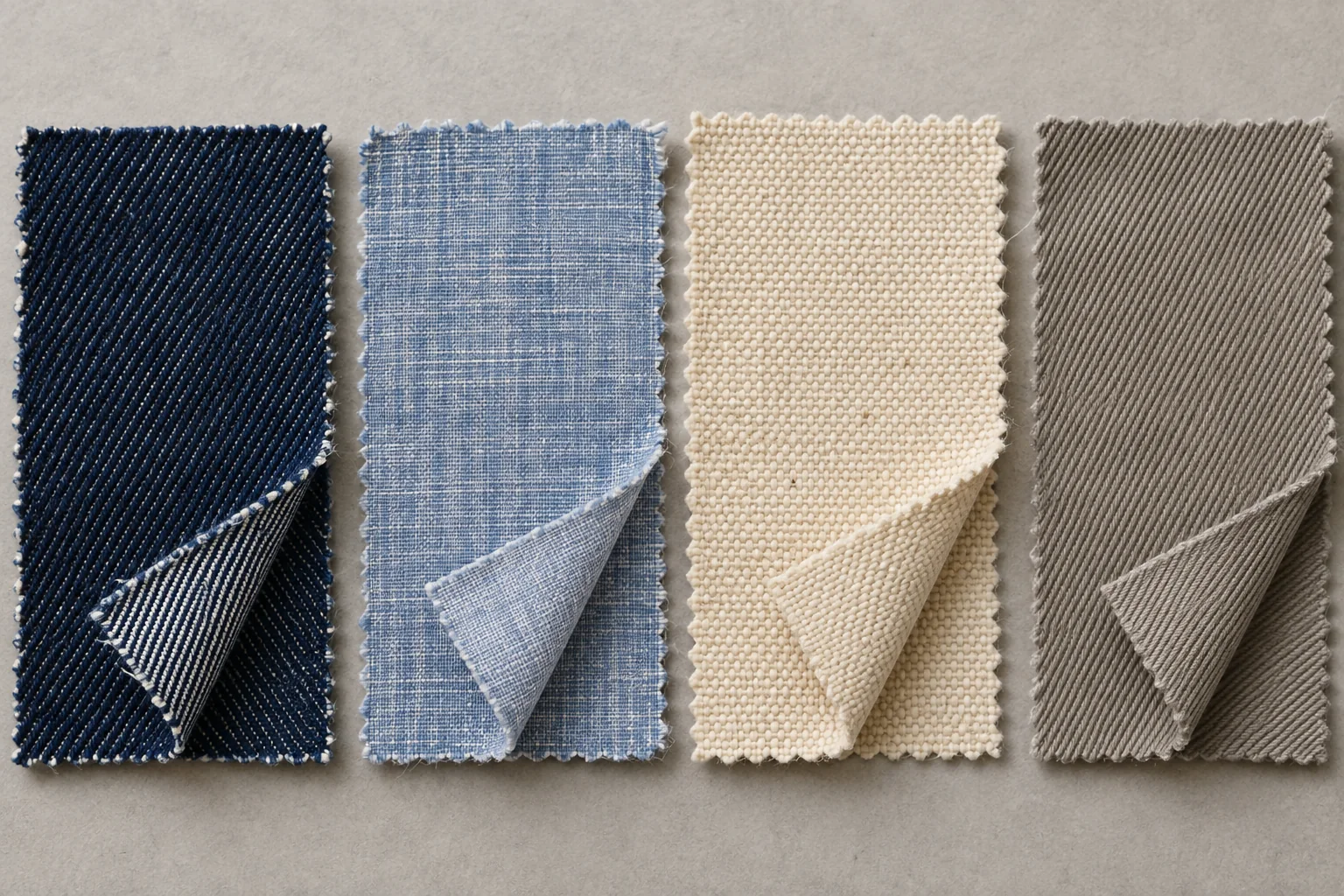
The right comparison is based on the garment risk. A product that needs a denim fade may need a specific warp-dye and wash route. A product that only needs a blue woven appearance may be better served by a lighter plain weave or another twill. Comparing the names without comparing construction can lead to the wrong hand, weight and care result.
| Fabric route | Surface or structure clue | When it may fit | Risk if the name is used loosely |
|---|---|---|---|
| Denim | Warp-faced twill, often with a colored warp and lighter filling | Jeans, jackets, cargo products, shirts and streetwear layers | A generic denim label can hide large differences in weight, wash and stretch |
| Other twill | Diagonal surface with many possible fiber and repeat combinations | Trousers, uniforms, overshirts and structured apparel | A twill may not develop the expected denim face or fade |
| Canvas or cotton duck | More even plain-weave appearance and firm body | Utility bags, workwear, outer layers and structured products | It may feel too rigid or lack the denim color contrast and aging effect |
| Chambray | Often a lighter plain weave with colored warp and lighter filling | Shirts, summer layers and soft casual garments | The color contrast can look denim-like while the construction behaves differently |
| Denim-look knit | Knit construction with a denim-like print or surface | Lightweight fashion or comfort-led products | Stretch, recovery, seam and care behavior may be closer to knitwear than denim |
When the garment depends on the diagonal structure, the reverse color, or a particular fade pattern, request a construction record and a physical swatch. A product photo is not enough evidence.
Where is denim used in apparel?
Denim is most familiar in jeans, but the same material family can support shirts, overshirts, jackets, skirts, shorts, cargo bottoms, hats, bags and selected accessories. The correct weight and finish depend on the silhouette, movement, climate, pocket loading and desired aging effect.
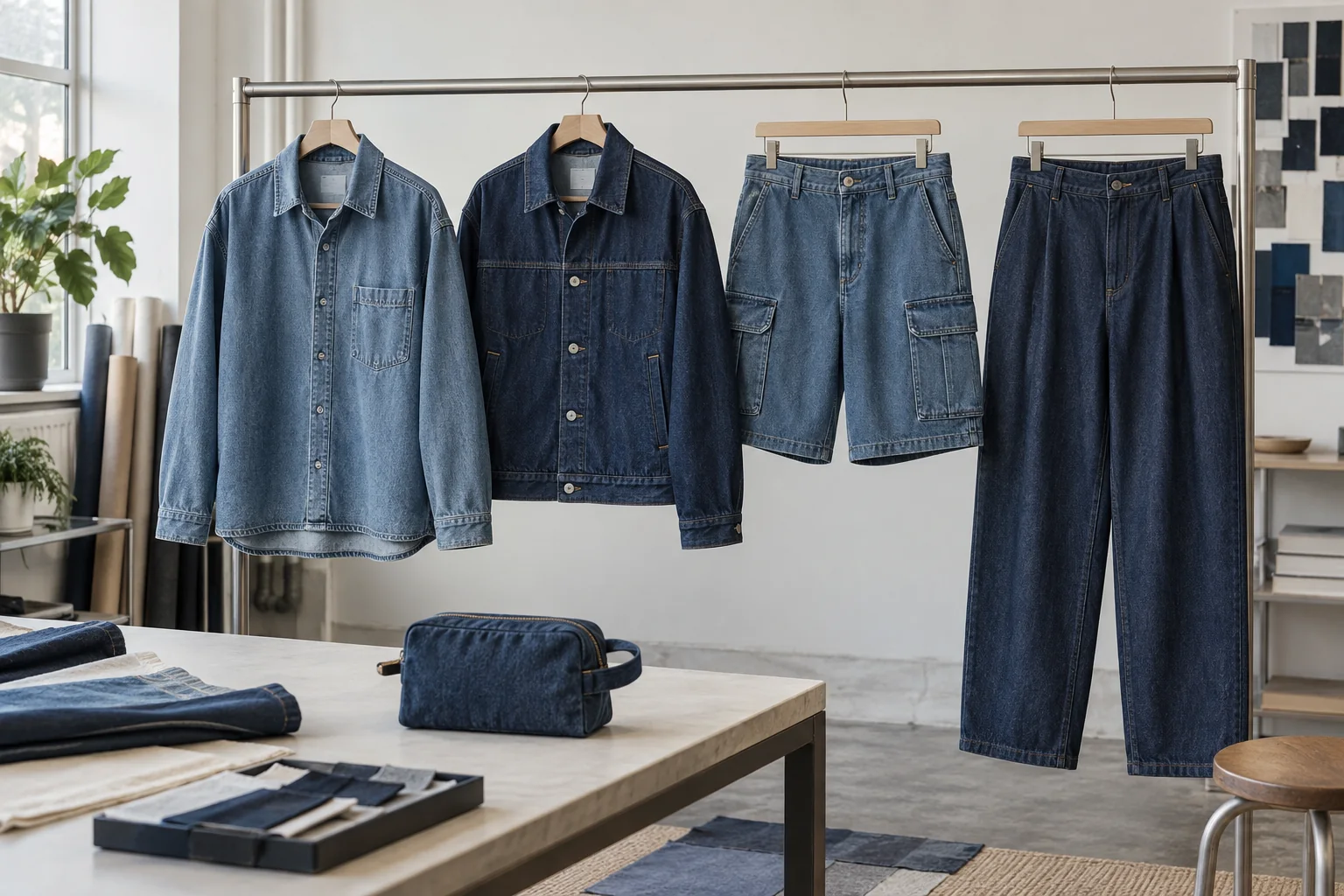
| Apparel direction | Why denim may fit | What the development sample must prove |
|---|---|---|
| Jeans or structured trousers | Twill body can support a stable silhouette and visible aging | Fit after wash, waistband stability, pocket strain, seam bulk and shade matching |
| Cargo shorts or utility bottoms | Weight and surface can support pockets, panels and streetwear styling | Pocket loading, bartack placement, range of motion and finished weight |
| Overshirt or light jacket | Lighter denim can provide structure without a heavy outerwear feel | Drape, collar roll, sleeve movement, opacity and shrinkage |
| Denim jacket | Mid to heavy routes can support shape and visible texture | Arm mobility, seam thickness, hardware interaction and wash consistency |
| Skirt or relaxed fashion bottom | Wash effects and a clear face can carry the design | Bias areas, hem behavior, color transfer, care and size stability |
| Accessory or panel detail | A small denim area can add contrast and a recognizable surface | Edge fray, seam reinforcement, bonding, abrasion and shade matching |
For a B2B program, define whether the denim is fabric-dyed, yarn-dyed, garment-washed, coated, printed, brushed, sanded or left close to its development state. Each choice changes the approval sample and the production risk.
Is denim suitable for activewear or streetwear?
Denim can work well for streetwear, lifestyle layers, warm-up pieces, cargo products and fashion-led training looks. It is not the default choice for a high-sweat base layer. A woven denim usually has a different moisture, airflow, stretch and friction profile from a performance knit.
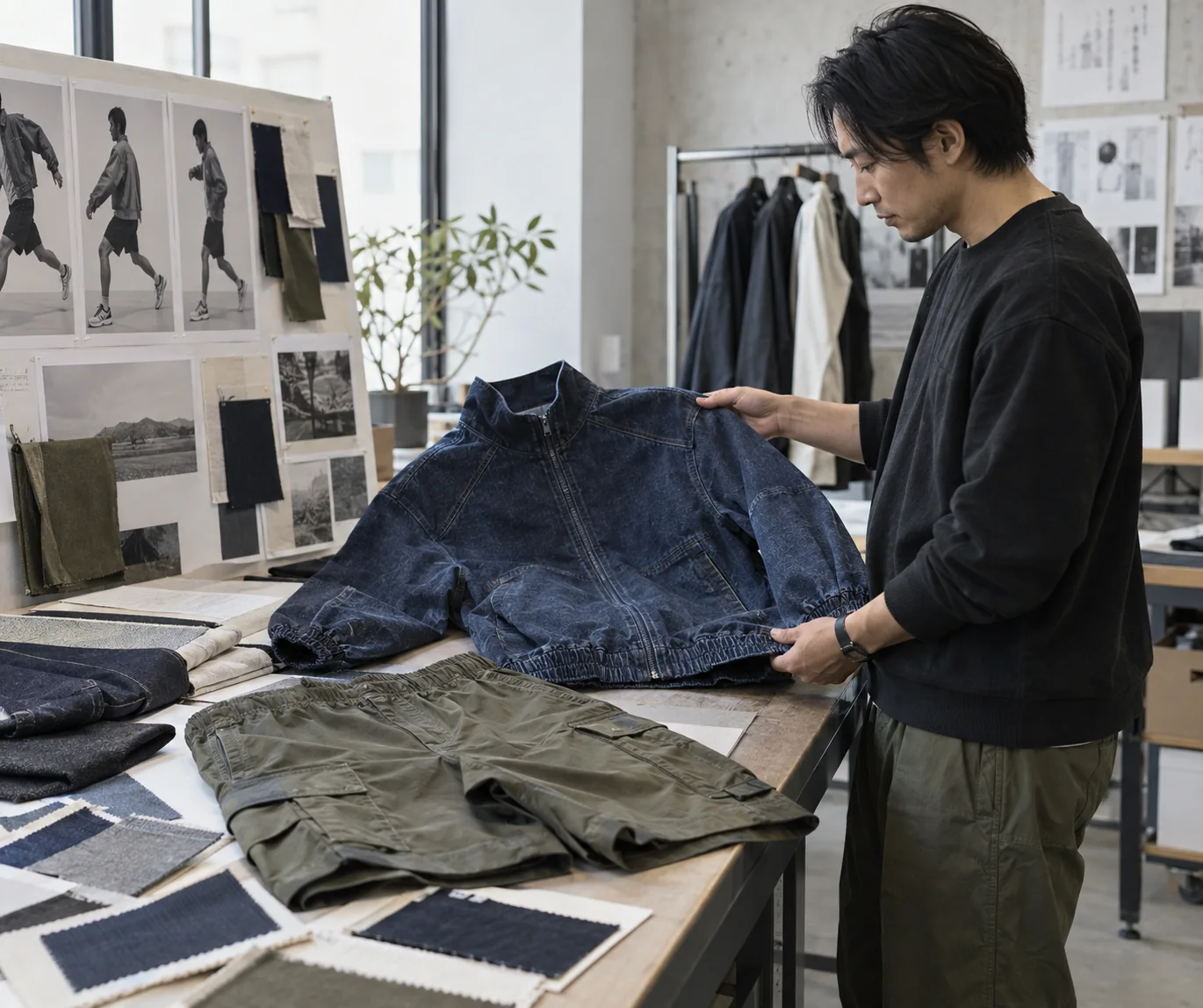
Use this decision rule:
- Choose lighter denim when the product needs a woven look, lower bulk and easier layering.
- Choose stretch denim only when the extension and recovery are specified in the movement direction.
- Use a midweight route for streetwear bottoms when pocket structure, body and wash appearance matter more than maximum airflow.
- Avoid assuming that a denim finish makes the product quick drying, sweat managing or abrasion proof.
- Sew and move in a sample before approving a tight fit, deep squat, cycling position or high-repetition training use.
For fabric selection across jerseys, wovens and performance materials, compare the denim brief with the site’s best fabric for activewear guide and use the fabric and trim library to keep the swatch conversation specific.
What should a buyer specify for denim fabric?
The phrase custom denim fabric is incomplete unless the buyer names the garment job and the acceptance evidence. A useful brief connects construction, material and finish to the actual product. This prevents the supplier from matching only the color while missing the intended hand, fit or wash result.
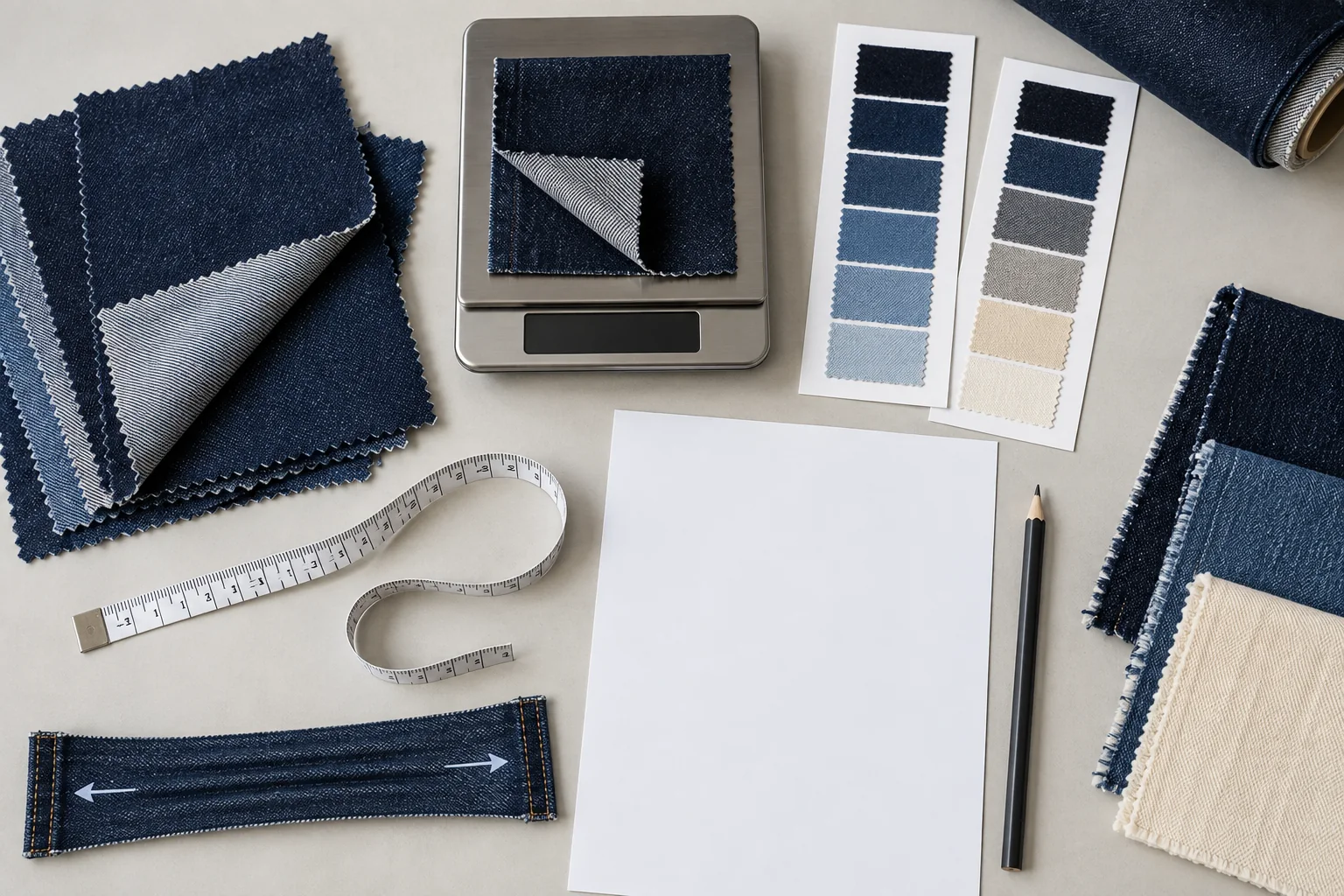
| Tech pack field | What to record | Why it matters |
|---|---|---|
| Fiber content | Exact fiber percentages and any declared recycled or stretch component | Controls labeling, care, hand and performance expectations |
| Weave and yarn | 2 x 1, 3 x 1, broken twill or other construction; yarn route and count | Makes the denim request reproducible instead of visual only |
| Finished weight | Target GSM or oz per square yard, tolerance and test basis | Affects fit, coverage, sewing, costing and packing volume |
| Width and direction | Full width, usable width, selvage condition and face direction | Supports marker planning, cutting and panel consistency |
| Color and finish | Warp and filling colors, shade standard, wash, coating or print | Controls face, reverse, fading, friction and lot comparison |
| Stretch and recovery | Direction, extension, force, recovery interval and repeat cycles | Connects the denim to movement and finished size stability |
| Care and end use | Garment type, climate, wash route, drying route and decoration | Makes testing reflect how the product will actually be used |
| Acceptance evidence | Approved swatch ID, photos, test method, tolerance and change rule | Gives sampling and bulk inspection a shared reference |
If a requested field is still open, say that it needs confirmation rather than filling it with a generic industry number. The tech pack customization service is a useful next step when the brief needs to connect fabric decisions with fit, construction and decoration.
How should denim be tested before bulk?
Testing should follow the risks created by the product. A light shirt, a stretch cargo short and a heavy workwear jacket do not need the same acceptance limits. Start with the fabric, then repeat the important checks on a sewn sample after the planned wash or care route.
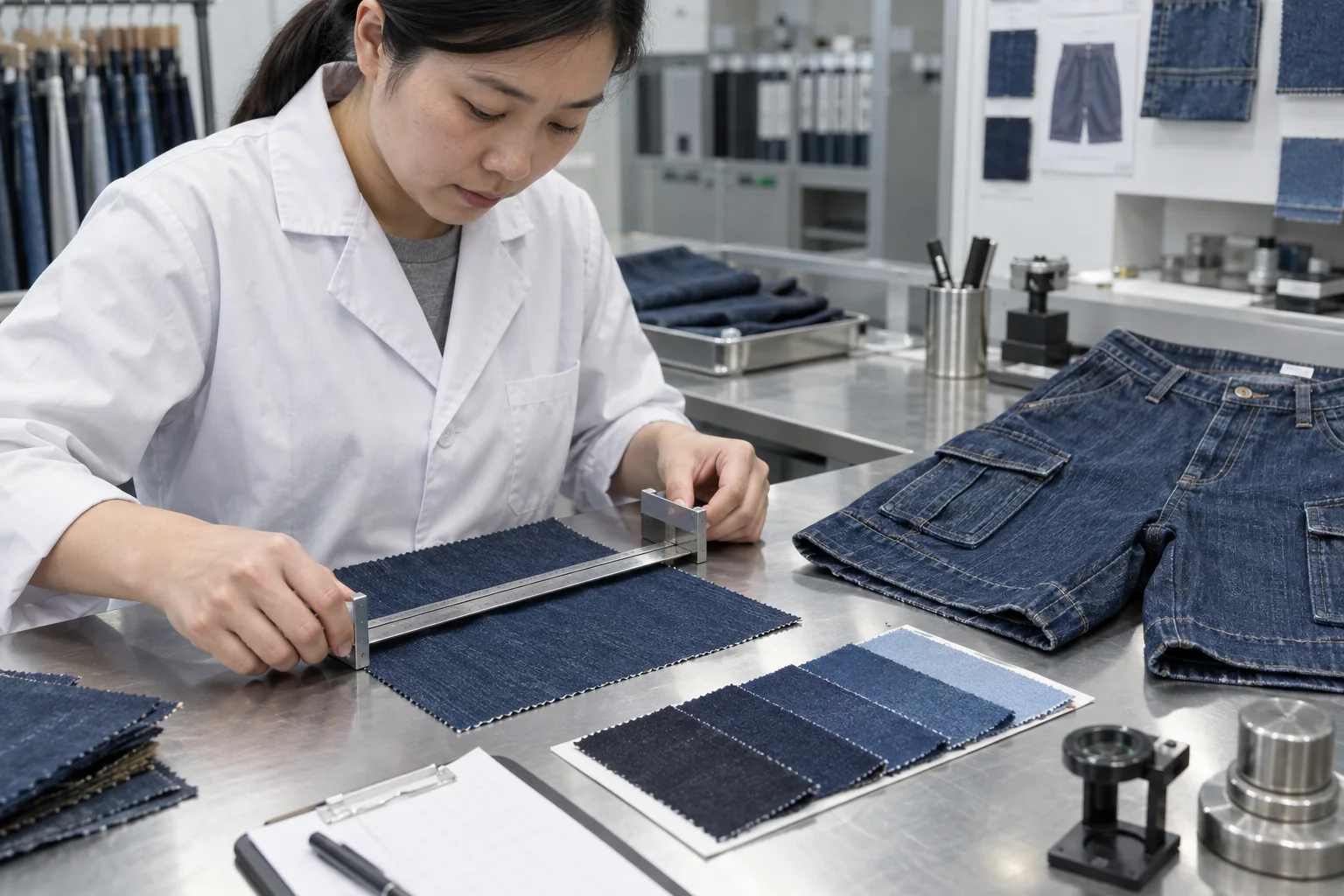
ASTM D3776 covers measurement of fabric mass per unit area and identifies different options for full pieces, full-width samples, small swatches and narrow fabrics. The choice matters because a small swatch result may not represent the full lot. ASTM D3776 is a useful reference for agreeing the basis of the weight check.
AATCC TM135 addresses length and width changes after home laundering using defined washing and drying parameters. For denim, that result should be connected to pattern measurements, garment wash, pressing, grading and the final care label. AATCC also identifies skew as a separate dimensional concern, so a buyer should not treat shrinkage and leg twist as the same measurement.
Use a risk-based test plan that may include:
- Mass per unit area, usable width and construction readings at agreed locations.
- Length and width change after the planned fabric or garment laundering route.
- Skew or leg twist when the garment is sensitive to side-seam rotation.
- Colorfastness to laundering, rubbing, perspiration or light when the shade and use require it.
- Stretch, growth and recovery for elastane or mechanical-stretch denim.
- Seam strength, tear behavior, needle damage and pocket or waistband loading for bottoms.
- Abrasion, pilling, snagging or surface change when the product will meet seats, bags, equipment or repeated friction.
The standard name is not a pass result. Record the edition, specimen, conditioning, cycles, rating scale and acceptance limit in the quality plan.
How should denim be inspected during sampling and bulk?
Denim can look attractive in a single folded photograph while varying across a roll or across garment panels. Inspection should compare the face, reverse, shade, direction, weight, width and wash result with the approved reference.
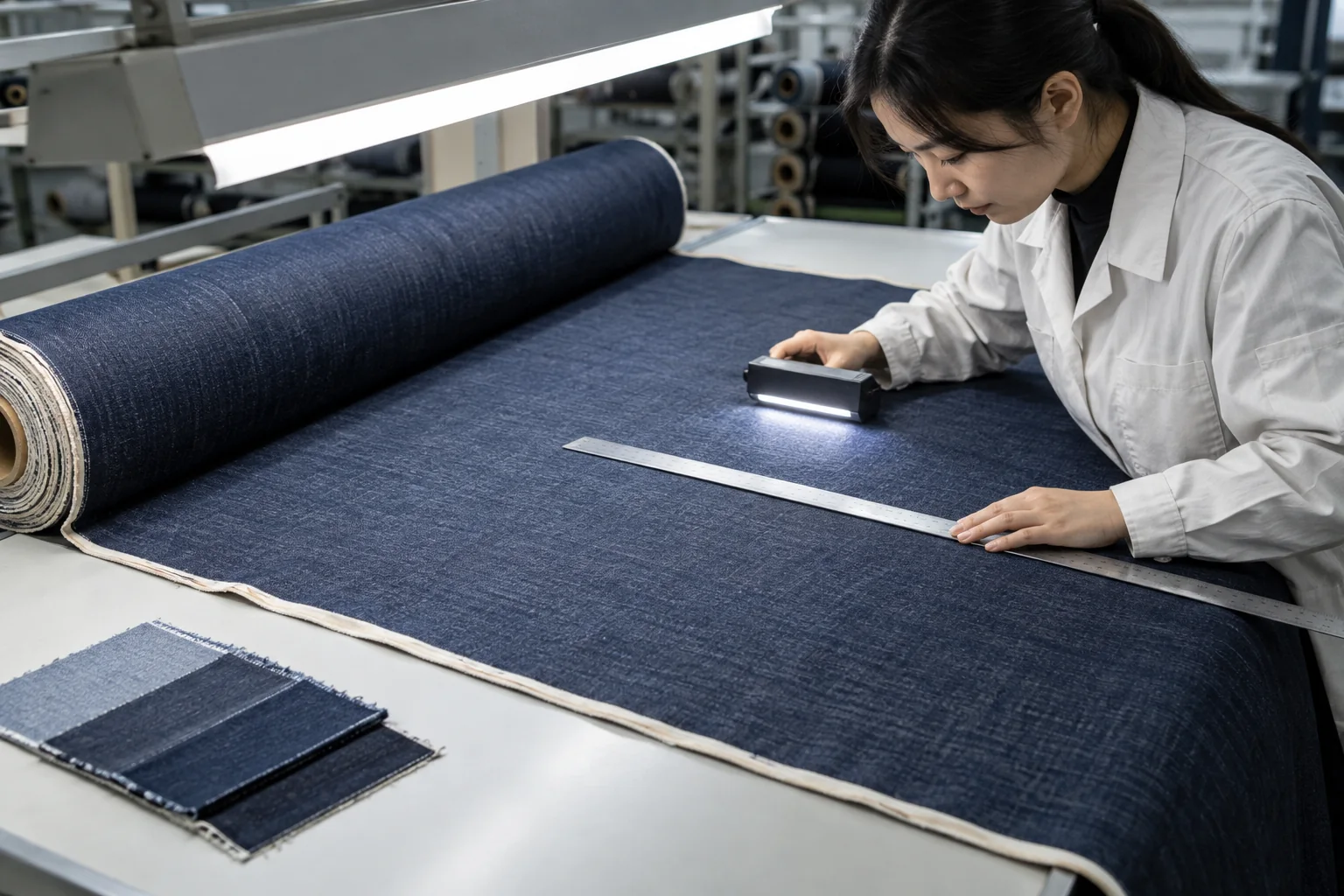
Use a repeatable inspection path:
- Compare the bulk roll or garment with the approved swatch under the agreed light source.
- Check shade bands, streaks, back staining, uneven wash, coating marks, broken yarns and surface holes.
- Measure weight and usable width at more than one position instead of relying on a center reading.
- Confirm that the face direction and twill angle are consistent where panels must be matched.
- Check pocket openings, belt loops, bartacks, zippers, rivets and heavy seam intersections on the sewn sample.
- Review whether the garment wash has changed hand, size, shade and surface more than the approved limit.
- Keep lot references and change records with the approved sample so a later replacement cannot silently reset the standard.
For buyer teams, the most useful inspection photo shows the material beside a reference swatch and a measurement tool. A close-up fashion photo can support a mood board, but it cannot replace a width, weight, color or care record.
How should denim care and wash details be approved?
Care is part of the product specification, not a label added at the end. Denim may be supplied raw, rinsed, softened, stonewashed, enzyme washed, bleached, overdyed, coated or mechanically distressed. The route affects color, hand, shrinkage, surface contrast and the buyer’s instructions to the consumer.
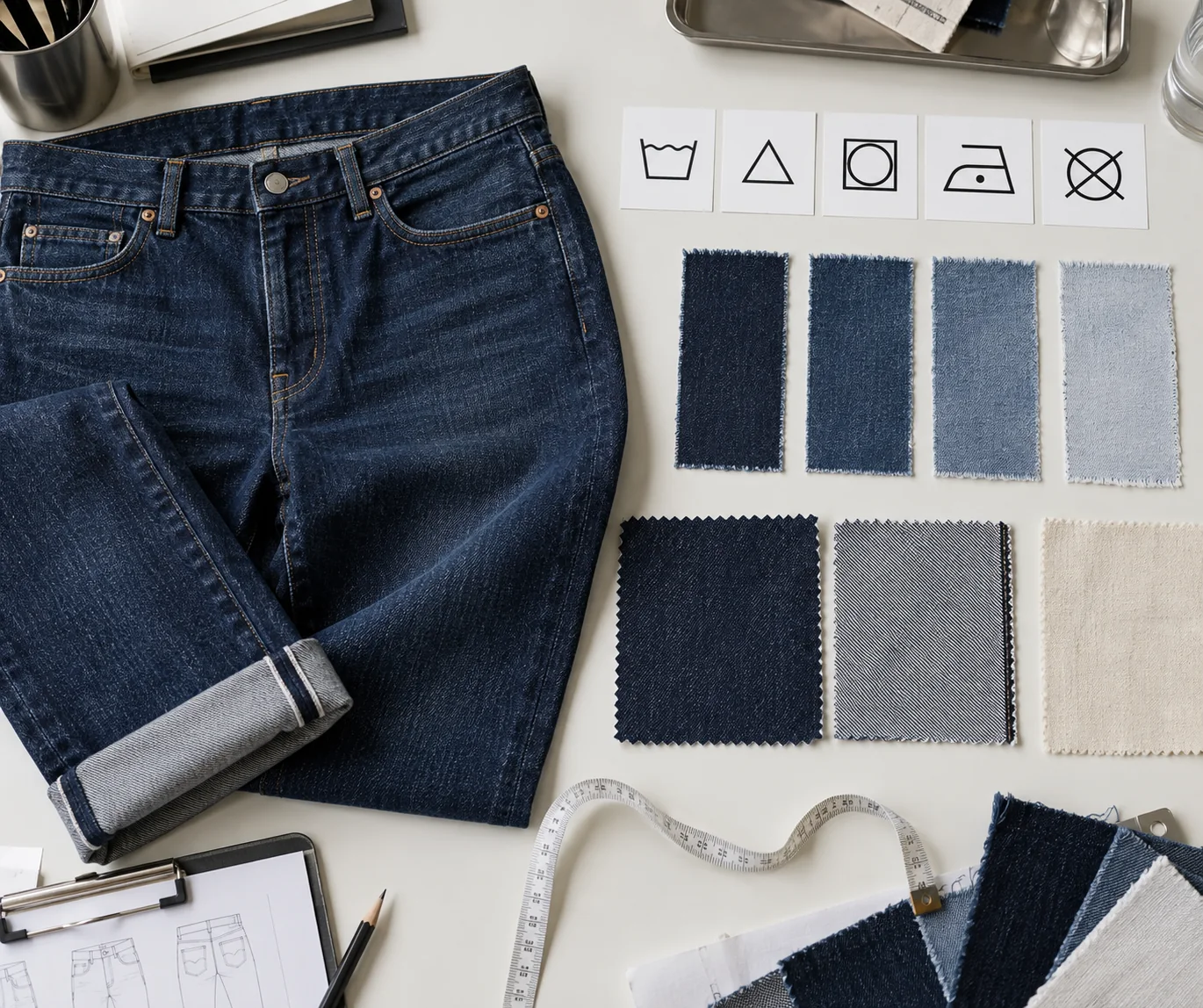
Before locking care instructions, confirm:
- Whether the test was run on fabric, a finished garment or both.
- Whether shrinkage was measured before and after the actual wash and dry route.
- Whether the face and reverse change at different rates.
- Whether indigo or another dye transfers during rubbing, wash or contact with light fabrics.
- Whether trims, labels, prints, embroidery, coatings and hardware tolerate the same care route.
- Whether the approved look depends on a controlled garment wash that must be repeated in production.
Do not describe denim as easy care from the fabric name alone. The correct care route belongs to the fiber, dye, finish, construction, trims and finished garment together.
What should a buyer approve before bulk production?
The best approval sample is not simply the bluest or softest swatch. It is the sample that records the decisions most likely to affect fit, appearance, cost and repeatability.
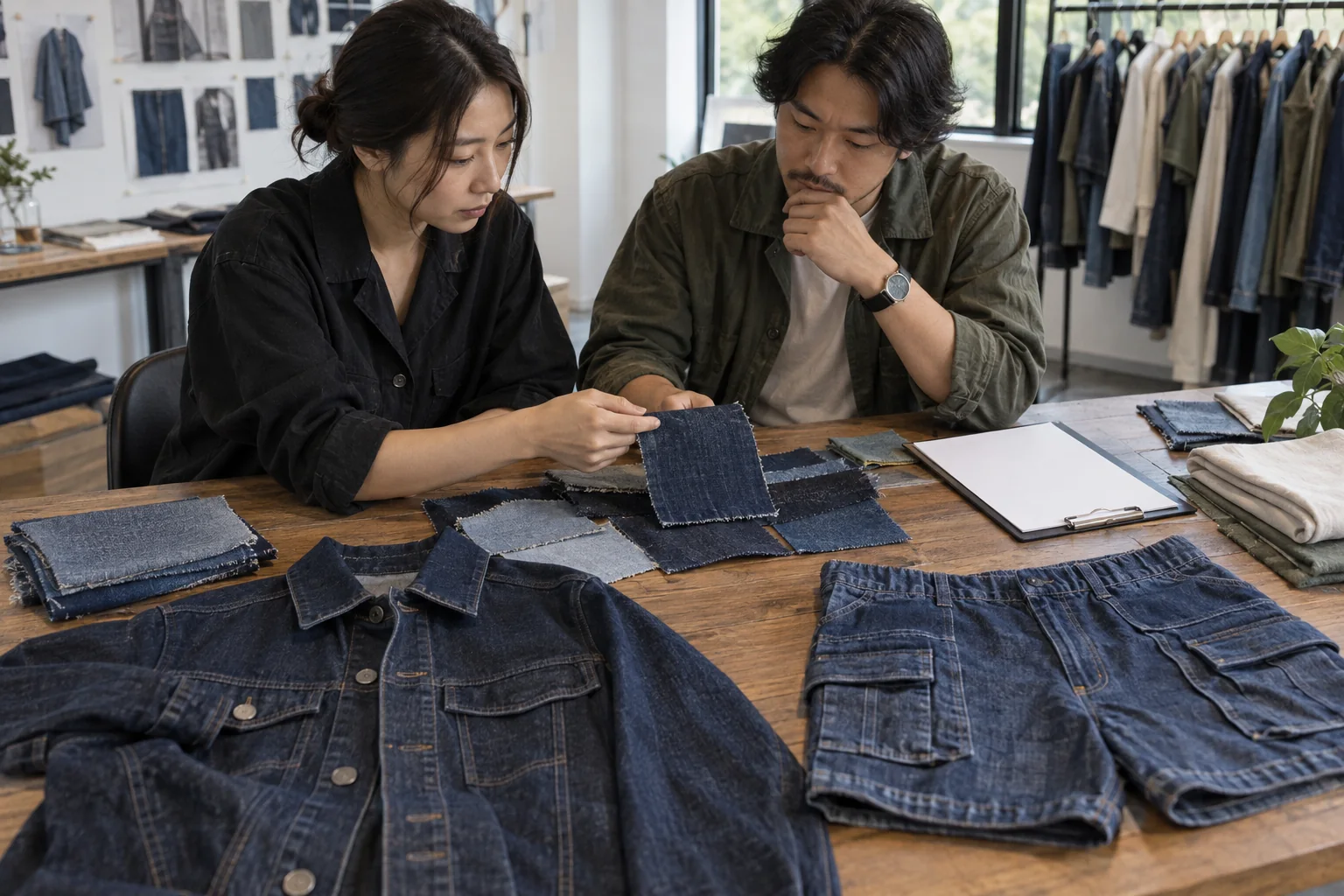
Approve the following in sequence:
- Construction: confirm fiber ratio, weave route, yarn information, finished weight and usable width.
- Appearance: approve face, reverse, twill direction, shade, contrast and any wash or finish.
- Movement: test the garment in the real posture and activity, especially when stretch or a close fit is involved.
- Care: run the intended wash and dry route and record size, shade, hand and surface changes.
- Quality: define the inspection points, test methods, tolerances and change-control rule.
- Commercial inputs: send the garment type, measurement chart, artwork or trim list, target quantity, destination market and sample comments for quotation.
This sequence makes the word denim useful for a production conversation. It also gives the manufacturer enough information to recommend a suitable swatch instead of quoting a visually similar fabric with a different risk profile.
Frequently asked questions
Traditional denim is strongly associated with cotton, but the word denim does not replace a fiber declaration. Cotton-rich blends and stretch denim are common development routes. Confirm the exact percentages, yarn route, labeling basis and finished-garment test results before treating a fabric as cotton denim.
Traditional denim is a warp-faced twill, commonly using a 2 x 1 or 3 x 1 route. However, a generic twill is not automatically denim. If the face, reverse, dye route and aging effect matter, specify them together instead of accepting the word twill as a full substitute.
Denim and chambray can both use a colored warp and lighter filling, but chambray is commonly associated with a lighter plain-weave construction. That difference changes the diagonal surface, drape, hand and wear behavior. Ask for the construction record when a denim appearance is required.
Denim weight describes mass per unit area, often in ounces per square yard or GSM. It helps predict body, coverage, sewing force and packing volume, but it does not predict comfort or durability by itself. Always agree the test method, specimen basis and tolerance with the supplier.
Rigid denim has little intentional extension, while stretch denim uses elastane or another stretch route. Some woven fabrics also gain limited mechanical give from construction. A buyer should specify direction, extension, force, recovery and repeat-cycle results instead of asking only for stretch denim.
Raw or dry denim generally means the material or garment has had limited wash-down or aging treatment before approval. It may have a firmer hand and more visible change during later care, but the exact result depends on sizing, construction, dye and finishing. Approve the actual care route rather than relying on the label.
Denim can suit streetwear, warm-up layers, cargo products and fashion-led activity looks. It is usually a poor default for a high-sweat base layer because it is a woven material with different airflow, moisture and stretch behavior from performance knits. Test movement, seam comfort, heat, care and recovery on a sewn sample.
Ask for fiber content, weave and yarn route, finished weight, usable width, face and reverse photos, shade reference, stretch and recovery data, wash or finish route, shrinkage and skew results, care instructions, sample ID and change-control rules. Send the garment type and measurement chart so the recommendation can be tied to a real product.