Types of hoodies are usually described by opening, fit, sleeve, hood construction, intended use, and fabric or finish. A product might be an oversized, drop-shoulder, double-layer pullover in brushed fleece. Each term answers a different design question.
For an apparel buyer, the name is only the beginning. A usable brief also defines measurements, fabric construction, hood shape, pocket, rib, zipper or drawcord, decoration, labels, care, and sample acceptance. This guide organizes 36 hoodie styles into six practical groups, then shows how to turn the chosen combination into a quote-ready specification.
How to read the 36 hoodie types
The groups are naming axes, not sealed product categories. A full-zip hoodie can also be cropped, raglan-sleeved, three-panel, running-oriented, and made from bonded double knit. Most commercial styles combine one or more decisions from several groups.
Start with the wearer and use. Then choose the opening, fit, sleeve, hood, material, pockets, and finish. Record the result as a specification instead of relying on a market name. Words such as heavyweight, performance, premium, warm, or oversized do not have one universal construction or measurement. If a word affects cost or approval, define what it means for the project.
Opening and closure types
1. Pullover hoodie
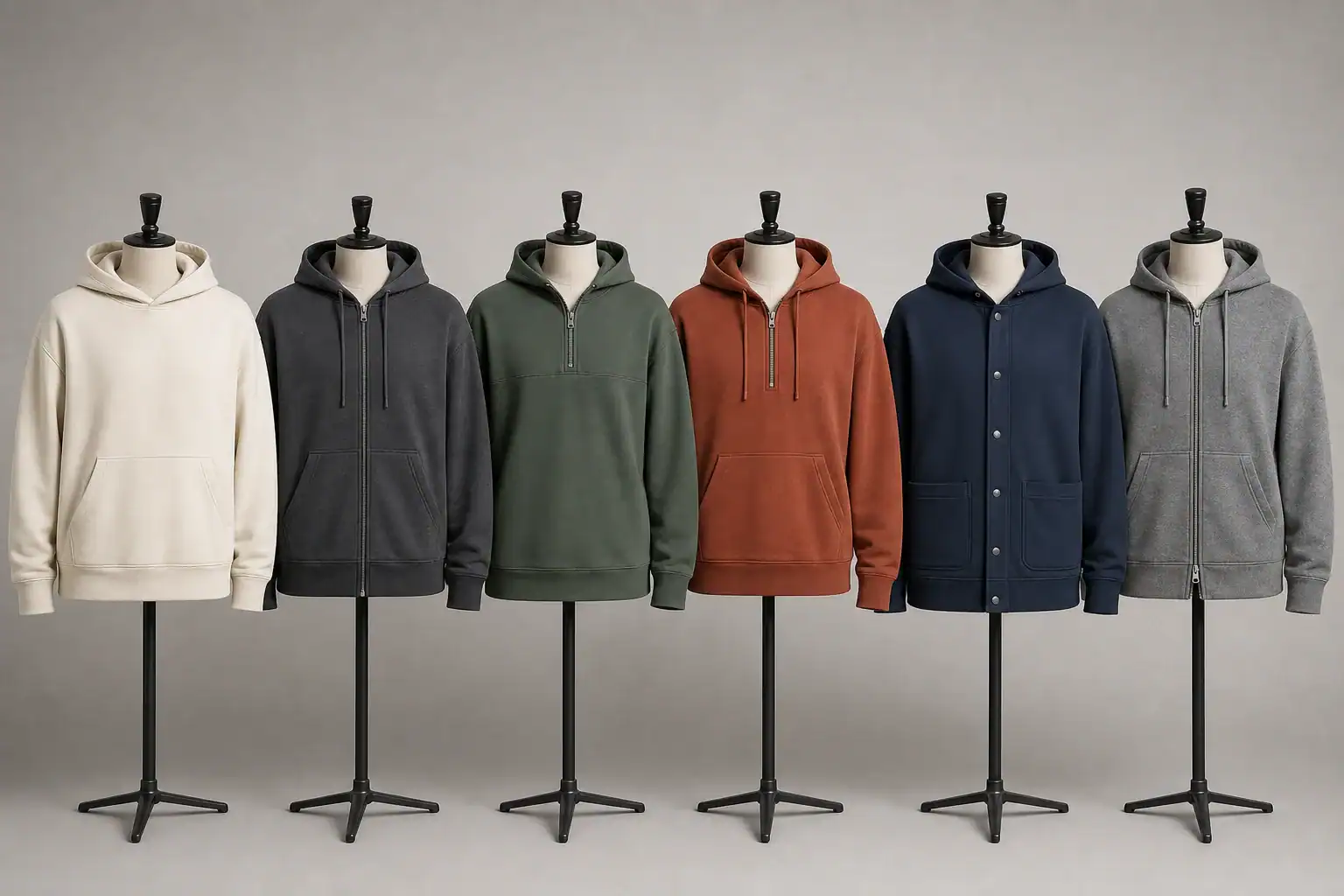
A pullover hoodie has no full front opening and is commonly finished with a kangaroo pocket, rib cuffs, and a rib hem. It gives a broad uninterrupted area for printing or embroidery, but the neck opening and hood entry must be large enough for the intended wearer. Specify neck stretch, hood attachment, pocket size, rib recovery, and whether the body is regular, relaxed, or oversized.
2. Full-zip hoodie
With an opening from hem to neck, the full-zip design behaves more like a soft jacket than a pullover. Its zipper changes the center-front structure, pocket layout, hood join, shrinkage balance, and decoration area. Confirm zipper material, gauge, color, puller, tape, top and bottom stops, pocket symmetry, and whether a facing or zipper guard is required. Sample the garment after care because uneven shrinkage beside the zipper can create a wavy front.
3. Quarter-zip hoodie
On a quarter-zip version, the center-front opening stops in the upper-chest area. It can provide ventilation without splitting the whole body. The brief needs zipper length, opening depth, placket or guard construction, neckline shape, hood join, and reinforcement at the zipper end. Check that the opening sits flat both open and closed and does not create a hard point against the chest.
4. Half-zip hoodie
A half-zip hoodie has a longer front opening than a quarter-zip, often reaching the mid chest or upper abdomen. It may be used in outdoor, streetwear, uniform, or athletic collections. Confirm opening length, zipper direction, puller access, facing, pocket relationship, and collar or hood behavior. The added opening can make the front hang differently, so fit should be approved with the zipper in several positions.
5. Snap-front hoodie
A snap-front hoodie uses press studs instead of a conventional zipper. It can resemble a hooded jacket, cardigan, or varsity layer. Specify snap size, finish, spacing, reinforcement, placket layers, opening force, and the risk of marking the fabric. Snaps placed through soft fleece without suitable reinforcement can distort the front or pull through during use.
6. Double-slider zip hoodie
A double-slider zip hoodie can open from the top or bottom. The lower opening may help sitting, layering, or styling, but it adds component and assembly requirements. Define the exact zipper type, slider orientation, bottom alignment, opening function, and care expectations. Test both sliders repeatedly on the finished sample and confirm that the hem remains level when the lower slider is opened.
Fit and body-length types
7. Regular-fit hoodie
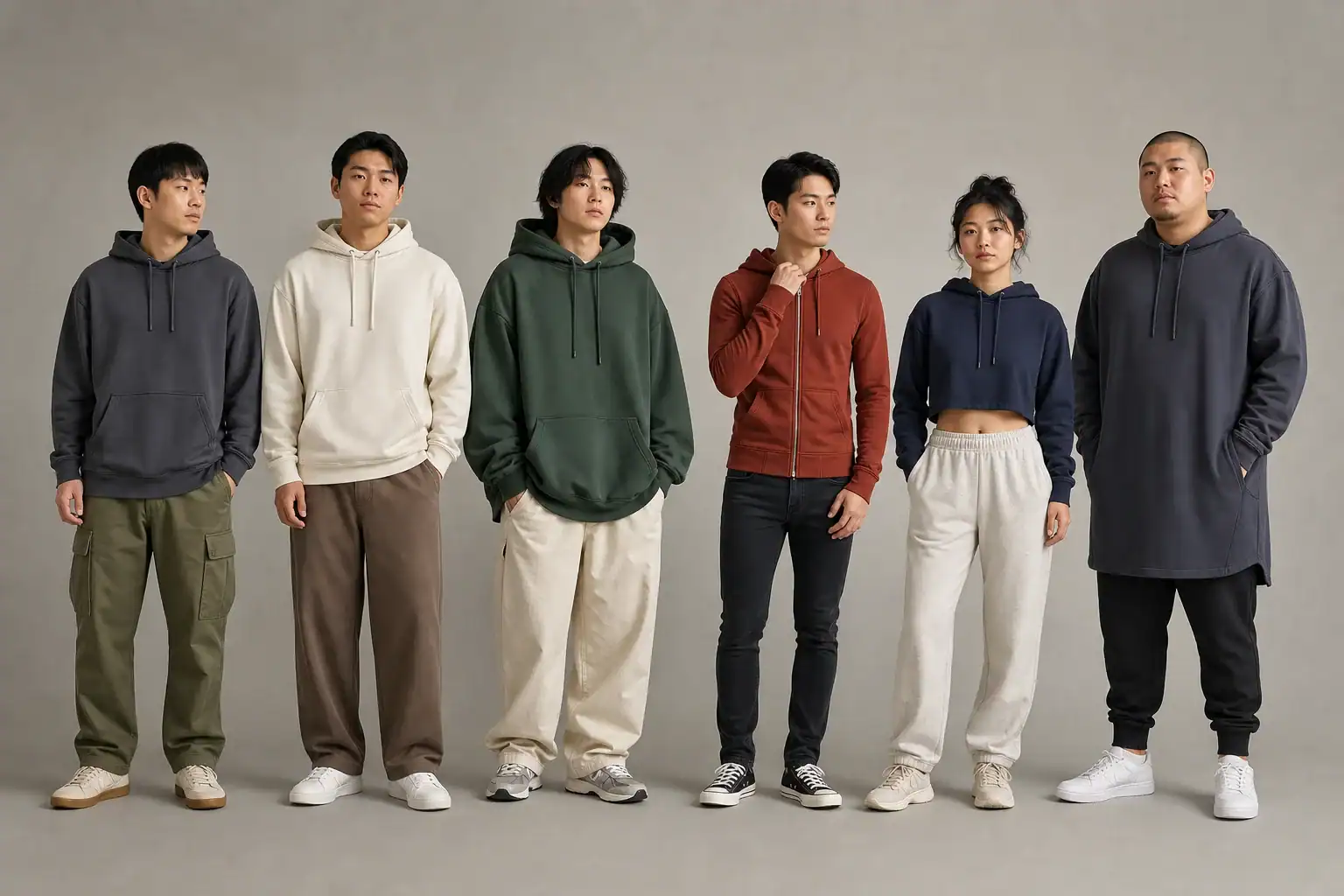
A regular-fit hoodie follows the brand’s standard body block with moderate ease. The term still needs measurements because one brand’s regular can resemble another brand’s relaxed fit. Define chest width, shoulder, body length, sleeve length, armhole, bicep, cuff, and hem opening at the reference size. State whether the hoodie is intended over a T-shirt or a heavier layer.
8. Relaxed-fit hoodie
A relaxed-fit hoodie adds wearing ease without necessarily using the exaggerated shoulder and volume of an oversized style. It can work for casual, team, travel, and light training collections. Confirm how much ease is added at the chest, waist, hem, armhole, and sleeve. Review movement and pocket access so the extra volume feels intentional rather than simply one size too large.
9. Oversized hoodie
An oversized hoodie uses deliberate volume, often with a wider chest, dropped shoulder, larger hood, fuller sleeve, and longer or sometimes shorter body. Sizing up a regular block rarely gives the same balance. Specify shoulder drop, chest, body length, sleeve length from the new shoulder point, hood scale, pocket position, and rib tension. Fit at more than one size to prevent the grading from becoming excessively long or wide.
10. Slim-fit hoodie
A slim-fit hoodie sits closer to the torso and arm. It may suit a fitted lifestyle layer or a clean uniform silhouette, but it needs enough stretch or ease for reaching and layering. Confirm chest, waist, hem, bicep, elbow, cuff, armhole, and fabric stretch. Check the sample while the wearer reaches forward, raises the arms, and sits, not only in a standing front view.
11. Cropped hoodie
A cropped hoodie ends near or above the natural waist, depending on the collection. The hem position, rib height, pocket choice, and sleeve proportion are more important than the word cropped. State body length from a stable shoulder point, finished hem location, front and back balance, pocket construction, and the bottom opening. Test movement because a short body can lift more than expected when the arms rise.
12. Longline hoodie
A longline hoodie extends below the usual hip area and may be straight, curved, stepped, or split at the hem. Extra length changes pocket placement, sitting comfort, zipper behavior, and fabric consumption. Specify center-front and center-back length, side seam, hem shape, slit, sweep, and whether the garment should cover the seat. Review the sample while walking and sitting so the hem does not pull or bunch.
Sleeve and armhole types
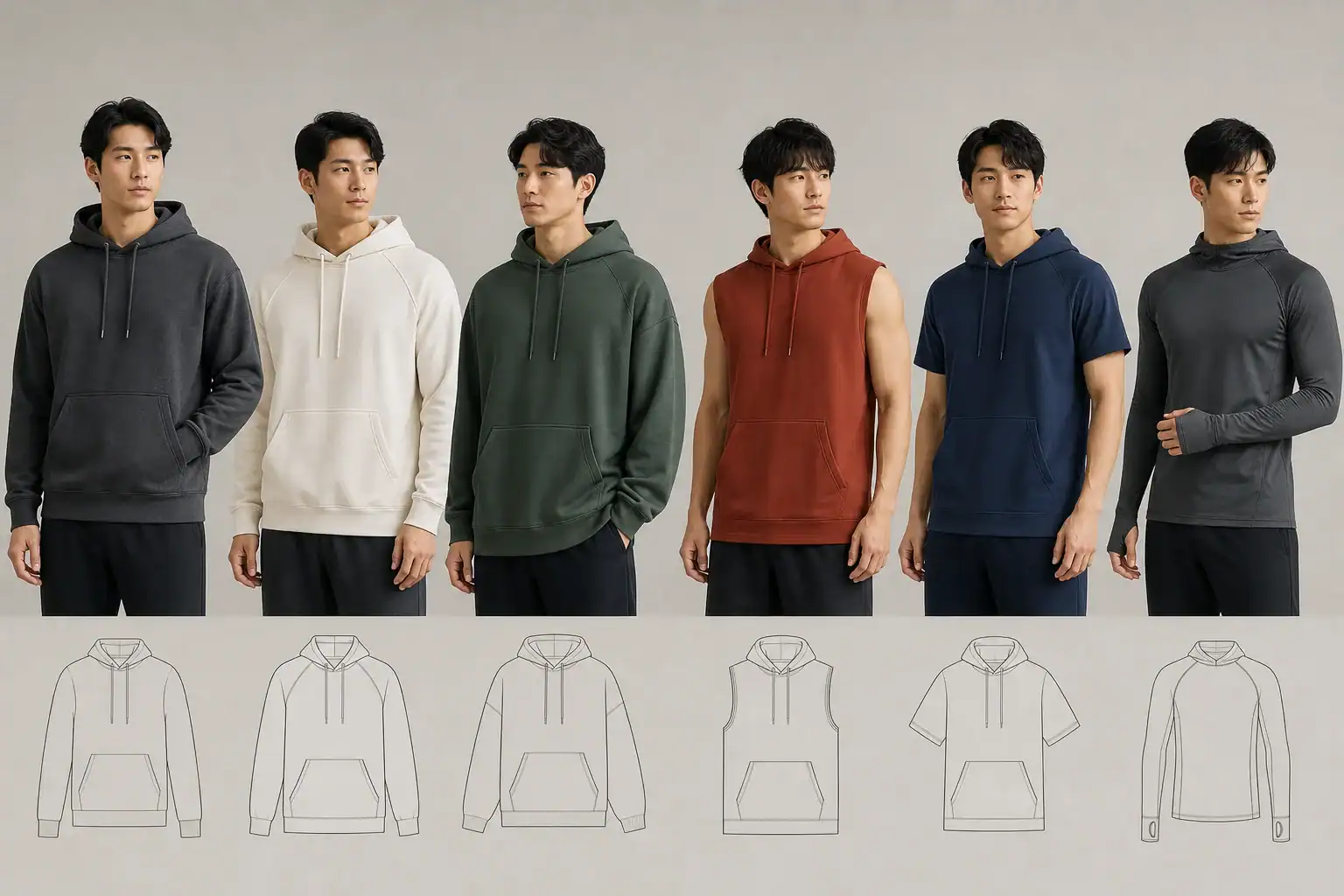
13. Set-in sleeve hoodie
The seam of a set-in sleeve follows a defined armhole around the shoulder. This creates a familiar tailored line and gives clear shoulder and sleeve measurement points. Specify shoulder width, armhole depth, sleeve cap, bicep, elbow, cuff, and sleeve length. Heavy fleece may need a different armhole and seam allowance from a light jersey because bulk changes both mobility and appearance.
14. Raglan sleeve hoodie
A raglan sleeve runs from the neckline or upper hood area toward the underarm. It can support movement, color blocking, or a sport-led look. Define the raglan seam path, front and back sleeve shape, neckline join, underarm, bicep, and sleeve length measurement method. If body and sleeve use different fabrics or colors, check shrinkage, stretch, and seam torque together.
15. Drop-shoulder hoodie
A drop-shoulder hoodie moves the armhole seam below the natural shoulder. It is common in relaxed and oversized silhouettes, but the amount of drop should be measurable. Specify shoulder width, drop from the intended shoulder point, upper sleeve volume, total sleeve reach, and armhole depth. An extreme drop can restrict arm lift if the body and sleeve shapes are not balanced.
16. Sleeveless hoodie
A sleeveless hoodie removes the conventional sleeve and may be used for gym layering, warm-weather streetwear, or fashion. The armhole is a visible and functional edge, so specify shape, depth, binding or facing, seam allowance, and desired coverage. Check the garment from the front, side, and back to control gaping and exposure around the underarm.
17. Short-sleeve hoodie
A short-sleeve hoodie combines a hooded body with sleeves ending above or near the elbow. It can use a standard set-in sleeve, raglan seam, drop shoulder, or wide boxy sleeve. Define sleeve length, opening, hem finish, armhole, bicep ease, and the relationship between body weight and sleeve drape. A heavy body with a narrow short sleeve can feel unbalanced.
18. Thumbhole performance hoodie
A thumbhole hoodie extends the cuff or lower sleeve over part of the hand. It may help layering or hand coverage, but comfort depends on the opening and sleeve length. Specify thumbhole position, shape, reinforcement, left and right orientation, cuff length, sleeve reach, and seam placement. Check rubbing, hand movement, and recovery after repeated use.
Hood construction types
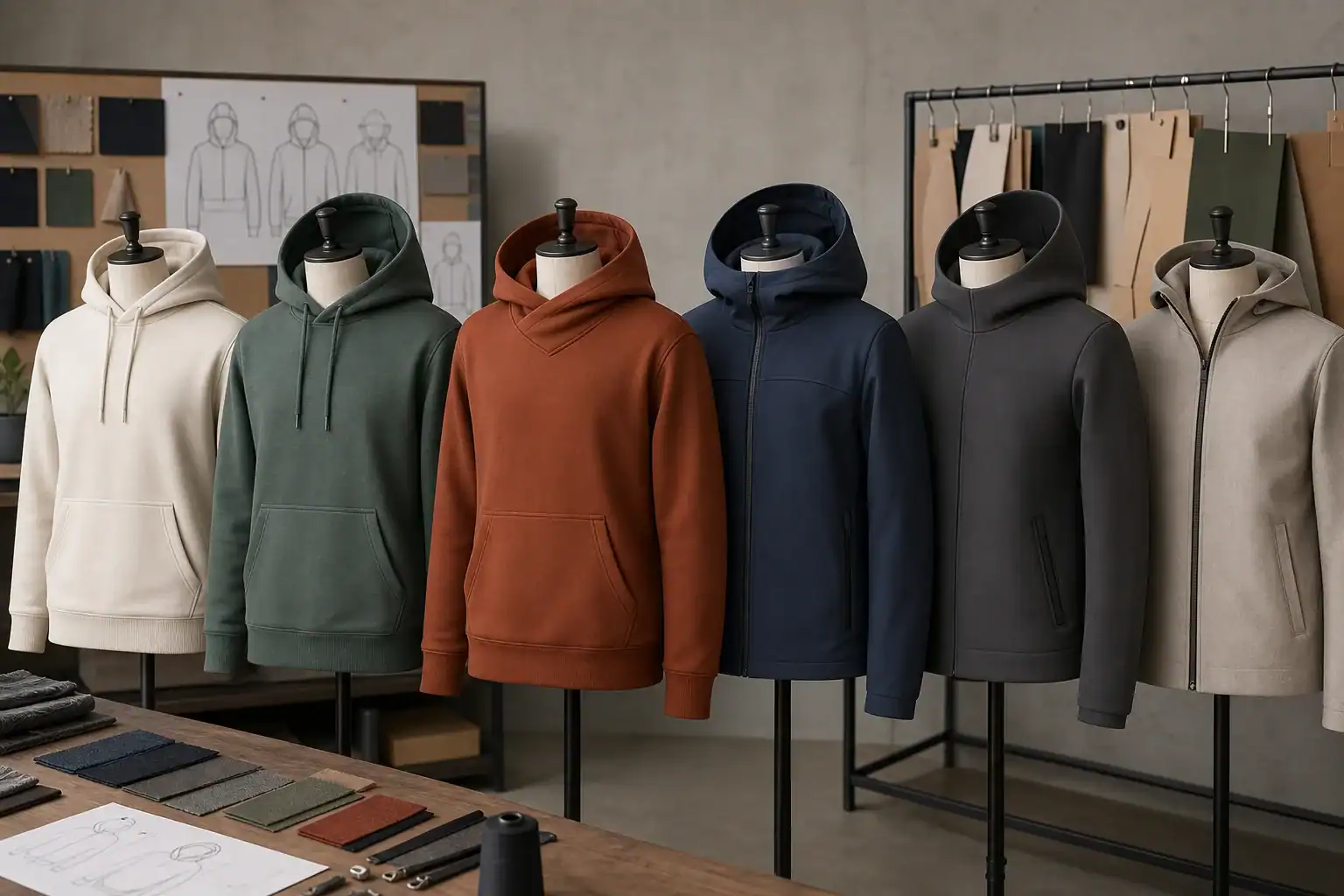
19. Single-layer hood
A single-layer hood uses one main fabric layer, often with internal seams visible or finished by overlock, binding, or tape. It can reduce weight and cost, but the hood may show the reverse face when worn down. Define seam finish, edge construction, drawcord channel, hood depth, height, and face opening. Check whether the fabric’s wrong side is acceptable as a visible surface.
20. Double-layer hood
A double-layer hood uses an outer and inner layer, which may be self fabric or a separate lining. It can improve structure, warmth, and interior appearance, while adding bulk and material use. Specify both materials, grain or stretch direction, seam turn, topstitch, drawcord channel, and attachment. Compare shrinkage between layers to avoid twisting or a lining that rolls outside.
21. Crossover-front hood
A crossover hood overlaps at the center front instead of ending in a simple open neckline. It can create more neck coverage and a distinctive visual line. Define overlap depth, neckline height, hood opening, seam order, drawcord position, and whether the overlap must lie flat. Test head entry and comfort at the throat because an attractive overlap can still be too tight.
22. Three-panel hood
A three-panel hood uses a center panel between two side panels. The extra seam can improve shaping and create color or decoration options. Specify panel width, seam position, topstitch, center-front opening, lining, and drawcord route. A well-shaped panel should be reviewed both on the head and lying down on the back.
23. Scuba hood
A scuba hood has a closer, taller shape around the head and neck, often without a loose drawcord. It may be used in technical, minimalist, or cold-weather styles. Define face opening, neck height, panel shape, stretch, zipper relationship, and lining. Check peripheral vision, head movement, and pressure around the face rather than judging it on a dress form alone.
24. Detachable hood
A detachable hood connects with a zipper, snaps, buttons, or another removable system. The body must still look finished when the hood is removed. Specify attachment method, reinforcement, concealment, neckline finish, component spacing, hood orientation, and storage if relevant. Repeatedly attach and remove the sample to check alignment, comfort, and component security.
Activity and use-case types

25. Casual streetwear hoodie
A casual streetwear hoodie is driven by silhouette, hand feel, color, and decoration as much as activity. It may be regular, cropped, oversized, washed, or heavyweight. Define the target outfit, fit reference, fabric surface, hood shape, pocket, rib, and decoration scale. Wash effects and large prints should be approved on the finished garment, not only on a flat swatch.
26. Gym warm-up hoodie
A gym warm-up hoodie is intended for travel to training, warm-up, rest periods, or light movement rather than every high-output session. Clarify the activity, climate, layering, stretch, ventilation, pocket, and care route. A soft brushed fleece can suit pre-training comfort, while a lighter knit may be easier to carry and dry.
27. Running hoodie
A running hoodie usually needs lower bulk, stable pockets, movement-friendly sleeves, and material suited to the climate. It may use a half zip, raglan seam, thumbholes, or a close hood. Specify route and weather, body fit, hood stability, zipper, storage contents, seam placement, visibility detail, and moisture-management claim requirements. Test it during motion with the intended pocket load.
28. Workwear hoodie
A workwear hoodie prioritizes practical layering, pocket access, reinforcement, and durability for a defined job environment. It is not automatically protective clothing. Specify abrasion risks, tools or items carried, outer-layer compatibility, cuff, hem, zipper, hood, and visibility requirements. If the job needs a regulated protective claim, confirm the applicable standard and product scope before development.
29. Travel hoodie
A travel hoodie may prioritize comfort, packability, secure storage, temperature changes, and repeated wear. Define trip type, climate, layer system, pocket contents, zipper access, fabric weight, odor or care expectations, and packed volume. Hidden pockets need actual object dimensions and accessibility checks rather than a vague request for more storage.
30. Team or school hoodie
A team or school hoodie usually needs a stable block, repeatable colors, decoration zones, size coverage, labels, and reorder consistency. Specify wearer group, size range, logo or artwork files, placement, name or number options, color standard, packing, and distribution method. Avoid assuming one unisex block will fit every wearer without a defined size strategy.
Fabric and finish types

31. Brushed-fleece hoodie
A brushed-fleece hoodie has a soft raised inner surface created during finishing. Warmth and loft vary by yarn, knit, weight, brushing, and compactness. Specify fiber content, knit construction, finished weight, brushing face, pile appearance, shrinkage, pilling risk, and hand feel. Ask for a finished garment sample because the inside can change after dyeing, brushing, and care.
32. French-terry hoodie
A French-terry hoodie has loops on the inside and a smoother outer face. It can suit trans-seasonal, casual, and light athletic programs, but loop size and density vary. Define fiber, loop construction, finished weight, stretch, recovery, surface, shrinkage, and desired drape. Check snagging and loop appearance at the seams and pocket openings.
33. Performance-interlock hoodie
A performance-interlock hoodie uses a compact double-knit structure that may provide a smooth face, stretch, and cleaner drape. Fiber content alone does not prove moisture management, quick drying, or abrasion performance. Specify construction, weight, stretch, recovery, surface, claim, test method, and acceptance target. Confirm seam and needle choices because compact knits can show holes or puckering.
34. Cotton-rich jersey hoodie
A cotton-rich jersey hoodie is usually lighter and less structured than a fleece or terry version. It may work for warm climates, layering, or a T-shirt-like hooded top. Define composition, knit, finished weight, stretch, opacity, shrinkage, spirality, and neck or hood stability. A soft lightweight jersey may require binding, tape, or another solution to control the hood seam.
35. Garment-washed hoodie
A garment-washed hoodie is washed after assembly to create a softer, faded, vintage, or broken-in effect. The process can change measurements, shade, seam appearance, labels, print, and metal trims. Specify wash reference, color range, hand feel, target shrinkage, distress limits, component compatibility, and sample approval method. Shade variation should be agreed rather than discovered after bulk finishing.
36. Bonded double-knit hoodie
A bonded hoodie combines two layers or surfaces into a structured material. It may create a clean technical look, but bonding affects stretch, breathability, seam bulk, edge finish, and care. Define both faces, bonding system, total weight, thickness, stretch, recovery, delamination risk, and permitted edge construction. Test bends, seams, washing, and repeated flexing for the intended product.
Quick comparison for collection planning

Use the following combinations as starting points, not fixed formulas:
- Core casual: pullover, regular or relaxed fit, set-in sleeve, double-layer hood, and French terry or brushed fleece.
- Streetwear drop: pullover or full zip, oversized fit, drop shoulder, crossover or double-layer hood, and garment wash.
- Studio-to-street layer: half zip, relaxed fit, raglan sleeve, three-panel hood, and performance interlock.
- Running layer: quarter or half zip, slim fit, raglan sleeve, scuba or three-panel hood, and compact performance knit.
- Travel program: double-slider zip, relaxed fit, set-in or raglan sleeve, double-layer hood, and secure pocket construction.
- Team program: pullover or full zip, regular fit, set-in sleeve, double-layer hood, and decoration-ready fleece.
- Warm-climate capsule: pullover, relaxed or cropped fit, short sleeve or sleeveless, single-layer hood, and cotton-rich jersey.
- Technical outer layer: full zip, regular or relaxed fit, raglan sleeve, close hood, and bonded double knit.
One block does not need to serve every role. A washed oversized hoodie and a fitted running hoodie have different pattern, seam, fabric, and approval priorities even when both use the same size label.
Turn the hoodie name into a tech pack
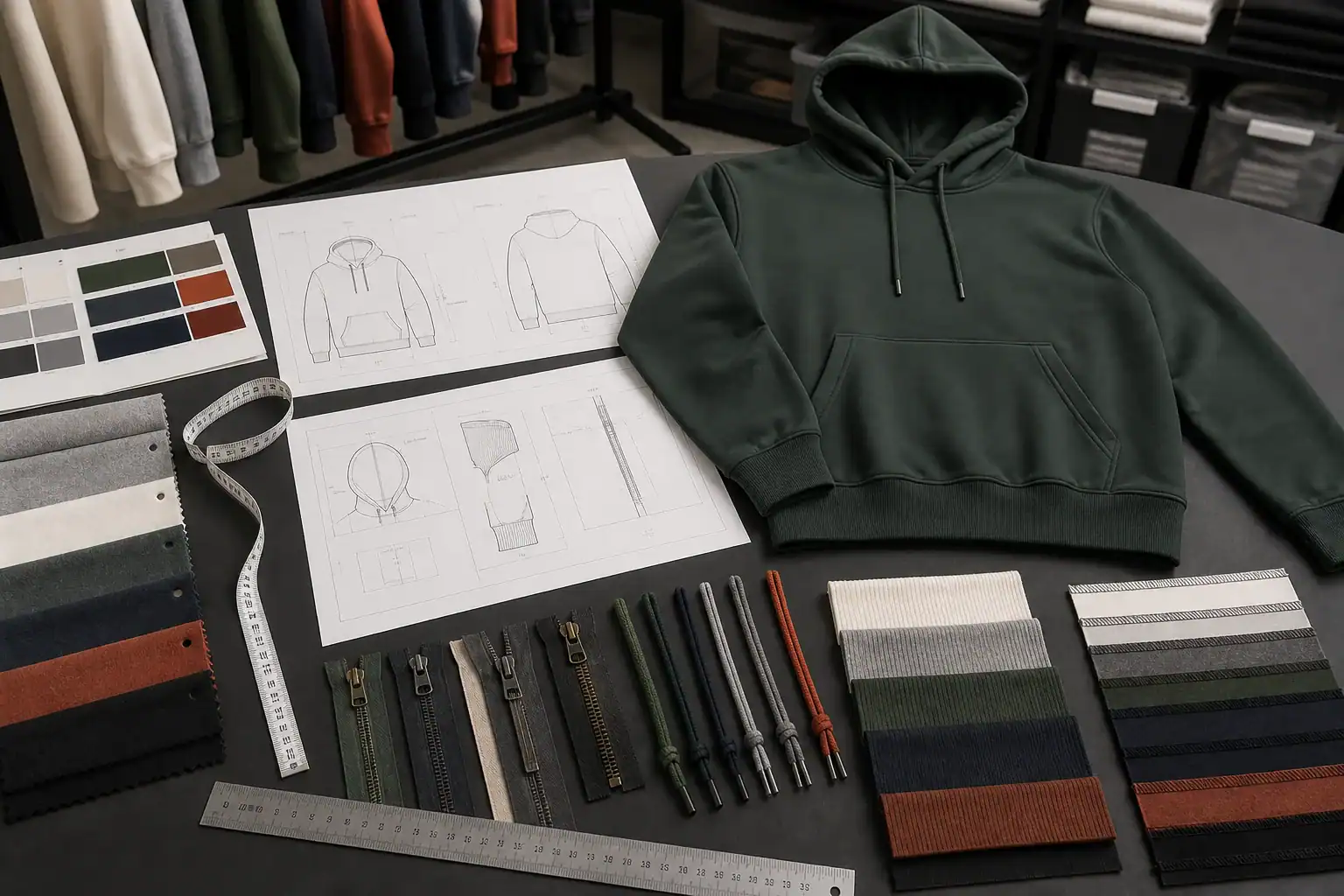
Write the style description as a sequence of decisions. "Relaxed full-zip hoodie" is clearer than "premium hoodie," but it still needs a reference size and construction record. Add the wearer, use, body fit, shoulder, sleeve, hood, opening, pocket, fabric, rib, decoration, labels, care, and packaging.
The measurement chart should define how each point is taken. Common points include chest, waist, bottom opening, body length, shoulder width, shoulder drop, armhole, bicep, elbow, sleeve length, cuff opening, cuff height, hood height, hood depth, face opening, neck width, pocket width and height, pocket position, zipper length, and rib height. Mark whether a measurement is taken flat, around the garment, along a curve, or after care.
Material notes should cover fiber content, knit construction, finished weight, usable width if relevant, stretch direction, stretch and recovery, shrinkage, spirality, pilling, abrasion risk, hand feel, surface, brushing, color, and care. A fabric family name is not enough to reproduce a result. DTS has a separate best fabric for activewear guide for the first stage of material comparison.
Construction notes should show stitch and seam type, seam allowance, topstitch, reinforcement, zipper, drawcord, eyelet, pocket, hood layers, rib, labels, and decoration. Reference photos help communicate direction, but annotate what should be followed and what should change. Buyers with an incomplete specification can review the tech pack customization process before sampling.
Decoration placement changes by hoodie type
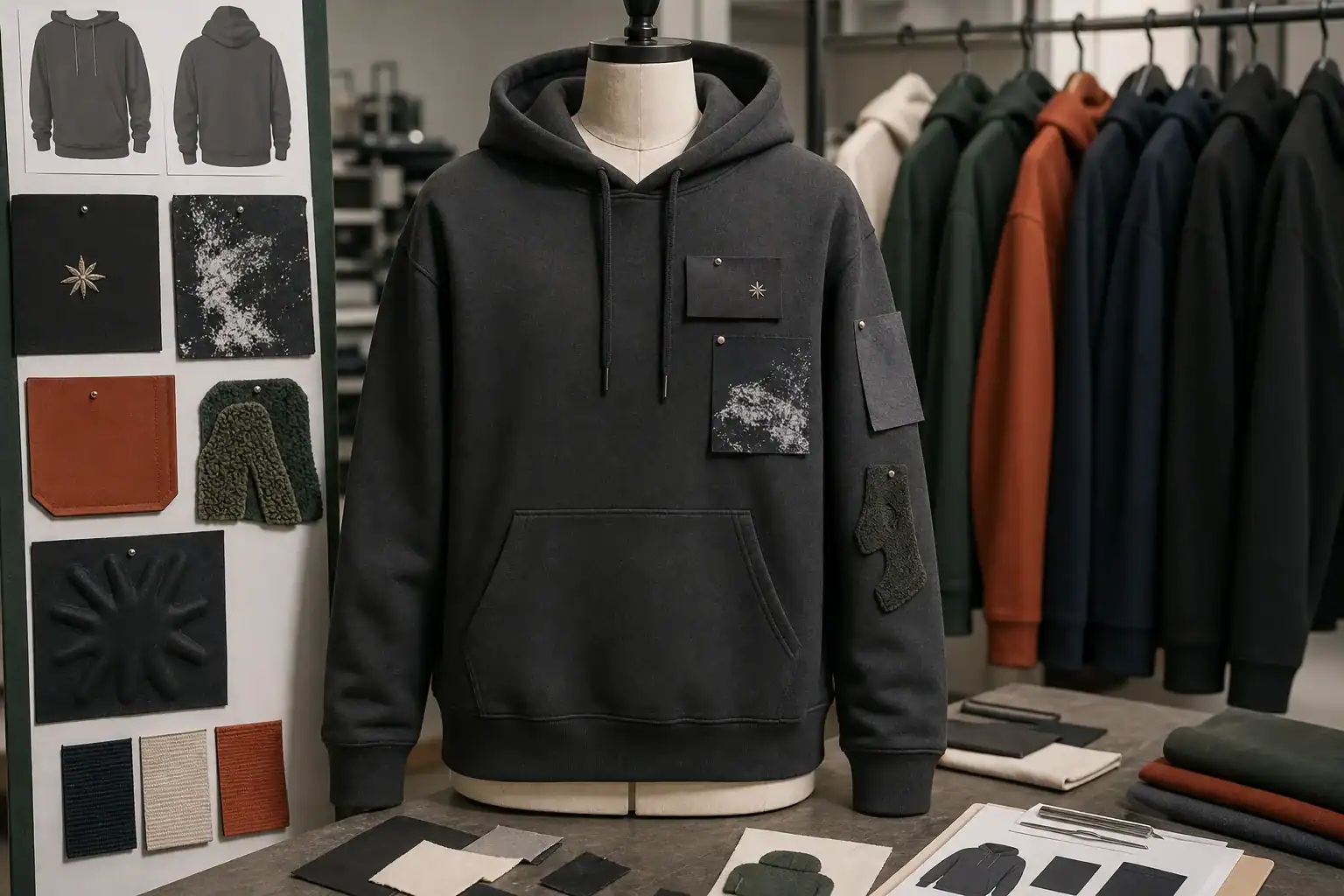
A pullover provides a broad center-front area unless a kangaroo pocket interrupts it. A full zip divides the front artwork and requires alignment across the zipper. A raglan seam reduces the usual upper-sleeve zone, while a drop shoulder creates a different visual center. A cropped body has less vertical space, and a bonded fabric may react differently to heat than fleece or jersey.
For each decoration, provide the file, method, color standard, finished size, placement measured from stable points, and tolerance. State whether the artwork is embroidery, screen print, heat transfer, applique, patch, puff effect, woven label, or another method. Confirm backing, stitch density, ink or adhesive compatibility, stretch, hand feel, care, and whether the inside surface touches skin.
Approve decoration on the actual material and color. A method that works on smooth interlock may sink into brushed fleece or show adhesive marks on a technical face. Large or heavy decoration can also change drape, stretch, and packed weight.
Fabric labeling, care, and test planning
When the destination market is the United States, the FTC apparel-labeling guidance addresses fiber content, country of origin, the identity of the responsible business, and care information. The FTC Care Labeling Rule requires care instructions supported by a reasonable basis. Requirements can differ by market and construction, so final labels should be reviewed for the intended destination.
Testing should answer a known material, construction, claim, or care risk. ASTM D4966 is one named method for abrasion resistance of textile fabrics, while ASTM D3786/D3786M covers hydraulic bursting strength for relevant textile fabrics. ISO 6330 specifies domestic washing and drying procedures used for textile testing. A named method does not provide one universal pass limit for every hoodie. The project still needs the sample condition, test route, target, and acceptance rule.
Possible hoodie checks include dimensional change, spirality, colorfastness, pilling, abrasion, bursting or seam performance, stretch and recovery, zipper function, snap attachment, drawcord security, print or embroidery durability, and appearance after care. Select checks that match the material, claim, destination, and risk instead of attaching a generic test list to every style.
Sampling workflow for a hoodie program
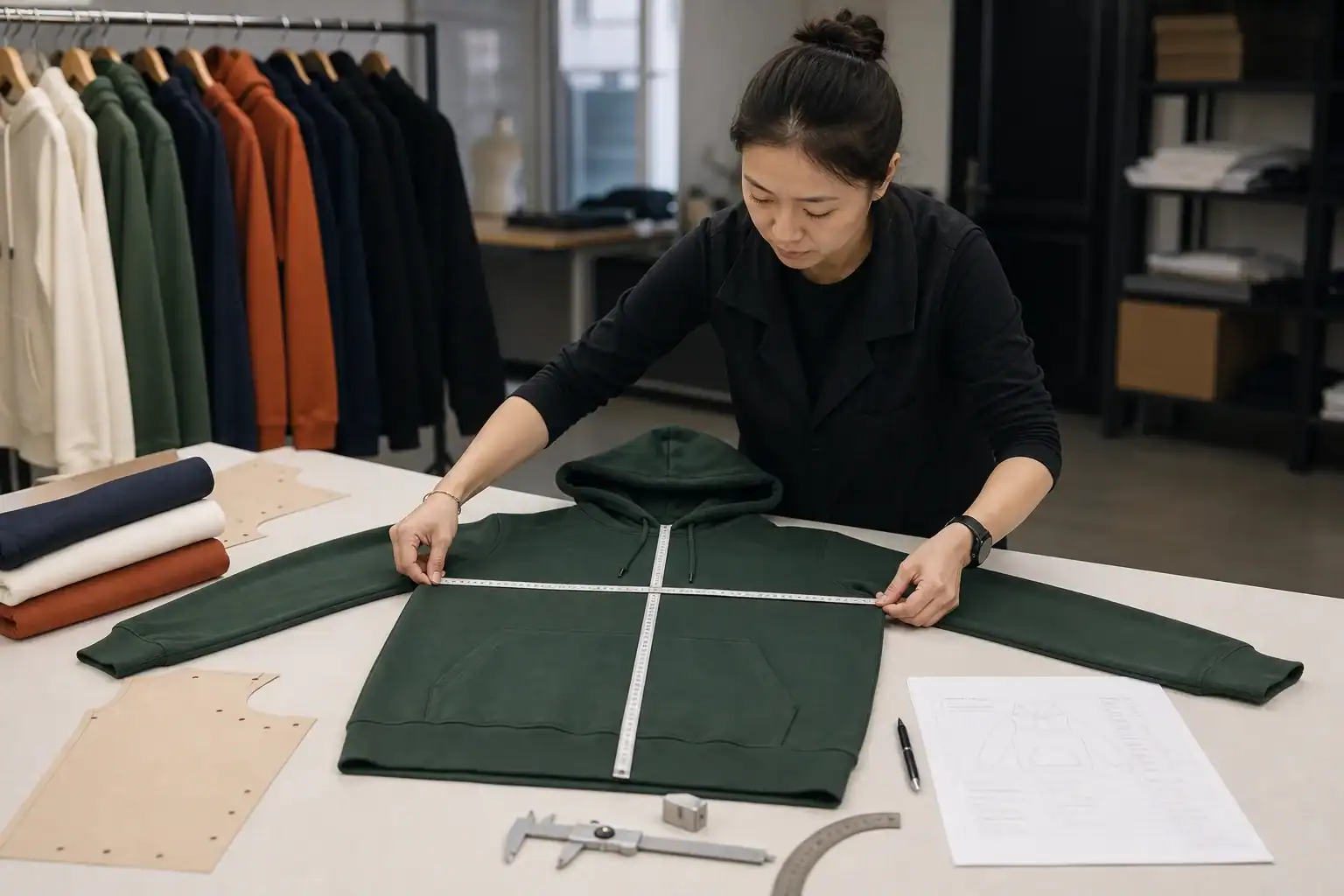
At the first sample, compare the garment with the latest brief and reference size. Measure the body, sleeve, hood, rib, pocket, and opening. Put the sample on the intended fit model and check head entry, arm lift, reach, sitting, layering, pocket access, hood movement, zipper or snap operation, and hem recovery.
Record comments against a version. Replace phrases such as "make it more oversized" or "use a better hood" with a changed measurement, pattern note, material reference, or construction instruction. When a fit change moves the shoulder or body length, review related points such as sleeve reach, pocket position, hood scale, and decoration placement.
At the next sample, confirm the requested changes and watch for side effects. A heavier hood can pull the neckline back. A tighter rib can gather the body. A garment wash can shorten the sleeve. A larger kangaroo pocket can restrict the usable print area. The approval record should include measurements, fabric and trim references, color, artwork, label, care route, and unresolved points.
Hoodie quality-control checkpoints
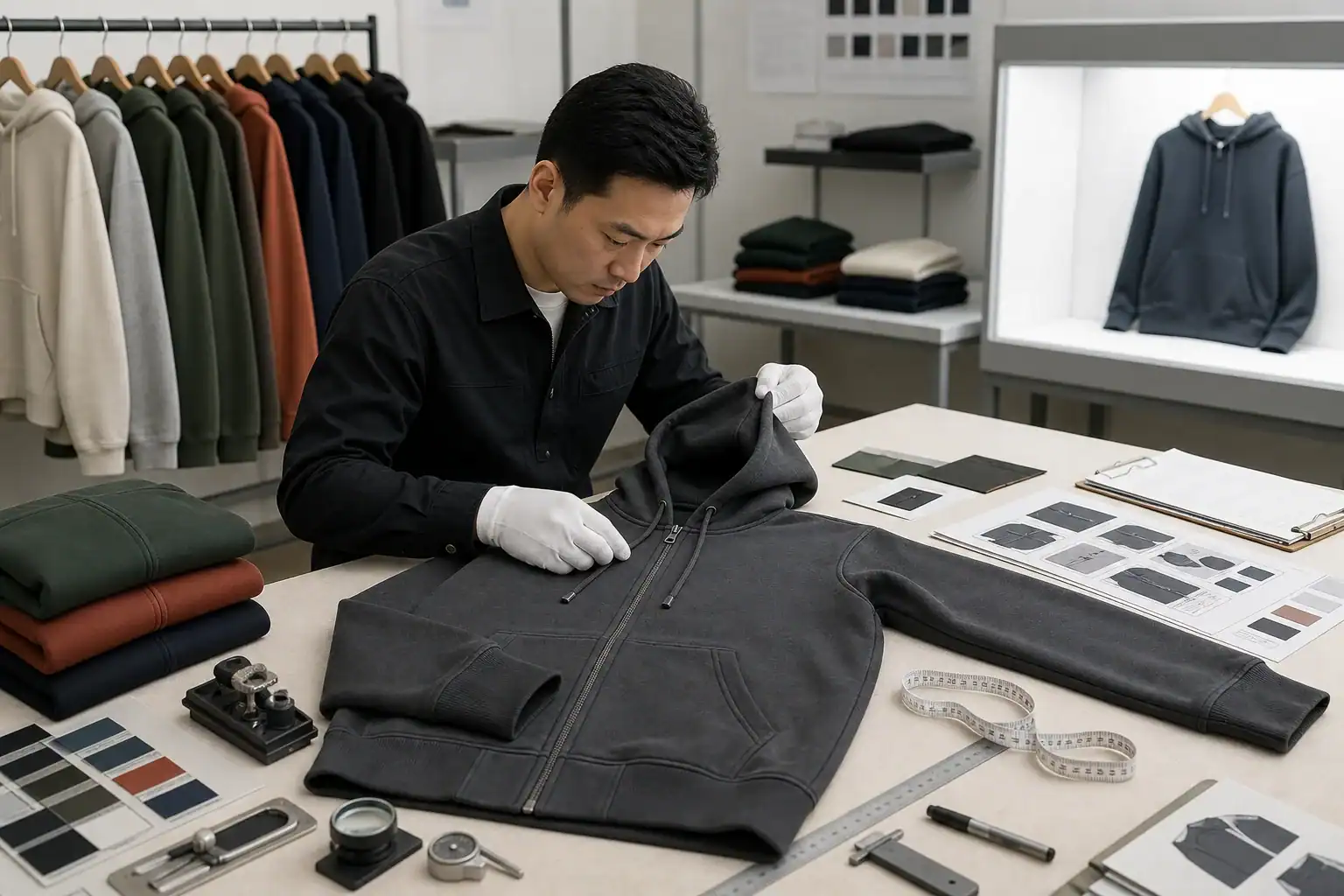
Before bulk approval or inspection, define what is checked and what tolerance applies. A practical hoodie checklist may include:
- garment measurements and grading against the approved chart;
- body balance, shoulder, sleeve pitch, armhole, cuff, hem, and side-seam alignment;
- hood symmetry, panel shape, lining, face opening, drawcord channel, and attachment;
- zipper length, wave, slider operation, stops, tape, snap spacing, and reinforcement;
- kangaroo, welt, side, chest, or hidden pocket dimensions and position;
- rib width, recovery, seam join, cuff opening, and hem gathering;
- fabric shade, surface, brushing, pilling risk, shrinkage, spirality, and appearance after care;
- seam type, stitch appearance, skipped stitches, puckering, loose thread, and reinforcement;
- print, embroidery, patch, transfer, label, and placement against approved artwork;
- fiber, origin, care, size, brand, and other labels required for the destination;
- folding, polybag, size marks, carton assortment, and shipping marks in the approved packing instruction.
DTS outlines separate sampling and prototyping and quality-control routes. Exact sample rounds, inspection level, tolerances, tests, documents, MOQ, cost, and timing remain project-specific and should be confirmed in the quote and approval plan.
What to send for a hoodie quote or sample
Send one organized project brief with the target wearer, use, market, reference size, chosen hoodie type, front and back references, measurement chart, fabric direction, colorways, artwork, trims, labels, packaging, estimated quantity, size range, destination, and target timing.
If the tech pack is incomplete, mark what is fixed and what needs development. For a reference garment, identify the features to follow and the features to change. State whether the priority is fit, hand feel, construction, price position, decoration, performance, or a specific delivery window. That gives the development team a better starting point than a folder of unmarked screenshots.
Frequently asked questions
The main naming groups are opening, fit and body length, sleeve and armhole, hood construction, activity or use, and fabric or finish. Common examples include pullover, full zip, oversized, cropped, raglan, drop shoulder, double-layer, running, fleece, French terry, and garment-washed hoodies. One product can combine several types.
A pullover has no full center-front opening and often uses a kangaroo pocket. A full-zip hoodie opens from hem to neck, divides the front, and changes pocket, decoration, and shrinkage considerations. The full-zip brief also needs zipper gauge, length, tape, puller, stops, and alignment.
An oversized hoodie uses a deliberately balanced pattern with planned shoulder drop, chest volume, sleeve shape, hood scale, body length, pocket position, and grading. Sizing up a regular block changes every measurement together and may create excessive length, low pockets, or sleeves that do not match the intended silhouette.
Neither is universally better. French terry can provide a looped interior and trans-seasonal feel, while brushed fleece can add loft and warmth. The decision depends on climate, activity, weight, drape, surface, stretch, shrinkage, pilling risk, care, and price position. Approve the finished sample, not only the fiber name.
A single-layer hood can reduce weight and material use, while a double-layer hood can add structure, warmth, and a cleaner interior. The right choice depends on fabric weight, reverse-face appearance, desired shape, climate, drawcord, and cost. Check hood balance because a heavy hood can pull the neckline backward.
Common points include chest, waist, hem, body length, shoulder, armhole, bicep, sleeve length, cuff, hood height and depth, face opening, neck, pocket, zipper, and rib. Define how each point is measured, the reference size, tolerance, grade rule, and whether the value is before or after care.
Measure it against the approved chart, then review fit and movement on the intended wearer. Check head entry, hood shape, arm lift, sleeve reach, pocket access, zipper or snap operation, rib recovery, decoration, seams, labels, and appearance after the agreed care route. Record every comment against a sample version.
Provide the target wearer, use, market, type, fit, reference size, measurements or tech pack, fabric direction, colorways, artwork, trims, labels, packaging, quantity, size range, destination, and timing. If information is missing, identify which decisions need supplier input so feasibility, sampling, MOQ, cost, and lead time can be discussed for the actual project.
Build the collection around a clear hoodie brief
A hoodie name helps buyers search and compare, but it does not confirm fit, fabric, performance, compliance, or production readiness. Select the types that match the customer and use. Then record the measurements, hood, opening, sleeve, pocket, material, rib, decoration, labels, care, tests, and approval checks.
If you are preparing a custom hoodie program, send the style references, tech pack or moodboard, target quantity, colorways, size range, destination, and timing through the DTS Activewear inquiry route. The project can then be reviewed for missing specifications before sampling or quoting.