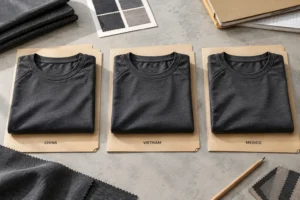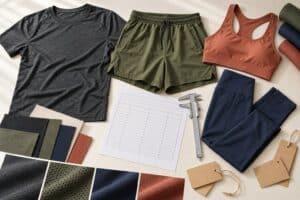
A useful clothing line business plan connects the customer problem to a specific product range, a workable production route, realistic unit economics, and approval gates before inventory is ordered.
Many clothing plans are written as brand stories. They describe the mood, the mission, and the customer, then jump to a sales forecast. That leaves the hardest questions unanswered: which garments will be made, how many versions will be cut, what will the factory need to quote, what will each unit really cost, and what evidence allows the founder to approve production?
This guide treats the plan as an operating document. It is designed for activewear, gym wear, streetwear, private-label apparel, and small clothing brands that need a plan a manufacturer can understand. It does not replace legal, accounting, or market-specific advice. It gives you a clearer brief for those conversations.
If you also need the broader execution sequence for an activewear launch, read how to start an activewear brand. The article below focuses on the planning document that supports sourcing, quotation, sampling, production, and cash decisions.
What a clothing line business plan must decide
A clothing line plan should answer five questions before it tries to forecast growth:
- Who is the first customer, and what clothing problem are you solving?
- Which products will carry the first launch, and what will make them different?
- How will the garments be developed, made, inspected, packed, and delivered?
- What does one sellable unit cost after production, freight, selling fees, and expected returns?
- Which results will make you continue, revise, reorder, or stop?
The U.S. Small Business Administration business-plan guidance provides a useful general structure for company description, market analysis, products, marketing, operations, and financial projections. An apparel plan needs those sections plus garment-level detail. A lender may accept the phrase "activewear collection" as a category. A manufacturer needs style count, fabric direction, size range, quantity assumptions, decoration, labels, packaging, and a sample path.
Use two layers in the same document:
- The business layer explains the customer, offer, channel, pricing, team, marketing, and financial target.
- The product and production layer explains the actual garments, supplier route, approvals, quality checks, and inventory exposure.
The plan becomes useful when the two layers agree. If the business layer promises premium performance but the product layer uses an untested fabric and a generic fit, the story and the product are pulling in different directions. If the financial layer assumes a small run but the production layer requires a large custom fabric minimum, the forecast is not ready.
Start with a customer problem, not a logo
The first page of the plan should define one customer, one use case, and one reason that customer will switch from an existing garment.
"Women who work out" is too broad to guide a first collection. A better starting point identifies the activity and the frustration. Examples include studio customers who want opaque leggings that also work for commuting, recreational runners who need a stable phone pocket, or strength-training buyers who need a longer training short with room through the thigh.

Write the customer statement in a form a product developer can use:
- The customer is a defined wearer with a recognizable activity, budget, and buying channel.
- The customer currently uses an alternative product or avoids a category because of a specific problem.
- The first garment solves that problem through a feature, fit decision, material choice, or service detail.
- The customer can notice the difference without a long technical explanation.
Then collect evidence before writing a large forecast. Useful evidence may include interviews, returns from an existing product, a waitlist, deposits, preorder requests, test sales, or repeated complaints in customer conversations. Social comments can reveal language and objections, but a comment is not the same as a purchase signal.
Ask prospective buyers:
- What do you wear for this activity now?
- What do you replace most often?
- What feature fails first?
- What price feels reasonable for a better version?
- Which size, length, color, or support concern makes online ordering risky?
- Would you switch if the product solved the stated problem?
Record the answers in the plan. Separate what people say they like from what they would buy, test, preorder, or recommend. That distinction keeps a founder from building a large SKU list around polite feedback.
Turn positioning into a product rule
Positioning should change what gets made. If the plan says "technical running basics," write down the performance decisions that follow: pocket stability, sweat exposure, waistband behavior, visibility, seam placement, and wash expectations. If it says "soft studio sets," the decisions may center on hand feel, recovery, opacity, comfort in seated positions, and styling across activities.
Avoid claims such as "premium quality" or "innovative design" unless the plan defines what the buyer will experience and how the team will check it. A specific statement such as "a mid-rise training short with a secure phone pocket and a longer inseam for strength sessions" can guide a sketch, a sample, a product page, and a quality review.

Define the first product capsule and SKU exposure
A first capsule should tell one product story while keeping the number of style, color, size, and trim combinations within the cash and sampling capacity of the business.
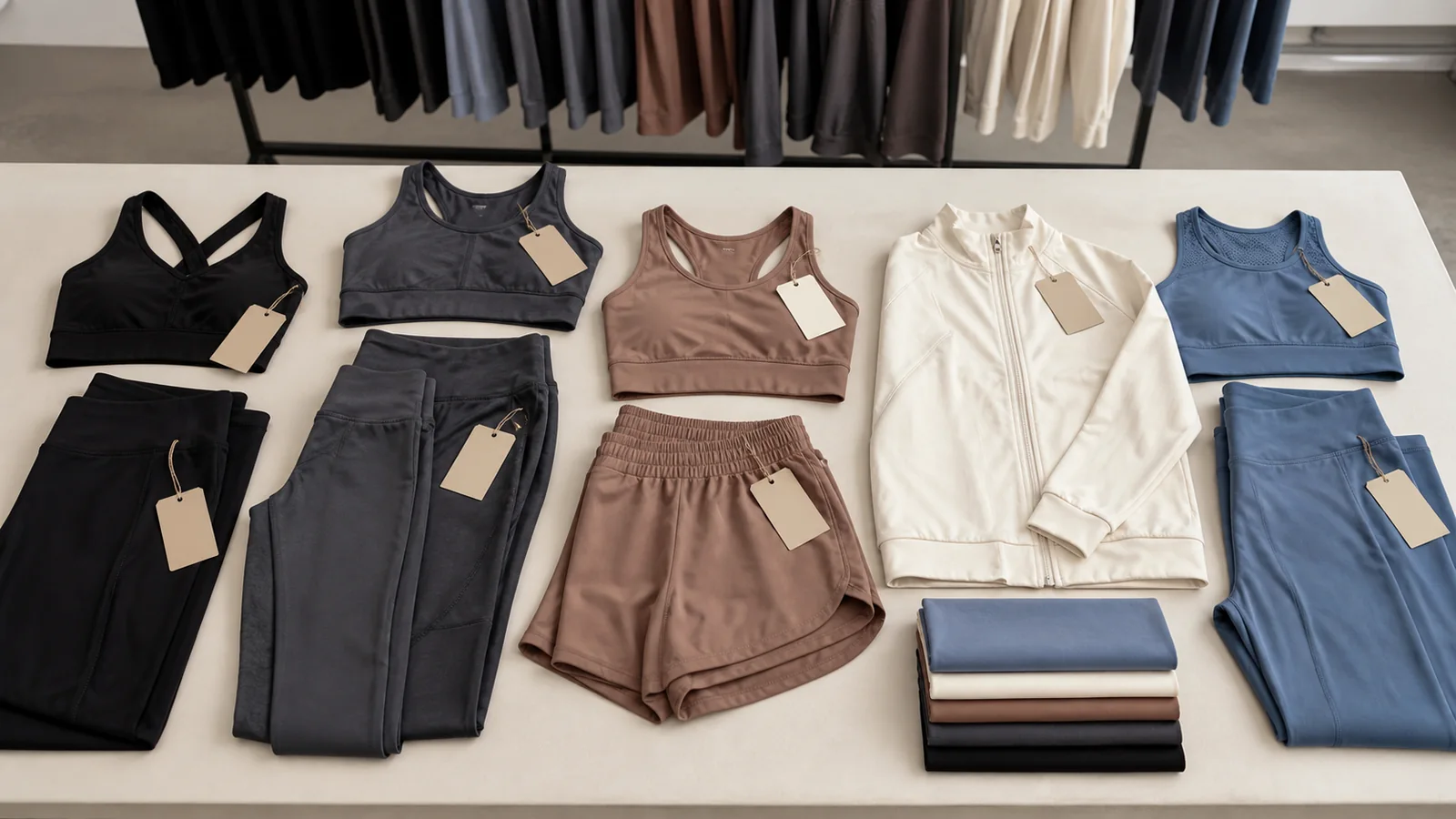
Start with a hero product. Add supporting pieces only when they share a customer, fabric family, activity, or styling purpose. A sports bra, legging, and light layer may work as a studio capsule. A training short, tank, and long-sleeve top may serve a gym collection. A streetwear capsule may share a graphic system and a small set of base garments.
Count the actual SKU cells, not just the number of sketches. Two styles, three colors, and five sizes create 30 sellable combinations. Add a second length, cup option, or print placement and the count changes again. The factory may also apply minimums per style, color, fabric, or size range. Confirm the rule instead of assuming that "100 pieces" describes the whole order.
Use this capsule worksheet in the plan:
- Hero style: the product most likely to explain the brand and attract the first buyer.
- Support style: a garment that increases outfit use or average order value.
- Test style: a limited option used to learn about a new fabric, fit, or feature.
- Color plan: colors supported by customer evidence, not only moodboard preference.
- Size plan: sizes based on the intended customer and the actual measurement chart.
- Reorder logic: the result that would justify another run or a new color.
For each style, write the job it performs, the target customer, the planned channel, the likely price band, the material direction, and the risk. A complicated style with a custom trim, several panels, and a new fabric may deserve a later drop even if it looks impressive in the concept deck. The first plan should make room for learning.
Choose the business model and production route
Your plan should name one primary production route and explain what control, speed, inventory, and cash trade-off that route creates.

Common routes include:
- Print on demand: lower inventory exposure, but less control over fabric, fit, finishing, and packaging.
- White label: a stock garment with branding added; faster to test, but product differentiation may be limited.
- Private label: an existing style with selected changes to fabric, color, trims, fit, or branding.
- Custom cut and sew: more control over pattern, materials, construction, and features, with more sample work and technical risk.
- Small-batch or preorder production: a way to limit the first inventory commitment, with more pressure on communication, scheduling, and unit cost.
The route should match the business advantage. If the brand wins through community, curation, and fast drops, a proven base product may be sensible. If the brand wins through a fit solution, unusual pocket construction, or a sport-specific feature, custom development may be necessary.
Ask a supplier to define the boundary between light customization and full development:
- Which base patterns are available?
- Which measurements can change?
- Can the buyer use stock fabric or select a custom material?
- What changes affect sample cost, MOQ, or lead time?
- Who owns the approved pattern and grading files?
- Which labels, trims, and packaging options have their own minimums?
- Can the supplier reorder the same approved material and construction?
Put the answers in the operations section. Do not write "custom manufacturing" as if it were one fixed service. The exact route determines what the supplier can quote and what the founder must approve.
Turn the product idea into a manufacturer-ready brief
A plan becomes actionable when the product section contains enough information for a supplier to identify missing decisions, recommend a development route, and prepare a comparable quotation.

The brief can begin with a moodboard or reference garment, but it should grow into a technical file. Include the following where available:
- Front, back, and detail flats for each style.
- Points of measure, requested measurements, and tolerances.
- Fit intent, size range, grading direction, and model or wear-test notes.
- Fabric composition, weight or hand-feel target, stretch direction, recovery, opacity, and intended use.
- Construction details for seams, hems, waistbands, pockets, gussets, closures, lining, and reinforcement.
- Artwork files, dimensions, placement, color references, and decoration method.
- Main labels, size labels, care labels, hangtags, packaging, barcodes, and carton marks.
- Planned quantities by style, color, and size.
- Sample stages, testing questions, inspection scope, destination, and target dates.
Do not hide open decisions. Add an "open items" list with an owner and a decision date. If the color is not approved, mark it as pending. If the fabric is a reference only, say so. A supplier should not have to guess which part of a moodboard is a requirement and which part is inspiration.
Use clear version control. A short file name such as brand-name-style-001-tech-pack-v03.pdf is easier to track than a chain of files named final, final2, and final-new. Keep a change log so sample comments do not disappear when the next revision is issued.
The Tech Pack Customization page is a useful internal handoff when sketches, measurements, or construction notes need professional review. If the concept is still rough, the Designer Consultation page is a more appropriate next step than asking for a final quote too early.
Plan sourcing, MOQ, lead time, and supplier questions
The sourcing section should explain how materials and supplier decisions affect the plan, rather than treating production as a single line called manufacturing.

Build a supplier comparison around the same brief. Ask each supplier to state:
- Development route and what is included in the first sample.
- Fabric source, composition, available colors, weight, stretch, recovery, and substitution rules.
- MOQ by style, color, fabric, trim, decoration, and size breakdown.
- Sample fee, revision policy, sample lead time, and courier responsibility.
- Bulk price basis, quantity breaks, payment stages, and quotation validity.
- Production lead-time trigger and the approvals required before cutting.
- Quality-control checkpoints, measurement tolerances, defect handling, and inspection documents.
- Labels, packaging, carton configuration, and shipping assumptions.
- Reorder conditions for fabric, color, trims, pattern, and packaging.
Lead time should be written as a chain, not one optimistic number. The chain may include brief review, quotation, material confirmation, pattern work, first sample, comments, revised sample, testing, purchase order, material booking, cutting, sewing, finishing, inspection, packing, and freight. Any founder approval in the chain can move the date.
MOQ is a business-plan variable. A lower minimum may come with stock-supported materials, fewer colors, existing patterns, or less customization. A custom fabric, special trim, or complex decoration may require a different minimum. Record the exact rule by style and color so the inventory forecast reflects the real order structure.
Do not choose a supplier from a low unit price alone. A cheaper quote with unknown fabric substitutions, missing packaging, no clear sample scope, or an untracked revision process may be more expensive after the first correction. Compare what each quote includes, excludes, and assumes.
Build the cost model from landed units and cash timing
A clothing line business plan needs three financial views: development cash, landed unit cost, and the cash gap between paying suppliers and collecting customer revenue.

Start with the costs that happen before a product can sell:
- Design or consultation time.
- Pattern work and sample rounds.
- Fabric and trim swatches.
- Testing, inspection, or compliance review where applicable.
- Labels, packaging prototypes, photography, and product content.
- Store setup, software, legal, accounting, and insurance costs.
Then model the landed cost of a sellable unit:
- Garment cost.
- Labels, decoration, and packaging.
- Inspection and rework allowance.
- Freight, duty, customs, and inbound handling.
- Fulfillment or storage allocation.
Finally, model the variable cost after the customer orders:
- Payment and platform fees.
- Pick and pack.
- Shipping subsidy.
- Returns and exchanges.
- Customer acquisition cost or creator commission.
- Discounts and damaged-stock reserve.
Use a simple formula:
Contribution per order = selling price - landed product cost - selling fees - fulfillment - expected returns - variable marketing cost
The formula is not a promise of profit. It is a way to show which assumption needs better evidence. If the contribution disappears when returns rise or freight changes, the plan should address sizing, packaging, price, product complexity, or channel choice before production.
Build three cases:
- Base case: the most defensible assumptions from current evidence.
- Slow case: lower conversion or sell-through, later reorder, and extra support cost.
- Upside case: stronger demand, but still capped by production and cash capacity.
Do not let an upside case justify a first order. Use the base or slow case to decide what the business can safely buy. If a founder needs outside funding, the plan should show exactly how the money will be used, when it is needed, and which milestones reduce risk.
Write a sales and launch plan that matches production
The marketing section should connect the first customer, the first product, the launch channel, and the quantity the supplier can actually deliver.

Choose a primary launch channel. It might be a direct-to-consumer store, a creator community, a gym or studio network, a small wholesale test, a pop-up, or a preorder. A plan can include several channels, but each one should have a job and an owner.
For each channel, record:
- Who will see the offer?
- What product problem will the message lead with?
- What proof will the buyer need before ordering?
- Which landing page, product page, or inquiry form will receive the traffic?
- What conversion event will be measured?
- How will the channel affect stock, packing, returns, and customer support?
Make the message specific to the product. "New premium activewear" is difficult to test. "A studio legging with a stable high-rise waistband and verified opacity under stretch" gives the content team a clearer claim to support. Keep the claim within what the sample, label, test, and product page can prove.
Plan launch assets around buyer questions:
- Full garment views and close-ups of construction.
- Measurements, fit notes, model information, and size guidance.
- Fabric composition, hand feel, stretch, opacity, and care instructions.
- Pocket, support, closure, lining, and decoration details.
- Packaging, delivery timing, exchanges, and returns.
If production is delayed, the customer message must change. Do not advertise an exact delivery date while the sample, materials, or purchase order remain open. A realistic launch plan protects the brand from promising an inventory position it does not yet control.
Add sample, quality, labels, and compliance gates
The plan should name the evidence required before production and the person who can approve each gate.
Use a sample gate with four possible decisions:
- Approved for the next stage.
- Approved with documented corrections.
- Revise and resubmit.
- Rejected and reworked through a new development route.
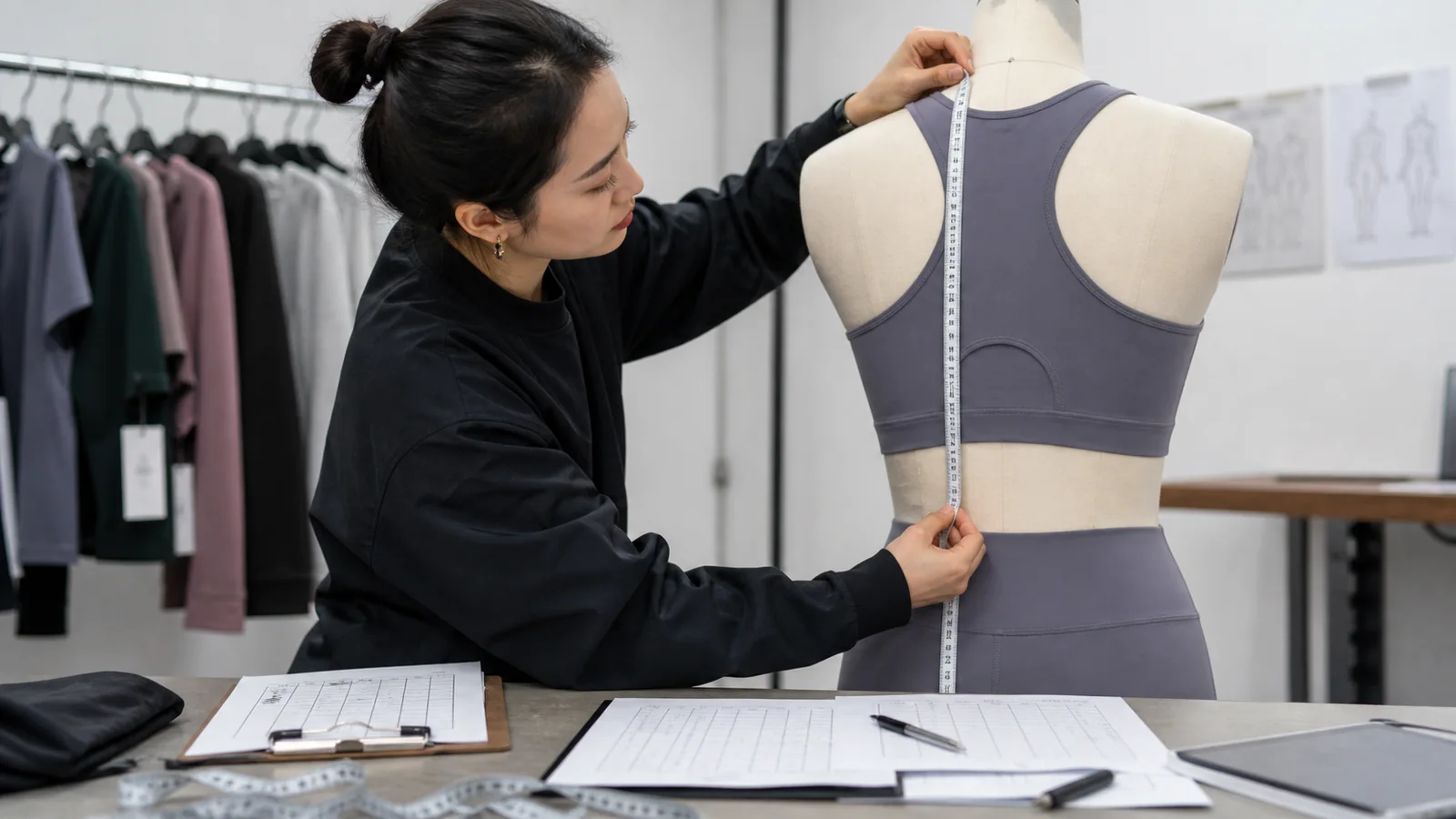
Review the sample against the intended use. Measure the garment using the same points of measure in the tech pack. Test movement with people close to the target size and activity. Check stretch and recovery, seam behavior, opacity, comfort, decoration, labels, care information, and packaging. Photograph the issue and record the requested correction in the next version.
Home checks can screen obvious issues. Formal claims may require a defined laboratory method, controlled conditioning, and market-specific review. Do not state that a garment is compression, antimicrobial, recycled, sun protective, or performance certified unless the product and claim have the evidence required for the intended market.
For United States textile products, the Federal Trade Commission apparel-labeling guidance explains the general need for fiber content, country of origin, and responsible-company information on many textile labels. Care instructions have their own requirements. Other sales markets may require different information. Treat the label as a planned product component, not a last-minute artwork file.
Quality control should focus on the risks in the product. A simple logo tee may need a different inspection emphasis than a high-stretch legging with a bonded waistband. Define measurements, appearance, seam, decoration, shade, packing, assortment, and documentation checks. The Quality Control page can support the internal route, but the exact acceptance criteria belong in the project documents.
Set milestones and approval gates
A launch plan becomes easier to manage when each milestone has an output, an owner, and a reason to stop or continue.
Use a sequence such as:
- Customer and use case: a one-sentence problem statement and supporting demand evidence.
- Capsule: style, color, size, feature, quantity, and price assumptions.
- Supplier route: white label, private label, custom, small batch, or preorder decision.
- Brief: sketches, measurements, material direction, artwork, labels, packaging, and open items.
- Quotation: comparable scope, assumptions, MOQ, timing, payment, and shipping basis.
- Sample: measurement record, movement review, appearance check, and correction log.
- Pre-production: approved sample, material codes, purchase order, inspection plan, and packing files.
- Launch: product page, size guidance, customer communication, fulfillment, and returns process.
- Review: sales, return reasons, margin, stock, defects, customer feedback, and reorder decision.
Do not turn the dates into false certainty. A milestone should move when a sample fails, a fabric becomes unavailable, or a buyer approval is late. The point of the plan is to make the dependency visible early.
Use a simple risk register:
- Risk: the chosen fabric cannot meet the target color or recovery. Response: approve a backup swatch before the first sample.
- Risk: the SKU count creates more inventory than the cash reserve supports. Response: reduce colors or stage the launch.
- Risk: the sample looks right but misses measurements. Response: use a point-of-measure sheet and a recorded fitting.
- Risk: the quote excludes labels, packing, testing, or freight. Response: send a line-item RFQ with one destination and scope.
- Risk: a launch date depends on too many approvals. Response: assign owners and add buffer.
Plan inventory, cash reserve, and reorders
The financial section is incomplete until it explains what happens after the first sale, including slow stock, returns, defects, and the next order.

Map inventory by style, color, size, and channel. A collection can be profitable in total while losing cash in a few slow cells. Set a rule for reorders before the launch, such as a stock threshold combined with observed sales, supplier lead time, and cash available. Do not reorder simply because one size sold out if the rest of the style is not moving.
Track the cash cycle:
- When the supplier deposit is paid.
- When the balance is due.
- When freight and duties are payable.
- When inventory arrives.
- When customers pay.
- When returns and refunds are likely to arrive.
- When the next sample or production deposit must be funded.
Keep an approval record for the final sample, color standard, measurements, labels, packaging, packing list, and inspection result. If a second order changes the material or fit, treat it as a new risk even when the style name is the same.
Use returns as product evidence. "Did not fit" is not enough. Record whether the waist was tight, the rise too short, the length too long, the opening loose, the fabric too sheer, or the size guide unclear. Connect each reason to a possible change in the garment, page, packaging, or customer support process.
Measure the plan after launch
The first collection should produce better decisions, not only revenue.

Review metrics at style, color, size, channel, and customer level where the data supports it:
- Sell-through by SKU and week.
- Gross and contribution margin by channel.
- Return rate and reason by style and size.
- Defect rate and rework cost.
- Conversion rate and average order value.
- Customer acquisition cost or creator commission.
- Repeat purchase, waitlist conversion, and preorder performance.
- Days of stock remaining and reorder lead time.
Do not use one number to describe the whole business. A strong conversion rate can hide a high return rate. A sold-out product can still have weak contribution if freight, refunds, discounts, or support costs were not included. A low return rate can be misleading if the product has not sold enough units to reveal a pattern.
Set review questions in advance:
- Which product problem did buyers recognize and pay to solve?
- Which size or color creates the most friction?
- Which costs differed from the plan, and why?
- Which supplier assumption remained unverified?
- What must change before a reorder?
- Which new style is supported by evidence rather than enthusiasm?
That turns the business plan into a living record. Update the assumptions after each launch rather than writing a new document from memory.
Write the executive summary last
The executive summary should be short enough to read quickly and specific enough to support a decision. Write it after the customer, product, production, channel, and financial sections are settled.
Include:
- The company and the first customer.
- The problem the product solves.
- The initial capsule and development route.
- The launch channel and demand evidence.
- The main production and inventory assumptions.
- The requested funding or cash requirement, if any.
- The milestones that determine whether the business continues or changes direction.
Avoid writing the summary as a promise of rapid growth. State what is known, what is assumed, and what will be tested. A clear summary gives a manufacturer, partner, lender, or team member a usable picture of the project without hiding the open decisions.
Frequently asked questions
There is no useful page count by itself. A short plan can work for a focused first capsule if it explains the customer, products, production route, costs, channel, risks, and milestones. A plan for outside funding, wholesale, or a larger assortment needs more operating and financial detail. Write enough to remove ambiguity, then keep the assumptions easy to update.
Include the customer problem, positioning, product capsule, business model, manufacturing route, sourcing assumptions, MOQ, lead time, marketing channel, financial model, inventory plan, quality gates, labels, risks, milestones, and reorder rules. The manufacturer-facing product section should also include sketches, measurements, material direction, artwork, labels, packaging, and quantity assumptions.
You can write the customer and product sections first, but supplier input improves the operations and financial sections. Ask potential manufacturers what information they need, what affects MOQ and cost, and how they structure sampling. Do not present a supplier estimate as a confirmed quotation until the scope, destination, materials, quantities, and approval assumptions are written and acknowledged.
Choose the smallest range that explains the product idea and gives the customer a meaningful choice. Two to four connected styles may be easier to fit, photograph, fund, and reorder than a wide collection, but the correct number depends on the product, audience, MOQ, and cash reserve. Count every style, color, size, length, and trim combination before approving the range.
No single number is enough. Landed cost shows what the product costs before sale. Contribution shows what remains after variable selling costs. Cash timing shows whether the business can pay suppliers, freight, refunds, and the next order before revenue arrives. Use all three, then stress-test them with slower sales, higher returns, and a delayed launch.
Send the same product brief to each supplier and compare the same fields: development route, materials, sample stages, MOQ, unit price, labels, packaging, quality checks, lead-time trigger, payment stages, shipping basis, and reorder conditions. Ask follow-up questions when a quote is vague. The lowest unit price is not a comparable offer if it excludes important work.
Approve it only after the product specification, sample, materials, quantity breakdown, labels, packaging, inspection criteria, payment terms, and delivery assumptions agree. The sample should pass the written measurements and intended-use review. If a known issue is left for bulk production without a measurable correction and verification step, the order is not ready.
DTS can review a product brief, moodboard, reference garment, sketch, or tech pack and identify the information needed for apparel development, sampling, quotation, and production discussion. Use the Inquiry and NDA route for a confidential project brief. Keep MOQ, cost, lead time, material, certification, and production claims project-specific until they are confirmed in writing.
Turn the plan into a manufacturer-ready brief
The next useful step is not another paragraph of brand story. It is a brief a product team can question and a manufacturer can quote.
Write down the target customer, activity, hero product, connected styles, size range, quantity range, target market, price target, destination, launch window, fabric direction, artwork, packaging, and open questions. Add the evidence behind the demand assumption. Mark unknown items instead of filling them with optimistic guesses.
Then ask for a structured review. You want to know which production route fits the project, which changes affect MOQ or cost, what the first sample includes, which tests or labels need review, and what information must be approved before bulk cutting. That response is more useful than a generic statement that a supplier can make clothing.

If you are ready to discuss a first capsule, send your clothing line brief through the inquiry page. Include sketches or reference products, target quantities, preferred destination, and the questions you need answered. Keep the final order decisions tied to the approved specification and written project response.