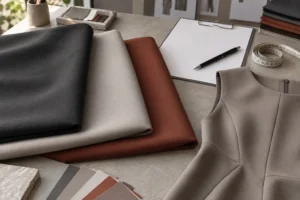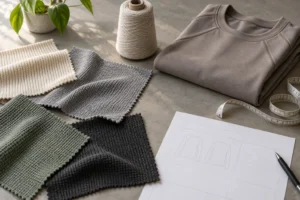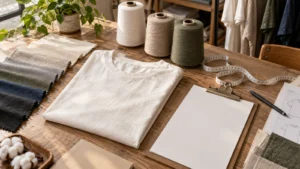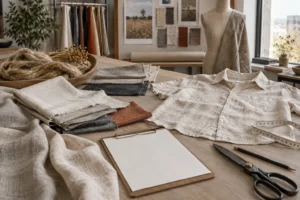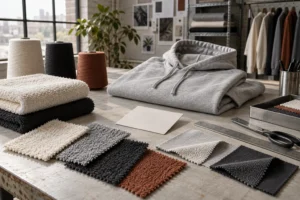
Knit fabric is a textile made from intermeshed loops of yarn rather than the over-under intersection used by a basic woven fabric. That looped construction can give a garment useful stretch, drape, recovery, softness or breathability, but the result depends on the fiber, yarn, stitch structure, finishing route and garment pattern. For apparel buyers, the useful question is not simply whether a fabric is knit. It is which knit structure meets the fit, weight, recovery, care and production requirements of the garment.
This guide explains knit fabric in plain language, compares the main knit families, and turns the technical choices into fields that a product developer can put into a tech pack. It also shows what to check during sampling before approving a bulk fabric or finished garment.
What is knit fabric?
Knit fabric is formed by drawing yarn into connected loops. The loops can be made across the fabric width in weft knitting or along the fabric length in warp knitting. In either route, the intermeshed structure is the defining feature. Cotton, polyester, nylon, rayon, wool, elastane and blended yarns can all be used in knit fabrics, so knit is a construction description, not a fiber name.
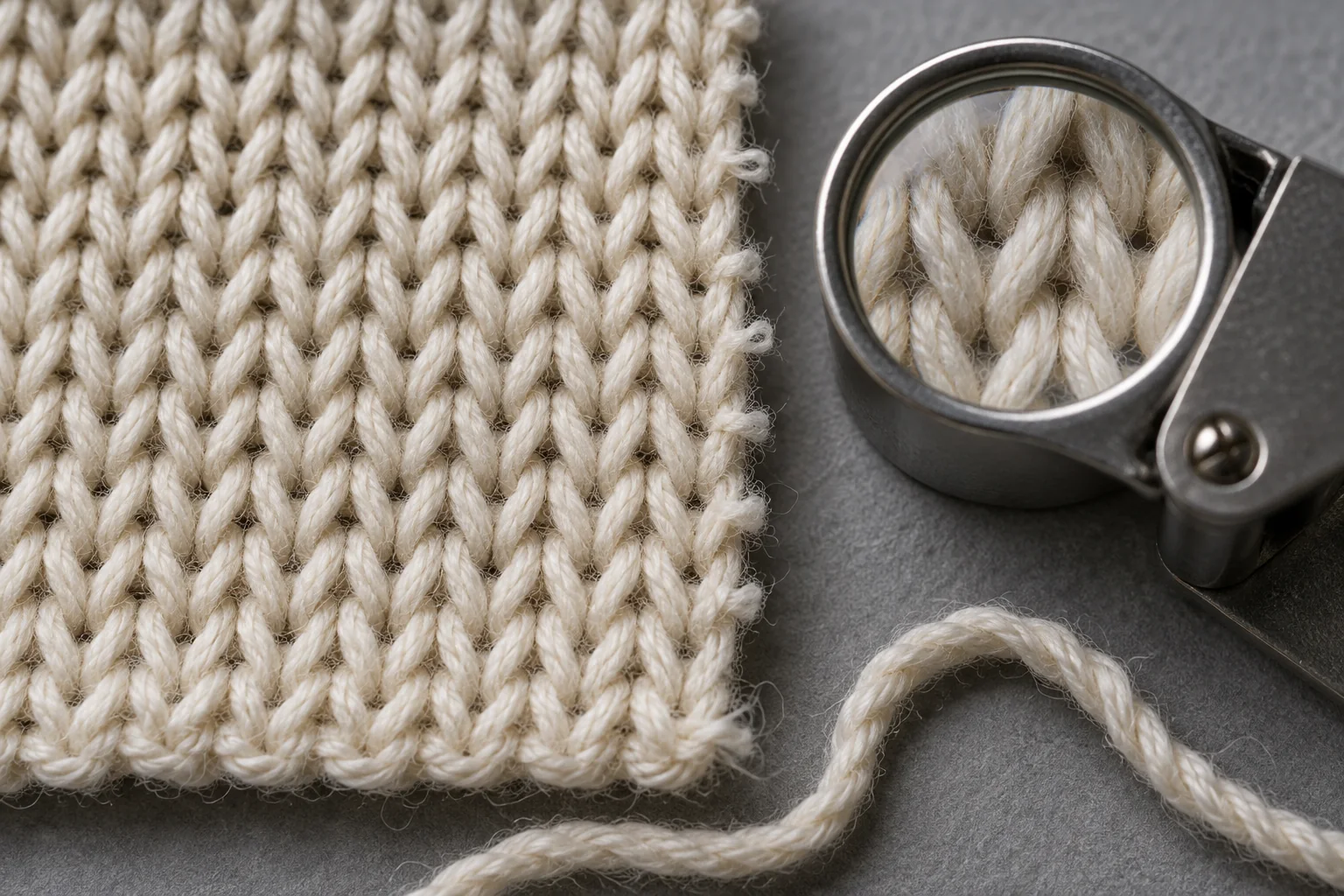
The two basic directions in a weft-knit fabric are often described as courses and wales. A course runs across a row of loops. A wale runs in the lengthwise direction. Changing the yarn, stitch, machine setting, gauge, finish or relaxation condition can change the density, hand feel, weight, width, stretch and stability.
Knitting systems commonly use knit, tuck and float stitches. A fabric can look simple on the face while its back, loop geometry and finishing history create very different behavior. This is why a supplier sample described only as "soft knit" is not a complete specification. CottonWorks explains the loop, course, wale and stitch basics in more technical detail.
| Buyer field | What it describes | Why it matters |
|---|---|---|
| Fiber and yarn | The raw material and yarn form | Influences hand feel, strength, moisture behavior, pilling risk and care route |
| Knit structure | Jersey, rib, interlock, terry, fleece, pique, mesh or another construction | Helps predict stretch, surface, thickness, appearance and end use |
| Courses and wales | Loop density in the two main directions | Provides a more useful construction reference than a generic fabric name |
| Finished GSM and width | Weight and usable fabric dimensions after finishing | Affects pattern yield, garment weight, cost and fit balance |
| Stretch and recovery | Extension and return under a defined test method | Helps prevent a garment that grows, bags out or feels restrictive |
Knit fabric vs woven fabric
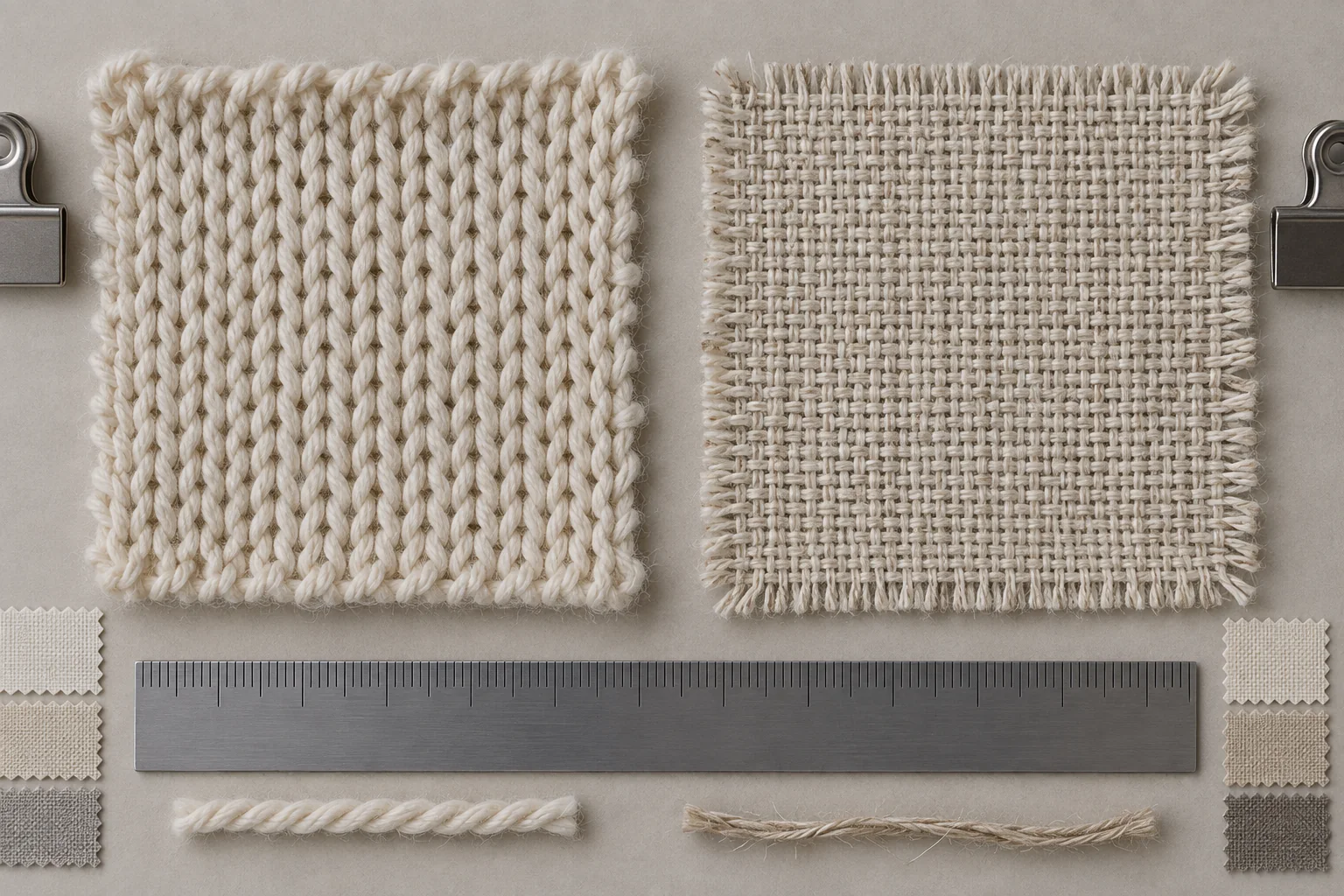
Knit and woven fabrics can both be made from the same fiber, yet they can produce different garments. A woven fabric is made by interlacing warp and weft yarns. A knit fabric is made from loops. The construction changes how the material bends, stretches, frays, drapes, recovers and responds to laundering.
The comparison below is a starting point, not a substitute for testing the actual fabric. A stabilized interlock may behave more firmly than a lightweight woven, while a high-stretch knit may need more pattern control and seam engineering than a rigid woven. Fiber, yarn, finishing and construction can override a simple category assumption.
| Decision point | Knit fabric | Woven fabric | Buyer implication |
|---|---|---|---|
| Stretch source | Loop geometry, elastane, yarn and finish can all contribute | Usually comes from fiber, yarn, mechanical give, elastane or a special construction | Specify the direction and test condition instead of promising a universal percentage |
| Drape and hand | Often flexible and body-following, depending on weight and structure | Can be crisp, fluid, structured or soft depending on yarn and weave | Approve a sewn panel instead of relying on a loose swatch |
| Edge behavior | Some knits curl, roll or ladder when cut | Many wovens fray at cut edges | Plan seam allowance, edge finish and cutting controls |
| Dimensional change | Relaxation, shrinkage, skew and growth may be important | Dimensional change also occurs, but the risk profile differs | Test after the intended care route before grading a pattern |
| Typical apparel roles | Tees, leggings, base layers, sweatshirts, polos, underwear and stretch lifestyle garments | Shirts, trousers, jackets, uniforms, woven dresses and structured outer layers | Select based on garment movement and appearance rather than category alone |
For a practical comparison of construction routes, CottonWorks describes single and double knits and explains why jersey, pique and related structures should not be treated as interchangeable.
The main knit fabric families
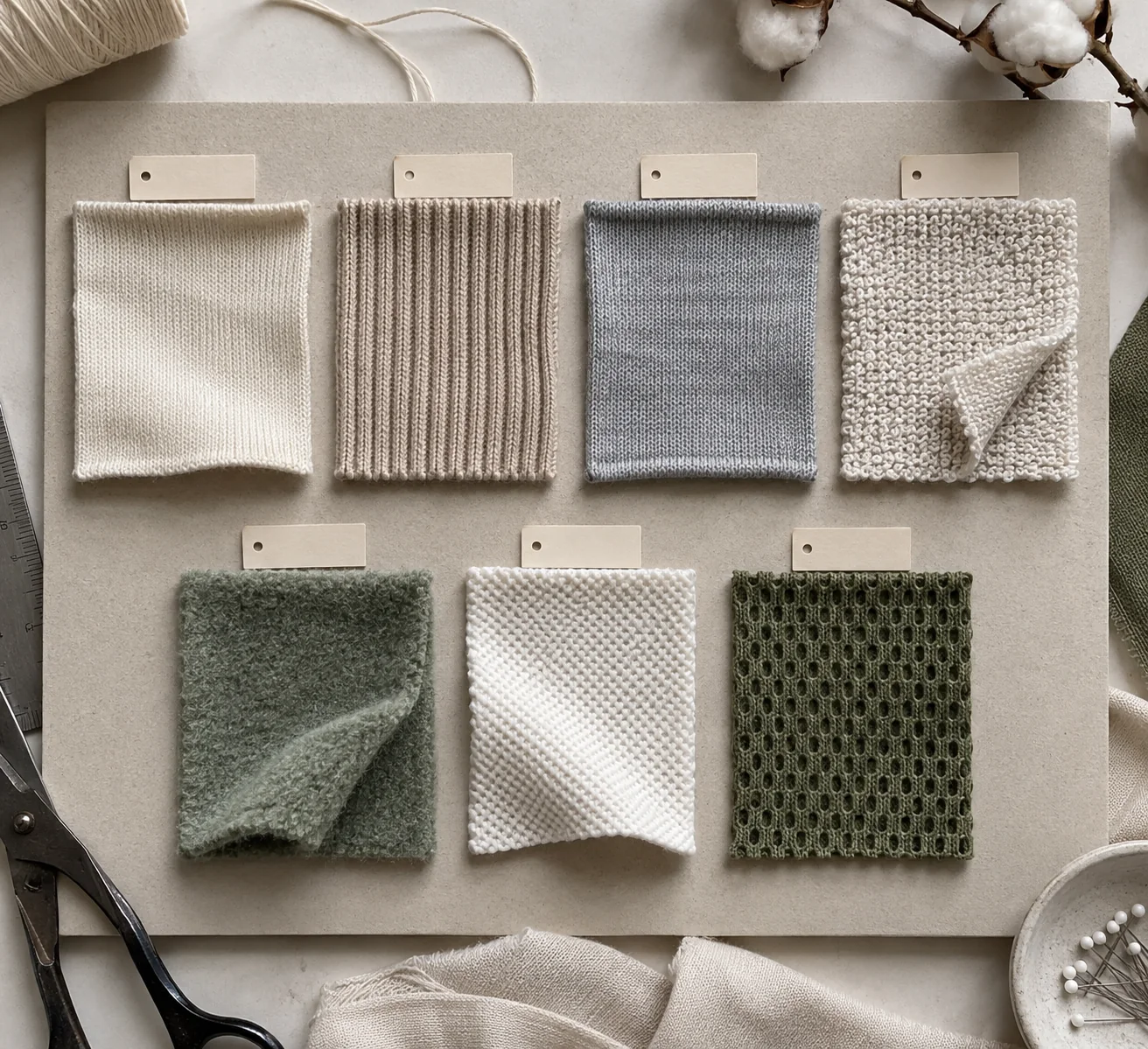
The names below are useful buyer shorthand, but each name still needs a construction and performance specification.
- Jersey is commonly a single-knit structure with a recognizable face and back. It is widely used for T-shirts, tanks, base layers and casual tops. Its weight, edge curl, opacity and recovery can vary significantly.
- Rib knit uses vertical rib columns and is often selected for cuffs, neckbands, waistbands, fitted tops and body-hugging details. Rib may stretch more readily in one direction than another, so the direction of cut matters.
- Interlock is a double-knit structure with a smoother, more stable appearance on both sides than many lightweight single knits. It is used when a buyer wants body, opacity or a clean surface, but the exact result depends on yarn and finishing.
- French terry has a smoother face and looped or lightly textured back. It is common in sweatshirts, joggers, shorts and lightweight layering pieces. Loop size and finishing can change absorbency, bulk and surface appearance.
- Fleece generally has a knit base with a brushed or otherwise raised back. The warmth, shedding, pilling and bulk depend on the base construction, fiber, brushing and finishing.
- Pique uses a textured knit construction often associated with polos and structured casual tops. The texture and stability should be approved against the intended collar, placket and body pattern.
- Mesh can refer to open or engineered knit constructions used where airflow or visual texture is needed. Open area, snag resistance, opacity and seam behavior must be evaluated for the actual garment.
- Tricot and other warp knits are made along the lengthwise direction and can be selected for lingerie, linings, sportswear or technical applications. They should not be assumed to behave like a weft-knit jersey.
Jersey, rib and interlock: the buyer decision
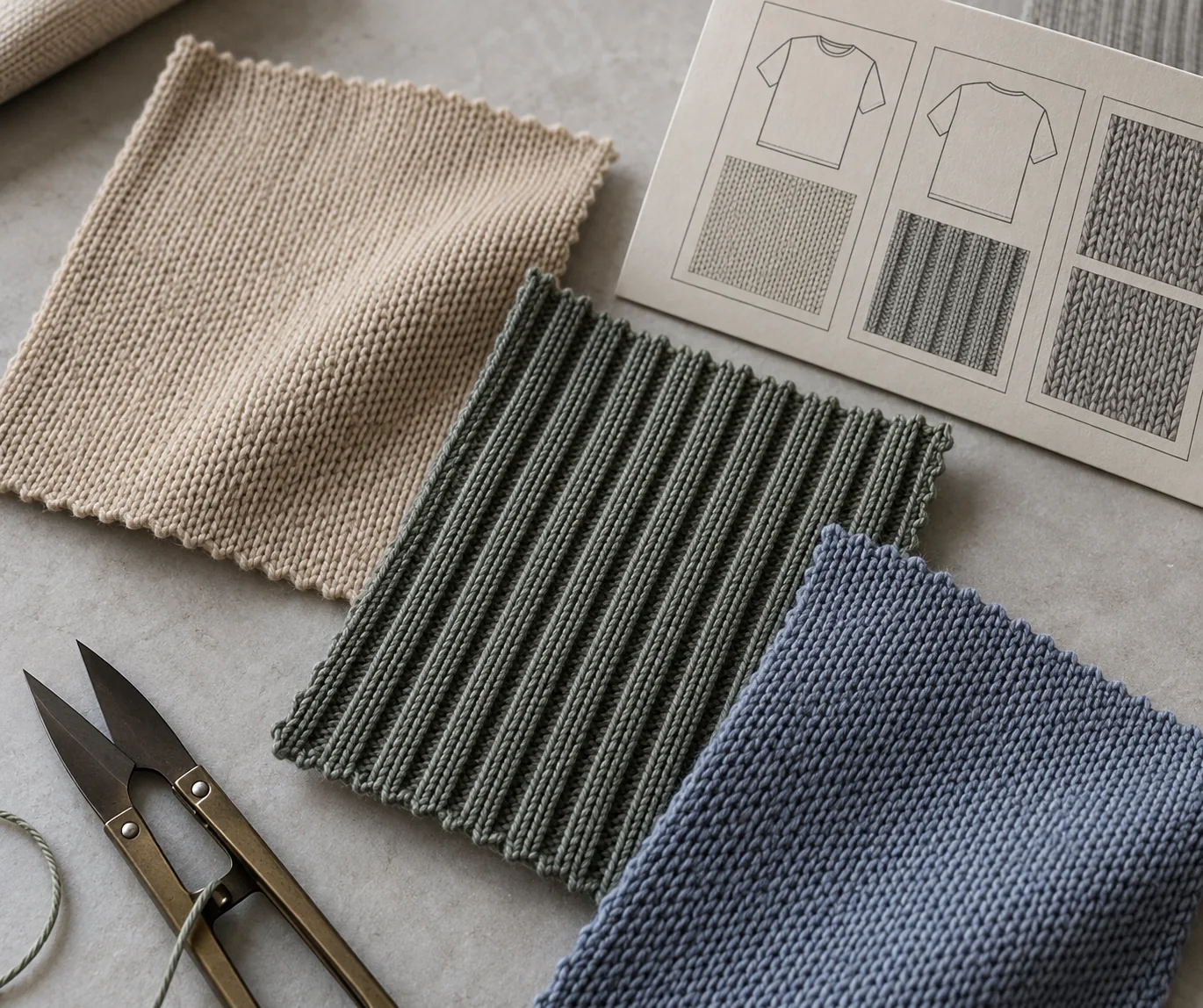
Jersey, rib and interlock are often compared first because all three appear in everyday apparel. Their names do not tell a buyer the final GSM, opacity, stretch, recovery or shrinkage. The same fiber can produce very different results in each structure.
| Knit family | Visual or construction cue | Common apparel use | Questions to answer before sampling |
|---|---|---|---|
| Jersey | One face and one back, usually a light single-knit appearance | T-shirts, tanks, base layers and casual tops | Does the edge curl? Is the body opaque enough? What are the widthwise recovery and growth after wear? |
| Rib | Ribs or wales create a visibly columned surface | Cuffs, neckbands, waistbands and fitted garments | What is the relaxed width? How much does it extend? Does it recover after repeated extension? |
| Interlock | Double-knit construction with a stable, smooth hand | Premium tees, babywear, leggings or structured casual styles | Is the fabric too warm or heavy for the use? How does it behave after laundering and pressing? |
| French terry | Smooth face with loops on the back | Sweatshirts, joggers, shorts and lightweight layers | What is the loop height, back appearance, shrinkage and pilling risk? |
| Pique or mesh | Textured or open construction | Polos, panels, inserts and airflow zones | Are opacity, snag resistance, seam support and pattern placement acceptable? |
Choose the structure first, then verify the fiber and yarn. A fabric label such as "cotton knit" is not enough to define whether a T-shirt will be lightweight and drapey, dense and smooth, or unstable after washing.
French terry, fleece, pique and mesh
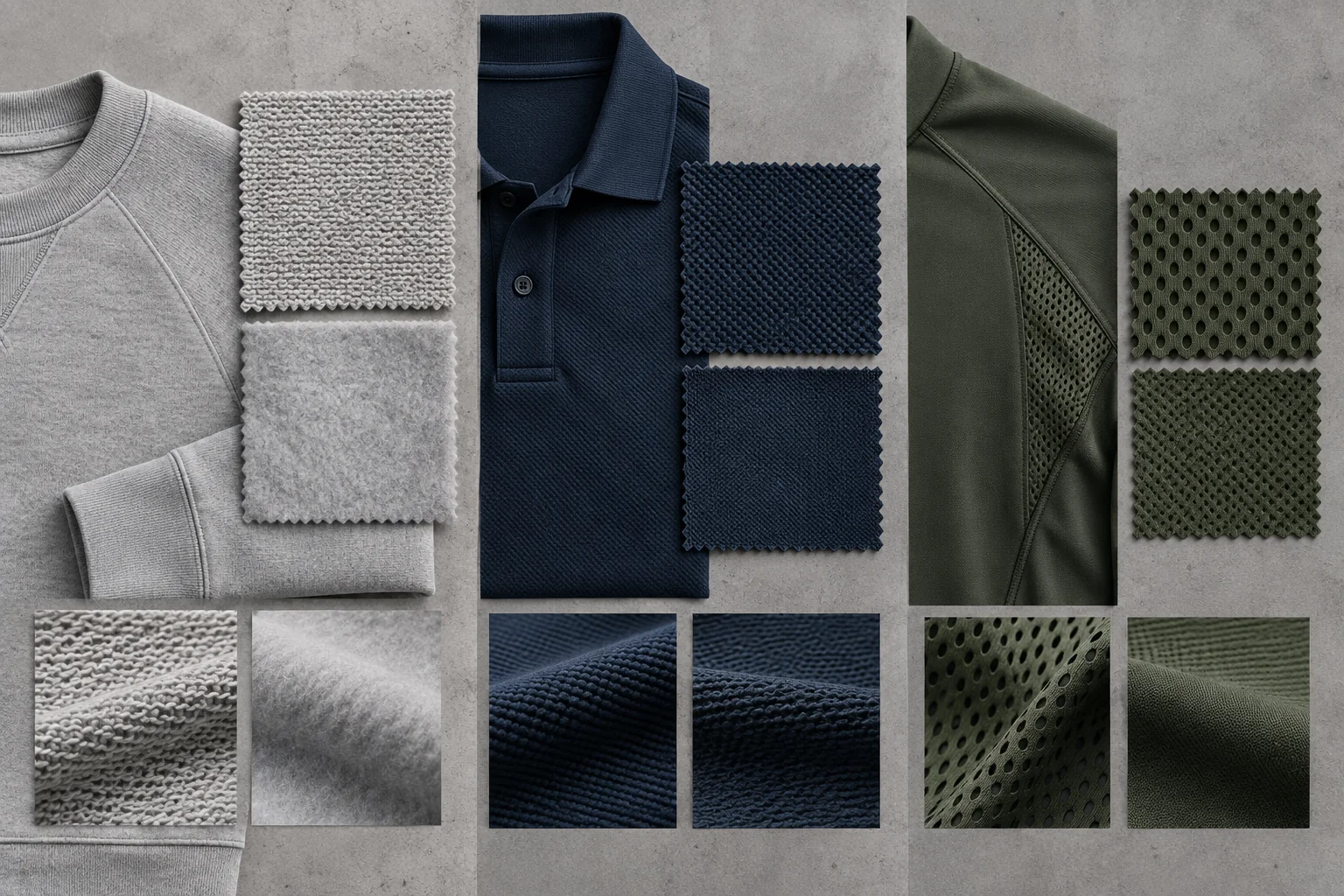
Back-surface design is especially important in sweatshirt and activewear development. French terry may retain visible loops, while fleece may be brushed to raise the back. Brushing changes the hand, warmth, thickness and possible shedding or pilling behavior. A buyer should request a finished swatch, not assume that "fleece" describes one fixed weight or warmth level.
Pique and mesh also need a use-specific review. A polo fabric may need enough stability for a collar and placket. An open mesh panel may need a lining, a backing layer or a seam design that protects the opening. In sportswear, airflow is only one part of the decision. Opacity, snag resistance, sweat visibility, recovery and wash appearance may be equally important.
Before sampling, photograph or label the face and back, record the intended orientation, and keep the approved swatch with the tech pack. This avoids a common production error in which the back surface, brushing direction or mesh orientation is reversed.
Weft knit and warp knit are different routes
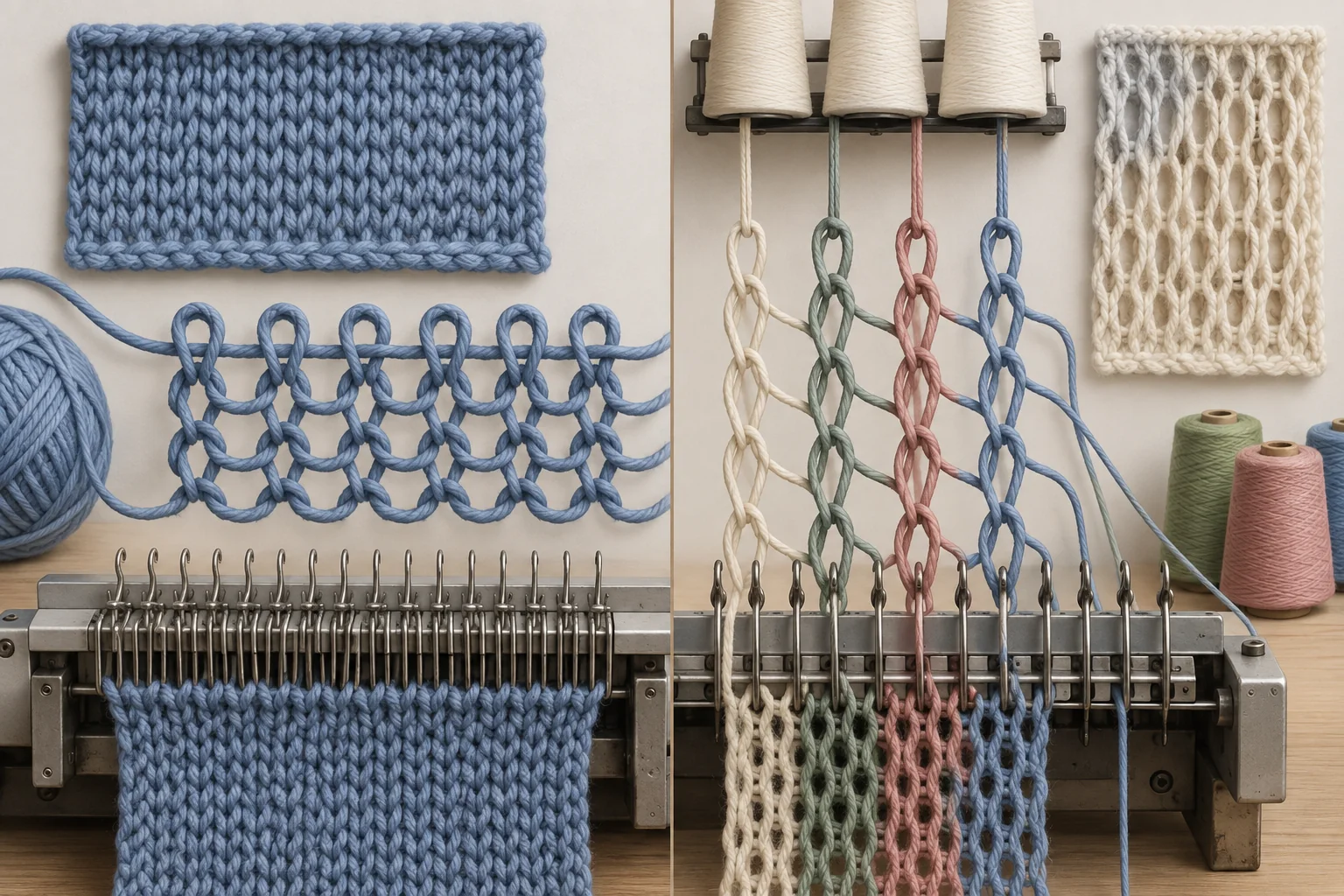
Weft knitting forms loops across the fabric width, while warp knitting forms loops along the fabric length. This difference affects the way a fabric can be engineered and how it may respond to stretch, laddering, run resistance, edge stability and pattern cutting. The exact performance still depends on the machine, yarn, stitch, finishing and fabric design.
For a garment buyer, the practical lesson is to name the knit route when it is important to the product. If a sportswear panel, lining or lingerie component requires warp-knit behavior, do not replace it with a generic jersey simply because both are called knit fabric. Ask for the construction description, finished swatch and relevant test evidence.
How fiber, yarn and construction change performance
Knit fabric performance is the result of a system. Fiber affects moisture behavior, strength, heat response, softness, static, color and care. Yarn size and spinning affect surface, density and evenness. The knit construction controls loop geometry and stability. Finishing can add or remove bulk, change the hand, stabilize dimensions, raise a surface or alter color appearance.
This is why "polyester knit" does not identify one performance profile. A fine polyester jersey for a lightweight top, a brushed polyester fleece for a warm layer and a dense polyester interlock for leggings may share a fiber family but require different pattern, seam, testing and care decisions.
Designing knit textiles is a useful technical reference because it connects yarn and knit construction to weight, cost, productivity and finished fabric performance. For a product team, the actionable habit is to keep the fiber, yarn, construction and finish fields separate in the specification.
How much stretch does knit fabric have?
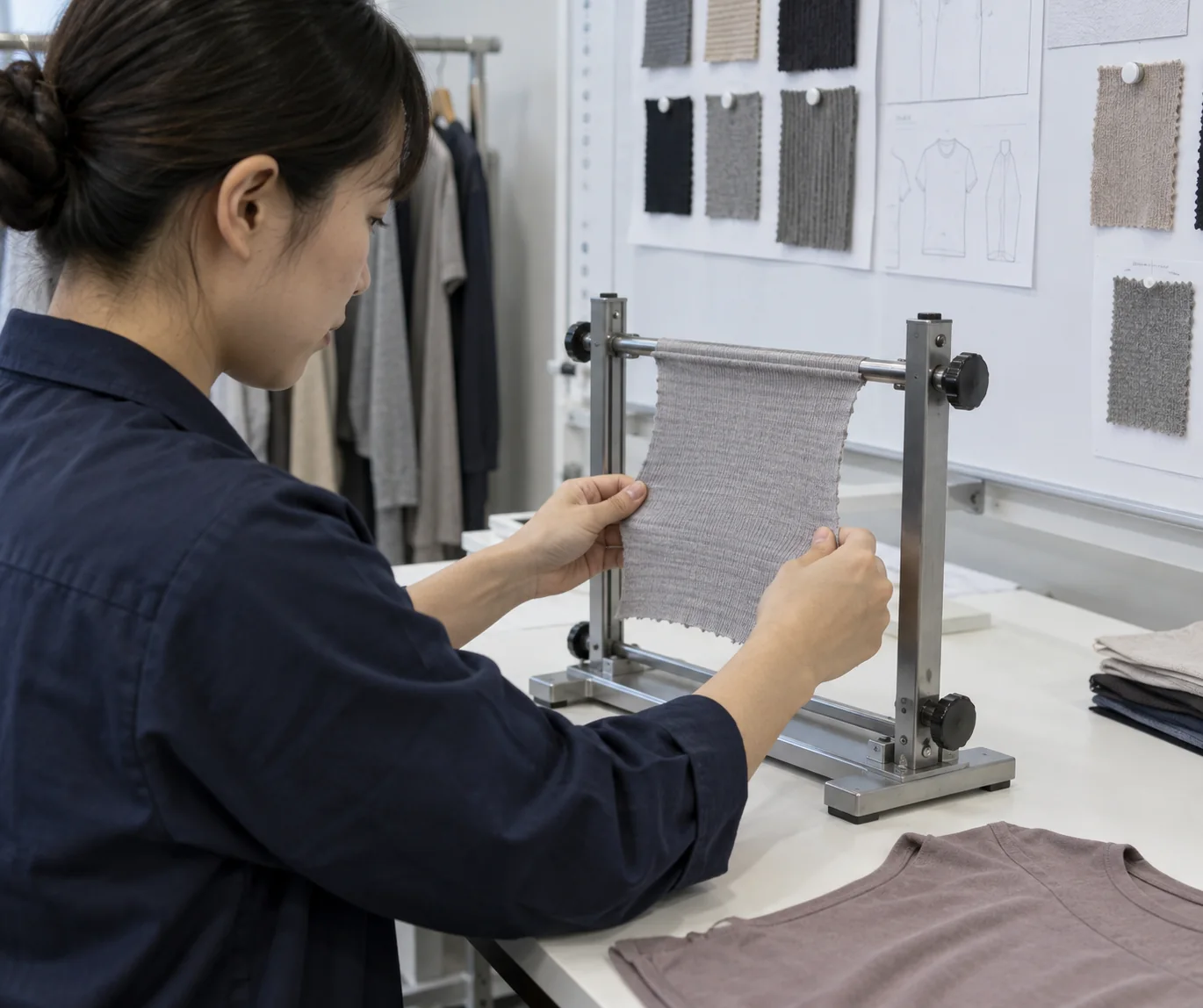
Some knit fabrics stretch readily, while others are relatively stable. Stretch may come from loop geometry, elastane, yarn selection, finishing or a combination. It can also be different in the widthwise and lengthwise directions. A fabric may extend under force but fail to recover fully, causing a neckline, waistband or knee area to grow during wear.
Do not place a single stretch percentage in a generic product brief. Define the test direction, specimen size, applied force or extension method, relaxation time, number of cycles and recovery reading. If the fabric will be used in a close-fitting garment, test the fabric together with the seam, elastic, lining or panel construction.
| Test or observation | What to record | Product risk it helps reveal |
|---|---|---|
| Widthwise extension | Direction, specimen, method and extension result | A garment may feel restrictive or over-expand across the body |
| Lengthwise extension | Direction and result after the defined loading | Body length or rise may change during wear |
| Recovery | Reading after a defined rest period or repeated cycles | Necklines, waistbands and knees may bag out |
| Growth during wear simulation | Change after movement, loading or repeated extension | A good first stretch result may not predict retained shape |
| Seam and panel review | Seam type, stitch, seam allowance and fabric layer | Fabric can pass a flat test but fail at a neckline, gusset or waistband |
The exact method should match the garment risk and customer requirement. Keep the laboratory or internal test record with the approved sample rather than relying on a supplier adjective such as "four-way stretch."
GSM, width, gauge, courses and wales
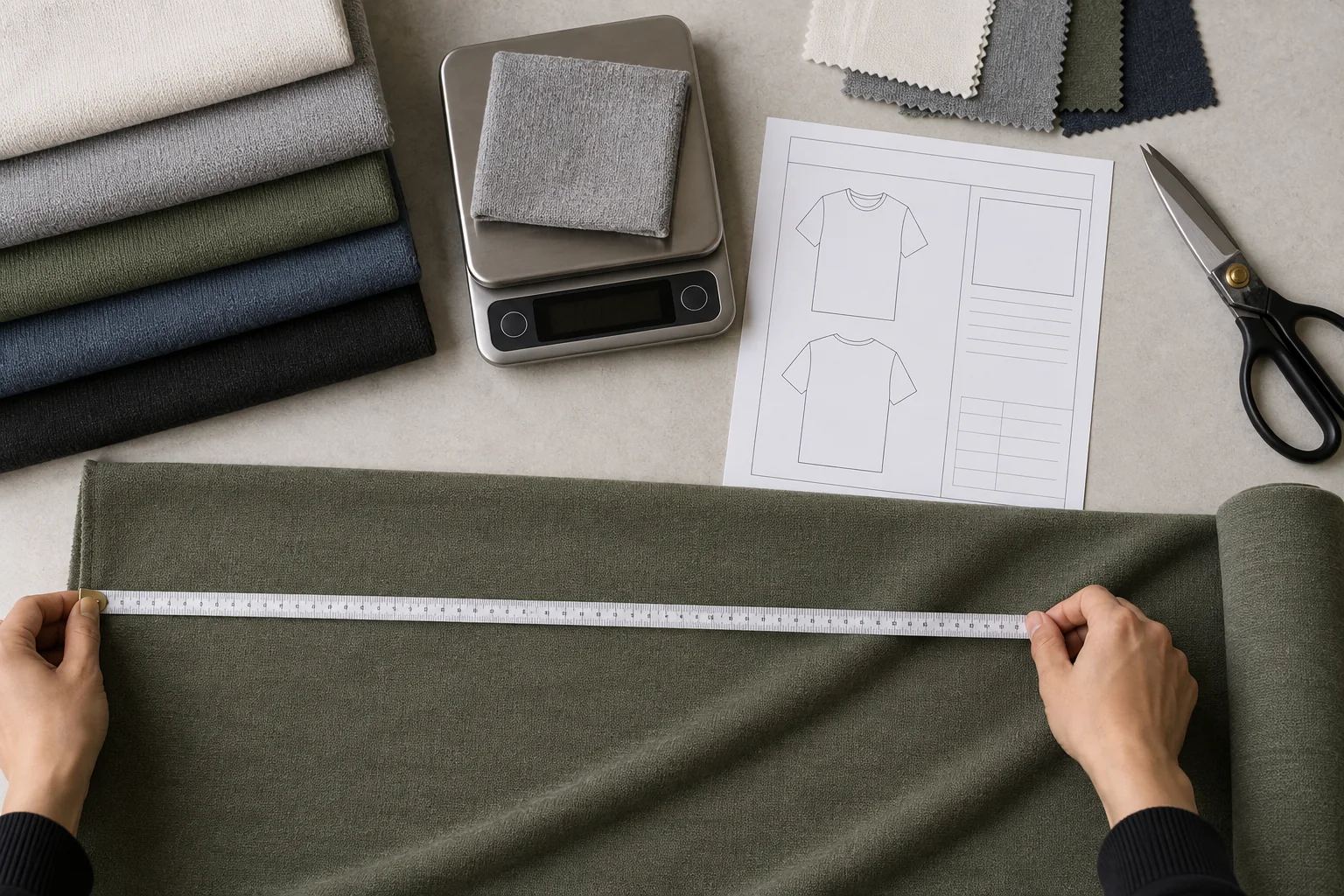
GSM means grams per square meter. It is useful for comparing finished fabric weight, but it does not by itself describe warmth, opacity, stretch or quality. Two fabrics at a similar GSM can feel and perform differently because their fibers, yarns, loop structures and finishes differ.
Record GSM in a defined condition, such as after the specified finishing and relaxation route. Record usable width separately from edge-to-edge width if the selvedge or tubular edge is not usable for the pattern. If the garment is cut from a tube, note the actual open or tubular form and how the pattern will be placed.
Gauge describes the fineness or needle density of a knitting machine. Courses and wales give a more direct construction reference for many weft knits. These fields help a technical team compare a replacement fabric, but they should be used alongside the approved swatch and performance requirements.
Avoid approving a replacement solely because it matches the target GSM. If it has a different width, recovery, opacity, surface, shrinkage or hand, the garment can change even when the scale reading looks similar.
What is knit fabric used for?
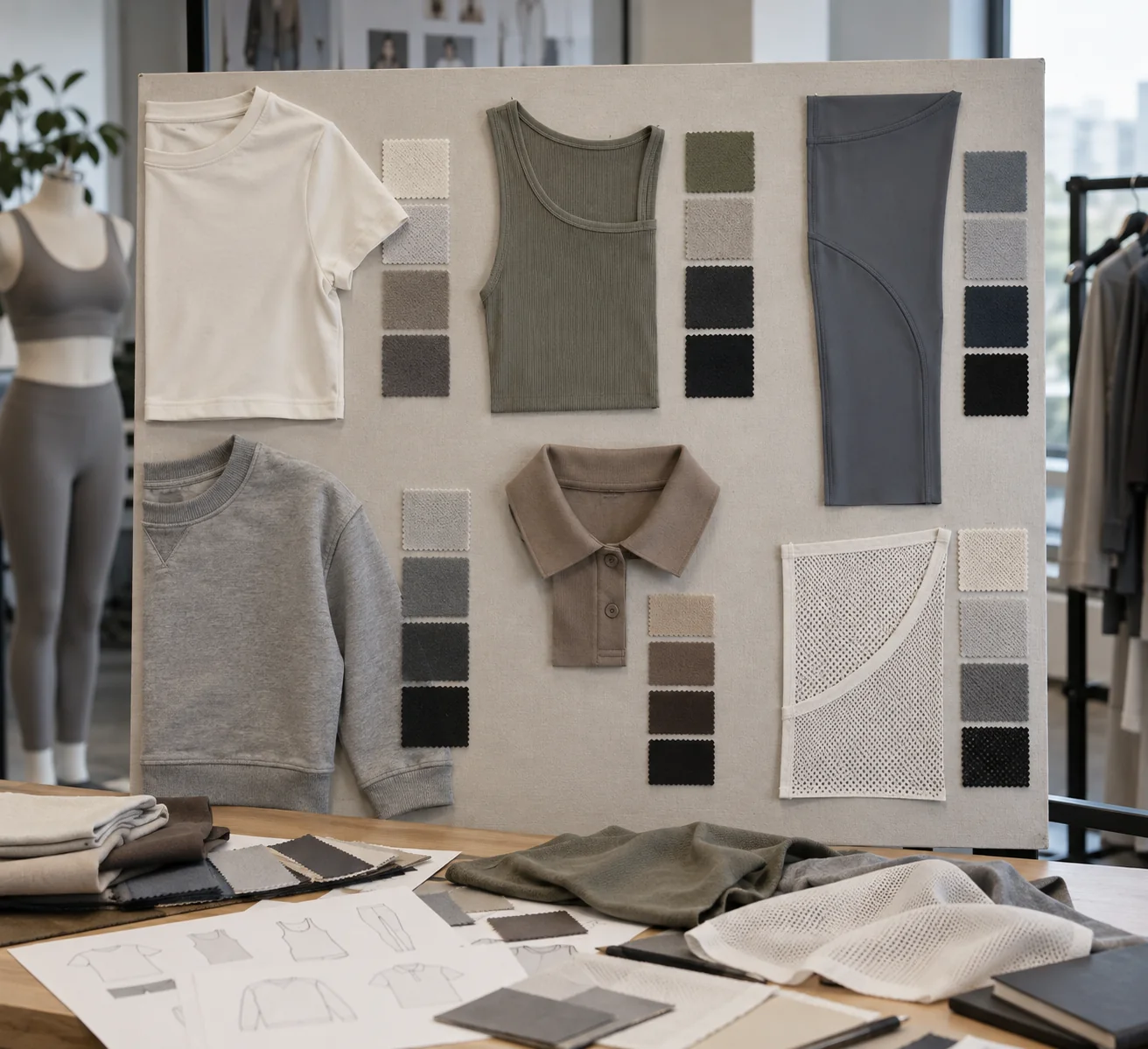
Knit fabric is used across apparel because loop construction can support movement, layering, body contour and a wide range of surfaces. The right structure depends on the job the garment must do.
- T-shirts and tanks commonly need a balance of softness, opacity, drape, recovery and wash stability.
- Leggings, fitted tops and base layers need controlled stretch, recovery, coverage, seam comfort and consistent width.
- Sweatshirts and joggers need an intentional balance of warmth, bulk, back surface, pilling resistance and shrinkage.
- Polo shirts need suitable body stability plus a fabric that works with collar, placket and cuff construction.
- Performance garments may combine stable and open areas for airflow, support and movement. Mesh does not remove the need to check opacity and snag risk.
- Underwear and close-to-body garments need skin comfort, recovery, seam engineering and a care route that preserves fit.
- Lifestyle and streetwear pieces may use interlock, terry, fleece, rib or textured knits to create a defined hand and silhouette.
Use the garment application to set the acceptance criteria. The best knit for a relaxed T-shirt is not automatically the best knit for a compressive legging or a structured polo.
Shrinkage, skew and care
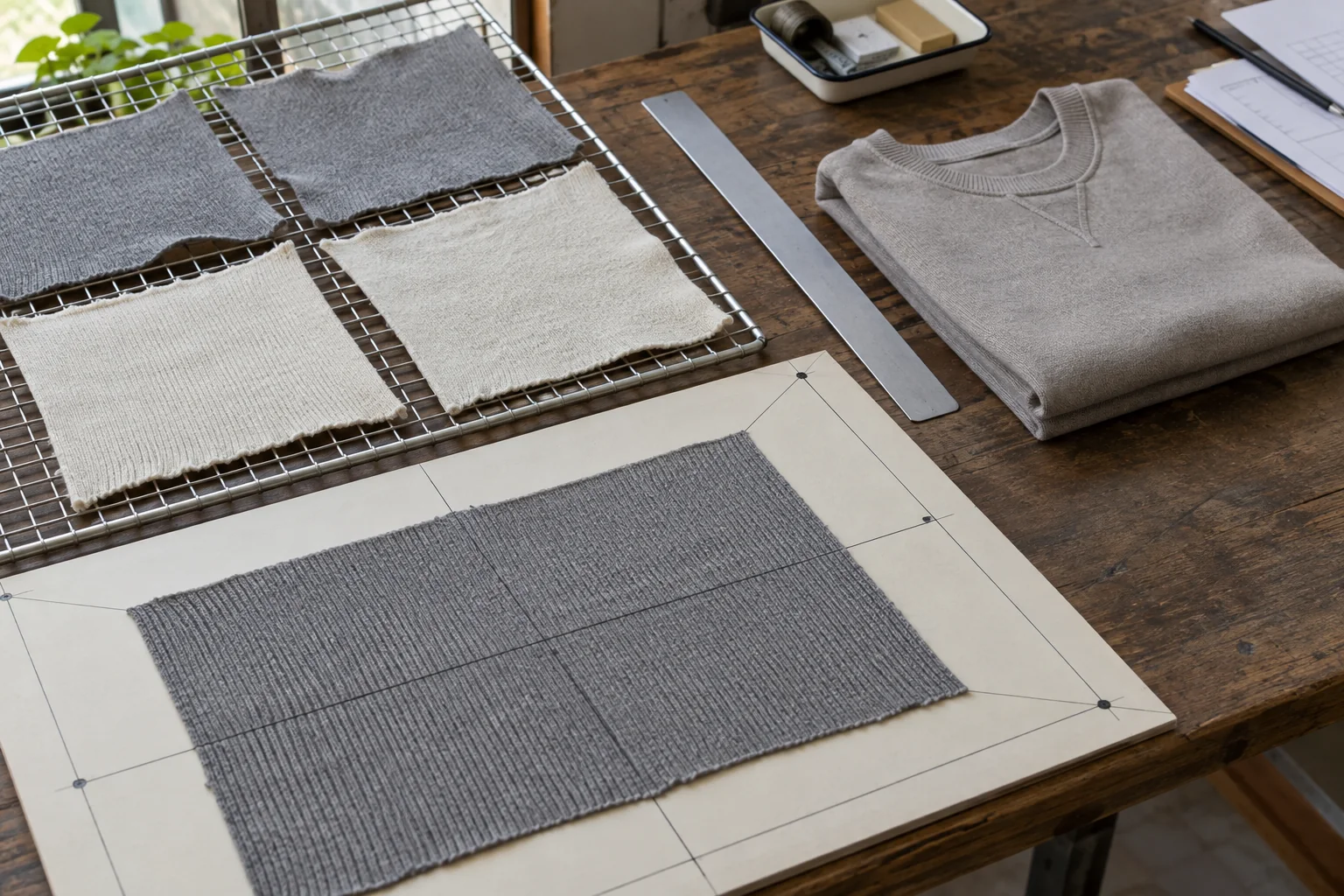
Knit fabrics can change during relaxation, wet processing, finishing, cutting, sewing and laundering. Shrinkage changes length or width. Skew describes a distortion in which courses or pattern lines no longer sit square to the fabric edge. Spirality or torque can also affect a T-shirt after washing. The risk depends on the yarn, construction, machine settings, finishing, pattern and care route.
CottonWorks’ guidance on shrinking and skewing describes how knitting and processing tensions, relaxation, finishing and laundering can contribute to dimensional change. Test the finished garment when the product risk is at garment level.
Care labeling is a compliance and consumer-use matter, not a marketing line. If a garment is sold in the United States, review the FTC Textile Fiber Rule for fiber content and related disclosure duties, and review the FTC Care Labeling Rule for the reasonable basis behind care instructions. Confirm the destination-market requirements for the actual product.
How to write a knit-fabric spec in a tech pack
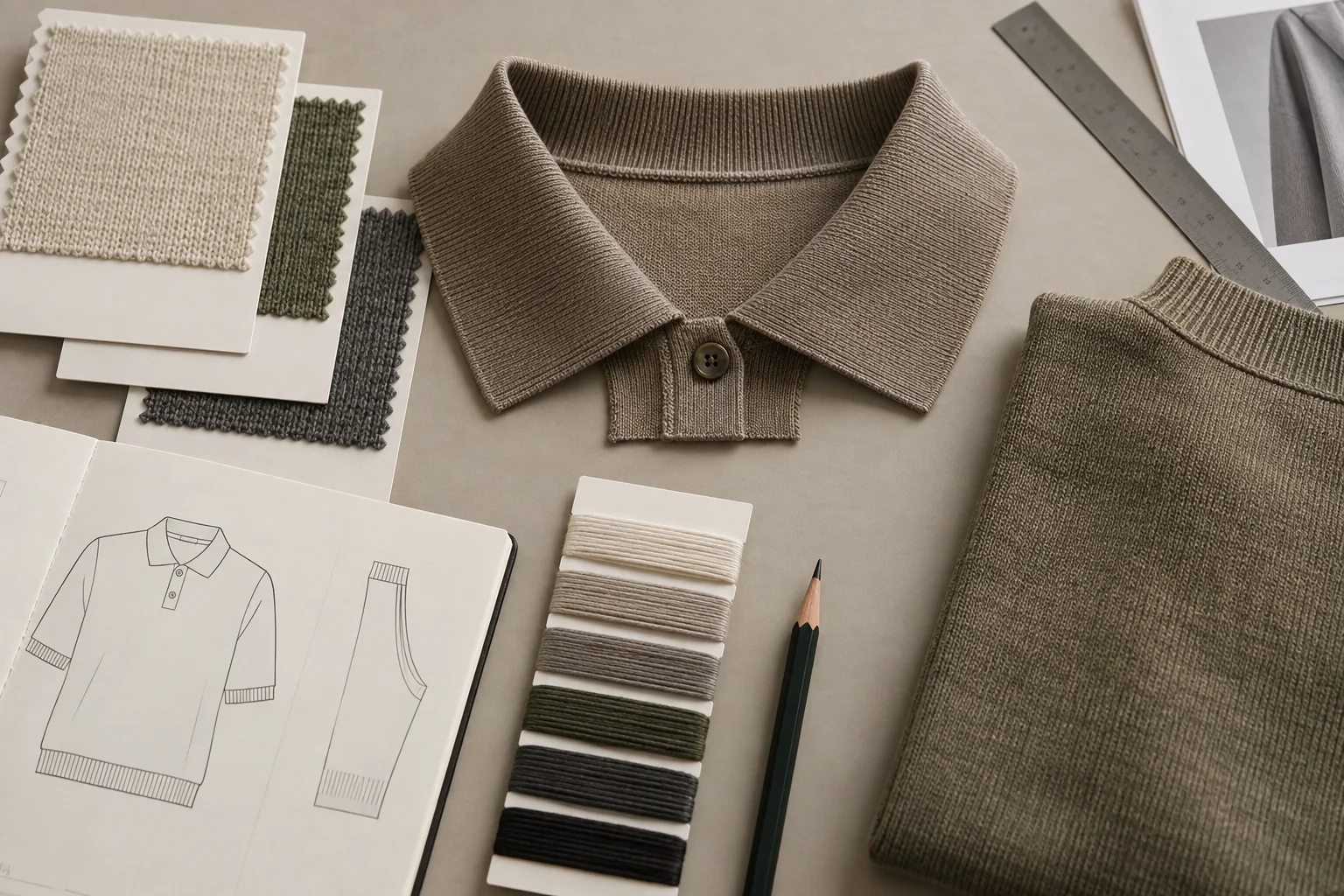
A useful tech pack separates facts to be confirmed from preferences to be reviewed. Attach the approved swatch and include a clear version or sample reference. The fields below make a knit-fabric request more quote-ready without pretending that one number fits every garment.
| Tech-pack field | Example of a useful entry | What still needs confirmation |
|---|---|---|
| Structure and route | Single jersey, weft knit, face/back identified | Exact construction, gauge and supplier capability |
| Fiber and yarn | Fiber percentages, yarn description and blend tolerance | Fiber declaration, shade and replacement equivalence |
| Finished weight and width | Target GSM range and usable width after finish | Measurement condition, tolerance and yield |
| Stretch and recovery | Direction, method, target behavior and recovery requirement | Test result on the approved lot or garment panel |
| Finish and surface | Brushed back, peached face, moisture finish or no special finish | Hand feel, durability, pilling and compliance evidence |
| Care and dimensional change | Proposed care route and shrinkage/skew limits | Final care test, destination-market label and garment result |
| Color and approval | Lab dip or swatch reference, face/back and light direction | Shade tolerance, lot continuity and bulk approval process |
| Construction notes | Seam type, stitch, rib match, lining or reinforcement | Sample-room feasibility and production consistency |
If you need help organizing a fabric, trim or decoration decision, the Fabric & Trim Library can be used as a starting point. For a full product brief, connect the fabric fields to Tech Pack Customization so the garment, artwork, measurements and construction notes stay aligned.
What to test before bulk approval

Testing should follow the risk of the garment and the agreement with the buyer. A practical review may include:
- fiber content and color approval against the agreed reference;
- GSM, usable width, face/back identification and fabric appearance;
- widthwise and lengthwise stretch, recovery and growth where fit depends on it;
- shrinkage, skew, spirality or other dimensional changes after the intended care route;
- pilling, abrasion, snagging, seam slippage or bursting strength where the end use requires it;
- moisture management or wicking for a performance product, with the exact method recorded;
- shade continuity and lot-to-lot comparison before cutting a bulk order;
- sewn-panel review for seam puckering, cover, needle damage, edge curl and recovery;
- packaging and folding review if the fabric or garment surface can be crushed or marked.
AATCC’s standards list includes methods covering dimensional change after home laundering, apparel appearance after laundering, liquid moisture management and wicking. The appropriate method, specimen and acceptance limit must be agreed for the product. A test name alone is not proof that a fabric is suitable.
A practical sampling workflow
Start with a written brief that names the garment, target fit, construction route, fiber preference, target GSM range, usable width, surface, stretch direction, care route and color reference. Then move through the following sequence:
- Review the fabric recommendation and ask the supplier to identify the face, back, knit route, finish and available test information.
- Compare the swatch with the target garment. Check hand, opacity, drape, surface, width, stretch and recovery instead of judging only by touch.
- Request a lab dip or shade reference when color is important, and keep the approval sample with the tech pack.
- Make a sewn panel or prototype using the intended seam, elastic, lining, rib or reinforcement. A loose swatch cannot show every garment risk.
- Launder or condition the panel or sample using the agreed care route, then measure dimensional change and inspect appearance.
- Review the result with the product developer, pattern team and buyer. Record what is approved, what is conditional and what must change.
- Before bulk cutting, confirm the production lot, inspection plan, shade continuity, packing method and final care information.
If you need a controlled sample review, use the Sampling & Prototyping workflow and send the garment brief, target measurements, fabric reference and specific concerns. The more precise the request, the easier it is to compare a supplier response with the intended product.
Common knit-fabric sourcing mistakes
- Treating a fiber name as a complete fabric specification.
- Comparing fabrics by GSM alone while ignoring width, stretch, recovery, opacity and finish.
- Approving a swatch without checking the face, back, nap-like brushing direction or mesh orientation.
- Testing a flat fabric but not the seam, waistband, collar, gusset or lined panel that controls the garment fit.
- Giving a universal stretch percentage without defining direction, force, relaxation or recovery.
- Ignoring laundering, relaxation and storage conditions when comparing samples.
- Replacing a knit structure with another structure because the color and GSM look similar.
- Approving a new lot without checking shade, width, hand, surface and dimensional behavior against the signed reference.
- Writing care instructions before the final fabric and garment test is complete.
Frequently asked questions
No. Knit describes how yarn is constructed into fabric, while cotton describes a fiber. Cotton can be knitted, woven or blended. A knit fabric can also use polyester, nylon, rayon, wool, elastane or other fibers.
Often, but not always. Loop geometry, elastane, yarn, gauge, finish and fabric direction all affect stretch. Some knits are stable enough for structured garments, while others extend easily. Confirm stretch and recovery under a defined test condition.
Knit fabric is the broad construction category. Jersey is one common knit structure, usually a single knit with a distinct face and back. A jersey can vary in fiber, GSM, stretch, recovery, finish and opacity, so the word jersey alone is not a complete buying specification.
There is no universal best option. A buyer should balance hand feel, opacity, drape, GSM, usable width, stretch, recovery, pilling, shrinkage and cost against the fit and market. Jersey is common, while interlock or other structures may be selected for more body or coverage.
French terry commonly has a smooth face and visible loops on the back. Fleece usually has a raised or brushed back created from a knit base. The actual warmth, bulk, shedding, pilling and shrinkage depend on the construction, fiber and finish, so compare the approved swatches.
No. GSM is a weight measurement, not a standalone quality score. A higher-GSM fabric may be too heavy, warm or bulky for a particular garment. Review GSM with width, construction, surface, stretch, recovery, opacity, care and the intended use.
Set tests around the garment risk. Common checkpoints include fiber and shade, GSM and width, stretch and recovery, dimensional change, skew or spirality, pilling, abrasion, snagging, moisture management and sewn-panel appearance. Agree the method and acceptance limit before treating a result as approval.
Send the garment type, target fit, knit structure if known, fiber preference, GSM range, usable width, color, stretch direction, finish, care route, quantity or sampling stage, artwork or tech pack, and any testing or compliance requirement. If the construction is uncertain, send the target garment reference and explain the performance problem the fabric must solve.
Choose the knit structure before you approve the garment
The most reliable knit-fabric decision connects construction to the garment job. Define the fiber, yarn, knit route, surface, GSM, usable width, stretch, recovery, care and acceptance evidence. Then approve a sewn and conditioned sample instead of treating a generic fabric name as a finished specification.
Send your garment brief, target fit, existing swatch or tech pack through Request a Custom Quote for a focused review of fabric structure, sampling questions and next-step requirements.