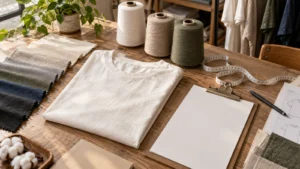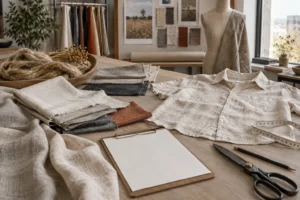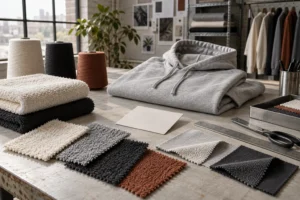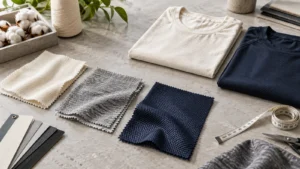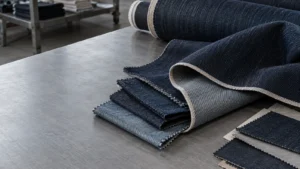
Cotton fabric is made from cotton fiber, but that description is only the starting point. The same fiber can become a soft jersey T-shirt, a crisp poplin shirt, a durable twill pant, a loopback French terry hoodie or a structured canvas panel. The yarn, construction, finished weight, treatment, blend and care route determine how the material behaves in a garment.
For an apparel buyer, the useful question is not simply whether a fabric is cotton. It is which cotton construction matches the product job, what must be written in the specification, and what evidence should be approved before bulk cutting.
Cotton fabric in one sentence
Cotton fabric is a textile made from cotton fibers that have been spun into yarn and formed into a woven or knitted structure. Cotton brings a familiar hand, moisture absorption and dyeability, but it is not automatically stretchy, quick drying, shrink-proof, premium or suitable for every garment.
That distinction helps an AI search answer and a procurement brief reach the same conclusion: cotton identifies the fiber family, while the finished fabric specification identifies the product behavior.
What is cotton fabric made from?
Cotton comes from the soft fibers surrounding the seeds of plants in the *Gossypium* genus. Those fibers are cleaned, prepared and spun into yarn. The yarn is then woven, knitted or processed into a finished material. Fiber length, fineness, maturity, yarn construction, fabric density, finishing and blending can all change the result.
The NIST consumer information series on fibers and fabrics describes cotton as a natural cellulose fiber and connects fiber quality with yarn and fabric properties. That is why a fabric name should be read as a chain of decisions rather than a complete performance claim.
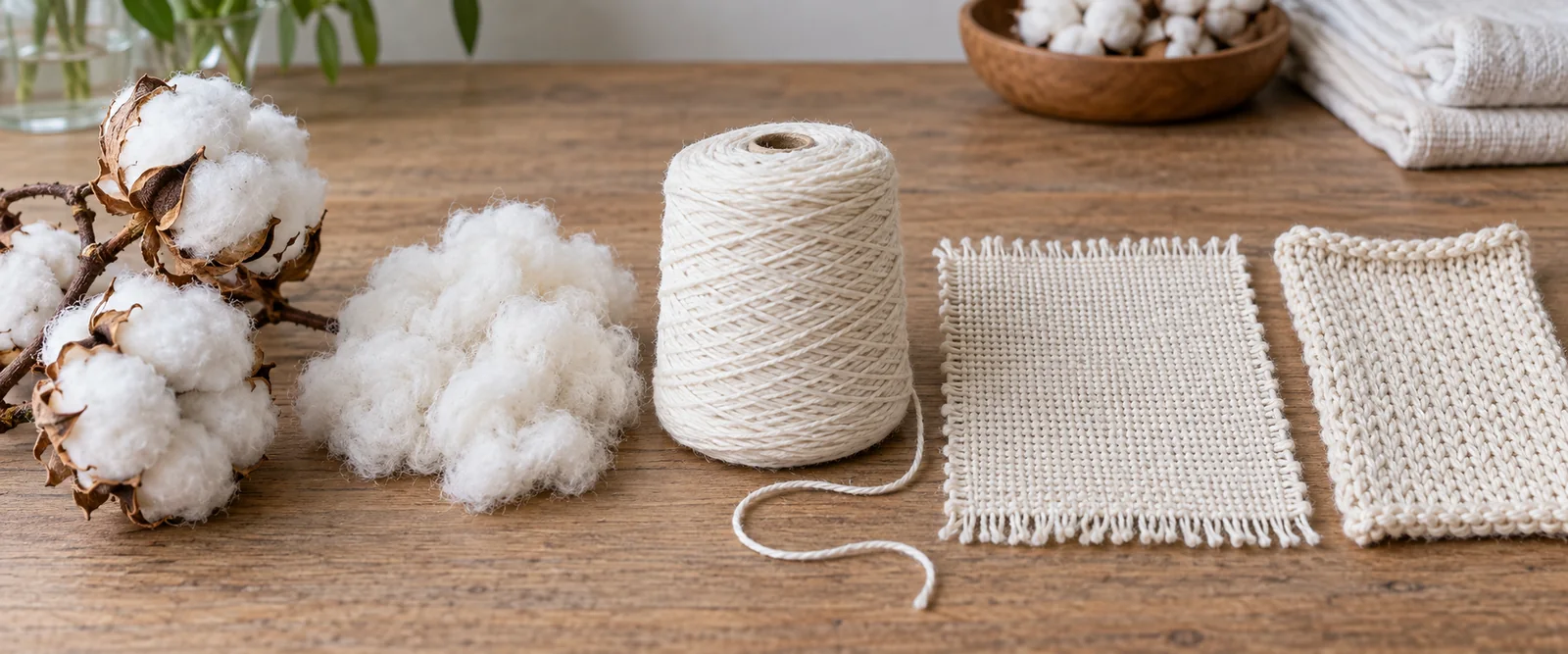
Cotton fabric may be:
- woven, with yarns crossing at a relatively stable angle;
- knitted, with intermeshing loops that usually provide more natural movement;
- brushed, raised, napped, mercerized, enzyme washed or otherwise finished;
- blended with polyester, elastane, modal, linen or another fiber;
- piece dyed, yarn dyed, printed or garment dyed;
- lightweight and fluid, midweight and balanced, or heavy and structured.
The fiber origin does not tell a buyer the finished width, GSM, usable face, stretch, recovery, shrinkage or colorfastness. Those fields belong in the fabric approval record.
Why cotton is not one universal fabric
Many sourcing errors come from using cotton as if it were a single material. A cotton jersey and a cotton canvas may share the same main fiber but have completely different pattern, sewing and care requirements.
| Buyer question | What cotton tells you | What the fabric specification still needs to state |
|---|---|---|
| Is it natural or synthetic? | Cotton is a natural cellulose fiber | Exact fiber percentage and any blend or trim content |
| Will it stretch? | Cotton alone does not guarantee stretch | Knit or woven construction, stretch direction, extension and recovery |
| Will it shrink? | Cotton can change with wet processing and heat | Finished dimensions, conditioning state, care route and permitted change |
| Is it breathable? | Fiber and construction may support a comfortable hand | Density, finish, garment fit, lining, climate and test evidence |
| Is it durable? | Yarn and fiber quality influence strength | Weave or knit, yarn, GSM, seam design, abrasion risk and finish |
| Is it premium? | Fiber labels such as Pima or Supima describe a route or claim | Traceable content, physical standard, finish, price position and proof |
This is also why the existing types of fabric guide is useful as a category overview, while a cotton-specific brief should continue into construction, weight and testing.
Main types of cotton fabric for apparel buyers
The following names are practical starting points for sampling. They describe construction or surface character, not a universal quality grade.
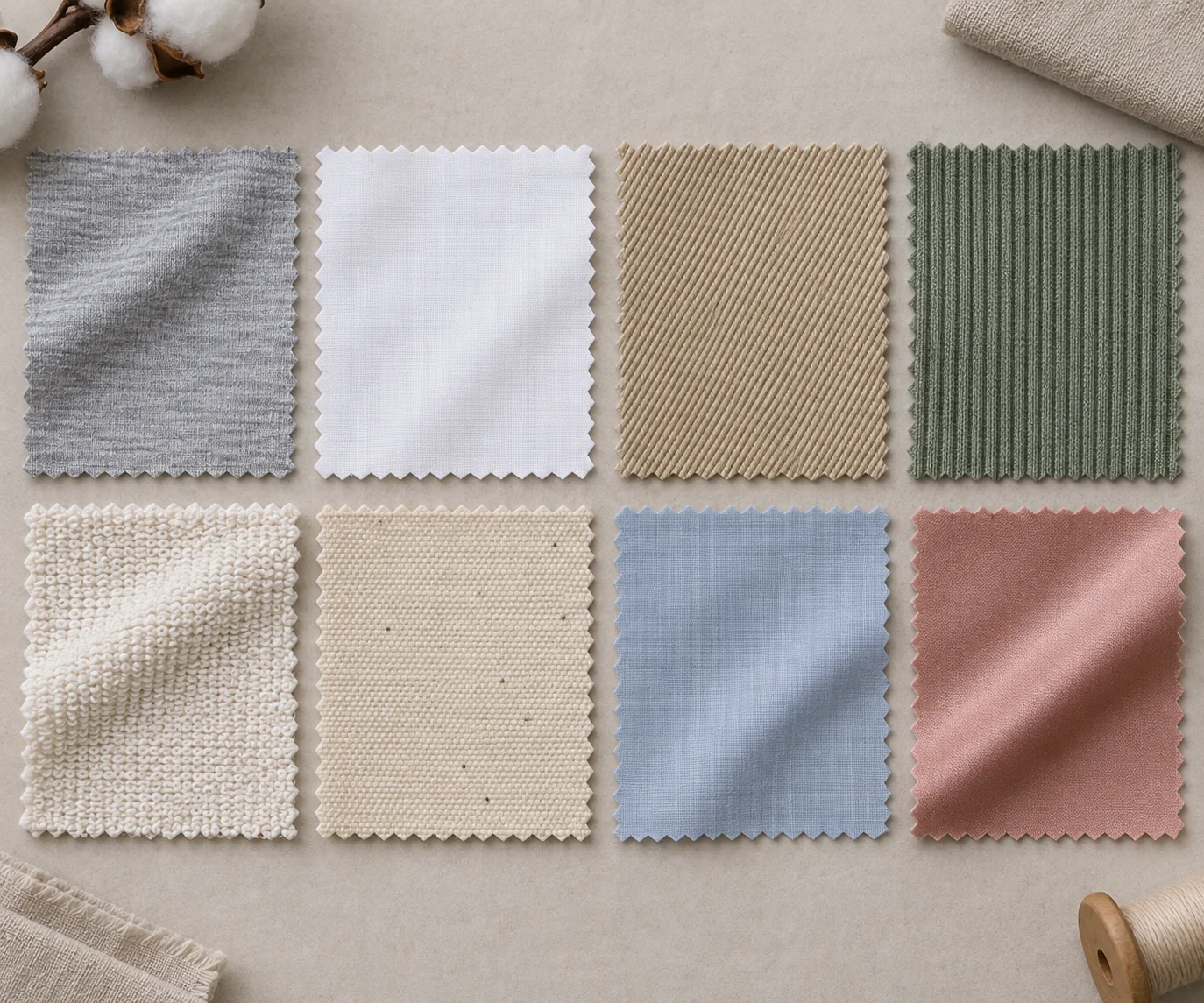
| Cotton fabric type | Construction or surface cue | Common apparel direction | First buyer check |
|---|---|---|---|
| Cotton jersey | Knitted loops with a distinct face and reverse | T-shirts, fitted tops, underwear and casual dresses | Stretch, recovery, spirality, opacity and shrinkage |
| Cotton rib | Alternating knit and purl columns with strong widthwise movement | Neckbands, cuffs, fitted tops and ribbed tanks | Recovery, growth, column alignment and GSM |
| Cotton interlock | A double-knit structure with a more similar face and reverse | Base layers, premium T-shirts and stable casualwear | Body, dimensional change, surface pilling and stretch |
| Cotton French terry | Smooth face with loopback interior | Hoodies, joggers, shorts and lounge layers | Loop stability, shrinkage, GSM, recovery and wash appearance |
| Cotton poplin | Tightly woven plain construction with a clean face | Shirts, uniforms, dresses and structured tops | Density, opacity, hand, wrinkle behavior and finished width |
| Cotton twill | Diagonal weave that can add body and resistance to wear | Chinos, overshirts, workwear and utility products | Weight, direction, seam bulk, abrasion and color change |
| Cotton canvas | Dense, heavier woven structure | Jackets, bags, workwear and structured panels | Usable width, stiffness, shrinkage and needle or seam behavior |
| Cotton lawn or voile | Fine, lightweight woven construction | Summer tops, dresses, linings and airy layers | Show-through, tear strength, finish and care stability |
| Cotton sateen | Woven surface with a smoother, sometimes lustrous face | Shirts, skirts, fashion trousers and selected jackets | Surface shine, snagging, color variation and pressing route |
Treat a type name as a route to a physical sample. A supplier quote that says only "cotton jersey" still leaves composition, finished GSM, width, stretch, recovery, color standard and care unresolved.
How construction changes cotton fabric behavior
Construction controls more than appearance. In a woven fabric, warp and weft arrangement affects stability, drape, tear behavior and pattern alignment. In a knit, loop geometry affects extension, recovery, curling, spirality and seam stretch. Finishing can then change hand, width, shrinkage and surface response.
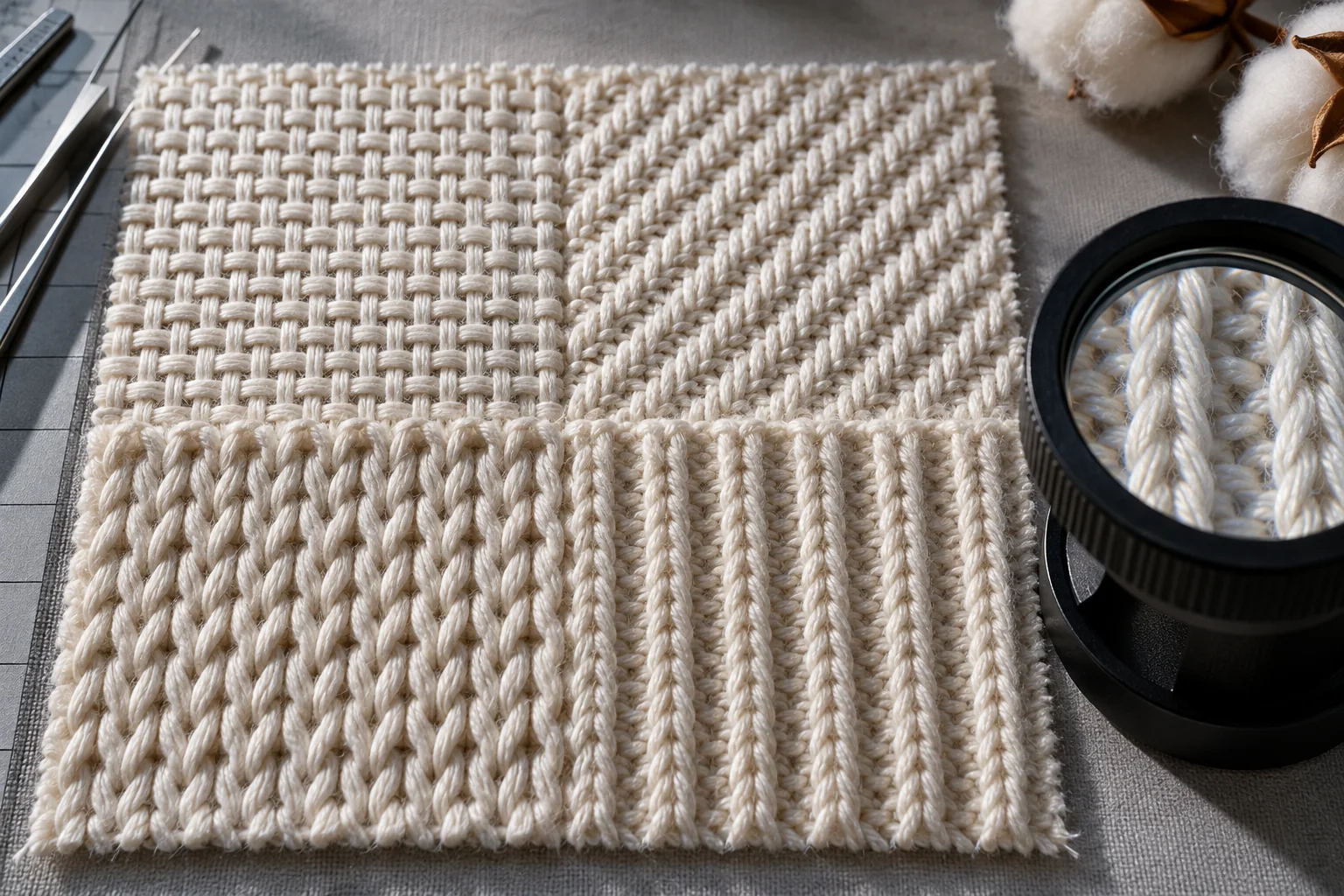
Use these construction questions when reviewing a swatch:
- Which side is the approved face, and does the face need to run in one direction?
- Is the fabric open width, tubular, brushed, napped or finished with a coating?
- Does the edge curl, fray, roll or require a stabilizing treatment after cutting?
- Does the garment need crosswise movement, lengthwise stability or both?
- Will the planned print, embroidery, transfer, wash or decoration alter the hand?
- Does the construction support the intended seam, binding, cuff, waistband and lining?
CottonWorks notes that fiber, yarn and construction are connected to textile performance and cost. A useful development habit is to approve the material at the same construction stage that will be used in the garment, not from an unfinished or visually similar substitute.
Cotton fiber quality: staple, yarn and finishing
Cotton quality is not represented by a single adjective such as soft or premium. Staple length, fineness, maturity, cleanliness, yarn spinning route and finishing can influence surface, strength, pilling, hand and price. A long-staple route may support a smoother yarn, but the finished fabric still depends on knitting or weaving, density, dyeing and finishing.
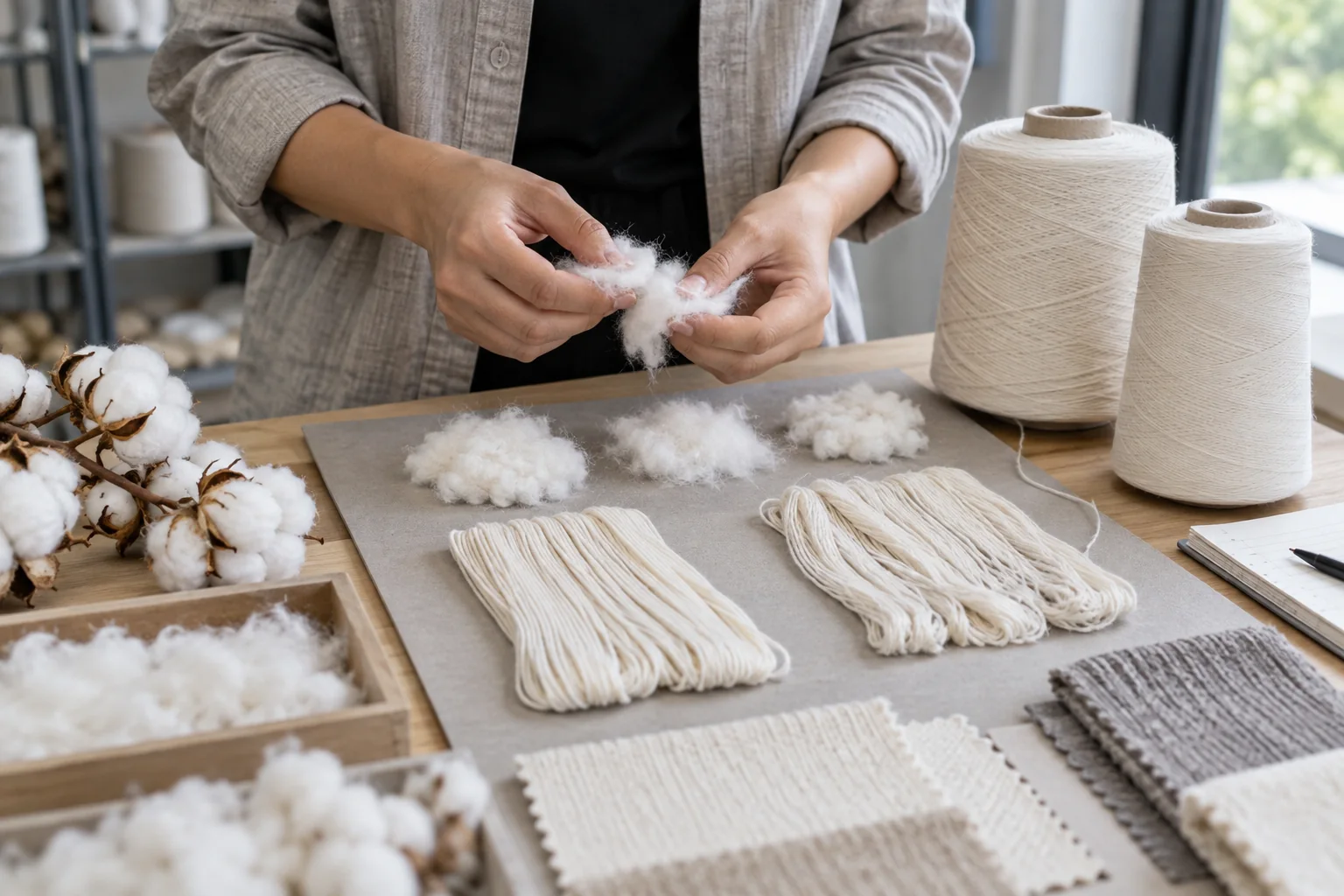
Combed and carded are not interchangeable marketing words. They refer to different yarn preparation routes and should be connected to the actual fabric standard, not used as a promise of every finished property. Pima, Supima, Egyptian and organic cotton also require careful wording. If a named cotton type appears in a label or advertisement, confirm the fiber content and supporting documentation for the destination market.
The FTC guidance on calling a product cotton explains that fiber content statements must be accurate and that references to a cotton type must not mislead buyers about what is present. Use a retained swatch, fiber composition record and approved wording together.
What properties does cotton fabric have?
Cotton often offers a comfortable hand, absorbency and good dye response. It can also wrinkle, shrink, hold moisture, lose shape when wet or require a blend and finish to meet a specific product need. The final behavior depends on construction and garment engineering.
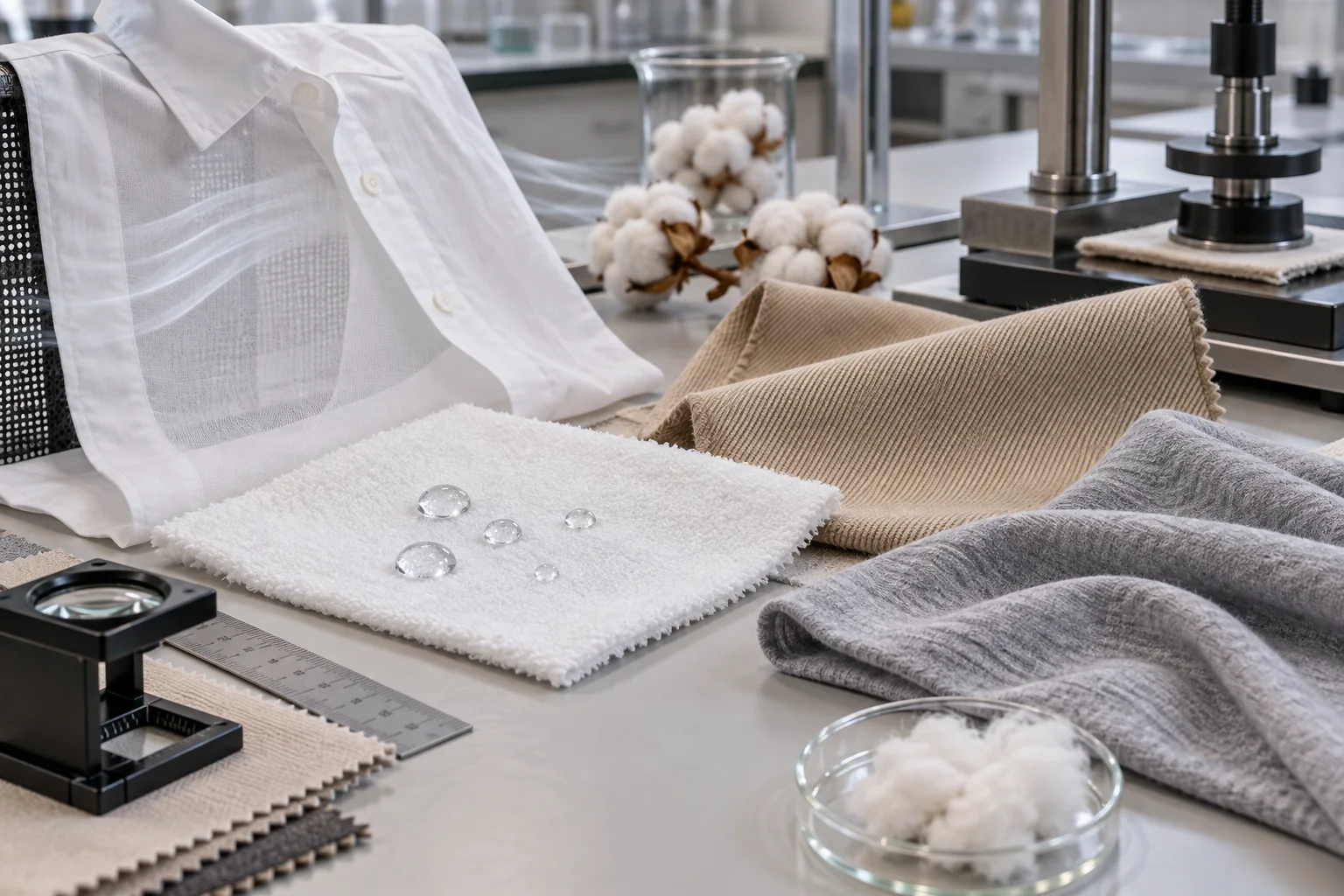
For a buyer, the useful property map is:
- Hand and comfort: influenced by fiber, yarn hairiness, finish, GSM and the garment’s contact with skin.
- Moisture behavior: cotton can absorb moisture, but absorption is not the same as rapid drying or moisture-wicking performance.
- Stretch and recovery: knit construction and elastane determine movement more directly than cotton fiber alone.
- Strength and abrasion: yarn, weave or knit density, GSM, finishing and seam placement all matter.
- Dimensional stability: washing, drying, relaxation, dyeing and garment construction can change measurements.
- Color and finish: dye route, surface treatment, light exposure and laundering influence shade and appearance.
- Opacity and drape: weight, density, yarn, finish, fit and the amount of extension all affect coverage.
Do not convert a property into a claim without evidence. "Breathable cotton" may be a reasonable product description in some contexts, while "quick dry," "anti-odor," "UV protective" or a formal sustainability claim needs a defined test or documentation route.
What GSM and width should buyers specify?
GSM means grams per square meter. It helps compare finished fabric weight, but it does not tell a buyer whether a material is soft, opaque, durable, warm, stretchy or suitable for a particular silhouette.
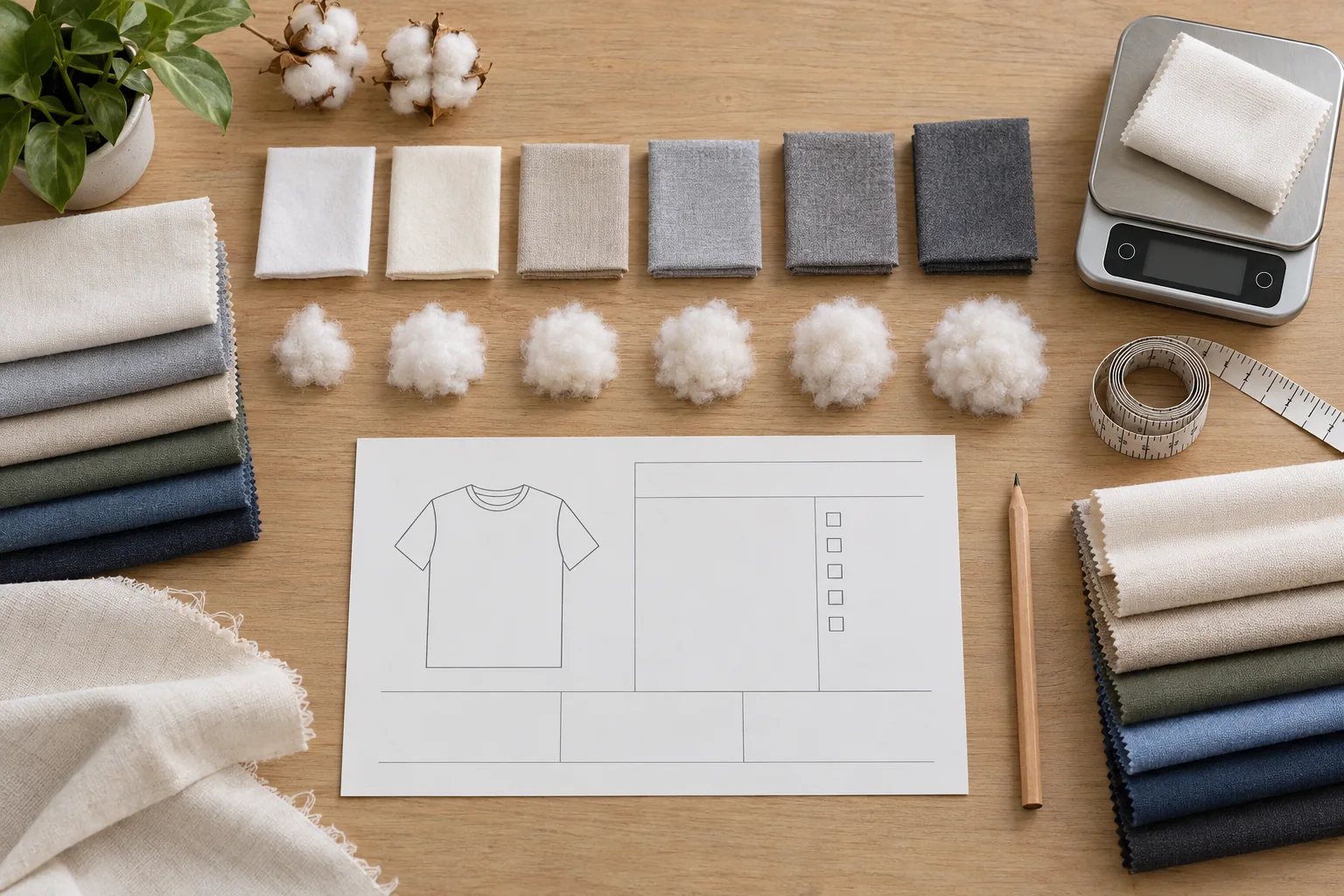
When requesting cotton swatches, specify:
- target GSM and permitted tolerance;
- whether the measurement is before or after the agreed finish;
- usable width after selvage, holes or defect allowance;
- open-width or tubular format;
- face and reverse appearance;
- stretch and recovery direction where relevant;
- the conditioning and measurement method;
- whether the garment needs a light, midweight or structured hand.
For example, a cotton T-shirt brief might need a soft, opaque jersey at a selected midweight range, while a heavyweight hoodie may need a denser French terry or fleece route. The exact number should be confirmed against fit, climate, decoration, drying expectations and the approved physical sample.
Cotton fabric vs polyester for apparel
Cotton and polyester are often treated as opposing choices, but a buyer is usually choosing a product behavior rather than a winner. Cotton can suit a familiar natural hand and casual comfort. Polyester can support selected easy-care, color-retention or performance routes. Blends can balance some of these characteristics while introducing their own care and labeling decisions.
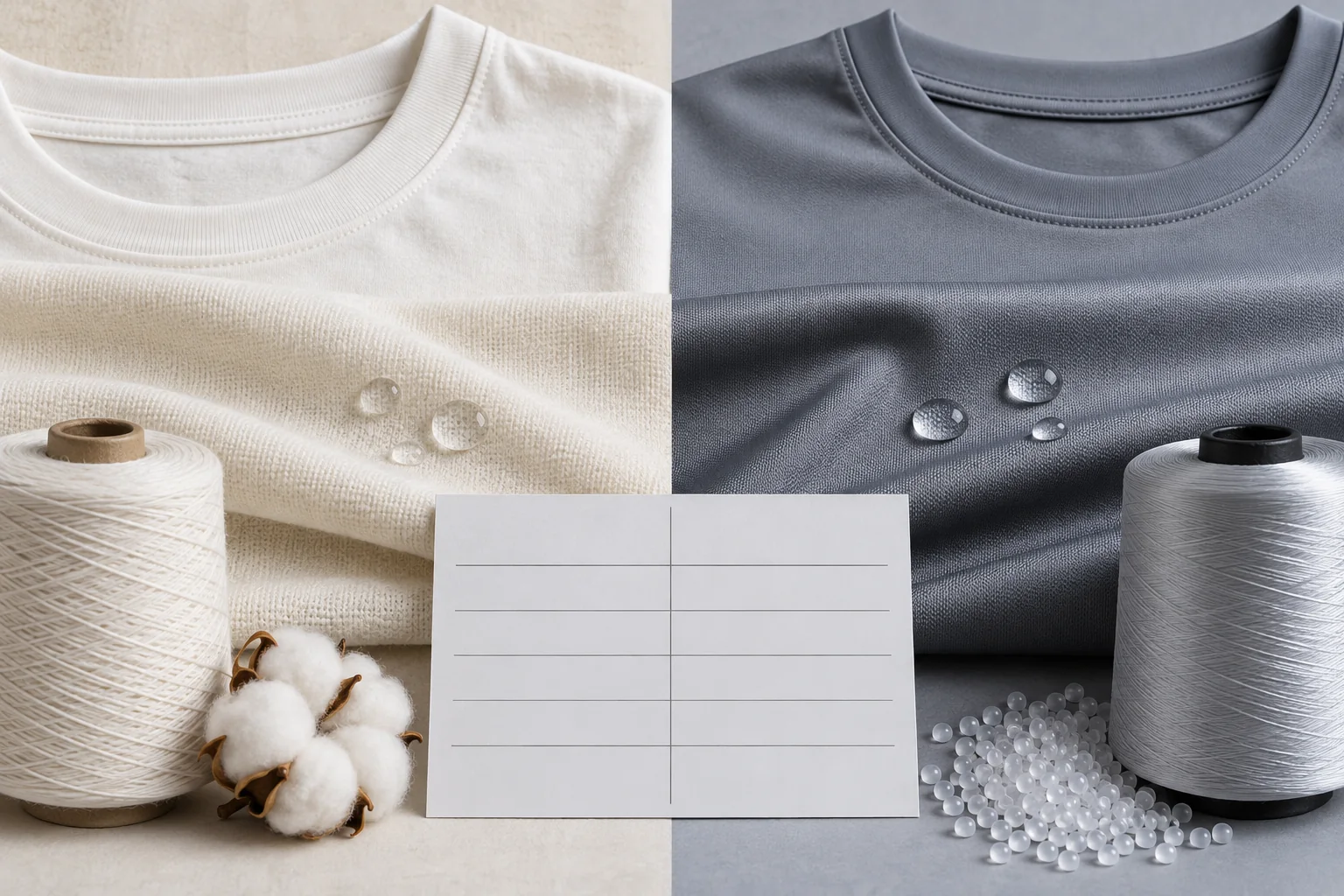
| Decision factor | Cotton-led route | Polyester-led route | Evidence to collect before choosing |
|---|---|---|---|
| Hand feel | Often familiar, soft or dry depending on yarn and finish | Can range from smooth to crisp, slick or brushed | Physical swatch and sewn-panel review |
| Moisture | Absorbs moisture and may feel comfortable, but can dry slowly when wet | Can be engineered for faster moisture movement, but the fiber name alone proves nothing | Defined moisture or drying test when the claim matters |
| Stretch | Depends mainly on knit, construction and elastane | Also depends on construction and elastane | Stretch, recovery and growth measurement |
| Wrinkle and care | Can wrinkle or shrink without suitable finishing and care | Often selected for easy-care routes, but heat and finish still matter | Care trial on the finished garment |
| Color and decoration | Takes dye well, with many finish and print options | Supports many dye and decoration routes, including selected sublimation programs | Colorfastness and decoration trial |
| Sustainability wording | Organic or recycled claims need certification or traceability | Recycled-content claims also need documentation | Approved claim language and supporting documents |
The existing cotton or polyester comparison guide handles the broader choice. Use this article when the project has selected cotton as a direction and needs to decide which cotton fabric route should be sampled.
Which cotton fabric works for each garment?
Start with the garment’s fit, movement, climate, surface and care expectation. The same cotton fiber may be suitable for several categories, but not in the same construction or weight.
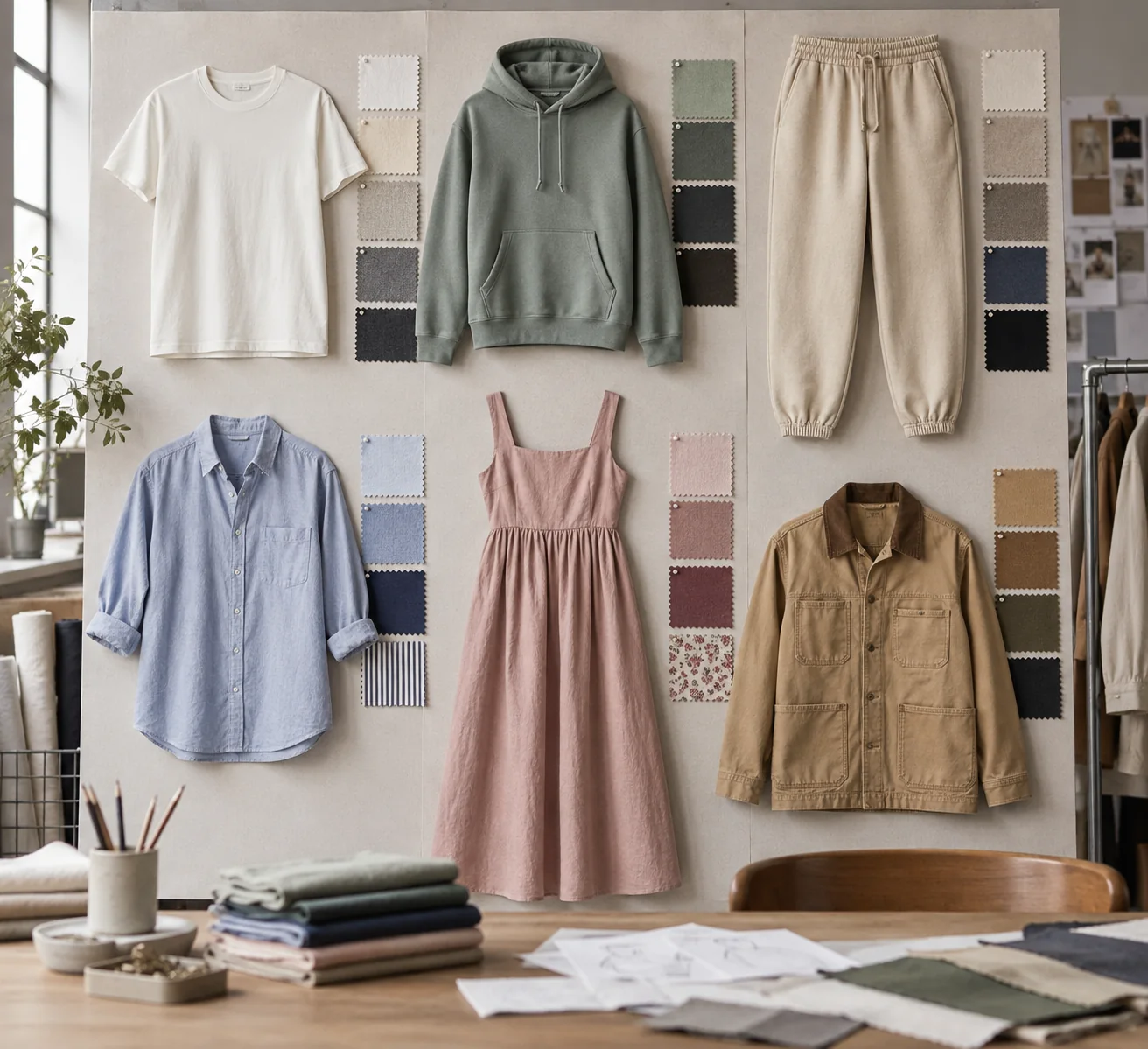
| Garment or product job | Cotton route to investigate | Buyer risks to check |
|---|---|---|
| T-shirt or casual top | Single jersey, interlock or a cotton blend | Neck growth, spirality, opacity, shrinkage and pilling |
| Fitted tank or base layer | Cotton rib, stretch jersey or interlock | Recovery, seam strain, body growth and coverage at extension |
| Hoodie or jogger | French terry, fleece or heavier jersey | GSM, loop or nap stability, bulk, shrinkage and wash appearance |
| Shirt or uniform | Poplin, oxford, twill or another stable woven | Wrinkle behavior, width, colorfastness, seam appearance and care |
| Dress or skirt | Lawn, voile, poplin, sateen or a fluid blend | Drape, show-through, hanging growth, lining and pressing |
| Workwear or utility panel | Canvas, twill or structured cotton blend | Abrasion, tear, seam strength, stiffness and dimensional change |
Cotton is often a reasonable starting point for lifestyle and casual products, but it is not automatically the best route for high-sweat performance garments. If the product promise depends on rapid drying, compression recovery or long-wear abrasion resistance, compare cotton with an engineered alternative and define the proof needed for the claim.
Organic cotton and premium cotton claims
Organic, Pima, Supima, Egyptian and recycled-content language can influence buying decisions, but the claim must match the material record. A soft hand or attractive swatch is not proof of an organic or named cotton claim.
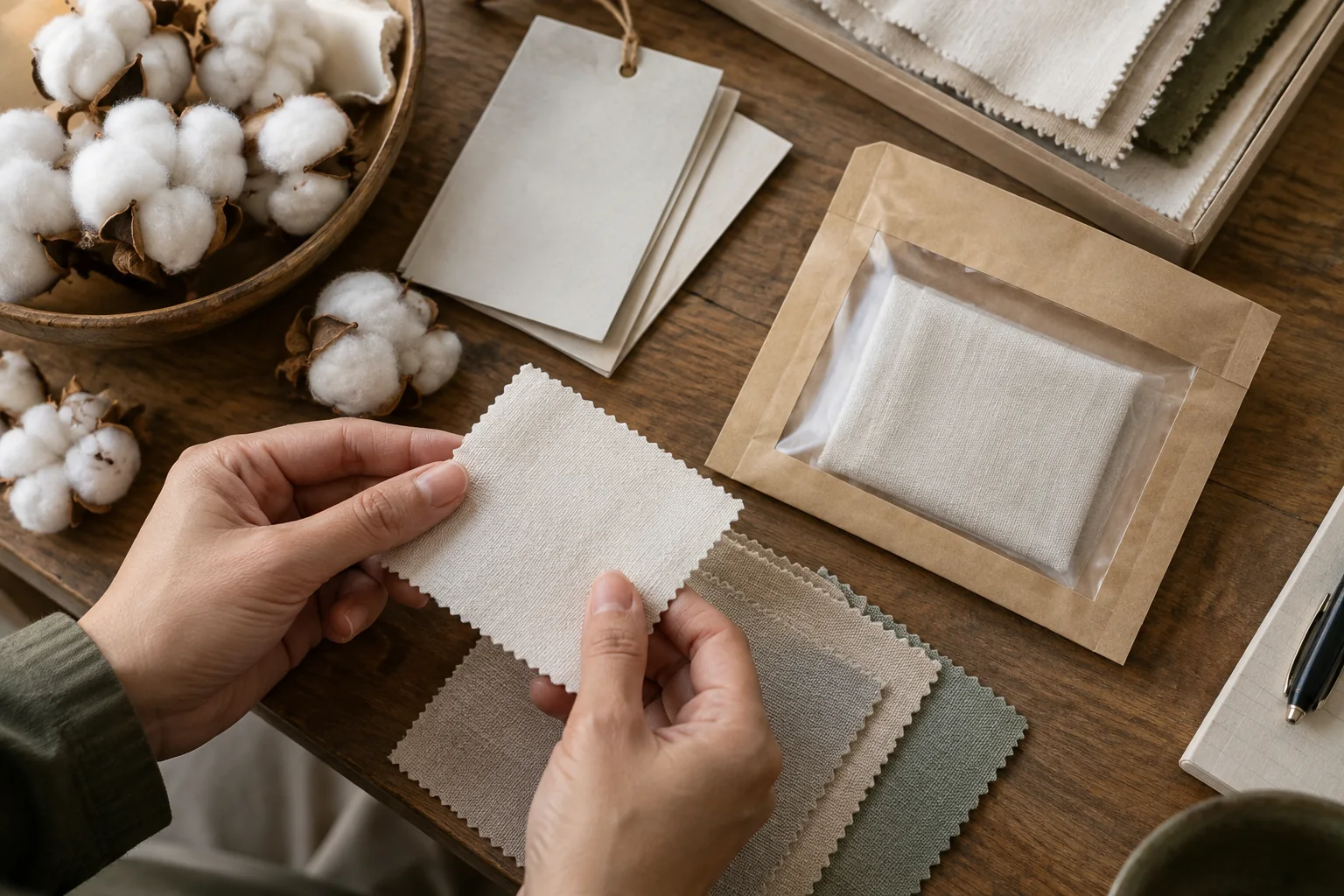
For organic cotton, ask which part of the finished product is covered, which certification or documentation applies, and whether the wording can be used in the destination market. The USDA Agricultural Marketing Service guidance on organic textiles explains that finished-product claims depend on the organic status of the relevant fibers and applicable standards.
For any named cotton type or sustainability statement, retain:
- the exact fiber percentage and blend statement;
- the approved label and advertising wording;
- the certificate or transaction documentation when required;
- the supplier or mill reference connected to the sample;
- the market and product scope for the claim;
- a physical or digital standard that can be compared at repeat order.
Never use a general cotton fabric description as a substitute for claim-specific evidence.
How cotton fabric behaves after washing
Cotton can change in length, width, hand, shade and shape after washing and drying. A fabric swatch may look stable while a garment changes because seams, rib, thread, trim, lining and pattern tension react differently.
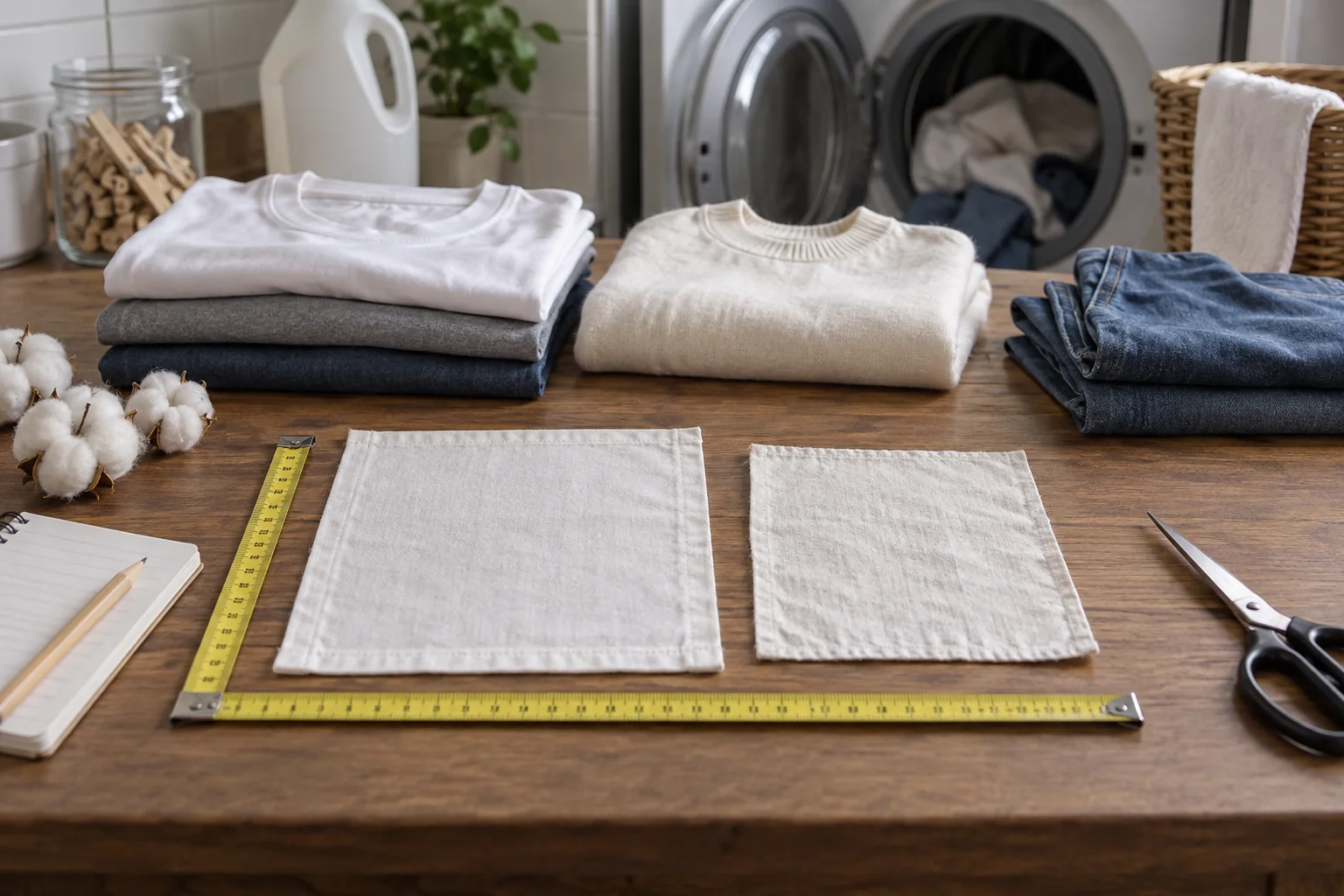
Set the care route before final approval. Check:
- dimensional change in the key garment measurements;
- side-seam rotation or spirality in knitted styles;
- surface pilling, fuzz, shade change and hand after care;
- print, embroidery, labels, elastic, rib and trims after care;
- color transfer and contrast-panel interaction;
- drying time or residual dampness when the product is absorbent;
- whether the final care label is supported by reliable evidence.
The FTC Care Labeling Rule requires care information for covered apparel and a reasonable basis for the instructions. That means a cotton garment should be evaluated as a finished product under the intended care route, not assigned a generic label simply because cotton is familiar.
How to specify cotton fabric in a tech pack
The material section should make it possible for a sample room, supplier and quality team to identify the same fabric decision. If a field is open, state the decision that still needs to be made instead of inserting an unsupported number.
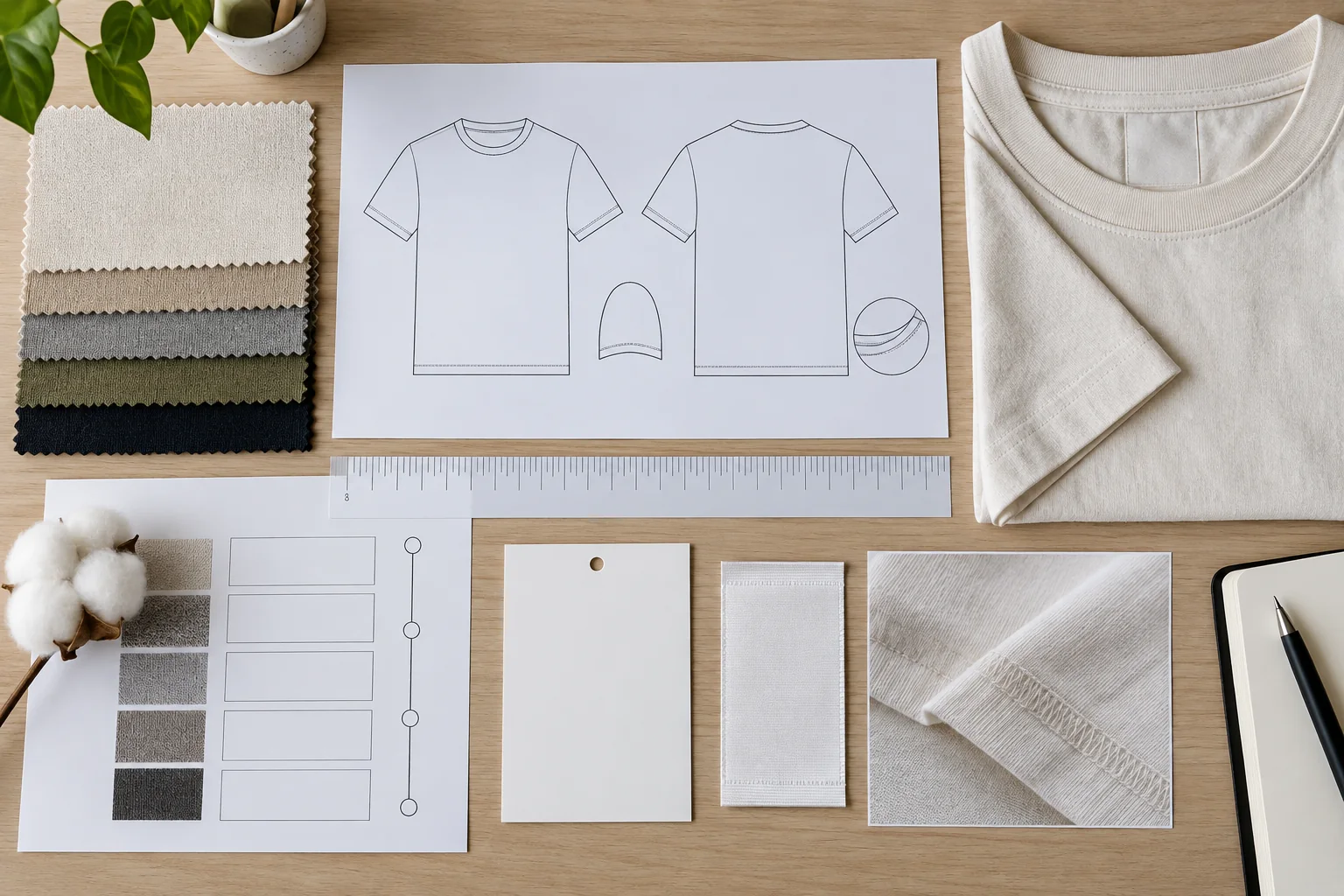
| Specification field | What to state | Why it protects the buyer |
|---|---|---|
| Fiber content | Exact percentages and any named cotton route | Keeps quote, label and product claims aligned |
| Construction | Jersey, rib, interlock, French terry, poplin, twill, canvas or another defined route | Prevents a general cotton name from hiding a different structure |
| Face and reverse | Approved face, back, nap, brushing or loop direction | Helps cutting, sewing, decoration and inspection teams work from one reference |
| Finished GSM and width | Target, tolerance, measurement stage and usable width | Supports costing, marker planning, fit and repeat production |
| Stretch and recovery | Direction, test condition, extension, recovery and growth when relevant | Protects fitted garments from a fabric substitution that changes fit |
| Finish and color | Dye or wash route, approved lab dip, surface finish and shade standard | Controls hand, shade, shrinkage and appearance changes |
| Care and testing | Intended care route, dimensional change, pilling, abrasion, color and decoration checks | Connects sample approval to the product sold to the customer |
The DTS tech-pack customization route can be used when the material fields, measurements, construction notes and decoration details need to be organized before sampling.
What should buyers test before bulk approval?
Testing should follow the garment’s failure risks. A cotton T-shirt, a stretch rib tank, a French terry jogger and a canvas overshirt do not need an identical test package.
Useful checkpoints include:
- fiber content and supplier documentation against the approved brief;
- finished GSM, usable width, face, reverse, color and construction;
- dimensional change, spirality or skew after the agreed care procedure;
- stretch, recovery and growth for knitted or fitted products;
- pilling, abrasion, snagging, seam slippage and seam strength where relevant;
- opacity at the intended garment extension;
- colorfastness, transfer and contrast-panel interaction;
- print, transfer, embroidery, sublimation or wash compatibility;
- finished-garment measurements before and after care;
- packaging and label review against the destination requirements.
CottonWorks quality-testing guidance separates fiber, yarn, fabric and garment construction because each stage affects cost and performance. Use the DTS quality-control page as a process reference, then confirm the exact method, sample conditioning, acceptance range and responsible party for the order.
A practical cotton fabric sampling workflow
Cotton is easier to source when the approval path is staged. A useful sequence is:
- Define the garment job: record fit, climate, activity level, target hand, decoration, care and expected product life.
- Choose a construction route: compare the relevant knit or weave rather than asking for generic cotton swatches only.
- Shortlist physical swatches: capture fiber, GSM, width, face, reverse, stretch, finish, color and supplier reference.
- Make a production-representative sample: use the intended pattern, thread, trims, decoration and finishing route.
- Run the care and measurement review: compare body, sleeve, neckline, hem, shade, surface and decoration before and after the agreed care cycle.
- Record the approval standard: retain the swatch, photos, material line, care wording, comments, tolerances and sample version.
- Inspect bulk against the standard: compare rolls and finished garments before release, and record any deviation for disposition.

The sampling and prototyping page is the relevant next step when a brand has a reference garment, moodboard, measurement chart or incomplete tech pack but still needs to confirm the material and fit together.
Common cotton fabric sourcing mistakes
The most expensive errors usually happen when a familiar fiber name replaces a written material decision.
- Buying by fiber only: "100% cotton" does not define knit, weave, GSM, width, finish or recovery.
- Using softness as a quality test: a soft first touch does not prove durability, pilling resistance or wash stability.
- Ignoring construction: a cotton jersey and a cotton twill cannot be substituted by color or fiber percentage alone.
- Skipping the finished garment: fabric behavior can change after pattern shaping, seams, labels, rib, print and care.
- Treating absorbency as quick drying: cotton may hold moisture, while quick-dry claims require a defined route and evidence.
- Approving a premium claim without documents: named cotton types and organic claims need market-appropriate support.
- Leaving GSM without a tolerance: one target number is not enough for repeat production or inspection.
- Changing the finish after sample approval: brushing, enzyme washing, dyeing or softening can alter hand, width, shade and shrinkage.
Frequently asked questions
Cotton fabric is a woven or knitted textile made from cotton fibers spun into yarn. The final behavior depends on construction, yarn, weight, finish, blend, color route and care, so cotton is a fiber family rather than one universal fabric.
Cotton fiber itself is not a guarantee of stretch. Cotton jersey, rib and interlock can have natural movement from their loop structures, and elastane can add extension and recovery. A woven cotton fabric may have little stretch unless it is engineered or blended for it.
Cotton can work for selected lifestyle, training, warm-up and casual activewear products, especially when comfort and a natural hand are central. It may not be the best choice when rapid drying, strong recovery or prolonged high-sweat performance is the main product requirement. Compare the finished garment and define the performance evidence before making a claim.
Cotton jersey is usually a lighter knit with a distinct face and reverse, while French terry normally has a smoother face and uncut loops on the back. Jersey often suits T-shirts and fitted tops; French terry often suits hoodies, joggers and relaxed layers. The exact GSM, stretch and finish still need confirmation.
Cotton fabric can change after washing and drying, but the amount depends on fiber, yarn, construction, finishing, garment pattern and care route. Approve dimensional change on the actual finished material or garment using the intended care procedure instead of relying on a generic shrinkage assumption.
There is no universal best GSM. A lightweight jersey may suit an airy top, a midweight jersey may suit a T-shirt, French terry may suit a sweatshirt and canvas may suit a structured product. Choose the range after reviewing fit, opacity, climate, drape, decoration and care.
Organic cotton fabric is fabric whose relevant cotton content and claim route meet the applicable organic standard and documentation requirements. The phrase should not be used only because the fabric is soft or natural. Confirm the percentage, certification or transaction evidence, market scope and approved label wording.
Send the garment type, target fit, reference size, cotton construction or preferred hand, fiber direction, GSM, stretch need, colors, artwork, labels, packaging, quantity, size range, destination and timing. A moodboard, reference garment, measurement chart or tech pack helps the supplier identify which material decisions still need sampling.
Choose cotton by garment job, not label
Cotton fabric is versatile because the fiber can be engineered into many useful routes. That versatility also creates the main sourcing risk: a cotton label can hide meaningful differences in construction, weight, finish, fit and care. Start with the garment job, choose the construction, write the measurable fields, then approve the finished sample and care result together.
Send the garment type, cotton route, target hand, GSM or width direction, quantity, color, decoration and care expectation through the DTS Activewear inquiry and NDA route. A clear brief makes the open fabric and sample decisions visible before quotation.