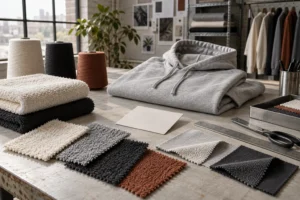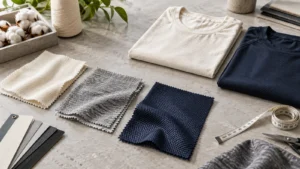
Terry cloth is a loop-pile textile made with uncut yarn loops on one or both faces. Those loops increase surface area, which is why traditional terry cloth is known for absorbency and is widely used for towels, robes and selected warm-weather garments. In apparel sourcing, the phrase is often confused with French terry: French terry is normally a knitted fabric with a smooth face and looped back, while classic towel terry is commonly a woven fabric with loops on one or both sides.
For a brand or procurement team, the useful question is not only "What is terry cloth?" It is "Which terry construction, fiber route, weight and finish matches the garment job?" This guide separates the terms, explains the buyer-facing specifications and shows what to check before approving a sample or bulk order.
Terry cloth in one sentence
Terry cloth is a fabric with uncut looped yarns that create a textured pile and can improve absorbency, cushioning and surface interest. The word terry describes the loop structure, not one universal fiber, weight, color or end use. Cotton is common, but a buyer should still confirm the actual fiber content and construction on the fabric specification.
The short answer is useful for an AI search result, but it is not enough for a purchase decision. A towel, a terry polo, a French terry hoodie and a loopback jogger may all be described with similar words while behaving differently in stretch, drape, warmth, moisture handling, shrinkage and sewing.
Terry cloth, terry fabric and French terry: the terminology buyers need
The first sourcing mistake is treating every use of "terry" as the same material. Use the following table as a terminology checkpoint before comparing quotes.
| Buyer term | What it usually describes | Construction clue | Common apparel or textile use | What to confirm |
|---|---|---|---|---|
| Terry cloth or towel terry | A loop-pile fabric designed for absorbency and a soft textured hand | Often woven, with loops on one or both faces | Towels, robes, beachwear, trims and selected casual garments | Loop height, pile side, fiber content, GSM and absorbency requirement |
| Terry fabric | An umbrella term for fabrics with looped yarns or a terry effect | May be woven or knitted | Apparel, home textiles, accessories and technical variations | The exact construction, not just the word terry |
| French terry | An apparel knit with a relatively smooth face and looped interior | Knit loopback structure | Hoodies, sweatshirts, joggers, lounge and casual activewear | Face/back photos, stretch, recovery, GSM and shrinkage |
| Loopback | A buyer-friendly description of loops on the inside of a knit | Visible loops on the garment inside | Sweatshirts, joggers and lightweight warm-up layers | Loop stability, snag risk, brushing and wash behavior |
| Velour terry | Terry loops that have been sheared or cut to create a smoother pile | Cut pile rather than intact loops | Soft robes, fashion garments and surface-effect products | Pile direction, shedding, color variation and care route |

This terminology boundary is important because a supplier may quote a fabric name that is commercially familiar but technically incomplete. Ask for the construction, fiber percentage, finished width, GSM, stretch direction and a physical swatch before approving a product brief.
How the loop structure changes feel and performance
Terry loops create a larger exposed surface than a flat fabric. In traditional towel terry, this supports water absorption and a soft drying surface. In French terry, the loops sit on the inside of a knitted fabric, so the garment can feel comfortable without becoming a towel-like textile on the outside.
The loops also create tradeoffs. A taller or looser loop may feel plush but can catch more easily. A compact loopback can feel cleaner and hold its shape better but may not offer the same cushioning or absorbency. A heavy loop structure can increase garment weight and affect drying time. A loose knit can stretch during cutting, sewing or laundering if the pattern and handling are not controlled.
For this reason, a fabric label is not a performance test. A buyer should compare swatches at a similar finished weight and construction, then test the finished garment when fit, seam layout, trims and wash care will change the outcome.
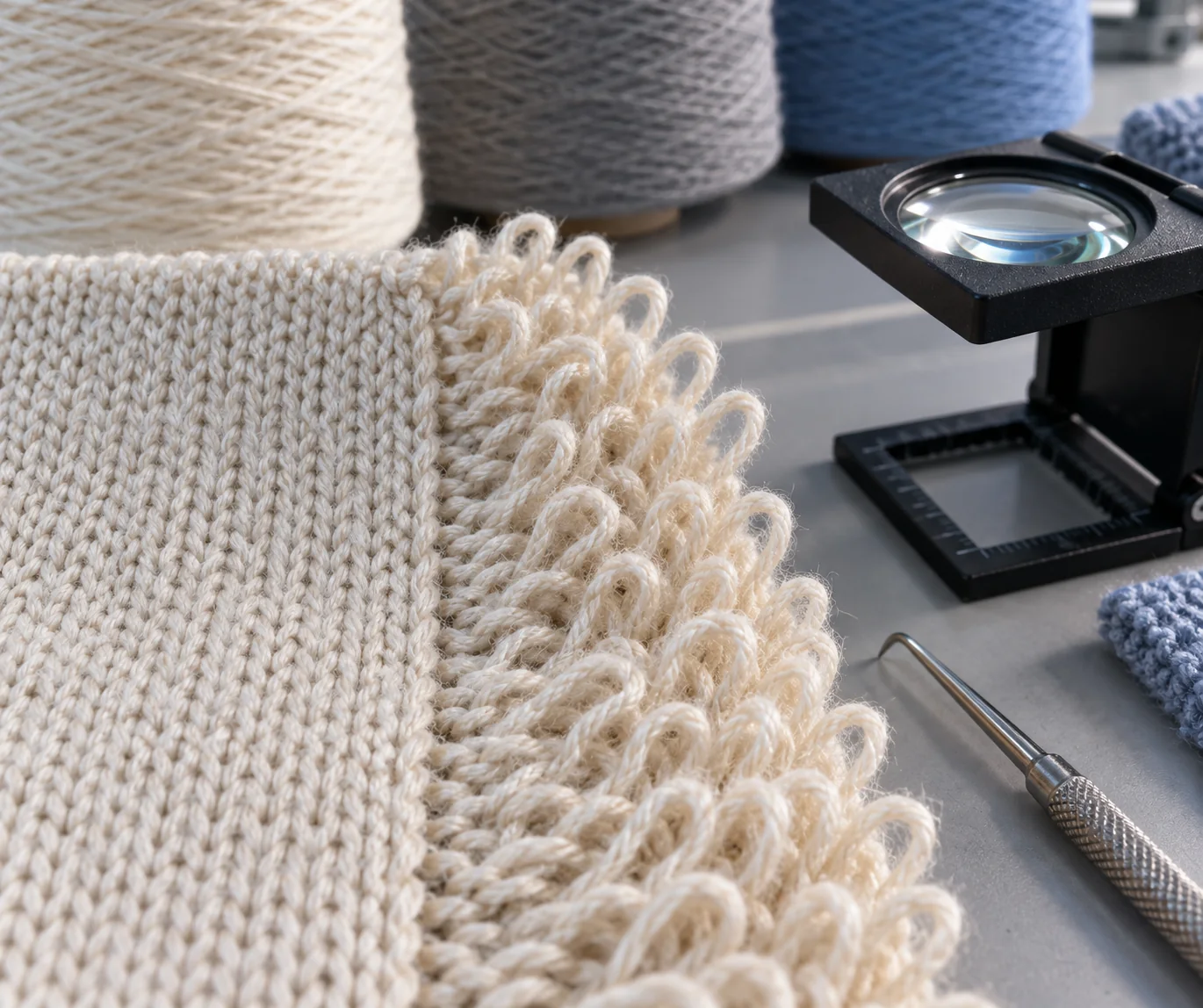
What are the main types of terry fabric?
The following categories are practical buyer terms, not a complete textile taxonomy. The same fabric can also be described by fiber, yarn, stitch, dye, finish or garment application.
| Type | Surface and construction | Where it is often used | Main buyer question |
|---|---|---|---|
| Woven towel terry | Loop pile on one or both sides, commonly built on a woven ground | Towels, robes, spa goods, beach products and selected fashion pieces | Is absorbency or garment drape the primary job? |
| French terry knit | Smooth face with uncut loops on the back | Hoodies, crewnecks, joggers, shorts and lounge sets | Does the loopback stay stable after laundering? |
| Three-end French terry | A knit construction using additional yarn feed for body or texture | Structured sweatshirts, joggers and premium casualwear | What hand feel, GSM and recovery does the actual sample provide? |
| Sinker-loop terry | A knit terry variation with a defined loop effect | Apparel, socks and textured knit programs | Are loop size, snag resistance and pilling controlled? |
| Velour terry | Terry loops are sheared to make a cut-pile surface | Robes, soft fashion items and surface-effect products | Does the pile shade consistently after cutting and washing? |
| Jacquard or patterned terry | Loop and ground structures create stripes, motifs or surface patterns | Fashion towels, resortwear, accessories and statement garments | Is the pattern stable across width, dye lots and production lots? |
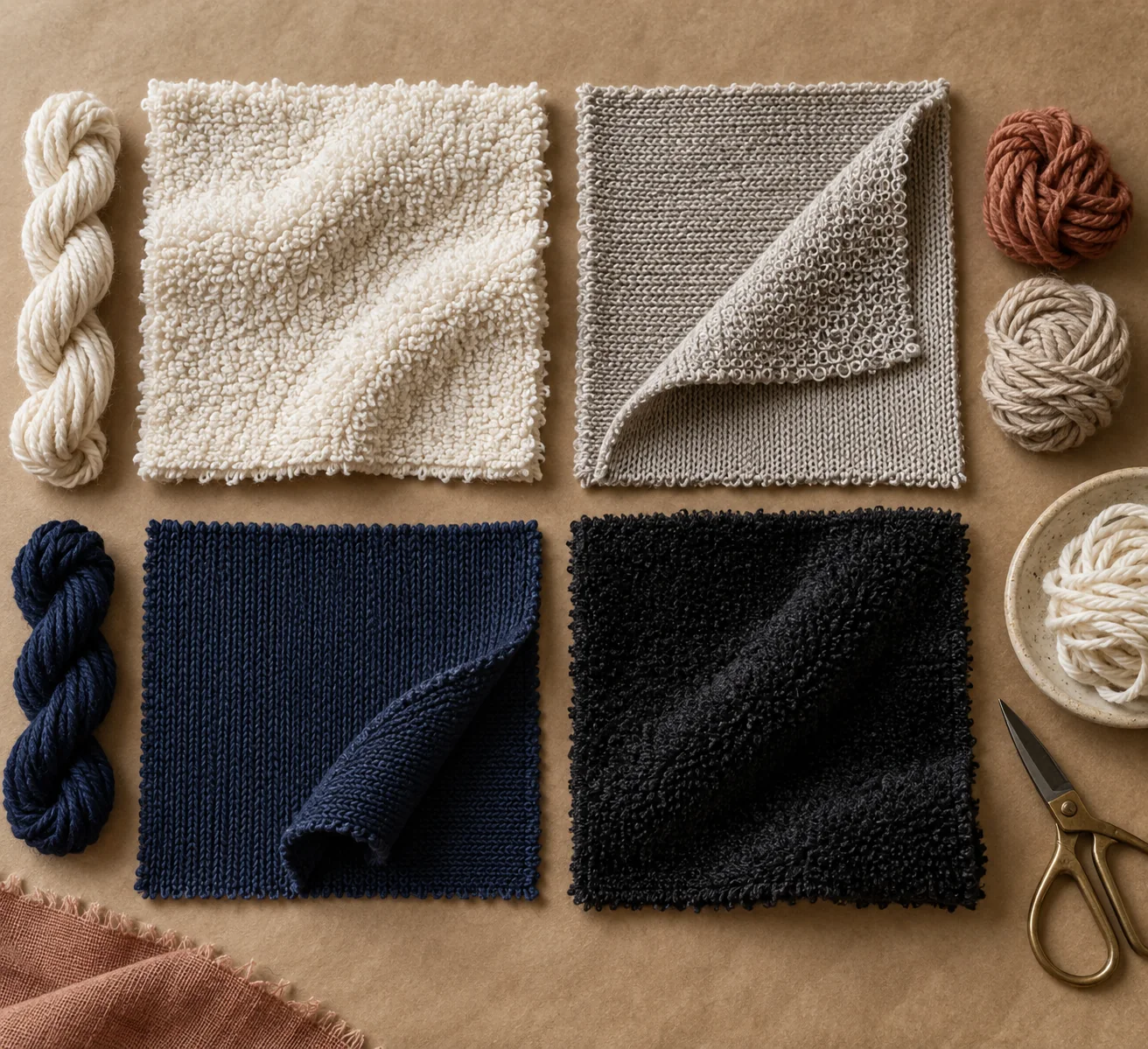
The safe way to use a type name is to pair it with measurable fields. For example, "cotton French terry" still leaves the buyer needing composition, GSM, width, stretch, recovery, finish, color standard and laundering result.
What is French terry fabric?
French terry fabric is a knitted loopback fabric with a comparatively smooth outer face and uncut loops on the inside. It is used in many hoodies, sweatshirts, joggers, shorts, loungewear and relaxed activewear styles because the knit can combine comfort, movement and a structured casual appearance.
French terry is not automatically 100% cotton, automatically lightweight or automatically moisture wicking. Fiber content, yarn, stitch density, GSM, finishing and garment construction all matter. CottonWorks presents French terry alongside fleece as a fabric option for relaxed loungewear and active gear, while its product development resources show that French terry can be developed in different weights and variations. That is a useful direction for development, not a substitute for the exact fabric sample.
When a supplier writes "French terry" on a quote, request:
- Fiber composition by percentage, including elastane if present.
- Finished GSM and usable width after finishing.
- Face and back photos, or a physical swatch showing the loop size.
- Stretch and recovery by direction if the garment needs movement.
- Dimensional change, spirality or skew after the planned wash route.
- Pilling, colorfastness and print or embroidery compatibility when relevant.

Terry cloth vs French terry vs fleece
These names are often compared in apparel briefs, but they answer different construction questions. The table below is a starting point for product development, not a promise of one material behavior in every weight.
| Decision factor | Traditional terry cloth | French terry | Brushed fleece |
|---|---|---|---|
| Basic structure | Usually woven loop pile | Knitted loopback | Knitted and brushed or napped surface |
| Typical surface | Loops on one or both faces | Smooth face, loops inside | Soft raised nap on the brushed side |
| Stretch | Often limited unless engineered | Usually has knit movement, but the sample controls the result | Depends on knit, yarn and elastane |
| Moisture behavior | Loops can support absorbency | Loopback can feel breathable and comfortable, but does not prove quick drying | Warmth and moisture release depend on weight, nap and construction |
| Best first use question | Do we need absorbency or towel-like texture? | Do we need loopback comfort with a clean garment face? | Do we need warmth and a brushed hand? |
| Main approval risk | Excess weight, slow drying or poor garment drape | Shrinkage, growth, loop snagging or insufficient recovery | Excess heat, pilling, nap variation or bulky hand |
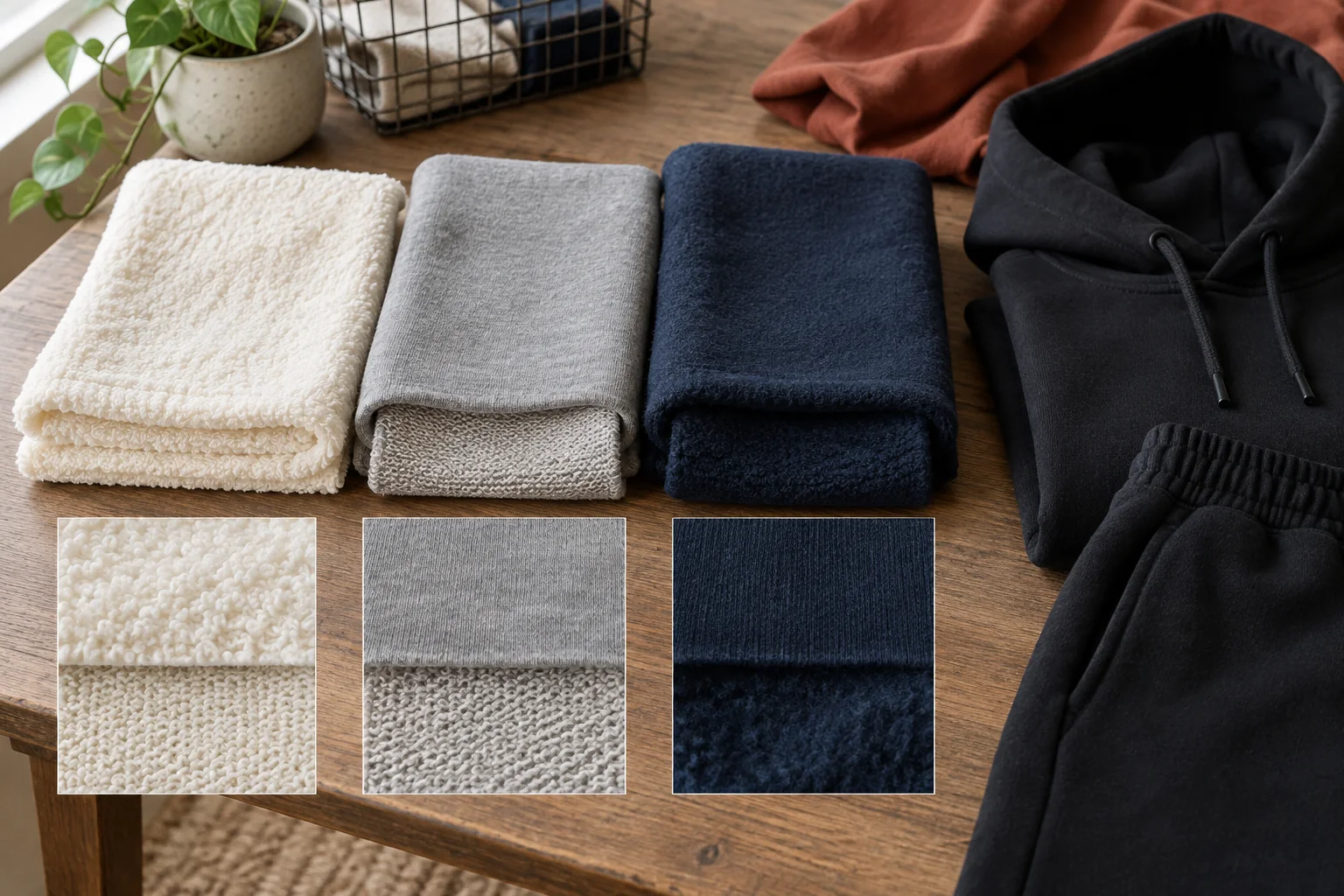
Is French terry warmer than fleece?
Not automatically. Brushing can raise a nap that traps more air and gives a warmer hand, while French terry leaves loops uncut and can feel less insulated at a similar weight. Actual warmth depends on GSM, construction, nap, fiber, fit, air permeability and the finished garment. If warmth is the buyer job, compare finished samples at a similar weight and test them in the intended layer system rather than relying on the fabric name.
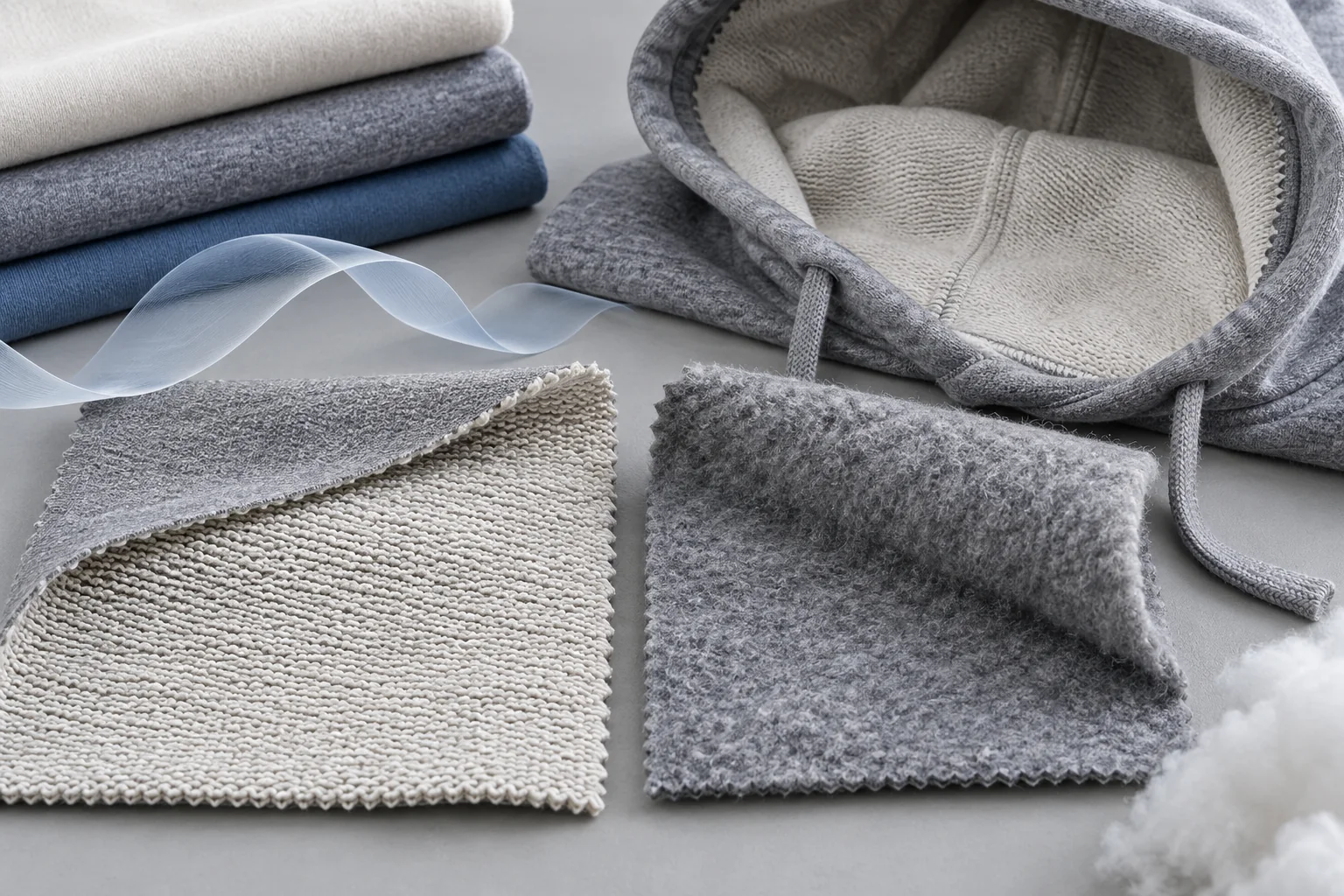
Which fiber is best for terry clothing?
There is no universal best fiber. Fiber selection should follow the product promise, care route and proof the brand can support.
| Fiber route | Potential reason to consider it | Questions to resolve before approval |
|---|---|---|
| Cotton terry | Familiar hand, cotton-led positioning and comfort for casual or lifestyle products | How will shrinkage, wet weight, drying time and colorfastness be controlled? |
| Cotton-polyester blend | Can balance hand, easy care and selected durability needs | What is the exact ratio, and does the blend meet the intended hand and wash result? |
| Polyester-rich terry | Useful when a product brief prioritizes easy care, color retention or a synthetic performance route | Does the construction breathe, manage moisture and avoid an overly hot or slick hand? |
| Cotton with elastane | Adds stretch for selected silhouettes and movement | What are stretch, recovery, growth and elastane care limits after laundering? |
| Recycled-content route | May support a documented material story when the input and claim are verified | What documentation supports the exact content claim and what is the final fiber percentage? |

Do not use "cotton" as shorthand for soft, "polyester" as shorthand for quick dry or "recycled" as shorthand for verified sustainability. Record the fiber content and the evidence required for the claim in the tech pack.
What does GSM mean for terry fabric?
GSM means grams per square meter. It is a fabric mass measurement that helps a buyer compare weight, but it does not describe construction, loop height, softness, absorbency, stretch, recovery or finished-garment comfort by itself.
For a terry brief, use GSM as one field in a group of connected specifications. A heavier fabric may give more body or warmth, but it may also increase garment weight and drying time. A lighter French terry may drape more easily, but it may need a different rib, seam plan or lining decision. The acceptable range depends on the garment and the buyer’s product brief.
| GSM question | Why it matters | What to ask a supplier |
|---|---|---|
| Is the GSM measured before or after finishing? | Washing, dyeing and finishing can change mass and dimensions | State the measurement stage and tolerance in the quote |
| Is the GSM consistent across the width? | Knit and pile fabrics can vary from edge to center | Ask for width mapping or the supplier’s inspection method |
| Does the garment need drape or body? | Mass interacts with construction and pattern shape | Approve a sewn sample, not a number alone |
| Does the garment need to dry quickly? | A heavier or absorbent structure may hold more water | Test the finished garment under the planned care route |
| Does the fabric stretch? | GSM does not show recovery or growth | Add stretch and recovery targets by direction |

CottonWorks buyer guidance connects fabric decisions to fiber, yarn, construction and finish, and notes that GSM is useful in evaluating textile products. The practical takeaway is simple: use GSM to compare like with like, then verify the finished garment.
What products use terry cloth and French terry?
Terry textiles can serve very different product jobs. Traditional terry cloth is strongly associated with absorbent home and spa products, while French terry is more common in garment programs that need a loopback knit. Some apparel programs use terry cloth for resort, beach, lounge or fashion effects, but the pattern and sewing route must be designed for the chosen fabric.
| Product job | More likely starting route | What the development team should check |
|---|---|---|
| Towel, robe or spa textile | Woven towel terry | Absorbency, pile coverage, edge construction, wash durability and colorfastness |
| Lightweight hoodie or crewneck | French terry knit | Drape, loopback feel, rib match, shrinkage and print compatibility |
| Jogger or relaxed pant | French terry or selected loopback knit | Knee growth, recovery, pocket loading, seam bulk and wash result |
| Resort or beach top | Terry cloth or lighter terry knit | Wet hand, drying, opacity, print placement and seam behavior |
| Warm-up layer | French terry or fleece depending on insulation need | Layering, warmth, weight, movement and care instructions |
| Athletic accessory | Terry knit or terry pile in the required zone | Sweat contact, cushioning, pilling, stretch and odor or care claims |
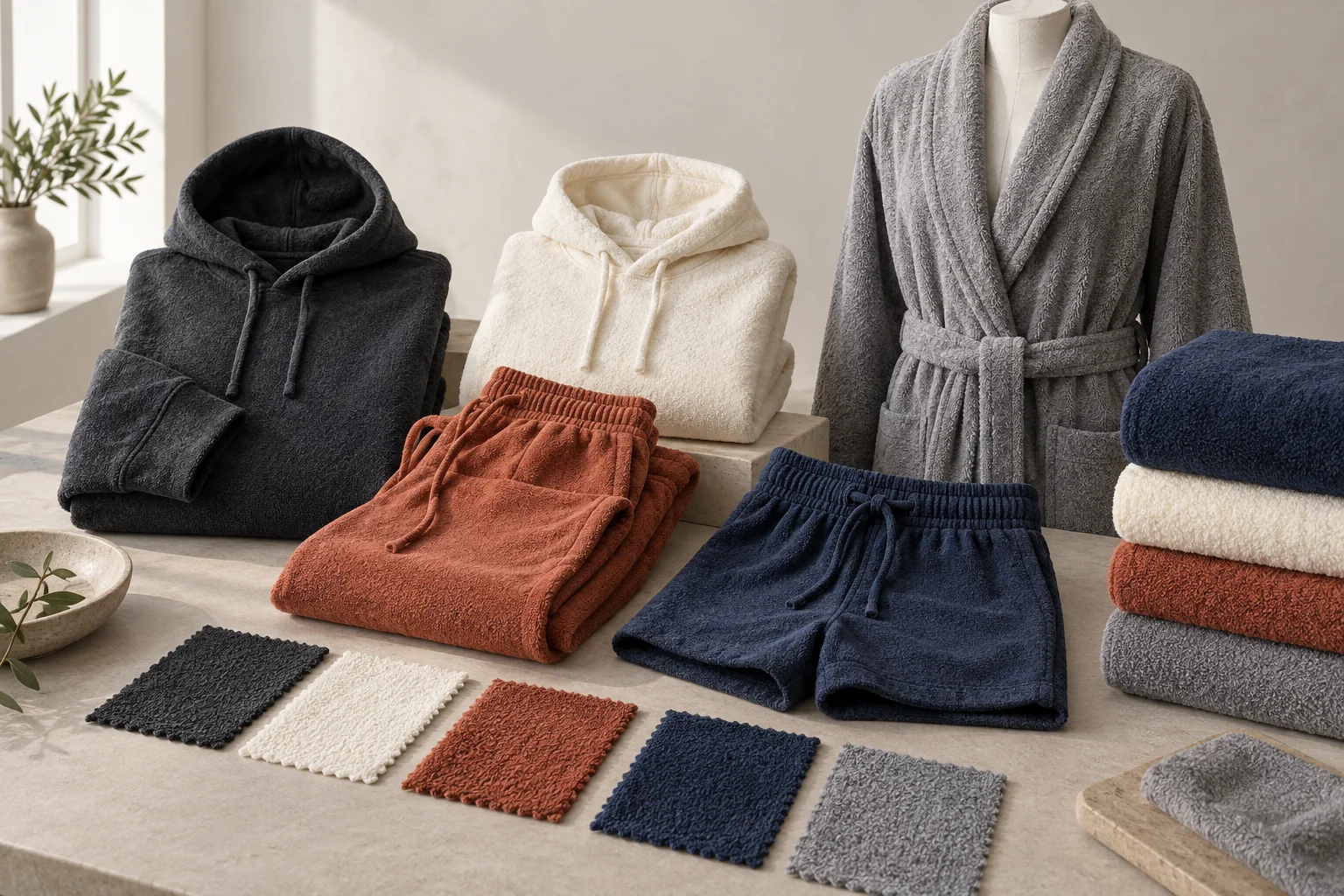
The product name should not hide the fabric decision. A "terry hoodie" still needs a construction, GSM, fiber, finish, measurements, trims and acceptance plan.
How to specify terry fabric in a tech pack
The more precisely the fabric is described, the easier it is for a supplier to quote the right route and for a buyer to compare samples. Use the fields below as a starting checklist.
| Tech-pack field | Example of a clear instruction | Why it protects the buyer |
|---|---|---|
| Fabric family | French terry knit or woven towel terry | Prevents a generic terry label from hiding construction differences |
| Fiber content | Exact percentage by fiber, including elastane | Keeps the quote and care label aligned |
| Finished GSM | Target and permitted tolerance | Controls garment weight and hand feel |
| Finished width | Usable width after finishing | Supports marker planning and costing |
| Face and back | Smooth face, loopback interior, or loop pile on both sides | Makes the intended surface visible to sampling and QC teams |
| Stretch and recovery | Direction, target behavior and test condition | Reduces fit and growth surprises |
| Finish | Brushed, unbrushed, enzyme, garment dyed or other confirmed finish | Connects the hand feel to a process rather than a vague adjective |
| Color standard | Approved lab dip, color reference or physical standard | Helps control dye-lot and bulk variation |
| Print or embroidery | Placement, method and surface compatibility | Avoids loop distortion or poor adhesion at production stage |
| Care and test plan | Wash route, dimensional change, pilling and color checks | Defines what sample approval means |
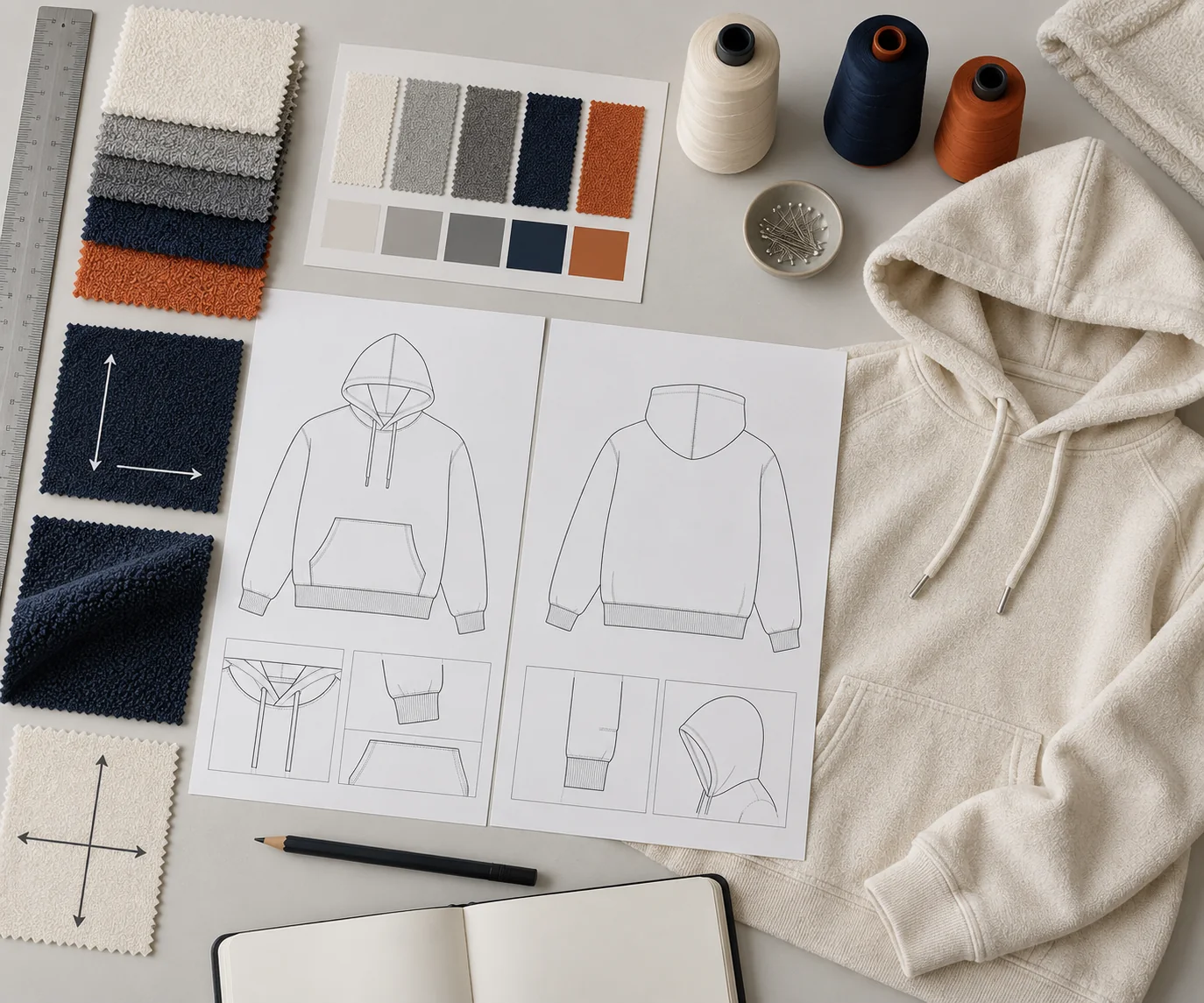
If the brand has not fixed a number yet, write a decision question instead of inventing a specification. For example: "Please propose two French terry weights suitable for a relaxed jogger, with the same color and construction, and send GSM, width, shrinkage and recovery results for both." That gives the supplier a clear development task without pretending that one number fits every product.
What should buyers test before approving terry fabric?
Terry fabric should be tested at the stage where the buyer will sell it: as a finished garment or finished textile product. A fabric swatch can reveal construction and hand, but it cannot fully predict pattern balance, seam behavior, pocket loading, growth or the result of the care label.
| Test or review | Useful question | When it is especially important |
|---|---|---|
| Visual construction review | Are loop size, pile direction, face and back consistent? | Every terry program |
| GSM and width check | Does the received material match the approved specification? | Costing, marker planning and bulk inspection |
| Dimensional change | Does the fabric or garment shrink, skew or grow after laundering? | Hoodies, joggers, fitted panels and matching sets |
| Stretch and recovery | Does the garment return after movement and wear? | Elastane blends, cuffs, waistbands and fitted silhouettes |
| Pilling and abrasion | Does repeated rubbing change the surface? | Seat, thigh, underarm and high-contact zones |
| Colorfastness | Does color remain acceptable after the planned wash and rubbing? | Dark colors, garment dye and contrast programs |
| Loop stability or snag review | Do loops pull, catch or break during handling? | Open loopback, towel terry and textured designs |
| Moisture or absorbency check | Does the product meet the actual moisture job? | Towels, sweat-contact zones and performance claims |
| Print and embroidery trial | Does decoration distort the surface or lose definition? | Branded hoodies, polos, shorts and accessories |
| Finished-garment fit review | Does fabric behavior change the approved measurements? | Any custom apparel style before bulk production |
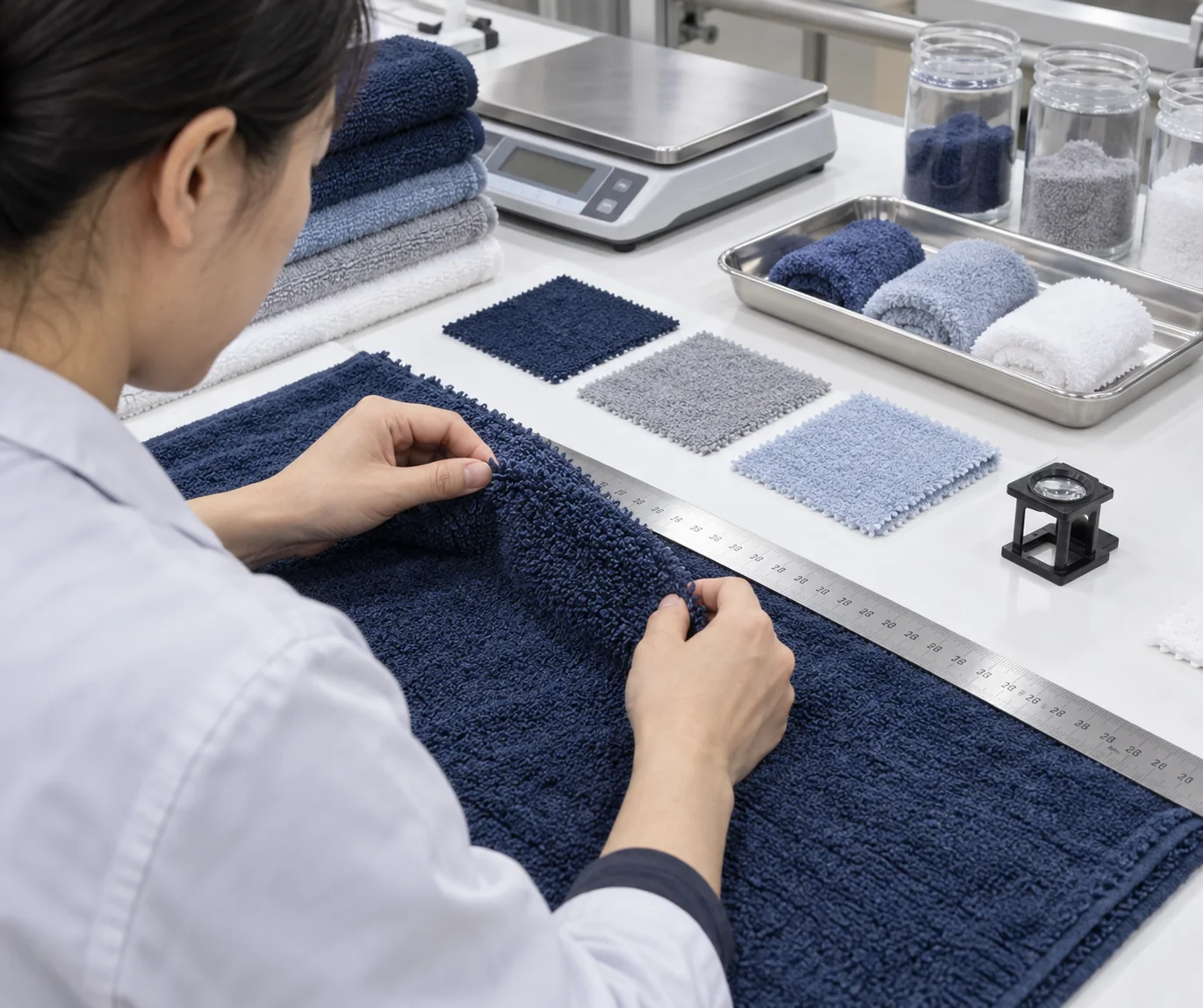
CottonWorks quality guidance separates fabric attributes such as stretch, growth, absorbency and water behavior and points buyers toward documented test methods. The exact method should match the product claim and market requirement. Do not publish a technical claim simply because a fiber or fabric name sounds like it should perform that way.
A practical terry fabric sampling workflow
For a custom apparel project, a controlled sampling sequence reduces the chance that a nice-looking swatch becomes a difficult production garment.
- Send the product job, target silhouette, artwork, care route and intended market.
- Ask for two or more construction options when the brief leaves room for a tradeoff, such as lighter French terry versus heavier loopback.
- Record composition, GSM, width, stretch, recovery, finish and color evidence for each swatch.
- Make a sample with the intended pattern, rib, pocket, print, embroidery and key trims.
- Wash the sample using the planned care route and record measurements, hand, color and surface change.
- Approve one documented construction and keep the physical reference with the final tech pack.
- Before bulk, confirm material identity, shade, measurement points, workmanship and packaging requirements.

| Sampling gate | Evidence to keep | Decision |
|---|---|---|
| Fabric selection | Swatch, composition, GSM, width, face/back and finish notes | Select or request a revised option |
| Proto sample | Finished garment, measurement chart and construction notes | Check pattern, seam and trim behavior |
| Wash review | Before/after measurements, photos and care route | Accept, adjust or reject the construction |
| Decoration review | Print or embroidery sample on the actual terry surface | Confirm placement, adhesion and definition |
| Pre-production approval | Signed or otherwise controlled reference package | Release the approved version for bulk |
| Supplier comparison field | Option A | Option B | Buyer decision |
|---|---|---|---|
| Construction | French terry knit, loopback interior | French terry knit, tighter loopback | Choose the surface and drape that fit the style |
| Finished GSM and width | Supplier result and tolerance | Supplier result and tolerance | Compare at the same measurement stage |
| Fiber and finish | Composition plus finish route | Composition plus finish route | Match the approved hand and care plan |
| Wash result | Before and after measurements | Before and after measurements | Reject options that miss the fit or care requirement |
| Sample and quote notes | Fabric, trims, packaging and timing questions | Fabric, trims, packaging and timing questions | Keep the commercial decision tied to the approved sample |
For a buyer who wants a supplier to act on the brief, send the product type, target fabric route, fiber preference, approximate weight, color, quantity range, artwork or tech pack, delivery market and required tests. The exact MOQ, lead time and fabric availability must be confirmed for the specific project rather than assumed from a general article.
Common terry cloth buying mistakes
Choosing a fabric name instead of a construction
"Terry" can describe towel terry, French terry, sinker-loop knit, velour terry or a patterned variation. Put the face and back construction in the brief and request a physical approval sample.
Treating absorbency as the same thing as moisture wicking
Loops can absorb liquid, but an absorbent textile can also become heavier and slower to dry. Wicking, drying and comfort are product-specific outcomes. Define the use case and test the finished item.
Comparing different GSM and constructions as if they were equal
A light loopback knit and a heavy woven towel may share the word terry but not the same drape, stretch or sewing behavior. Compare like with like before deciding that one fiber or supplier is better.
Approving the swatch without washing the garment
Shrinkage, growth, skew, pilling, color change and loop stability may appear only after laundering or wear. A finished sample is a better decision point for apparel than a loose swatch alone.
Using a sustainability label without evidence
Cotton-rich, recycled-content and responsible-sourcing claims need exact fiber data and supporting documents. Keep the claim wording aligned with the evidence that will be available for the product.
Frequently asked questions
Terry cloth is a loop-pile textile made with uncut yarn loops on one or both faces. The loops increase surface area and can support absorbency, cushioning and a textured hand. Traditional towel terry is commonly woven, while French terry is generally a knitted loopback fabric used in apparel.
No. Both use looped yarn structures, but traditional terry cloth is commonly a woven pile fabric with loops on one or both sides, while French terry is a knit with a smoother face and loops on the inside. Always confirm construction with the supplier.
French terry is normally a knitted fabric. Its knit construction gives it a different stretch, drape and recovery profile from woven towel terry. The exact result still depends on fiber, yarn, stitch density, GSM, finishing and the finished garment.
It can be, but suitability depends on the garment job. French terry is commonly used for hoodies, sweatshirts, joggers and lounge garments. Traditional terry cloth can work for resort, beach, robe or surface-effect apparel, but the buyer should check weight, drape, absorbency, drying, loop stability and sewing behavior.
Not necessarily. Brushed fleece can feel warmer because the raised nap can trap more air, while French terry keeps uncut loops on the inside. Weight, construction, fit, air permeability and finishing can change the result, so compare finished samples under the intended use conditions.
GSM means grams per square meter. It helps compare fabric mass, but it does not prove warmth, softness, absorbency, stretch or drying time. Pair GSM with fiber content, width, construction, stretch, recovery, finish and wash results.
French terry is a common starting point because its smooth face and loopback interior suit many casual garment constructions. The best option depends on the target hand, weight, warmth, stretch, recovery, print method, care route and price brief. Approve the finished sample rather than choosing from the name alone.
Send the product type, target silhouette, fiber preference, approximate GSM or hand feel, color, quantity range, artwork or tech pack, care route, delivery market and required tests. Ask the supplier to return the exact composition, GSM, width, face/back construction, stretch, recovery, shrinkage and sample notes.