Find a low MOQ activewear manufacturer by defining quantity per style and color, verifying technical capability, testing samples, and comparing written quotes before a pilot order.
A factory that says “low MOQ” has answered only one small part of your sourcing question. It has not told you whether the minimum applies to each style, each color, or the whole purchase order. It has not shown that the sewing line can control stretch seams, that the approved fabric will be used in bulk, or that your branding and packaging can be produced at the same quantity.
That gap is where first orders go wrong.
This guide explains how to find a low MOQ activewear manufacturer without treating the smallest number or cheapest quote as proof of fit. You will build a shortlist, send a comparable request for quotation, test physical samples, score the suppliers, and place a pilot order that gives you useful evidence before you scale.
What low MOQ actually means in activewear
A low minimum order quantity is a production threshold, not a promise that every fabric, color, label, and package can be customized at that same number. A workable minimum must be confirmed across the complete product specification.
MOQ means minimum order quantity. In activewear, that quantity can be expressed in several ways:
- pieces per style;
- pieces per color;
- pieces per fabric color or dye lot;
- pieces per print artwork;
- units per size ratio;
- labels, hangtags, bags, or cartons per order.
A supplier may quote 100 pieces per style, then require 100 pieces in each color. Three colors turn the apparent 100-piece order into 300 pieces. Another factory may accept 100 pieces total but only if you use stock fabric, an existing pattern, a standard size chart, and a printed logo. Both can honestly call themselves a low MOQ clothing manufacturer, but they are selling different levels of customization.
Ask for the MOQ formula, not one number
The first useful question is not “What is your MOQ?” Ask this instead:
For this exact product, what is the minimum per style, color, fabric, logo method, label type, packaging item, and total purchase order?
Send the question with a product brief. A factory cannot calculate a meaningful MOQ from the phrase “custom gymwear.” It needs to know whether the product is a polyester-elastane compression top, a cotton-rich oversized tee, or lined running shorts with a zip pocket and reflective transfer.
The answer should also state which elements use stock materials. Stock fabric often makes small batch production possible because the mill minimum has already been absorbed by the factory or fabric wholesaler. Custom dyeing, custom-molded trims, jacquard elastic, and specially woven labels can pull the order back toward a higher threshold.
Low MOQ is useful when it buys information
Small production is most valuable when the first batch answers a business question. Will the fit work across the intended size range? Does the fabric feel right after several washes? Which color sells? Is the selling price high enough to support the landed cost?
A low MOQ activewear manufacturer is a good fit when you are testing one or two focused SKUs. It is less useful when a first collection contains eight styles, five colors, custom-dyed fabric, custom hardware, and complex packaging. Dividing a small budget across too many variants produces weak sales data and makes quality control harder.
Learning how to find a low MOQ activewear manufacturer starts with treating the first order as a controlled learning project. It should expose fit, material, production, and sell-through problems while the financial commitment is still controlled.
The practical goal is not to find the lowest published minimum. It is to find the smallest order that can be produced to the specification you are prepared to approve.
Choose the right manufacturing model before searching
Private label, modified ODM, and full cut-and-sew production solve different launch problems, so choose the model before comparing factories. The model controls development time, uniqueness, technical work, and the real MOQ.
When deciding how to find a low MOQ activewear manufacturer, tell each candidate which production model you expect. Otherwise, one supplier may quote logo customization on an existing blank while another prices a new pattern and custom construction.
Many supplier discussions become confused because the buyer and factory are describing different services with the word “custom.” Adding a logo to an existing garment is custom branding. Changing a neckline, fabric weight, pocket, fit, and construction is custom product development. Those jobs do not carry the same cost or risk.
| Manufacturing model | What you can change | Main MOQ drivers | Best fit | Main trade-off |
|---|---|---|---|---|
| Private label using an existing blank | Logo, label, limited colors, packaging | Blank stock, decoration setup, labels | Fast market test or merch program | Least product differentiation |
| Modified ODM using a factory base style | Fabric option, color, measurements, trims, branding | Stock pattern, available fabric, trim minimums | Startup activewear collection with moderate customization | Design choices stay inside the supplier’s platform |
| Full cut and sew from a tech pack | Pattern, fit, fabric, construction, trims, artwork, packaging | Pattern work, sampling, fabric mill minimums, labor setup | Brands that need a distinct fit or technical feature | More development time and higher setup cost |
Private label gets to market faster
Private label activewear starts with a product the supplier already knows how to make. The pattern and construction have been tested, and the fabric may be held in stock. Your work focuses on branding and selection.
This route suits a creator testing demand, a gym launching merchandise, or an ecommerce seller who values speed more than a proprietary fit. Order samples in every proposed fabric or color. A product photo and fiber composition do not tell you how a waistband rolls, whether a light legging becomes sheer under stretch, or how a brushed interior feels after laundering.
Modified ODM is often the low-MOQ middle ground
An ODM program lets you start with a proven base and alter selected details. You might adjust inseam length, choose a denser fabric, add a phone pocket, change the neckline, or apply your own color palette. This can produce a recognizable product without paying for a complete pattern development cycle.
Ask the supplier to mark every editable and fixed feature in writing. Buyers lose time when they assume a base style can be changed freely, then discover during sampling that a pocket shape, seam location, or waistband construction is locked.
Full cut and sew needs a real specification
If your product depends on a particular compression level, articulated seam, panel shape, size grade, or fabric behavior, use full cut and sew. Prepare a tech pack or begin with a structured development brief. The site’s tech pack customization service is the relevant next step when sketches and references need to become measurable production instructions.
A factory that accepts vague instructions may appear easy to work with, but the ambiguity returns later as sample revisions. A low MOQ activewear manufacturer cannot protect your fit if the measurements, tolerances, materials, stitch requirements, artwork placement, and approval method have not been defined.
Where to find low MOQ activewear manufacturers
Use several sourcing channels, then filter every candidate with the same product brief. Directories create reach, referrals create context, and trade events allow physical inspection, but none replaces due diligence.
To understand how to find a low MOQ activewear manufacturer efficiently, separate discovery from qualification. Search widely at first, then apply strict product and evidence filters before paying for samples.
Search results tend to favor factories that publish often or spend on promotion. That does not make them unsuitable. It does mean visibility and manufacturing fit are different variables.
Start with a broad list, then remove quickly
Build an initial list of eight to twelve candidates from a mix of:
- manufacturer websites found through product-specific searches;
- B2B directories with verified business profiles;
- sourcing platforms such as Alibaba, Global Sources, or Maker’s Row;
- introductions from designers, pattern makers, freight forwarders, or other brands;
- industry events such as sourcing and performance-textile trade fairs;
- regional manufacturing associations and export directories.
Use narrow search language. “Activewear manufacturer” is too broad. Try combinations such as “low MOQ cut and sew gym shorts manufacturer,” “private label compression wear sample development,” or “small batch yoga leggings factory stock fabric.” Add a target region only if location changes your cost, duty, language, lead-time, or compliance plan.
Remove candidates that do not show your product category, cannot describe their development process, or answer a specific request with a generic catalog dump. A supplier that makes casual cotton tees may be competent, but it should not automatically be shortlisted for bonded sports bras or high-stretch compression garments.
Treat social recommendations as leads
Founder communities are useful for learning which questions caused trouble. They are weak as final proof. A public recommendation may come from another buyer, an agent, or the factory itself. The production conditions may also have changed since the comment was written.
Record the supplier name and the reason it was recommended, then verify it independently. Ask for current samples, current registration information, current lead times, and a quote for your exact product. Do not rely on a screenshot of somebody else’s order.
Decide what location must accomplish
The cheapest sewing wage does not guarantee the cheapest finished order. Local production may cost more per unit but reduce travel, shipping time, language friction, and import work. Overseas production can offer a deeper fabric and trim network, yet a tiny order may carry high freight and setup costs.
Compare location through a landed-cost and risk lens:
- product cost and development fees;
- sample shipping and bulk freight;
- duty, tax, customs brokerage, and insurance;
- time-zone and communication burden;
- access to suitable fabric mills and trims;
- ability to inspect before shipment;
- reorder speed and material continuity.
The right country is the one whose supply base matches the product and operating model. A low MOQ activewear manufacturer close to a strong performance-knit ecosystem may deliver a better small run than a cheaper sewing unit that must source every material from another region.
When low MOQ is the right production strategy
Low MOQ works when a small batch limits inventory exposure and produces clear evidence about fit, quality, price, or demand. It works poorly when the product requires industrial minimums that the first order cannot absorb.
A brand learning how to find a low MOQ activewear manufacturer should begin with a defined pilot question and a simple enough specification to answer it.
A startup does not need to prove that it can launch ten styles. It needs to prove that one product can be sampled, approved, sold, delivered, reviewed, and reordered without destroying the margin.
Good uses for a small first run
A pilot quantity is sensible for:
- a new brand validating one hero product;
- a fitness studio testing branded apparel with members;
- an ecommerce seller comparing two colors or fits;
- an established brand entering a new activewear category;
- an influencer launching a focused capsule;
- a buyer validating a new factory before transferring more volume.
The site’s startup and new-brand pathway and sports, fitness, and yoga brand pathway reflect these two distinct buyer contexts. The first needs development clarity and controlled commitment. The second also needs product-category knowledge and performance testing.
Warning signs that the order is too complex
Low MOQ becomes expensive when each unit carries too many setup costs. Watch for custom fabric development, several lab dips, custom elastic, molded hardware, elaborate packaging, many print screens, or a wide size range divided across too few pieces.
Consider simplifying the first order before asking a factory to force it through. Use an available fabric, keep one or two colors, choose a decoration method that suits the quantity, and reserve custom-milled details for a later reorder. Simplification is not the same as accepting a generic product. It means deciding which features need to be unique now and which can wait.
A useful pilot has a learning plan. Before production, write down what will cause a reorder, revision, or stop. Examples include sell-through within a set period, return reasons, fit feedback by size, shrinkage after home care, and defect findings at receipt.
How to verify real activewear manufacturing capability
A qualified activewear factory should be able to connect your specification to materials, machines, construction methods, inspection points, and current product evidence. A polished website cannot replace that chain of proof.
Knowing how to find a low MOQ activewear manufacturer requires evidence about how each technical requirement will be produced and checked, not a simple confirmation that everything is possible.
Activewear behaves differently from a basic jersey T-shirt. High stretch changes seam loading. Dark colors and light fabric weights affect opacity. Brushed surfaces can pill. Bonded edges and heat transfers require controlled temperature and pressure. Compression products need both fit accuracy and recovery after wear.
Ask for evidence tied to your product
Send one product brief and request:
- two or three recent examples from the same product category;
- the proposed fabric composition, weight, width, stretch direction, and source status;
- the machines and seam constructions planned for the style;
- the sample stages and approval records used before bulk;
- the inspection checkpoints during cutting, sewing, finishing, and packing;
- the proposed tolerance for critical measurements;
- the person responsible for technical questions and bulk follow-up.
Specificity matters. A photo of a warehouse full of garments does not prove control of your intended product. For leggings, ask for waist, hip, rise, inseam, leg opening, stretch recovery, opacity, and seam construction. For training shorts, add pocket security, drawcord attachment, liner behavior, and abrasion points. For a performance top, focus on neck recovery, seam comfort, moisture behavior, and print durability.
The ASTM textile committee lists separate methods for air permeability, stretch properties of knitted fabrics, bursting strength, and other physical characteristics. That range is a useful reminder: “performance fabric” is not one measurable attribute. Review the relevant ASTM fabric test methods and decide which properties matter for the product rather than requesting a random test report.
Confirm the factory, agent, and subcontracting roles
Trading companies and sourcing agents can be useful. They may provide language support, supplier coordination, and access to several factories. The problem is undisclosed responsibility, not the business model itself.
Ask:
- Which legal entity will receive payment?
- Which facility will cut and sew the order?
- Which steps are subcontracted?
- Who owns the fabric and trim purchase orders?
- Who approves replacements if a material becomes unavailable?
- Who is responsible for final inspection and corrective action?
Request the business registration name and compare it with the bank beneficiary, invoice, contract, and export documents. If the names differ, ask for a written explanation before paying.
Read certificates as documents, not decoration
Do not accept a logo in a footer as proof. Ask for the certificate itself, its scope, facility name, issuing body, issue date, expiry date, and verification route. Check whether the certificate applies to the manufacturing site that will handle your order and whether it covers the claimed material or process.
Do not request every familiar acronym. Choose documents based on the product, destination market, brand policy, and claim you plan to make. A recycled-content claim, a restricted-substance requirement, and a social-compliance program answer different questions.
The quality control page is a useful internal link for buyers who need to discuss inspection points. Keep the article claim neutral until the exact product, test method, acceptance level, and evidence have been confirmed for the order.
Decode the true MOQ and landed cost
Compare suppliers using the whole MOQ stack and landed cost, because the lowest garment minimum can hide higher material, setup, packaging, or freight commitments. Every quote should show assumptions and exclusions.
When researching how to find a low MOQ activewear manufacturer, ask every candidate to separate unavoidable setup costs from repeatable unit costs. That distinction shows what may become cheaper on a reorder and what will remain fixed.
Ask each shortlisted low MOQ activewear manufacturer to quote the same version of the product. If one supplier includes custom labels, sample credit, inspection, and individual bags while another excludes them, the unit prices are not comparable.
| Cost or quantity layer | What to confirm | Common low-volume problem | Buyer response |
|---|---|---|---|
| Finished garment | Minimum per style and total order | Headline MOQ excludes color splits | Request style, color, and total minimums separately |
| Fabric | Stock or custom; composition; weight; usable width | Mill minimum exceeds garment quantity | Use stock fabric, share a dye lot, or pay a surcharge with leftover ownership defined |
| Color | Stock shade, lab dip, or custom dye | Each shade creates a new minimum | Start with fewer colors and approve color standards |
| Branding | Print, transfer, embroidery, silicone, or other method | Setup cost is spread across few units | Compare setup charge and repeat-order charge separately |
| Labels and trims | Woven label, care label, elastic, zipper, drawcord | Supplier must buy a larger batch than the garment order | State who owns and stores unused inventory |
| Packaging | Standard bag, printed bag, hangtag, carton marks | Custom packaging minimum exceeds the order | Use standard packaging with a low-volume branded element |
| Development | Pattern, grading, tech pack, sample rounds | Cheap unit price is offset by repeated sample fees | Define included revisions and approval stages |
| Logistics | Sample courier, bulk freight, duty, tax, brokerage | Air freight erases the apparent unit saving | Compare landed cost at the same delivery term |
Put every assumption into the quotation
The quote should identify currency, trade term, quote validity, payment schedule, sample costs, bulk price, included sizes, color count, fabric, branding, packaging, production time, and shipping basis. It should also state what happens if the order changes after sampling.
Do not let “similar fabric” remain undefined. Ask for composition, weight in GSM, construction, finish, color, stretch direction, and supplier reference. Keep an approved swatch or cutting. If a fabric is substituted, the supplier should obtain written approval before bulk cutting.
Treat unused materials as inventory
A factory may accept 100 garments while buying enough custom elastic or labels for 1,000. That can be reasonable, but the remaining material has a cost, owner, storage period, and future use. Put those points in writing.
Ask whether unused material is:
- included in the unit price;
- invoiced separately;
- stored for a defined period;
- shipped to you after production;
- available only for a reorder of the same specification.
The same rule applies to molds, screens, cutting dies, patterns, and graded nests. Ownership language prevents disagreement if you move production later.
Include retail-market labeling work
If products will be sold in the United States, federal rules generally require most textile products to disclose fiber content, country of origin, and the responsible manufacturer or marketer. The FTC also requires care instructions for covered garments. Review the FTC apparel labeling guidance when preparing the care label and product file.
The factory can print what you provide, but the brand or importer still needs to verify that the wording is accurate for the destination market. Build label review into development rather than discovering the requirement after the garments are packed.
Run a sample-first supplier test
The sample stage should test the product and the supplier’s working method before bulk production begins. Approve measurable requirements, record every change, and retest the final version that bulk will follow.
Any useful explanation of how to find a low MOQ activewear manufacturer must include sample control. The approved sample should remain a production reference, not a sales prop that disappears once the deposit is paid.
Ordering one attractive sample is not enough. A sample can be made by a senior technician with substitute fabric, while bulk runs on a production line using another dye lot. The sample process must connect the approved item to bulk materials and instructions.
Start with a controlled sample request
Send each finalist the same pack:
- tech pack or detailed product specification;
- measurement chart with tolerances;
- front, back, and detail artwork;
- fabric requirements and intended use;
- color references;
- branding and packaging instructions;
- target quantity and size ratio;
- target delivery date and destination;
- questions requiring a written response.
The site’s sampling workflow can be used as the inquiry path when the product is ready for physical development. At this stage, ask which sample type you will receive: development sample, fit sample, size set, or pre-production sample. The names vary by supplier, so define the purpose rather than relying on the label.
Test activewear in the way it will be used
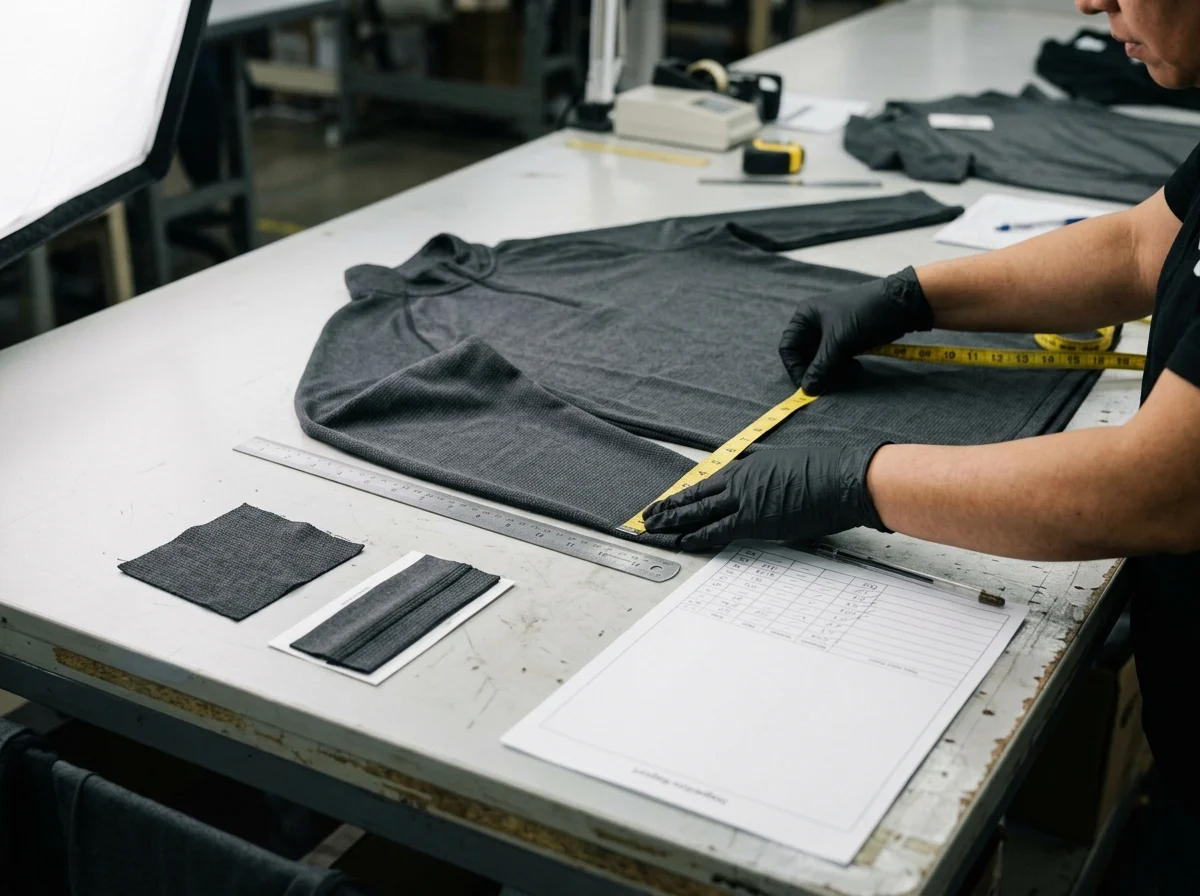
Begin with appearance and measurements, then move into use and care. Record the starting condition with photos and measurements.
For leggings or fitted bottoms:
- check opacity in the intended size under deep flexion;
- inspect waistband roll and recovery;
- measure rise, hip, thigh, inseam, and opening;
- check seam comfort against the skin;
- load pockets with the intended phone or item;
- inspect for grin-through at stretched seams.
For tops and training layers:
- check neck and armhole recovery;
- test the garment during overhead movement;
- inspect underarm and shoulder seams for restriction;
- check print cracking or edge lift after stretch;
- compare wet and dry hand feel if moisture performance matters.
Use a repeatable laundering protocol. AATCC TM135 defines standard procedures for measuring length and width changes after home laundering, with multiple washing temperatures, agitation cycles, and drying procedures. You may not need a laboratory for every early sample, but the AATCC dimensional-change method gives you a disciplined model: record the method, mark measurement points, repeat the same cycle, and calculate change rather than writing “washed well.”
Separate comments from approvals
Use one numbered comment sheet. Mark each revision as open, accepted, rejected, or pending. Include a photo, measurement, or drawing whenever text could be interpreted in more than one way.
Do not approve bulk through scattered chat messages. Issue a final approval record that identifies:
- approved sample date and version;
- approved fabric and color reference;
- final measurements and tolerances;
- artwork files and placement dimensions;
- labels, trims, and packaging;
- unresolved exceptions, if any;
- sign-off from both parties.
A supplier that handles this small project cleanly has demonstrated more than sewing ability. It has shown document control, communication, and change management. Those traits become more important when the order grows.
Compare manufacturers with one scoring system
Score every finalist against the same weighted criteria so a cheap quote cannot hide weak sampling, unclear responsibility, or poor activewear capability. Use the score to structure judgment, not to replace it.
A buyer deciding how to find a low MOQ activewear manufacturer can use one scorecard to see where a higher price is buying better evidence, stronger development work, or clearer bulk control.
Rate evidence, not promises. A supplier receives points for a complete sample report, traceable fabric, or a clear corrective-action response. It should not receive full credit for writing “strict QC” in a brochure.
| Criterion | Weight | Evidence to review | Low score signal |
|---|---|---|---|
| Product-category fit | 15 | Relevant current samples, construction knowledge, material options | Generic catalog or unrelated products |
| Sample accuracy | 20 | Measurements, fit, construction, finish, test results | Repeated misses without clear correction |
| Fabric and trim control | 15 | Traceable references, stock status, substitution procedure | Vague descriptions or unapproved alternatives |
| Quote transparency | 10 | MOQ layers, fees, inclusions, trade term, validity | One unexplained unit price |
| Communication and documents | 10 | Timely answers, version control, written confirmations | Conflicting answers and scattered approvals |
| Quality-control method | 15 | Inspection stages, records, defect response | Final inspection only or no written criteria |
| Business and compliance verification | 10 | Registration, matching payment entity, relevant documents | Names do not match and explanation is weak |
| Pilot-to-reorder capacity | 5 | Reorder material plan, repeat lead time, scaling explanation | Low MOQ is possible but repeat consistency is unclear |
Use the same RFQ for every finalist
A comparable request should ask:
- What manufacturing model do you propose for this style?
- What is the MOQ per style, color, size, fabric, logo method, and package?
- Which materials are in stock, and how long will they remain available?
- What samples are required before bulk, and what does each cost?
- How many revisions are included?
- Which measurements are critical, and what tolerances can you hold?
- Which operations are completed at another facility?
- What inspections occur before, during, and after sewing?
- How will you obtain approval for substitutions?
- What is the production schedule after final sample approval?
- What are the payment milestones and trade terms?
- How will unused branded materials be stored or returned?
Send follow-up questions when an answer is incomplete. Communication speed matters, but a fast vague answer is not stronger than a slower precise one.
Use a rejection rule
Some failures should remove a supplier regardless of the total score. Examples include an unverified payment beneficiary, refusal to provide a physical sample, repeated material substitution without approval, altered documents, or pressure to pay the full bulk amount before basic terms are agreed.
A score of 82 with a serious identity problem is not safer than a score of 78 with clean documentation. The numbers help compare normal trade-offs. They do not excuse a fundamental trust failure.
Red flags before paying for a pilot order
Stop and investigate when the supplier’s identity, scope, materials, price, or approval process changes without a documented reason. Small orders still deserve traceable agreements.
Knowing how to find a low MOQ activewear manufacturer also means knowing when to walk away. Reject a candidate when a basic identity or trust failure remains unresolved; a small order does not make mismatched bank details or altered documents acceptable.
The most common warning is a quote that becomes less specific each time you ask a question. The first message promises full customization. The quotation lists only “sportswear set.” The sample invoice uses another company name. The bank account belongs to a third entity. None of those points automatically proves fraud, but together they require an explanation and verification.
Watch for operational red flags
- The supplier refuses a sample but wants a bulk deposit.
- The MOQ changes after artwork or colors are disclosed.
- The fabric is described only as “premium” or “high quality.”
- Product photos appear on many unrelated supplier websites.
- The factory cannot explain how your stretch seams will be constructed.
- Every question is answered with a discount.
- A certificate has no facility scope or verification route.
- The contract permits substitutions without buyer approval.
- The delivery date starts before material approval is possible.
- The supplier promises every customization at the same very small quantity.
Check responsible-sourcing claims in proportion to risk
Supplier due diligence should cover more than a certificate folder. The OECD garment and footwear guidance uses a six-step process for identifying, preventing, mitigating, tracking, communicating, and remediating supply-chain impacts. It has been adopted by 50 governments. Use the OECD responsible garment supply-chain guidance to shape questions about facility identity, subcontracting, labor, environmental risks, and corrective action.
For a small brand, proportional due diligence might mean verifying business identity, mapping the actual facilities, checking relevant documents, asking about high-risk processes, and recording how issues will be handled. It does not mean claiming that a short questionnaire proves the entire supply chain is ethical.
Protect the product file
Use an NDA when confidential design information warrants it, but do not mistake a signed NDA for operational control. Limit access to current files, label versions clearly, and specify ownership of patterns, artwork, molds, screens, and unused branded materials.
The inquiry and NDA page gives buyers a direct route for discussing confidential product material before sending a full pack.
Plan the pilot order and reorder path
A pilot order should be simple enough to inspect and large enough to reveal whether the supplier can repeat the approved sample in production. Define the bulk checkpoints and reorder rules before paying the deposit.
A practical answer to how to find a low MOQ activewear manufacturer includes the pilot rules. The supplier should know before production which results will trigger acceptance, correction, replacement, or a stop.
Start with the style that teaches you the most. A hero legging may reveal fit, stretch, opacity, seam, waistband, and fabric issues. A heavily decorated capsule with several unrelated products makes it hard to identify why a result succeeded or failed.
Freeze the production baseline
Before bulk cutting, confirm:
- final purchase order and size ratio;
- approved pre-production sample;
- sealed fabric and color references;
- bill of materials;
- measurement chart and tolerances;
- artwork and branding files;
- packaging and carton marks;
- inspection method and acceptance criteria;
- production and shipping milestones.
The production process is the relevant internal resource when a buyer needs to understand how approved information moves into cutting, sewing, finishing, packing, and handover.
Inspect during production, not only at the end
An early check can catch a repeated problem while it can still be corrected. Review first output after line setup, verify measurements and workmanship during production, and inspect finished goods before shipment. The exact inspection plan should match the quantity and product risk.
Keep defect language observable. “Poor quality” is difficult to act on. “Waistband topstitch skipped for 18 millimeters at center back” identifies the location and failure. Photos should include scale and item identifiers.
Decide what earns a reorder
The reorder decision should combine customer and factory evidence:
- sell-through by style, color, and size;
- returns and fit complaints;
- defects found at receipt or after use;
- margin after freight, duty, replacements, and discounts;
- supplier response to problems;
- material availability for the repeat run;
- ability to hold the approved specification.
Scale the parts that worked. Do not add several new colors, materials, and constructions to the first reorder while also asking the factory to improve fit. Change one group of variables at a time so the result remains interpretable.
Low-MOQ activewear sourcing trends for 2026 and beyond
Small-batch sourcing is moving toward stock-material platforms, clearer material data, digital development, and staged reorders rather than unlimited one-off customization. Buyers will still need physical validation because performance and fit cannot be approved from a screen.
In 2026, understanding how to find a low MOQ activewear manufacturer means valuing a stable material platform and disciplined documentation over promises of unlimited customization at any quantity.
Material availability will shape small orders
Performance apparel depends heavily on synthetic fibers. Textile Exchange reports that global fiber production reached about 132 million tonnes in the latest reporting year and that polyester represented 59% of output. Those figures explain why polyester-based performance fabrics are widely available, but availability does not prove suitability or a responsible sourcing claim. Use the Textile Exchange reports archive to review current material-volume and sourcing data.
For low MOQ buyers, the practical trend is a more structured stock-fabric offer. A factory can support smaller garment quantities when it maintains tested materials across several base styles. The buyer gains speed and continuity but accepts a defined material platform.
Ask for a stable fabric reference, not only a composition. Two fabrics labeled 75% polyester and 25% elastane can differ in weight, knit construction, stretch, recovery, opacity, finish, and dye behavior.
Testing will become more product-specific
General claims such as moisture wicking or durable stretch are losing value without a method and acceptance target. Current textile standards cover properties such as air permeability, stretch, bursting strength, dimensional change, pilling, and abrasion. ASTM also notes that laboratory abrasion results are only one factor in actual wear performance. That caveat matters: ASTM’s Martindale abrasion guidance supports controlled comparison, while wear trials show how the complete garment behaves on a body.
Small brands do not need to order every possible laboratory test. They need a risk-based plan. Test the claims customers will rely on, the failures most likely to create returns, and any evidence needed for a regulated or specific marketing statement.
Digital tools will improve control, not replace samples
Digital patterns, 3D visualization, shared comment systems, and production dashboards can reduce avoidable back-and-forth. They are useful for checking proportion, artwork placement, and document versions. They do not reproduce fabric hand, skin comfort, compression, recovery, or wash behavior accurately enough to remove physical sampling.
The stronger 2026 workflow is hybrid: digital clarification first, physical testing second, controlled pilot third. Each stage removes a different type of uncertainty.
Frequently asked questions
What is considered a low MOQ for activewear?
u003cstrongu003eThere is no universal number.u003c/strongu003e The real minimum depends on the product, material, color split, branding, and customization level. A stock-fabric private-label garment may support dozens of pieces, while custom-dyed cut-and-sew activewear may require hundreds. Bottom line: compare the full MOQ formula, not the headline number.
Is MOQ calculated per style, color, or size?
u003cstrongu003eIt may be calculated at all three levels.u003c/strongu003e Ask the supplier to state the minimum per style, color, fabric, size ratio, and total purchase order in writing. Bottom line: a total-order MOQ matters only after its internal splits are confirmed.
Where is the cheapest place to manufacture clothing?
u003cstrongu003eNo country is always cheapest after all costs are included.u003c/strongu003e Compare product development, freight, duty, delays, inspection, and correction risk under the same delivery term. Bottom line: choose the lowest controlled landed cost, not the lowest sewing price.
What should I send before requesting a quote?
u003cstrongu003eSend a tech pack or structured product brief.u003c/strongu003e Include quantity, colors, size ratio, fabric requirements, branding, packaging, delivery location, and target date. Bottom line: complete inputs produce quotes that are easier to compare and samples with fewer interpretation-driven revisions.
How can I verify that a manufacturer is legitimate?
u003cstrongu003eMatch the legal business, facility, payment beneficiary, invoice, contract, and production role.u003c/strongu003e Verify relevant documents through their issuers and use a live facility call or independent inspection when the risk justifies it. Bottom line: legitimacy is a chain of consistent evidence, not one certificate or video.
Should I choose private label or custom cut and sew?
u003cstrongu003eChoose private label for speed and lower development work.u003c/strongu003e Choose cut and sew when a unique fit, construction, material, or technical feature matters. Bottom line: fund custom development where it creates a product advantage customers will notice.
How many sample rounds should I expect?
u003cstrongu003ePlan enough rounds to approve fit, materials, construction, and bulk readiness.u003c/strongu003e The exact number depends on product complexity and the quality of the starting specification. Bottom line: the target is fewer repeated mistakes, not fewer samples at any cost.
Can a low MOQ manufacturer handle larger reorders?
u003cstrongu003eSome can scale well, while others specialize in development and small runs.u003c/strongu003e Confirm capacity, material continuity, lead time, inspection, and pricing before the pilot. Bottom line: approve a scaling plan before sales force a rushed reorder.
Choose the supplier that makes risk visible
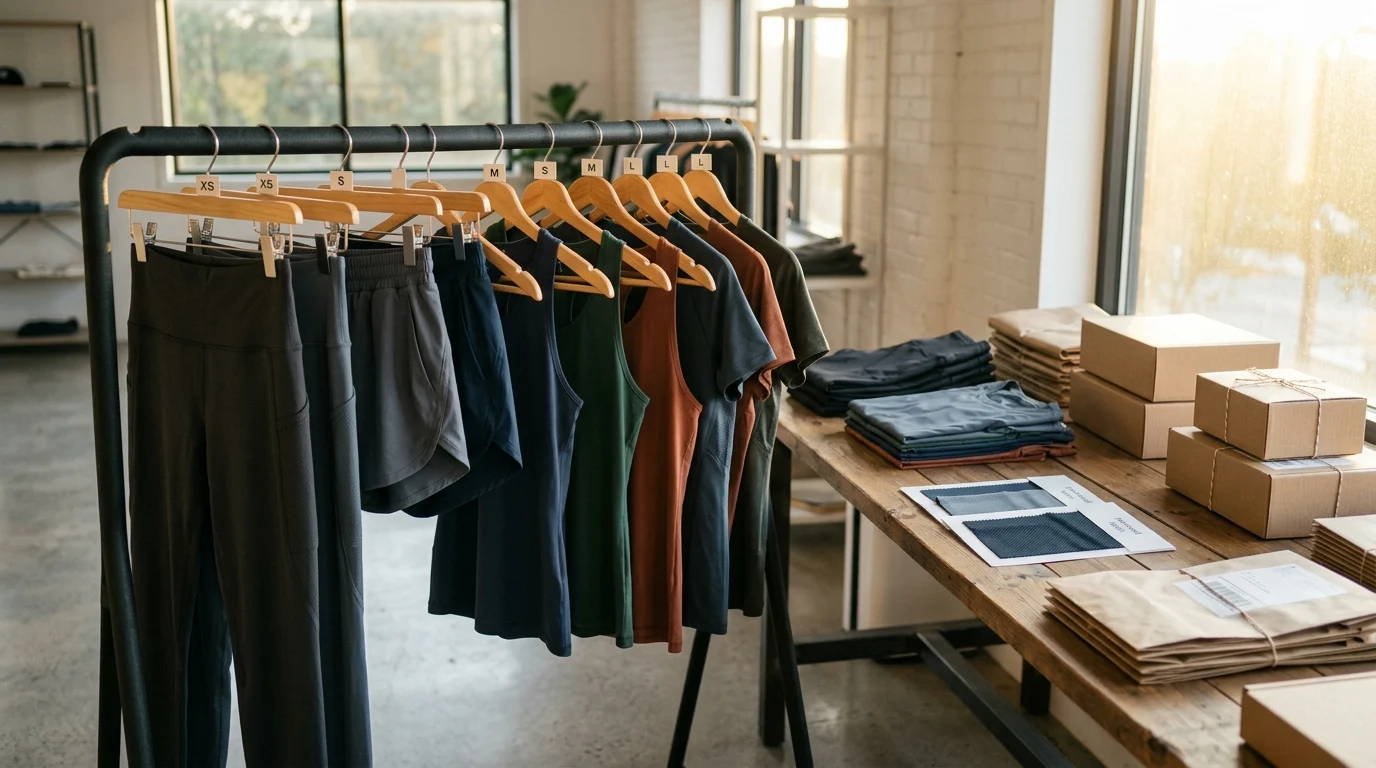
A suitable low MOQ activewear manufacturer will make quantities, materials, responsibilities, approvals, and trade-offs clear before asking you to scale. That transparency is more useful than a dramatic minimum or an unexplained low price.
Start with one focused product brief. Shortlist suppliers with relevant activewear evidence, send the same RFQ, test physical samples, and score what you can verify. Place a controlled pilot only after the approved product and bulk instructions match.
If you already have sketches, measurements, or a tech pack, send your product information for review. Ask for the MOQ by style and color, sample route, proposed fabric, branding limits, production checkpoints, and landed-cost assumptions in the first conversation.