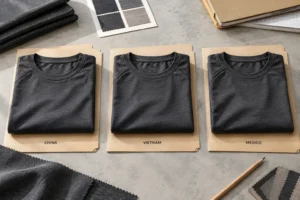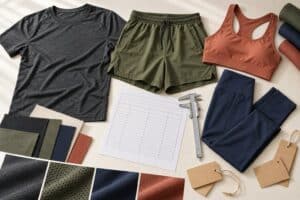
Tariffs can put pressure on apparel margins, but they do not create a universal clothing MOQ. A factory may reject a small order because it cannot source the material batch, recover the setup work, or fit the run into its schedule. Before agreeing to more pieces, ask which constraint applies and whether changing the order structure would solve it.
A 600-piece collection can look substantial to a new brand and still look fragmented to a production team. Divide it across several patterns, colors and decoration files, and the factory is evaluating many short runs. The factory still has to plan each of those runs.
When reviewing apparel MOQ and tariffs in 2026, compare a simpler assortment, a paid pilot, staged delivery and a different production model. Agreeing to extra pieces before identifying the constraint can leave the brand with stock it did not plan to buy.
Reviewed November 6, 2026. All cost examples are hypothetical planning exercises. The original AI-generated images are conceptual illustrations, not photographs of DTS facilities, employees, shipments or customer projects.
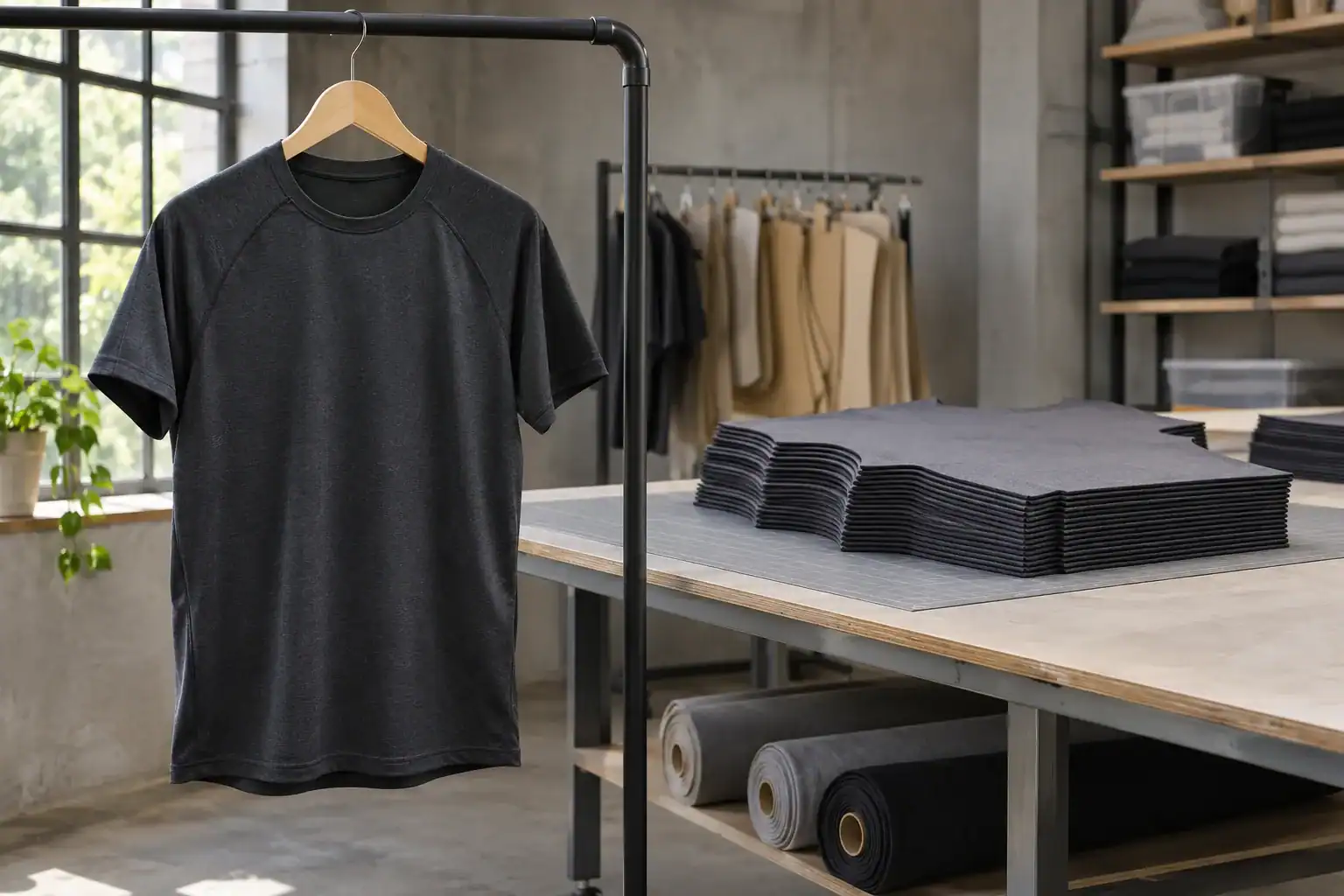
Have tariffs actually raised clothing MOQs?
There is evidence of tariff pressure and supplier consolidation, but that does not establish an industry-wide increase in factories’ minimum orders. Buyers should distinguish a change in sourcing strategy from a change in the minimum for a particular garment.
Образец 2026 USFIA Fashion Industry Benchmarking Study describes companies concentrating relationships with strategic suppliers while maintaining geographic diversity. Its full report also recognizes China’s flexibility in handling smaller and more varied orders. Neither finding supports the claim that all factories now insist on larger runs.
A buyer trying to offset a higher landed cost might request a lower factory price. The supplier might offer that price only with fewer changeovers or a firmer material commitment. That is a conditional commercial proposal, not proof that tariffs physically require more garments.
Ask the supplier to separate two offers: the price for your actual pilot quantity, and the price for a more concentrated or larger order. Keep the garment specification and delivery scope comparable. If the MOQ changed since a previous quote, request the reason in writing: material availability, customization, price target, payment exposure or production timing.
Which part of the order is the factory rejecting?
If a supplier says “below our MOQ,” ask what prevents the order from going ahead. The same answer can conceal very different constraints.
The material batch is too small
A sewing factory might accept the garment quantity while the nominated fabric, custom color, elastic or packaging supplier will not accept its component order. The garment minimum and the material minimum are separate constraints.
This predates the current tariff debate. The International Trade Centre’s Source-it material-sourcing guide, published in 2005, explains that mill minimums can reflect both commercial decisions and batch-processing requirements. It provides background on the mechanism, not a current MOQ benchmark.
Ask which material is binding, the quantity required, and what happens to the unused balance. A stock fabric alternative may help, provided the approved composition, weight, feel and performance remain suitable. Paying a sewing surcharge alone will not create an unavailable fabric color.

The run cannot cover its setup work
Pattern preparation, size grading, cutting preparation, machine adjustment and artwork setup can require work before useful production output begins. A short run has fewer units over which to recover that work.
Request a separately identified setup charge or a small-run price. Then ask what is reusable on a repeat order and what would trigger a new charge. A repeat of an approved black tee may require less development than a revised fit with a new print and different fabric. Do not assume that paying once makes every subsequent variation free.
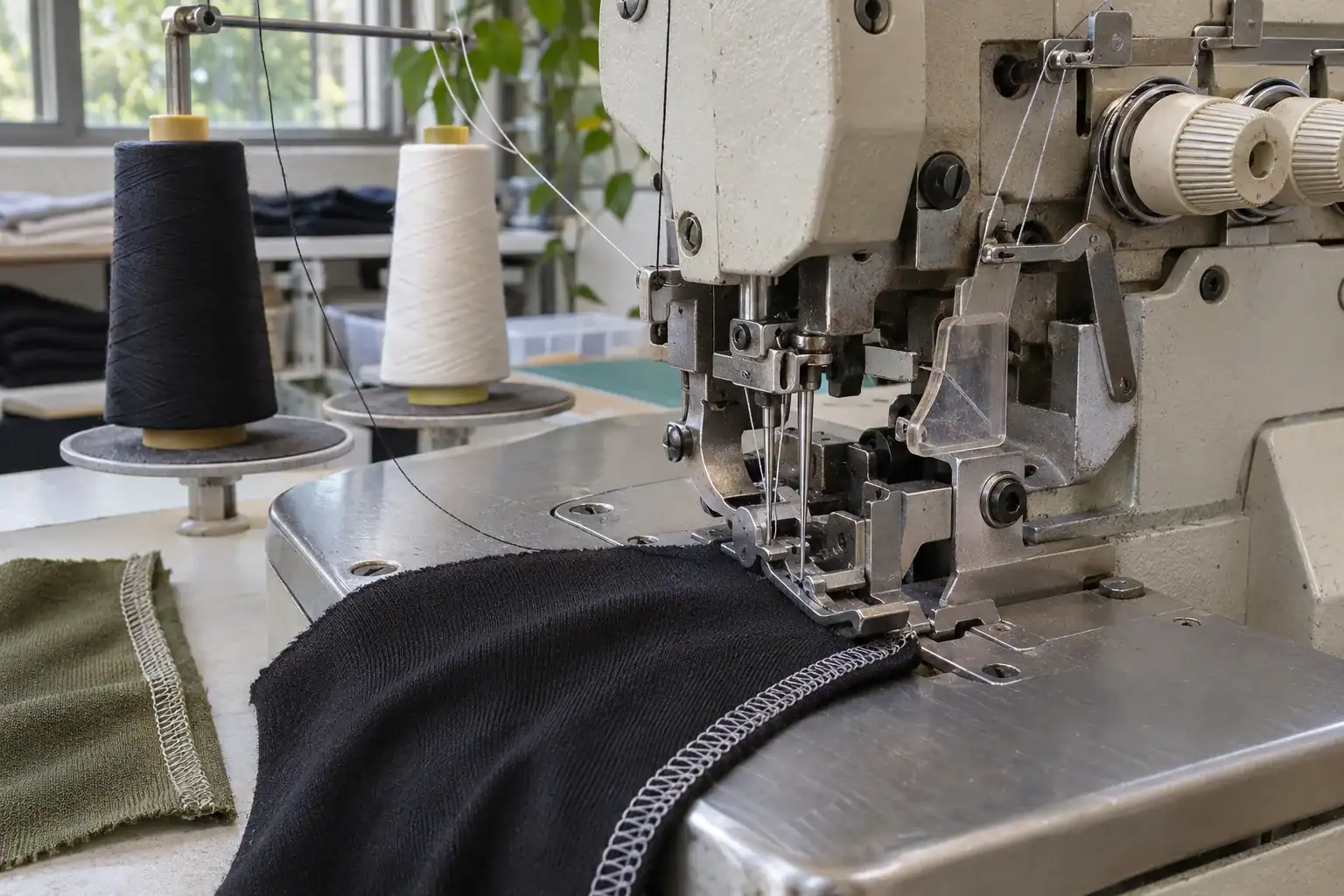
The factory cannot commit a suitable production slot
A technically feasible order may still be unattractive at the requested date. A factory organized around long runs may have difficulty inserting several short jobs, even when the buyer accepts a higher piece price.
Ask whether a later production window, fewer changes or an agreed repeat-order schedule would alter the answer. If the business needs a tiny one-off run, a supplier built for that work may be a better fit. The existing low-MOQ activewear sourcing guide covers supplier qualification; this decision starts with diagnosing why the present quote failed.
Why fewer styles can work better than a larger collection
Concentrating the same total quantity can improve production economics without increasing the number of garments bought. That works only when the removed variants actually eliminate separate work.
Consider a hypothetical 600-piece launch:
- Six styles in two colors create 12 style-color combinations, averaging 50 garments each.
- Two styles in two colors create four combinations, averaging 150 garments each.
For a simple costing model, assume every combination creates a separate run with $150 of setup cost. Also assume an $8 manufacturing cost per garment before those setup charges.
The fragmented collection costs $4,800 for garments plus $1,800 for 12 setups: $6,600, or $11 per garment. The concentrated collection costs $4,800 plus $600 for four setups: $5,400, or $9 per garment.
The modeled saving is $1,200 on the same 600 pieces. It comes from eight avoided setups. No tariff rate changed.
Actual factories may group work differently. Two styles might share a fabric purchase but still require different patterns and machine settings. Several colors might share one artwork setup while requiring separate cutting or printing steps. Ask the supplier to identify what genuinely disappears from the cost, rather than applying the $150 assumption to a live quote.
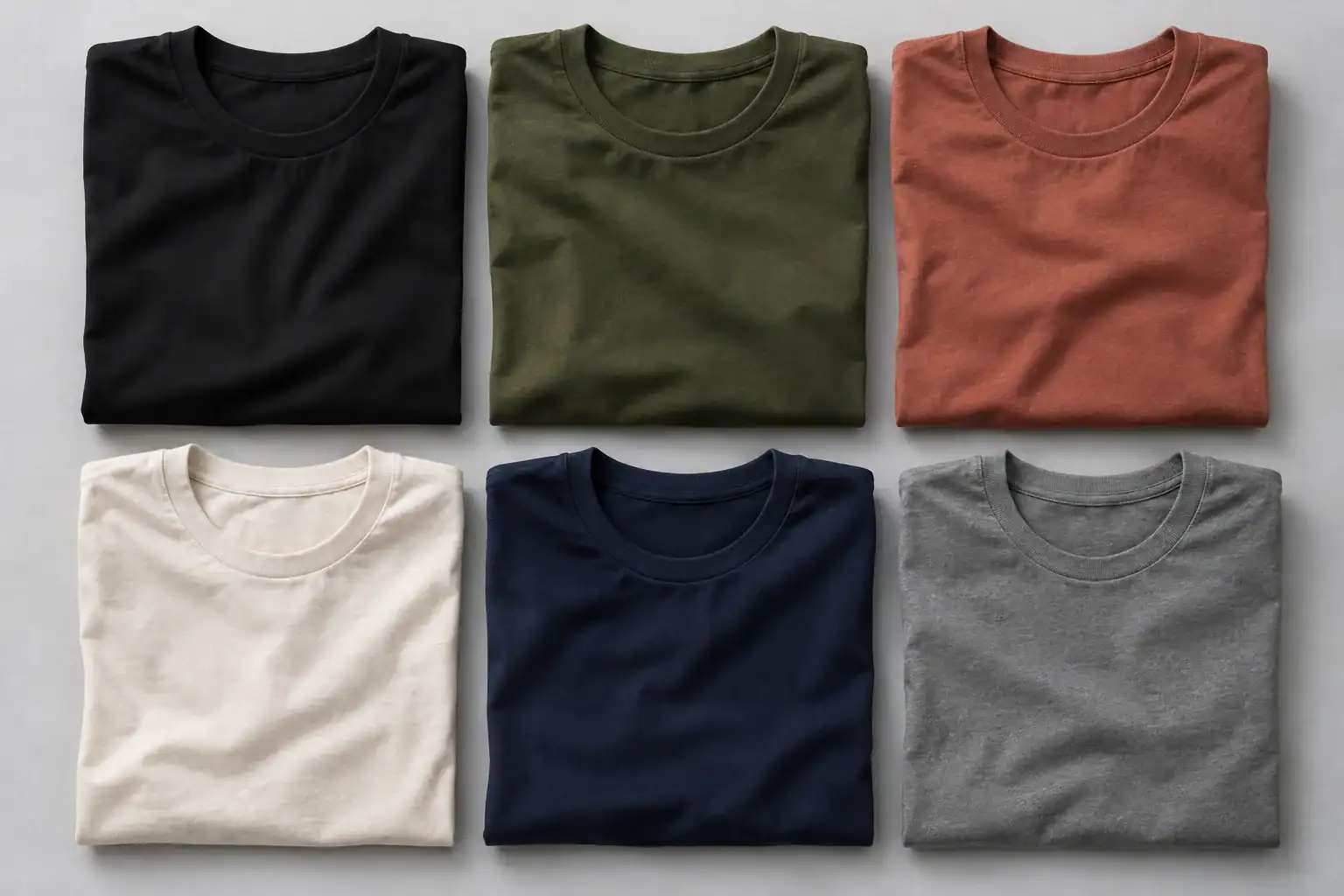
A lower unit price can still require more cash
Order concentration and higher quantity are different decisions. The first may remove unnecessary work. The second commits the buyer to additional stock.
Keep the duty scenario separate from the production saving
To stress-test the 600-piece example, assume a hypothetical 20% duty and, solely for this calculation, a duty base equal to each manufacturing subtotal. These are arithmetic inputs, not current US apparel tariff rates or a determination of customs value.
- Fragmented order: $6,600 + $1,320 assumed duty = $7,920.
- Concentrated order: $5,400 + $1,080 assumed duty = $6,480.
The modeled difference becomes $1,440. Of that, $1,200 comes from production setup savings and $240 from applying the same assumed rate to a lower assumed duty base. Neither quantity nor order concentration earns a lower tariff rate in this model.
Freight, inspections, brokerage, storage and other charges are excluded here so the mechanism stays visible. Use the clothing landed-cost calculator to build a fuller comparison with your own inputs. Confirm classification, origin, valuation and measures applicable to the intended entry; the текущем Гармонизированном тарифном расписании ВТО is a starting point for that review, not a substitute for a shipment-specific determination.
Compare the total commitment before accepting the discount
Now suppose a fictional supplier offers 1,000 garments at an all-in manufacturing price of $8 each, including setup. That is an $8,000 commitment before import and delivery charges. The 600-piece concentrated order above commits $5,400 at the same stage.
The larger offer lowers the unit price but requires $2,600 more manufacturing cash and leaves the buyer with 400 additional garments to sell. Their eventual selling price and timing are unknown. Do not count them as profit merely because they cost less per piece.
Before buying the extra stock, test whether the business can afford slow sales, a weak color or a fit revision. Set a maximum cash commitment as well as a target unit cost. A pilot that answers a fit or demand question may justify its higher unit price; an oversized first run may expose the brand to more loss than it can absorb.
Match your response to the reason for rejection
Start with the constraint the supplier can identify. Explain which specifications or dates you can change; an uncommitted forecast of future volume may not help the supplier plan the current run.
| Reason given | Useful response and its limit |
|---|---|
| Custom fabric or color minimum | Review available material or fewer colors. Approve the replacement; confirm who pays for any unused material. |
| Setup recovery | Request a pilot surcharge or fewer style changes. Record the repeat-order terms rather than assuming the charge disappears. |
| Schedule conflict | Review another production window or a small-run supplier. A higher piece price does not guarantee a slot. |
| Too many trim or packing variants | Standardize the parts that do not define the product. Confirm branding and market requirements before changing them. |
| Price target is too low | Compare a feasible pilot price against the cash risk of extra stock. A bigger order is optional, not automatically the better purchase. |
Record the selected compromise in the specification. Switching to stock material can change the available shade or feel; replacing a label or decoration can alter the product’s appearance. Use разработка образцов и прототипирование to approve the version you will actually order.
Separate the production commitment from the delivery schedule
Making a larger batch and shipping it in stages can change delivery timing without reducing the quantity you have agreed to buy. Treat production quantity, material ownership and release quantities as separate terms.
For example, a supplier might discuss producing 600 garments and releasing them in three shipments. That arrangement does not, by itself, let the buyer cancel the last two releases if the first sells slowly.
Before accepting staged delivery, confirm:
- When the commitment to materials and finished goods becomes binding.
- The deposit, balance-payment and release-payment dates.
- Who owns the remaining stock and where it will be stored.
- Storage charges, condition checks and responsibility for damage or loss.
- The final release date and what happens if demand is below plan.
- Which freight, handling and entry costs recur with each shipment.
If the supplier instead reserves fabric and sews each release later, ask about material continuity, shade control, capacity and the expiry of the reservation. That is a different arrangement from holding completed garments. Neither arrangement guarantees that an earlier tariff assumption will apply to a later entry.

Send an order brief the factory can evaluate
Requesting “a low MOQ because tariffs are high” does not tell a supplier what it would need to make. Include enough detail for the team to separate material, price and scheduling constraints.
Send a quantity breakdown alongside the product specification:
- Одежда: reference image or drawing, fit, size range, measurements and construction requirements.
- Material: composition, GSM, finish, approved swatch if available, and whether stock colors are acceptable.
- Variants: pieces per style and color, size mix, and which features can be shared.
- Брендинг: artwork dimensions, placement, decoration method, labels, hangtags and packing.
- Timing and destination: sample deadline, required delivery date, receiving location and requested quote scope.
- Commercial limits: maximum first-order commitment and which options you can change without losing the product’s purpose.
If the specification is incomplete, the tech-pack review service is a relevant first step. Avoid asking different suppliers to price different versions and then comparing only the headline piece price.
Request two written scenarios: the smallest feasible approved pilot, and a concentrated order using the same core specification. Ask each scenario to show its binding minimum, development and setup charges, manufacturing subtotal, material balance and quote validity. Keep import charges separately identified unless the offer explicitly includes them.

Questions buyers ask about clothing MOQ and tariffs
Does buying more clothing automatically reduce the tariff rate?
No automatic volume discount is assumed here. Buying more may change the manufacturing price or cost allocation, but classification, origin and applicable entry measures require their own review. Ask for the duty calculation separately from the factory’s quantity price break.
Can a setup fee replace a higher MOQ?
Sometimes, if setup recovery is the obstacle and the supplier accepts that arrangement. It will not necessarily resolve a fabric-batch requirement, unavailable trim or unsuitable production schedule. Ask what the fee covers and which constraints remain.
Is a 600-piece order enough if it contains many colors?
The total does not answer that question. A six-style, two-color order has 12 combinations before considering sizes. Confirm the minimum for each relevant layer and whether any material, cutting or branding work can be combined.
Should a startup accept a bigger order to preserve its target margin?
Only if the extra cash and stock exposure fit the launch plan. Compare the larger order with a paid pilot, a simpler assortment and a different production model. A margin forecast based on selling every unit at full price can conceal the cost of a weak launch.
Does DTS offer the same MOQ for every custom garment?
This article does not quote a universal DTS minimum. Submit the style, fabric, color breakdown, size mix, branding and packing brief for review. Ask the team to confirm the feasible quantity and commercial terms against that specification.
Approve the smallest order that answers your buying question
If the first run must validate fit, fabric behavior or customer demand, size it around that learning goal and the loss the business can afford. If demand is already established and the specification is stable, a concentrated repeat order may offer a more useful comparison.
Ask the factory to identify the limiting input, the avoidable setup work and the firm commitment behind each offer. Then choose the order that gives you an approved product, a manageable cash requirement and a clear reason to reorder.
Request an order-feasibility review from DTS Activewear
DTS Activewear’s published services include tech-pack review, sampling and custom activewear and streetwear development. For a training tee, shorts or jogger project, begin with the garment brief and proposed quantity.
Send the proposed pieces by style, color and size, material direction, artwork, labels, packaging, destination and target date. Identify the features that must stay and those that can change. This gives the team the information needed to discuss material availability, sample work and a feasible production scope.
Request a pilot scenario alongside any proposed concentrated order, with the quantity basis and separately charged work explained. This review does not promise a particular MOQ, tariff saving, price or lead time.
Send Your Quantity Breakdown for MOQ Review.