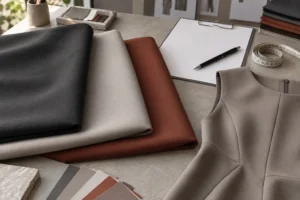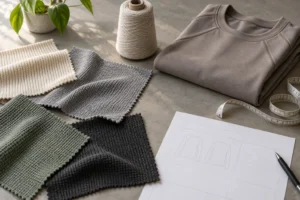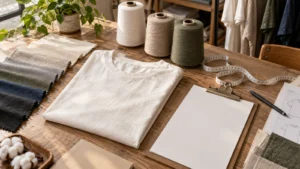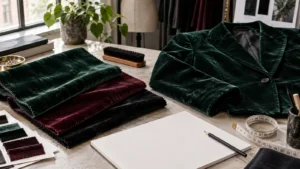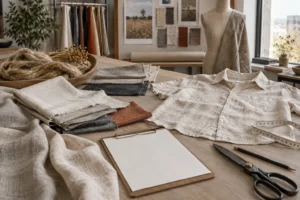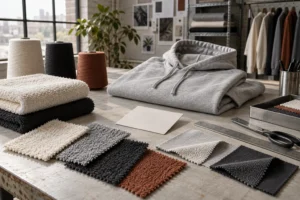
Scuba fabric is usually a dense, smooth double-knit fabric chosen when a garment needs more body and shape retention than a light jersey. The word scuba does not identify one universal fiber, GSM, stretch percentage or finish. In apparel sourcing, it is a construction and hand-feel description that must be completed with fiber content, yarn, finished weight, usable width, stretch, recovery, surface and care requirements.
This guide answers what scuba fabric is, whether it is the same as neoprene, how it compares with ponte and other double knits, where it works in apparel, and what a buyer should record before approving a sample or bulk lot. It is written for apparel brands, product developers, procurement teams and manufacturers who need a usable fabric brief rather than a generic glossary definition.
What is scuba fabric?
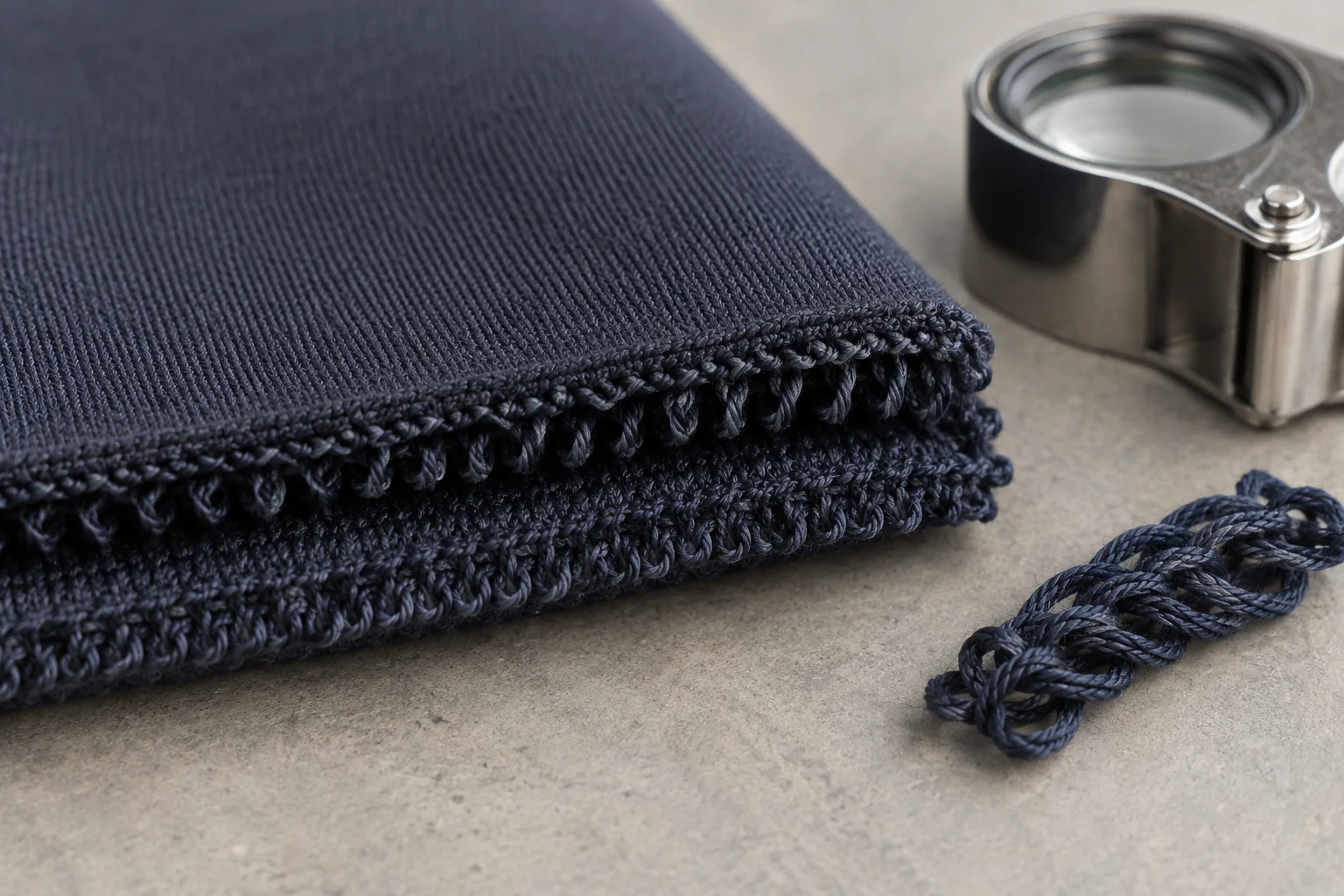
Scuba fabric is commonly made as a dense double knit: two knitted layers are formed together so the resulting textile has a fuller hand, a smooth surface and more stability than many single jerseys. A textile education reference defines double knit as two interlocked layers, while an industry description of scuba links its structured hand to this double-knit construction. The construction is the important starting point, not the word scuba by itself.
Scuba can be made with different fiber systems, yarns and finishes. Polyester and elastane blends are common in commercial apparel, but a buyer should not assume that every scuba sample has the same blend or performance. Fiber affects moisture behavior, color, heat response, pilling and care. Yarn size, machine settings, finishing and relaxation affect density, width, surface and recovery.
That is why "polyester scuba" is still not a complete specification. It names a fiber family and a market fabric name, but it does not tell a pattern team whether the material will be opaque enough, whether a seam will hold, or whether a bodycon garment will keep its shape after laundering. For a useful overview of the broader construction category, see what knit fabric means for apparel buyers.
| حقل المشتري | ما تصفه | Why it matters before sampling |
|---|---|---|
| التركيب | Double knit, face and back, knit route and any air-layer or engineered structure | Helps the team compare like-for-like fabrics instead of relying on a retail name |
| Fiber and yarn | Fiber percentages, yarn type and elastane or other stretch component | Changes hand, moisture behavior, strength, recovery, pilling and care |
| الوزن النهائي | GSM after the agreed finishing and relaxation route | Affects opacity, warmth, drape, garment weight, yield and cost |
| العرض القابل للاستخدام | Width available for pattern placement after edge or tube limitations | Prevents a fabric that matches the hand but fails yield or marker planning |
| التمدد والاسترداد | Direction, extension method, recovery reading and repeated-cycle behavior | Protects fit, neckline, waistband, seat and knee shape |
| Surface and finish | Matte or slight sheen, smoothness, brushing, print route and finish durability | Determines appearance, pressing risk, pilling risk and whether the surface suits the design |
A buyer can therefore use this short definition: scuba is a structured apparel knit family, usually based on a dense double-knit construction, whose final behavior depends on the actual fiber, yarn, weight, finish and test result.
Is scuba fabric the same as neoprene?
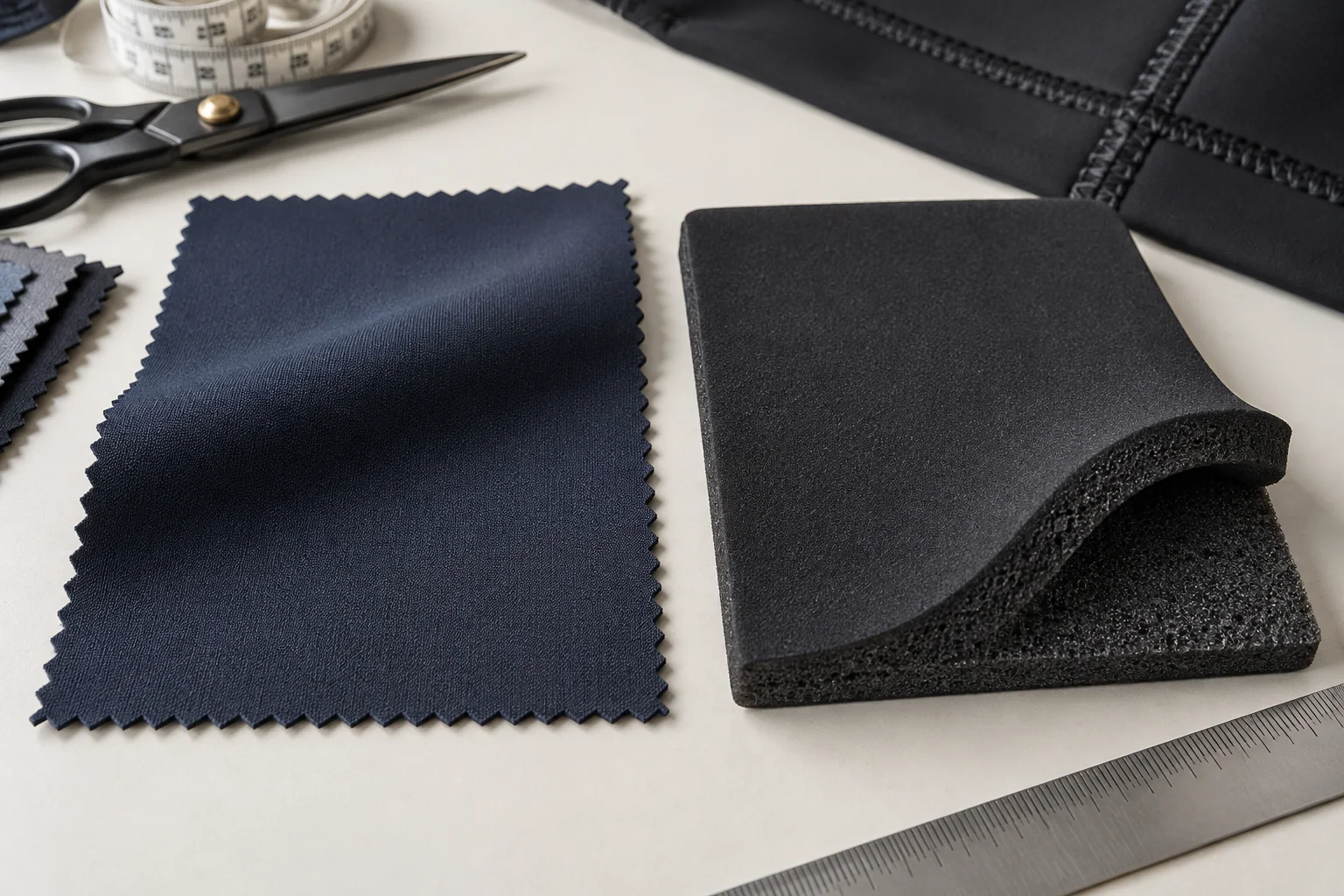
Usually, no. Neoprene is a synthetic rubber made by polymerizing chloroprene, according to the National Library of Medicine’s MeSH definition. Textile scuba is generally a knitted fabric. The two may share a smooth, slightly cushioned or structured visual impression, which explains the name, but a knitted textile and a rubber foam material are not interchangeable for fiber declaration, breathability, sewing, pressing, laundering or end use.
The word scuba is also used inconsistently in retail and supplier conversations. One supplier may use it for a compact double jersey, another for an air-layer knit, and another for a heavier fashion knit with a smooth finish. Do not approve a sample because the name sounds familiar. Ask the supplier to identify the fiber content, knit construction, finished GSM, usable width, stretch direction, recovery and care route. If a product truly uses neoprene or a foam laminate, it should be identified and tested as that material rather than hidden behind a fabric nickname.
| Material name | Typical starting point | What can overlap | What a buyer must not assume |
|---|---|---|---|
| Scuba textile | Dense, smooth double knit with body and controlled stretch | Smooth hand, shape retention and a slightly cushioned feel | One fixed fiber blend, one GSM, or automatic high breathability |
| Neoprene | Synthetic rubber or foam-based material | Smooth surface and structured silhouette | That it sews, washes, presses or breathes like a knitted textile |
| Ponte | Stable, substantial double knit, often used for tailored or fitted apparel | Body, recovery and a clean surface | That ponte and scuba have the same face, thickness, drape or stretch |
| الربط المتداخل | Double-knit structure with a smooth appearance on both sides | Coverage, stability and a cleaner hand than many single jerseys | That every interlock has scuba’s firmness or surface finish |
| Jersey | Usually a single-knit family with a distinct face and back | Stretch and close-to-body comfort | That a jersey will provide the same sculpted shape or opacity |
The safest sourcing language is descriptive: "dense double-knit fabric with a smooth surface and target recovery for the attached garment." Add the preferred fiber and weight as requirements to verify, not as facts to invent before a sample exists.
Scuba fabric vs ponte and other double knits
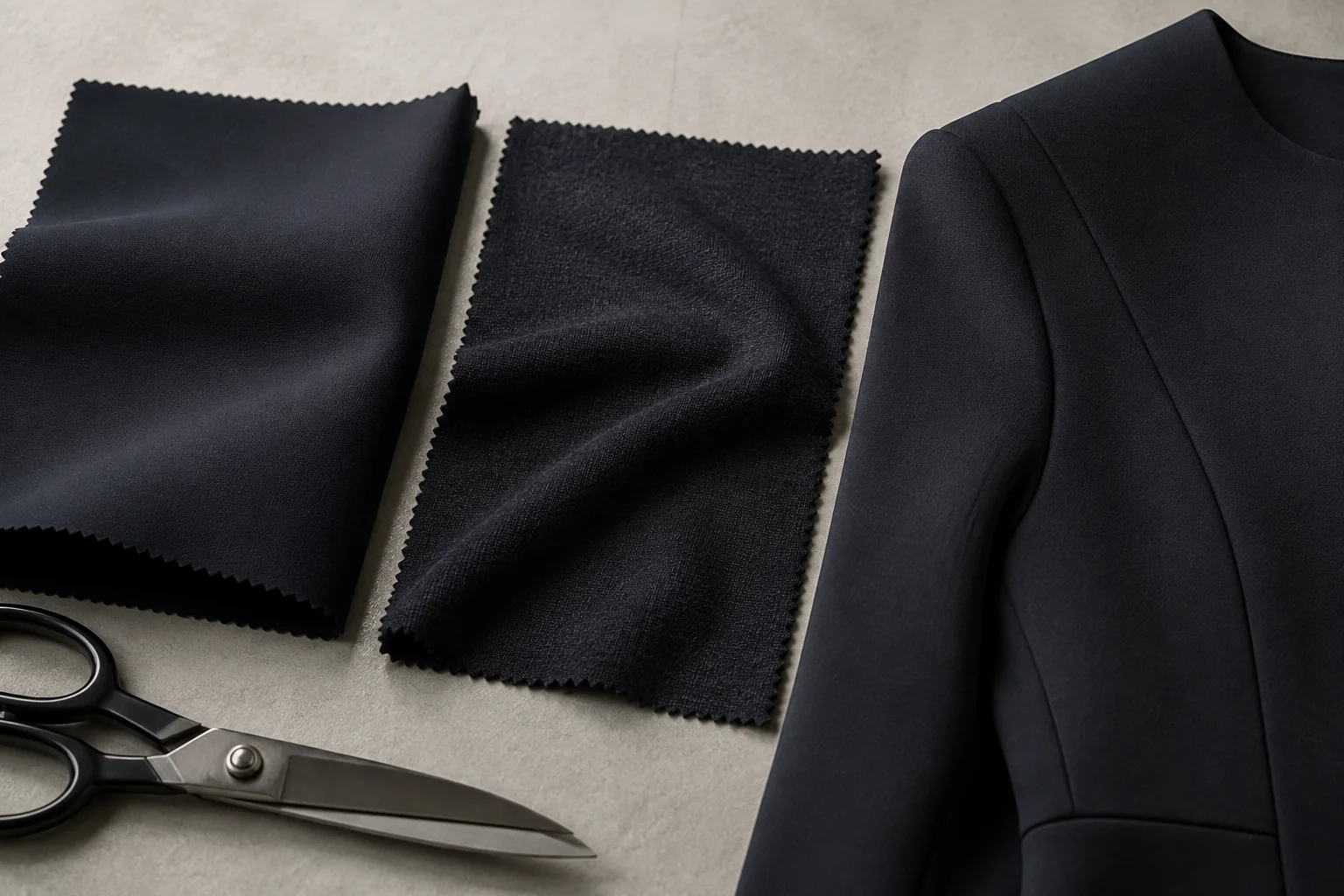
Scuba and ponte are often compared because both can give a garment more structure than a lightweight jersey. The names still describe different commercial fabric families, and supplier definitions vary. Ponte is commonly selected for trousers, skirts, structured dresses and tailored knit garments. Scuba is often chosen for a smoother, more sculpted or slightly spongy fashion surface. Those are starting tendencies, not guaranteed results.
Use the garment job to make the decision. If the product needs a clean, sculpted silhouette, compare surface, bending stiffness, recovery, seam appearance and pressing behavior. If it needs a soft tailored hand, stable waistband and comfortable movement, compare ponte samples under the same pattern and laundering route. If it needs sweat management or all-day high-output movement, neither name alone is enough; review the actual moisture and heat behavior.
Do not use the word double knit as a shortcut for quality. Double-knit construction can improve stability, but fiber, yarn, density and finishing still control the final material. A thin interlock, a compact ponte and a heavier scuba can all be described as double knits while producing very different garments.
How much stretch does scuba fabric have?
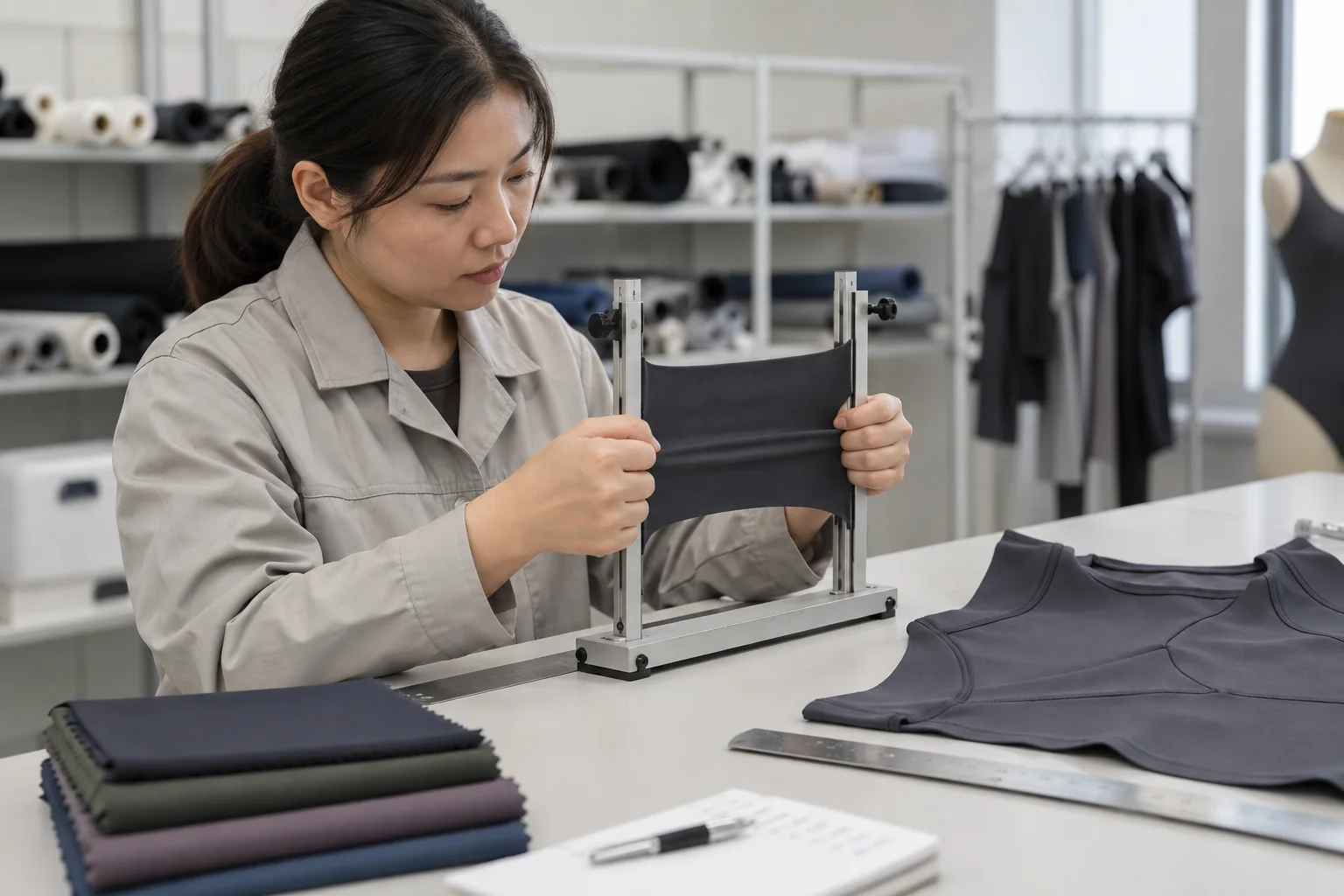
Scuba fabric may have moderate or high stretch, but there is no universal scuba percentage. Stretch comes from loop geometry, elastane, yarn, density, finishing and direction. A fabric can extend well across the width and remain comparatively stable in the length. It can also extend under force but recover poorly after repeated wear, which may cause a neckline, waist, seat or knee to grow.
For a close-fitting garment, measure both the flat fabric and a sewn panel. Record the direction, specimen size, applied force or extension method, relaxation time, number of cycles and recovery reading. If a buyer asks for four-way stretch, define what four-way means for the product. It should not be treated as a substitute for a test method.
| Test or observation | ما يجب تسجيله | Risk it helps reveal |
|---|---|---|
| Widthwise extension | Direction, specimen, condition, method and extension result | The garment may feel restrictive or over-expand across the body |
| Lengthwise extension | Direction and result after the defined loading | Body length, rise or sleeve length may change during wear |
| الاستعادة | Reading after a defined rest period or repeated cycles | Necklines, waistbands, knees and seat may bag out |
| Growth simulation | Change after movement, loading or repeated extension | A strong first stretch result may not predict retained shape |
| Sewn-panel review | Seam type, stitch, seam allowance, lining and fabric layers | A flat fabric can pass while a neckline, gusset or waistband fails |
If the buyer does not have a laboratory method, the sampling brief should still define a repeatable internal method and acceptance limit. Keep the result with the approved swatch and sample version. A supplier adjective such as "high stretch" is not a substitute for evidence.
Scuba fabric weight, GSM and usable width
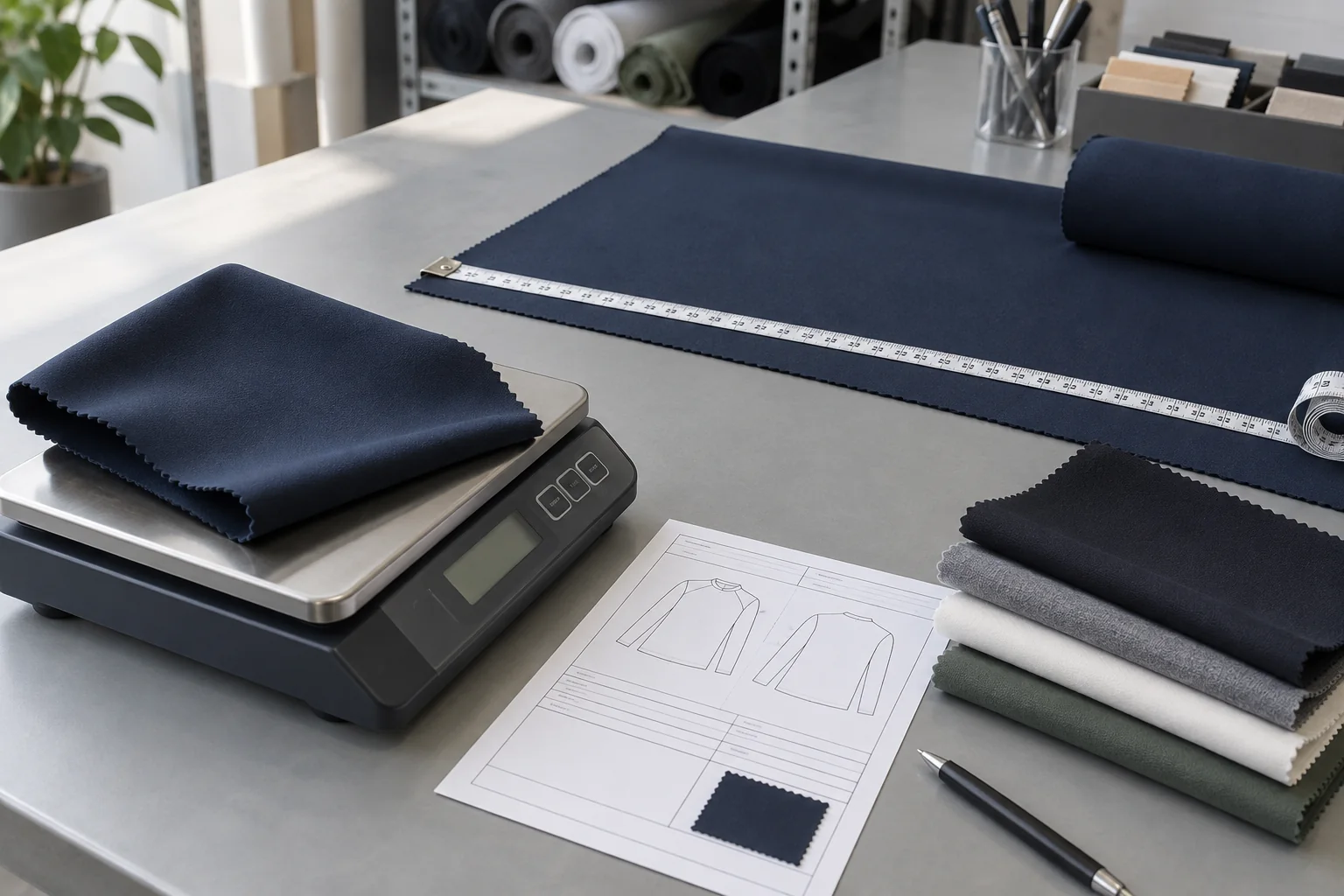
GSM means grams per square meter. It is useful for comparing finished fabric weight, but it is not a quality score and it does not predict every aspect of warmth, opacity, stretch or drape. Two scuba samples with similar GSM can feel different when their fiber, yarn, loop density, finish or relaxation history differs.
Record GSM after the specified finishing and relaxation route, and state the tolerance. Record usable width separately from edge-to-edge width if the selvedge, tubular edge or damaged edge cannot be used for the marker. If the fabric is supplied in tubular form, note whether the pattern will be cut folded or opened. A replacement that matches GSM but loses usable width can change yield and cost.
Also record the face and back, roll condition, shade reference, surface appearance and any direction that affects cutting. Heavy or smooth fabrics can show pressure marks, shine changes or fold memory after storage. The sample review should include the actual packing and handling route when those risks matter.
Surface, drape and garment shape
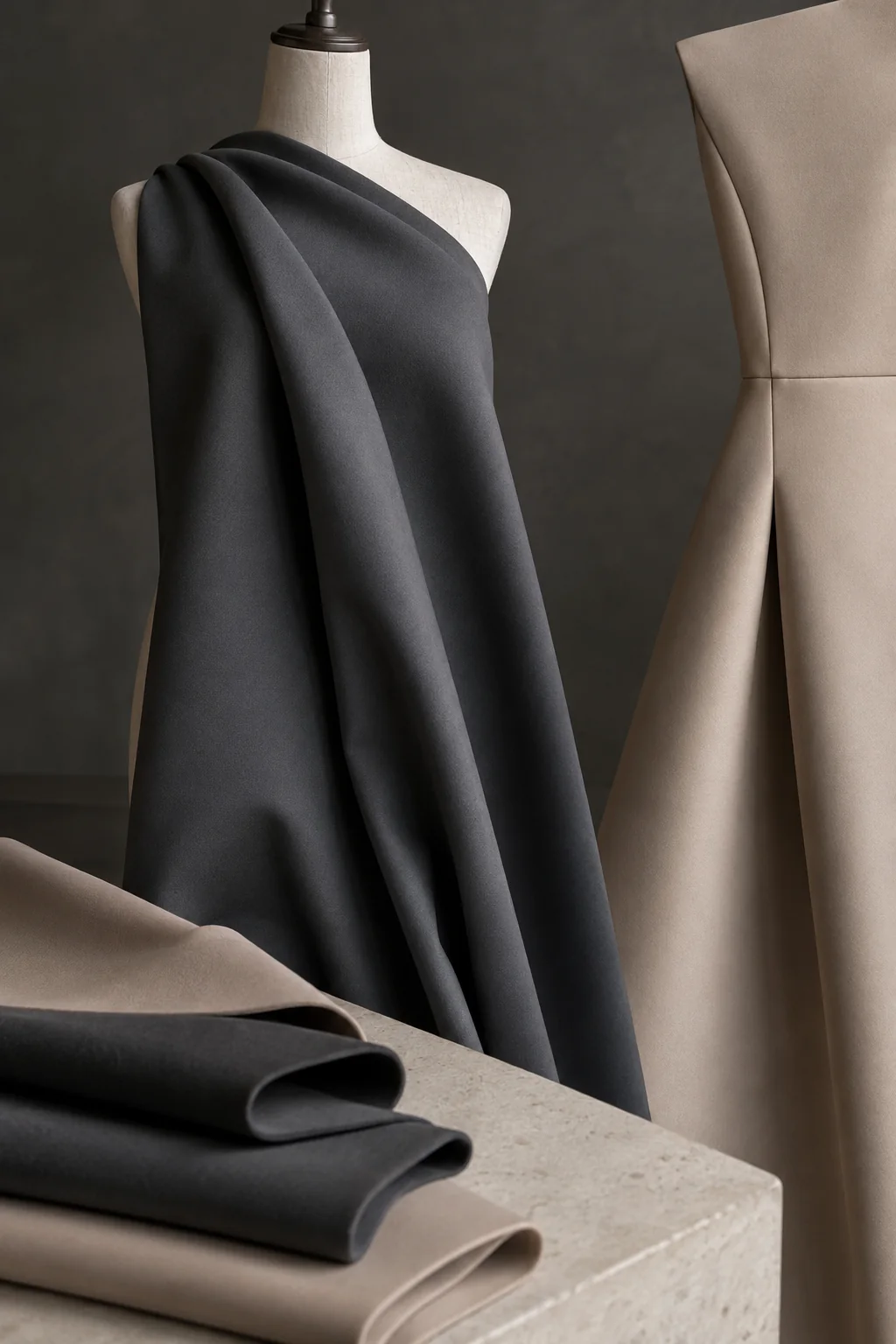
Scuba is often selected for a smooth surface and a silhouette that stands away from the body more than a fluid jersey. The same quality can be a benefit or a problem. It can support a clean dress panel, structured skirt, modern top or lightweight jacket, but it may look too stiff for a soft draped blouse or too warm for a high-output base layer.
Review the fabric on a hanger, on a flat table and in a sewn panel. Look for collapse, edge roll, seam rippling, shine changes, pressure marks and the way the fabric returns after bending. Check whether the garment needs a lining, facing, stabilizer or a different seam allowance. A swatch may look elegant while the full garment exposes bulk at a zipper, shoulder, hem or pocket opening.
Surface terminology also needs care. Matte, smooth, compact, spongy, brushed and slight sheen are visual or hand descriptions. They do not replace a fiber declaration or finish specification. If the surface affects the brand look, include a signed swatch or approved panel rather than a word alone.
What is scuba fabric used for?

Scuba fabric is most useful when the product needs body, a clean surface and controlled stretch. Common applications include:
- structured dresses and body-conscious silhouettes where recovery and opacity are important;
- skirts and panels that need a stable outline rather than a soft collapse;
- fashion tops, peplum shapes and sculpted sleeves;
- lightweight jackets, bomber-style panels or lifestyle outer layers when the sample meets the pressing and seam requirements;
- selected leggings, tops or athleisure garments when the actual fabric passes stretch, recovery, heat and moisture checks;
- color-blocked or printed panels where the surface, opacity and print route have been approved;
- prototypes where a designer needs shape before choosing a final production fabric.
Scuba should not be chosen only because it is thick or attractive. The product brief should explain whether the priority is shape, coverage, movement, moisture handling, warmth, print clarity, seam support or cost. For high-sweat products, compare the material against the broader requirements in the performance fabric guide و the activewear fabric selection guide.
Is scuba fabric breathable for activewear?
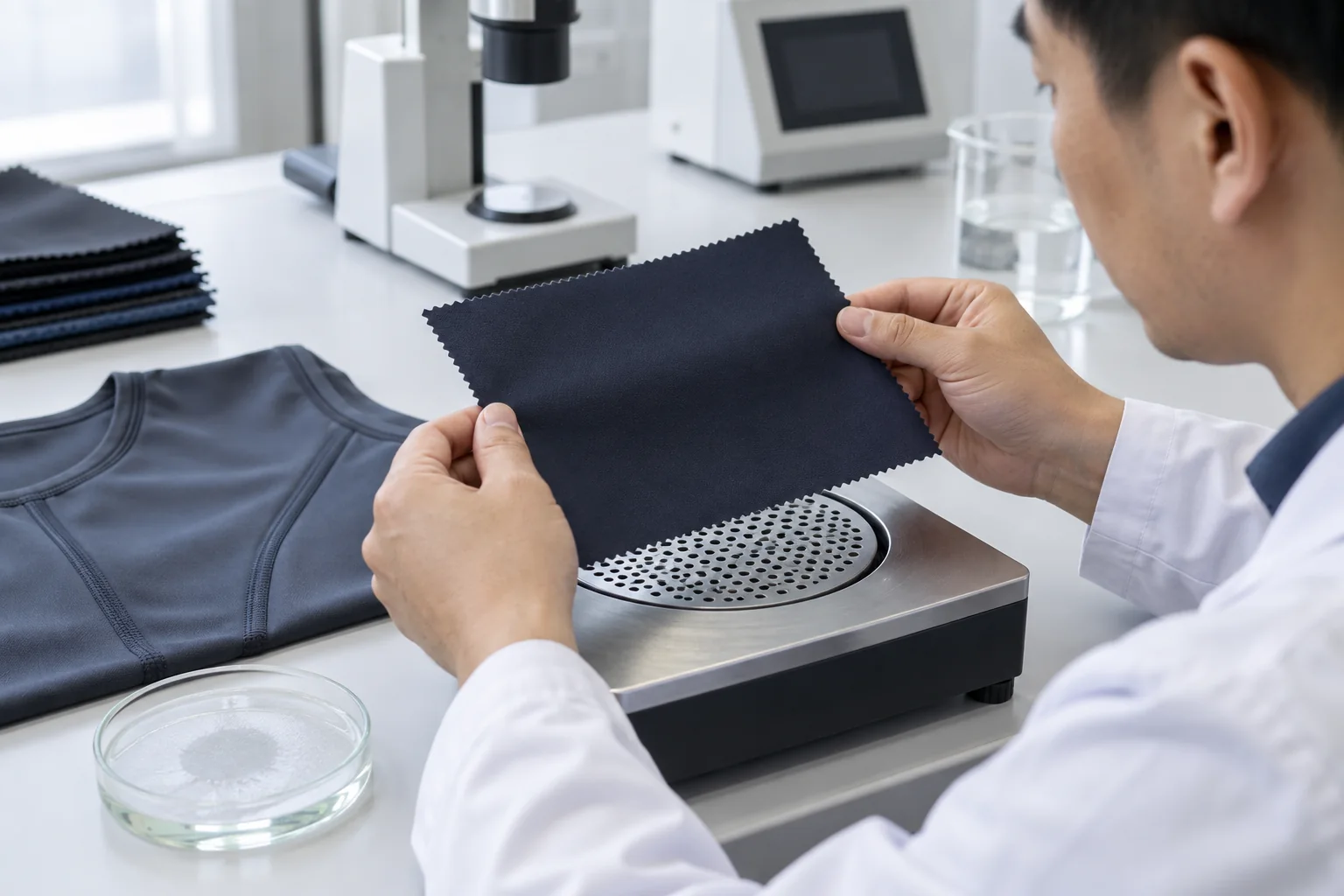
Breathability is not guaranteed by the name scuba, the presence of stretch or the fact that the fabric is knitted. A dense, smooth double knit may retain more heat and moisture than an open mesh or a lighter jersey. Fiber, thickness, finish, garment ease, lining, panel placement and the wear environment all matter.
That does not make scuba unusable for activewear. It may work for a structured athleisure top, skirt, warm-up layer, low-to-moderate intensity product or fashion panel. It needs a more careful review for running, hot-weather training or garments worn close to the body for long periods. Test the fabric in the intended garment with the intended seam, lining and panel combination.
Ask for evidence that matches the product claim. Depending on the brief, that may include absorbency, wicking, drying behavior, water-vapor transmission, air permeability or a wearer trial. A finish described as moisture-wicking should be tied to a method and an acceptance result, not only a hangtag phrase.
Scuba fabric care, shrinkage and pilling
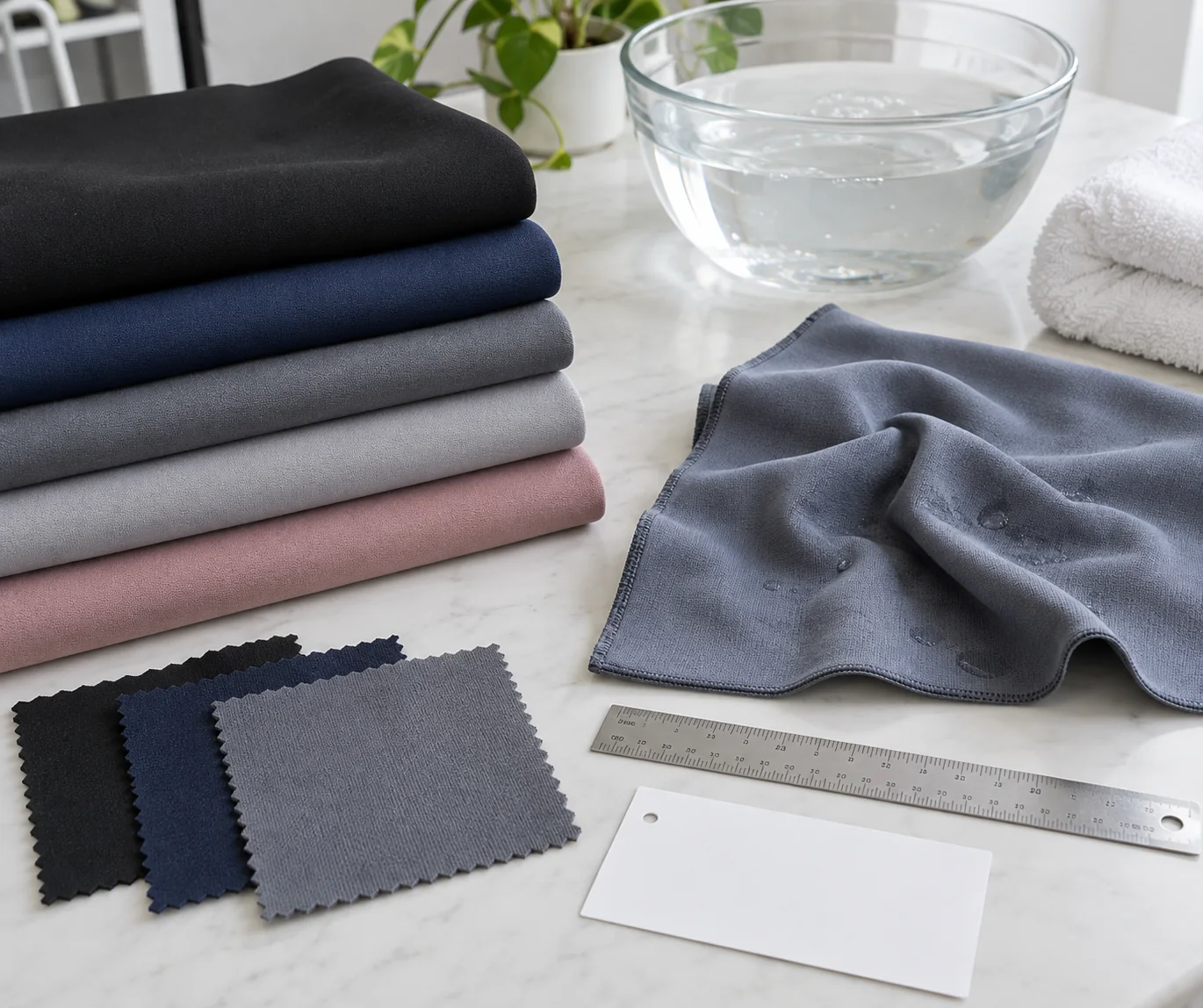
Care instructions should be based on the actual fabric and garment test. Heat, agitation, drying, pressing and storage can change dimensions, surface appearance, recovery or seam behavior. A dense smooth surface may show shine or pressure marks after heat, while elastane-containing fabric may lose recovery under unsuitable conditions. Pilling and abrasion depend on fiber, yarn, surface friction, construction and use.
Use a consistent preconditioning and laundering route for development samples. Measure length and width before and after the agreed process, inspect the surface and compare the sewn panel with the approved reference. If the fabric is intended for a consumer product, the care statement should be supported by the test and reviewed for the destination market.
ال قائمة معايير AATCC includes methods for dimensional change after home laundering, apparel appearance, colorfastness, moisture management and related textile evaluation. The method, specimen and acceptance limit still need to be selected for the garment. The FTC apparel guidance explains that most textile products need fiber-content and origin information and that care instructions are a product responsibility. This article does not replace a compliance review for a specific market.
How to specify scuba fabric in a tech pack
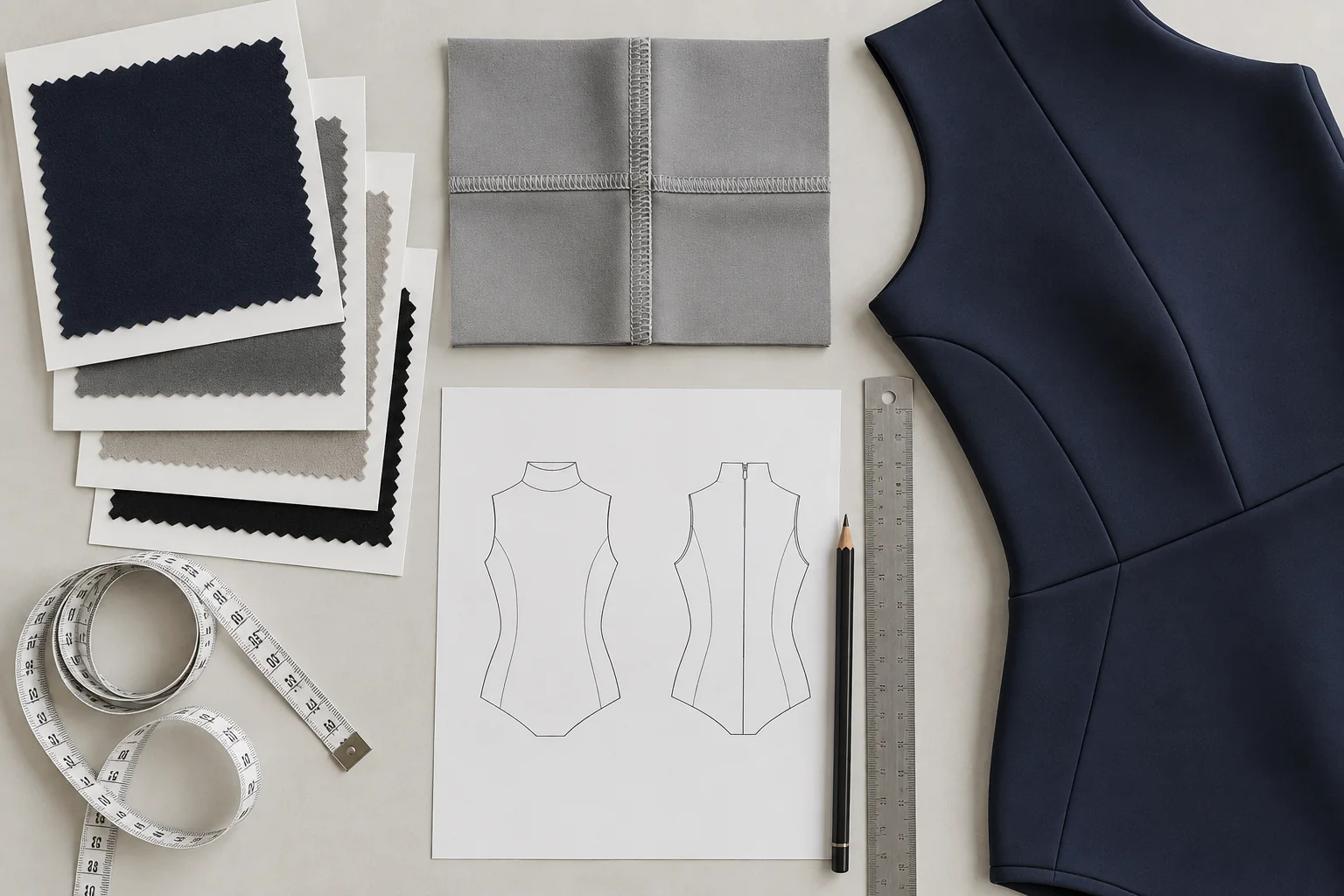
A quote-ready request separates known requirements from points that must be confirmed by the supplier. Attach the approved swatch or panel, identify its version, and state which characteristics are essential. A useful brief can include the following:
| حقل حزمة المواصفات الفنية | Useful entry | Confirmation still required |
|---|---|---|
| Construction and route | Dense double knit, face and back identified, tubular or open width | Exact knit structure, machine route, gauge and supplier capability |
| Fiber and yarn | Target fiber percentages, yarn description and blend tolerance | Fiber declaration, lot consistency and replacement equivalence |
| الوزن والعرض النهائيان | Target GSM range, tolerance and usable width after finish | Measurement condition, yield and roll inspection |
| التمدد والاسترداد | Direction, method, target behavior and recovery requirement | Result on the approved lot and, when needed, on a sewn panel |
| Surface and finish | Smooth matte surface, slight sheen, print route or no special finish | Hand, durability, pressing response, pilling and compliance evidence |
| Care and dimensional change | Proposed care route and shrinkage or skew limits | Final fabric and garment care test for the destination market |
| Color and approval | Lab dip or swatch reference, face/back, light direction and version | Shade tolerance, lot continuity and bulk approval process |
| Construction notes | Seam, lining, facing, zipper, hem and reinforcement requirements | Sample-room feasibility and production consistency |
For help organizing fabric, trims and decoration decisions, use the مكتبة الأقمشة والزينة as a starting point. If the request involves measurements, artwork and construction notes, connect the fabric fields to سترينجرز so the garment brief stays aligned.
What to test before bulk approval
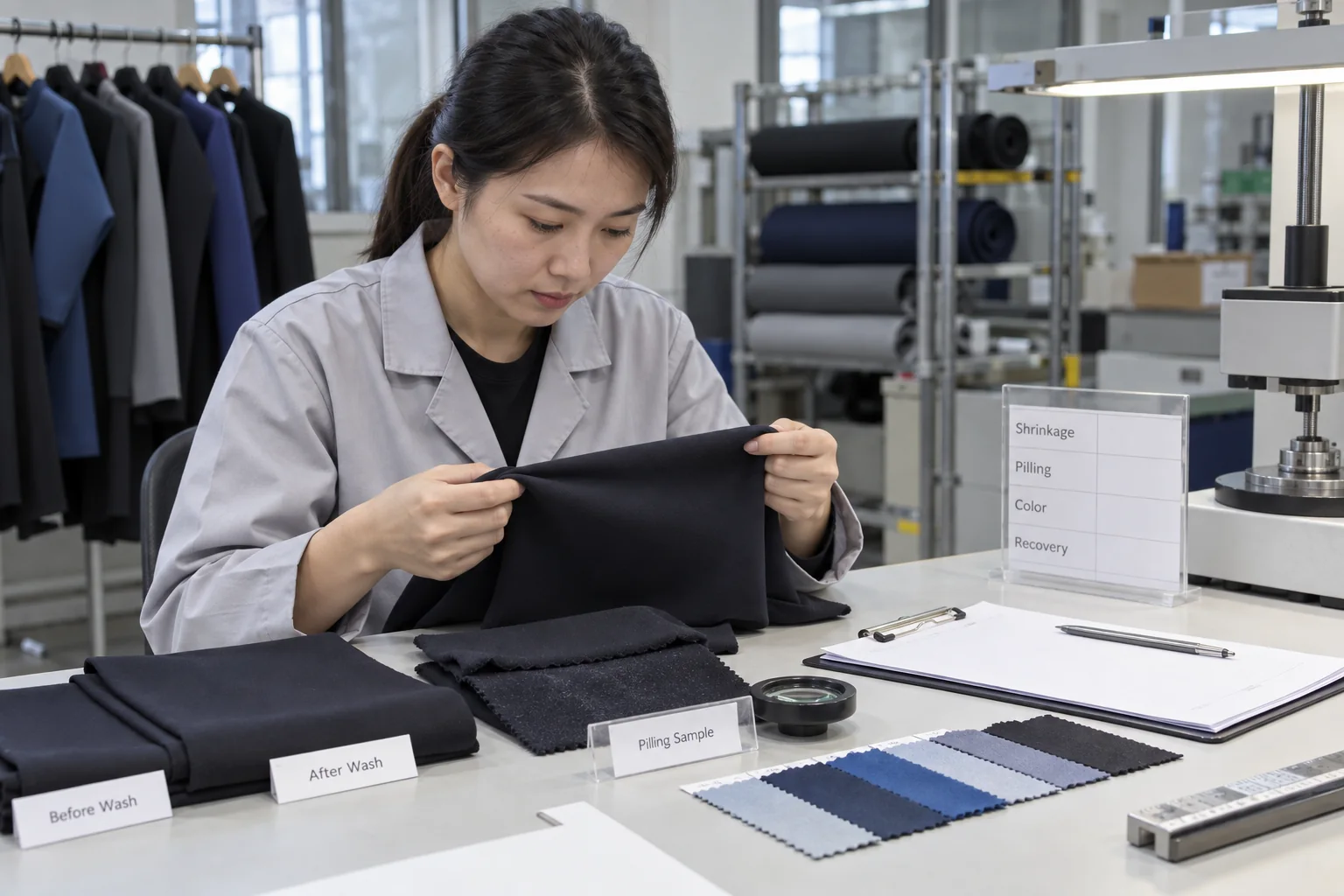
Testing should follow the risk of the garment and the agreement with the buyer. Do not copy a test list from another product without checking whether it reflects the actual use. A practical review can include:
| Checkpoint | الأدلة التي يجب الاحتفاظ بها | القرار الذي يدعمه |
|---|---|---|
| Fiber, color and surface | Fiber declaration, approved shade, face/back photos and signed swatch | Confirms that the material is the agreed product, not only a similar color |
| GSM, width and construction | Conditioned measurement record, usable width, knit description and roll notes | Supports yield, cost, replacement and production planning |
| التمدد والاسترداد | Directional results, repeated-cycle notes and sewn-panel review | Confirms fit, shape retention and seam compatibility |
| Laundering and appearance | Before/after dimensions, surface photos, pilling or abrasion result and care route | Shows whether the garment remains acceptable after intended use |
| Moisture and wear behavior | Method, specimen, acceptance limit and wearer or panel observation where relevant | Helps decide if the fabric suits activewear, lifestyle or fashion use |
The AATCC standards catalog includes methods such as TM135 for fabric dimensional change after home laundering, TM150 for garment dimensional change, TM195 for liquid moisture management, TM197 for vertical wicking and TM199 for drying time. Select the method with the buyer and record the acceptance limit. A test name without a result, specimen and limit is not proof of suitability.
A practical scuba-fabric sampling workflow
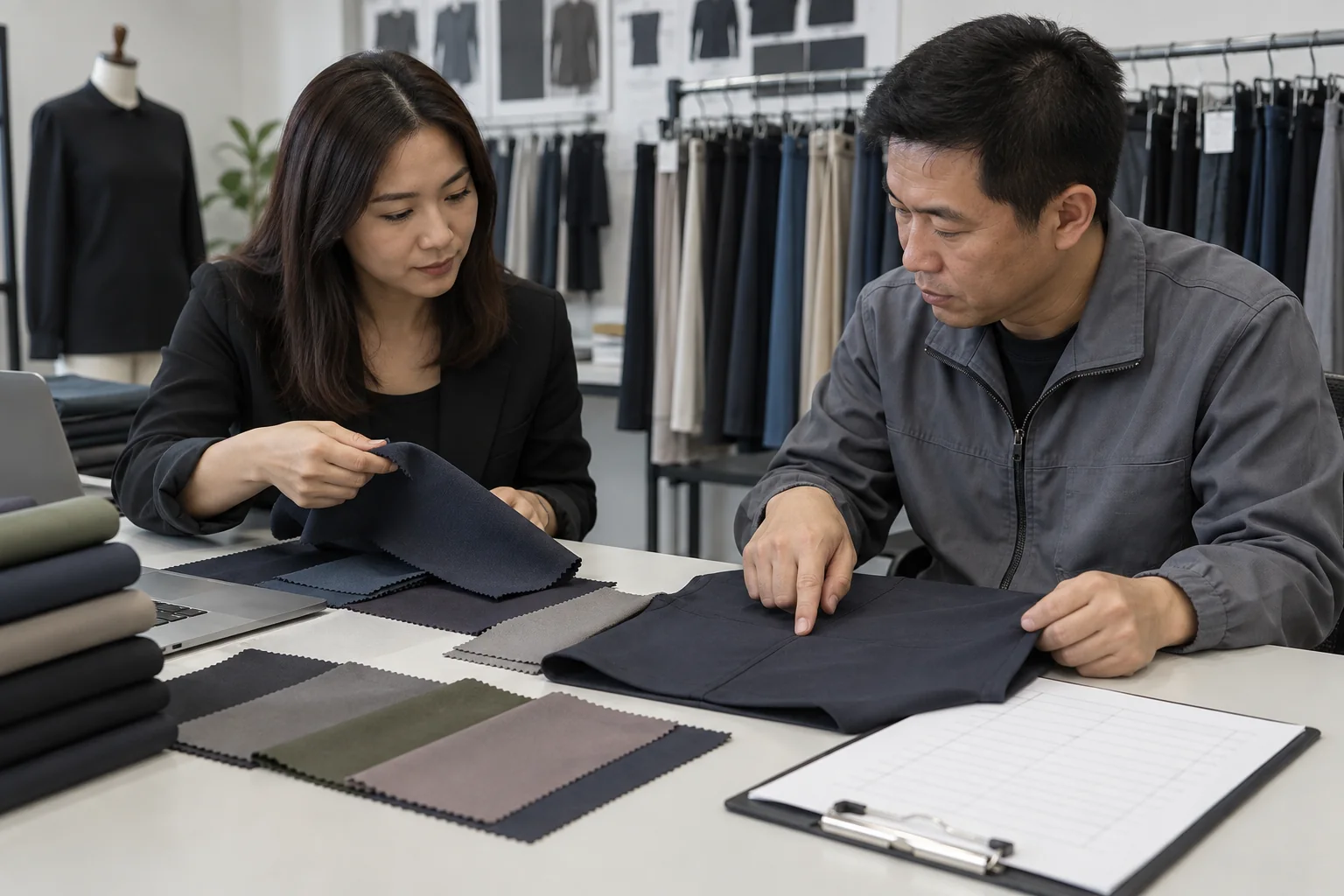
- Write the brief. Name the garment, target fit, construction preference, fiber preference, target GSM range, usable width, surface, stretch direction, care route and color reference.
- Request the fabric recommendation. Ask the supplier to identify the face, back, knit route, finish, available fiber information and any test evidence.
- Review the swatch under several conditions. Check hand, opacity, drape, width, stretch, recovery, surface, pressure marks and edge behavior.
- Make a sewn panel or prototype using the intended seam, elastic, lining, zipper, facing and hem. A loose swatch cannot show every garment risk.
- Condition or launder the panel using the agreed route. Measure dimensions, inspect appearance and compare recovery with the signed reference.
- Confirm color and surface. Keep the approved swatch, panel photos, version and shade reference with the tech pack.
- Record the decision. Mark the sample approved, conditionally approved or rejected, and write the change required for the next round.
- Before bulk cutting, confirm the production lot, inspection plan, width, shade continuity, packing method, final care information and any agreed test report.
For a controlled sample review, use التنقيط والنماذج الأولية and send the garment brief, target measurements, fabric reference and specific concern. A precise question makes it easier to compare a supplier response with the intended product.
Common scuba-fabric sourcing mistakes
- Treating scuba as a fixed fiber instead of confirming fiber content and construction.
- Assuming scuba means neoprene, or assuming neoprene-like appearance means rubber foam.
- Comparing samples by GSM alone while ignoring usable width, recovery, opacity, surface and care.
- Approving a swatch without checking the face, back, storage marks, pressing response and cut-edge behavior.
- Giving a universal stretch percentage without defining direction, force, relaxation, cycles or recovery.
- Testing a flat fabric but not the seam, waistband, zipper, hem, lined panel or garment silhouette.
- Choosing a dense fabric for a high-sweat product without checking heat, moisture and drying behavior.
- Replacing scuba with ponte, interlock or jersey because the color and weight appear similar.
- Approving a new lot without checking shade, width, hand, surface and dimensional behavior against the signed reference.
- Writing care instructions before the final fabric and garment test is complete.
الأسئلة الشائعة
No. Neoprene is a synthetic rubber, while apparel scuba is generally a knitted textile. They may share a smooth, structured appearance, but they differ in construction, fiber declaration, breathability, sewing, pressing and care. Confirm the actual material instead of relying on the name.
Often, but not always. Stretch depends on the loop structure, elastane, yarn, density, finish and direction. Measure widthwise and lengthwise extension and record recovery after a defined load or repeated cycles. Test a sewn panel when garment fit depends on the result.
It can be a good choice for structured or body-conscious dresses because its smooth, stable hand can help a silhouette hold shape. Review drape, opacity, seam bulk, pressing response, recovery and care before approval. A fluid dress may need a lighter or more drapey fabric.
Breathability varies by fiber, thickness, density, finish, lining and garment design. A dense scuba knit may feel warmer than an open mesh or light jersey. For activewear, use a moisture, drying or vapor-related test that matches the product claim rather than assuming a knit fabric is automatically breathable.
There is no single universal scuba GSM. The commercial name covers more than one weight and construction. Specify a target range and tolerance after confirming the garment’s opacity, drape, stretch, recovery, warmth, usable width and yield requirements.
It can, depending on fiber, yarn, surface friction, construction, finish and use. Review pilling and abrasion under a method and acceptance limit that fit the garment. A smooth first impression is not enough to guarantee long-term surface appearance.
Yes, for selected products and conditions, but the fabric should pass the intended stretch, recovery, moisture, drying, heat and care checks. It may suit structured athleisure or low-to-moderate intensity products more readily than a hot-weather, high-output base layer. Approve the finished garment, not only the swatch.
Send the garment type, target fit, reference image or existing swatch, preferred construction, fiber preference, GSM range, usable width, color, stretch direction, surface, care route, quantity or sample stage, tech pack and any testing or compliance requirement. State the problem the fabric must solve, such as shape retention, opacity, smoothness or movement.
Choose the structure before you approve the silhouette
The reliable way to buy scuba fabric is to connect the construction to the garment job. Define the fiber, yarn, double-knit structure, surface, GSM, usable width, stretch, recovery, care and acceptance evidence. Then approve a sewn and conditioned sample instead of treating a generic fabric name as a finished specification.
Send your garment brief, target fit, existing swatch or tech pack through اطلب عرض سعر مخصص for a focused review of fabric construction, sampling questions and next-step requirements.